Telephoto Landscape Photography: Why a 70-200mm Belongs in Your Bag
How longer focal lengths isolate patterns, stack mountain ridges, and pull distant light into the frame, with the real explanation of what lens compression actually is.
Telephoto Landscape Photography: Why a 70-200mm Belongs in Your Bag
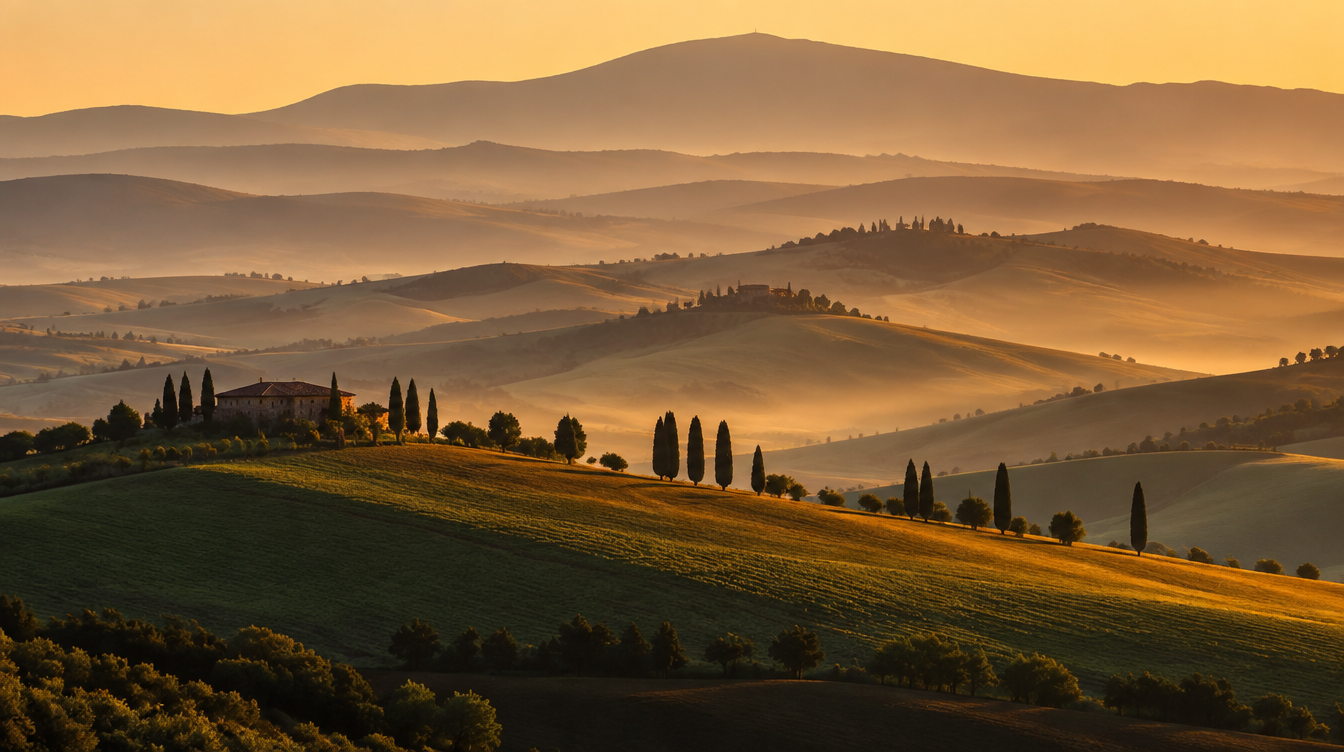
Almost every photographer who joins one of our Tuscany trips shows up with a wide angle lens mounted and a 70-200mm buried at the bottom of the bag, saved for the one portrait they might take of a teammate at dinner. By the second morning, that same lens is usually the one they reach for first. Standing above Podere Belvedere as the sun comes up over Val d'Orcia, a wide angle gives you the whole valley. A telephoto gives you the three or four ridgelines stacked behind each other, the graphic layering that makes a Tuscany photograph look like a Tuscany photograph rather than a snapshot of some hills.
This guide is the technique deep dive promised in our complete landscape photography guide, focused on the lens most people underpack: the 70-200mm, or any mid telephoto zoom in that range. We will get the physics right first, because almost every article on this topic gets it slightly wrong, then spend the rest of the piece on what to actually do with a telephoto once you understand why it works.
Key Takeaways
A 70-200mm is not a specialty lens for sports and portraits that happens to also work outdoors. For certain landscape scenes, it is the only lens that gets the shot.
| Point | Details |
|---|---|
| What "compression" really is | A distance effect, not a lens effect. Standing farther back shrinks the relative size gap between near and far objects; a telephoto lens just lets you stand that far back and still fill the frame |
| Where it earns its place | Stacking ridgelines, isolating a single subject from a busy scene, pulling in distant light, and simplifying repeating patterns |
| Aperture for landscape use | f/8 to f/11, the same sweet spot as any other landscape lens, which makes the lighter f/4 70-200mm a smarter buy than f/2.8 for this specific job |
| Camera shake risk | Roughly double at 200mm compared with 100mm, under the standard 1-over-focal-length handheld shutter speed rule |
| Best Val d'Orcia use case | Layered ridgelines at Podere Belvedere, the isolated silhouette of Cappella Vitaleta, and the badland texture of Crete Senesi |
Table of Contents
- What "compression" actually is (and isn't)
- Why it still feels like a telephoto effect
- Four things a 70-200mm does that a wide angle can't
- Field technique: settings, tripod, and camera shake
- Telephoto vs wide angle: a decision framework
- Case study: a 70-200mm in Val d'Orcia
- Common mistakes with telephoto landscapes
- Frequently asked questions about telephoto landscape photography
- Plan your own telephoto landscape shoot
What "compression" actually is (and isn't)
Open almost any article on telephoto landscapes and you will hit the same claim within the first paragraph: longer focal lengths "compress" a scene, squeezing distant objects closer together. It is repeated so often that it sounds like settled optics. It is not quite right, and understanding why matters, because it changes how you actually use the lens in the field.
What changes the relationship between near and far objects in a photograph is not the lens. It is where you are standing. Cambridge in Colour's guide to camera lenses puts it directly: "strictly speaking, perspective only changes with one's location relative to their subject," and focal length on its own "only determines how much of the scene" ends up in the frame. Two photographs taken from the exact same spot, one with a 24mm lens and one with a 200mm lens, will show the telephoto frame cropped tightly into the center of the wide frame. The relative size relationship between a foreground rock and a distant ridge does not change at all between those two shots, because you have not moved.
The compression effect shows up the moment you change your distance to keep the subject the same size in the frame, which is exactly what a telephoto lens' narrow field of view forces you to do. Wikipedia's entry on perspective distortion states the mechanism plainly: "linear perspective changes are caused by distance, not by the lens per se. Two shots of the same scene from the same distance will exhibit identical perspective geometry, regardless of lens used." Wide angle lenses have a wide field of view, so you naturally shoot them from close. Telephoto lenses have a narrow field of view, so filling the frame with the same subject means backing up, sometimes by a lot, and at that greater distance the relative size difference between a near object and a far one shrinks. That is the literal mechanism behind what everyone calls compression.
Try the thought experiment yourself in the field. Frame a distant hilltop village at 24mm from fifty feet away, then walk back five hundred feet and reframe the same village at 200mm so it fills a similar portion of the frame. The village looks nearly identical in size in both shots, but everything around it has changed. From five hundred feet back, the ridgelines in front of and behind the village have barely shifted relative to each other, so they stack into flat, graphic bands. From fifty feet away, those same ridgelines spread out with real depth between them. Same subject, same framing, a completely different sense of space, and the only variable that actually moved is your distance from the scene.
Pro Tip: If you want to see the compression effect in isolation, pick one fixed subject and shoot it at three focal lengths while repositioning each time to keep the subject the same size in the frame. Compare the backgrounds side by side afterward. That is the cleanest way to actually understand what changed, rather than just reading about it.
Why it still feels like a telephoto effect
None of this means the "telephoto look" is a myth you should stop thinking about. It is real and reliably tied to focal length in practice, just not for the reason most people assume. Focal length and angle of view have a strict inverse relationship: Wikipedia's entry on focal length notes that "longer focal length... leads to higher magnification and a narrower angle of view," while a shorter focal length gives the opposite, lower magnification and a wider field of view. That relationship is what forces the distance change that produces compression. A 200mm lens has such a narrow angle of view that you are mechanically unable to fill the frame with a wide scene from close range, so you get pushed back, every time, by the optics of the lens itself.
So the shorthand "telephoto lenses compress" is not wrong as a rule of thumb. It is wrong as an explanation. The lens does not reach out and squash the scene; it restricts your angle of view enough that the only way to use it on a landscape is from far enough away that compression happens as a side effect. Once you know compression is a distance effect, you can create it or avoid it with any lens, simply by choosing where to stand.
Four things a 70-200mm does that a wide angle can't
Knowing the physics is the setup. Here is the actual payoff, the four jobs a mid telephoto does better than any wide angle lens on a landscape shoot.
Stacking ridgelines and hills into layers. Val d'Orcia's rolling hills are the textbook case. Shot wide, the hills recede naturally into the distance with real depth between each one, which is a beautiful but very different image. Shot at 135mm or 200mm from a high vantage point like Podere Belvedere, those same hills compress into flat, graphic bands of light and shadow, especially in the low side light of early morning when each ridge catches the sun at a slightly different angle than the one behind it. We cover the foreground and layering side of this same idea, shot wider, in our guide to photographing rolling hills with real depth; a telephoto is the other half of that same compositional toolkit, flattening instead of extending.
Isolating repeating patterns. Cypress rows, vineyard lines, and terracing are everywhere in Tuscany, and a wide shot of a whole row usually just looks busy. A telephoto lets you pull three or four trees out of a long row and let them repeat across the frame as a clean pattern, with everything outside that pattern simply left out of the shot rather than fighting for attention. This is a composition principle as much as a gear choice, and it pairs directly with the pattern and repetition techniques in our guide to landscape composition. The famous cypress-lined roads near San Quirico, which we cover in more depth in our dedicated cypress road guide, are one of the clearest places in the region to practice this.
Pulling in distant light and atmosphere. A telephoto lens narrows your field of view enough that a thin band of haze, fog, or golden sidelight on a distant ridge can become the entire subject of the frame rather than a small detail lost in a wide composition. On a morning with light valley mist in Val d'Orcia, a 200mm shot of a single hilltop farmhouse rising just above the fog line often reads stronger than the wide version of the same scene, because the telephoto frame strips out everything except the farmhouse and the fog.
Picking a single subject out of a cluttered scene. Not every strong composition starts clean. Sometimes the real subject, a chapel, a lone tree, a farmhouse, sits surrounded by road signs, parked cars, or other distractions a wide angle cannot avoid including. A telephoto lets you reach past the clutter and isolate exactly the part of the scene that is working, often faster than hunting for a wide composition with a perfectly clean foreground.
Field technique: settings, tripod, and camera shake
The good news is that a 70-200mm does not ask for a different exposure philosophy than any other landscape lens. The same f/8 to f/11 sweet spot that applies to a 16-35mm applies here, holding a layered scene sharp without stopping down so far that diffraction softens detail. That is also why the f/2.8 version matters far less for landscape work than for sports or low light event photography. A telephoto lens, in the strict optical sense, is simply "a specific type of a long-focus lens... in which the physical length of the lens is shorter than the focal length," a design detail that has nothing to do with maximum aperture. Shooting at f/8 to f/11 on a tripod rather than wide open in low light, the lighter, cheaper f/4 70-200mm does the same job as the f/2.8 for a fraction of the weight.
Where a telephoto genuinely changes your field discipline is camera shake. There is a long standing rule of thumb for the slowest shutter speed you can reasonably hand hold without visible blur: the reciprocal of your focal length. Wikipedia's entry on image stabilization notes that "camera shake is a particular problem at slow shutter speeds or with long focal length lenses," with a worked example: "at a focal length of 125mm... vibration or camera shake could affect sharpness if the shutter speed is slower than 1/125 second." Scale that to 200mm and your handheld floor moves to roughly 1/200th of a second, twice as fast as 100mm would demand. Landscape work often wants shutter speeds slower than that, for depth of field at a smaller aperture or to smooth moving cloud or water, which is why a tripod matters more with a telephoto than with almost any other landscape lens.
In practice that means a genuinely stable tripod, a remote release or built in timer to remove shutter-press vibration, and some awareness of wind. A long lens catches more wind load through the camera and tripod than a short one, so on an exposed hilltop viewpoint like Podere Belvedere, hanging your bag from the tripod's center column for extra ballast is a small habit that saves a surprising number of otherwise sharp frames.
| Focal length | Approximate handheld shutter floor | Practical note |
|---|---|---|
| 24mm | 1/25s | Forgiving; easy to handhold even in lower light |
| 100mm | 1/100s | Still workable handheld in good light, tighter margin |
| 200mm | 1/200s | Needs a genuinely fast shutter or a tripod for anything slower |
Pro Tip: Do not assume your lens' image stabilization rating lets you ignore the reciprocal rule on a landscape shoot. Stabilization compensates for hand shake, not for wind moving your tripod or for long shutter speeds needed to smooth cloud or water motion. Use it as a safety margin, not a replacement for a tripod when the shot calls for one.
Telephoto vs wide angle: a decision framework
This is not a contest with a winner, and treating it like one is where most gear advice goes wrong. The two lenses solve different compositional problems, and the useful skill is recognizing which problem is actually in front of you.
Reach for a wide angle when the scene is built on foreground interest and genuine depth: a field of poppies leading toward a distant farmhouse, a cypress-lined road where the near trees matter as much as the far ones, or any composition where an expansive sky is doing real compositional work. Reach for a telephoto when the scene is about pattern, repetition, distant light, or isolating one element from a busy frame: stacked ridgelines, a single hilltop subject, a repeating row of trees, or any scene where a wide shot would simply look cluttered or flat.
Most photographers who shoot Val d'Orcia seriously carry both and switch lenses several times in a single session, sometimes from the same tripod position. We go deeper on the full lens kit, including where a standard zoom fits between these two extremes, in our practical lens comparison for Tuscany photography. That piece helps you decide what to pack; this one helps you decide which lens to mount once you are standing in front of the scene.
Case study: a 70-200mm in Val d'Orcia
Val d'Orcia earned its UNESCO World Heritage status in 2004, and the terrain itself is described as "gentle, cultivated hills... occasionally broken by gullies and by towns and villages," exactly the kind of layered, repeating landscape that rewards a telephoto lens. Here is how that plays out at four specific stops on our own Tuscany itinerary.
At Podere Belvedere, near San Quirico, you are standing above several rows of hills that recede toward the horizon. At 24mm the scene reads as one expansive valley. At 135mm to 200mm, each ridge separates into its own band of light, especially in the raking side light of early morning, and the hills stack into the kind of graphic, almost abstract composition that photographs of this specific viewpoint are known for.
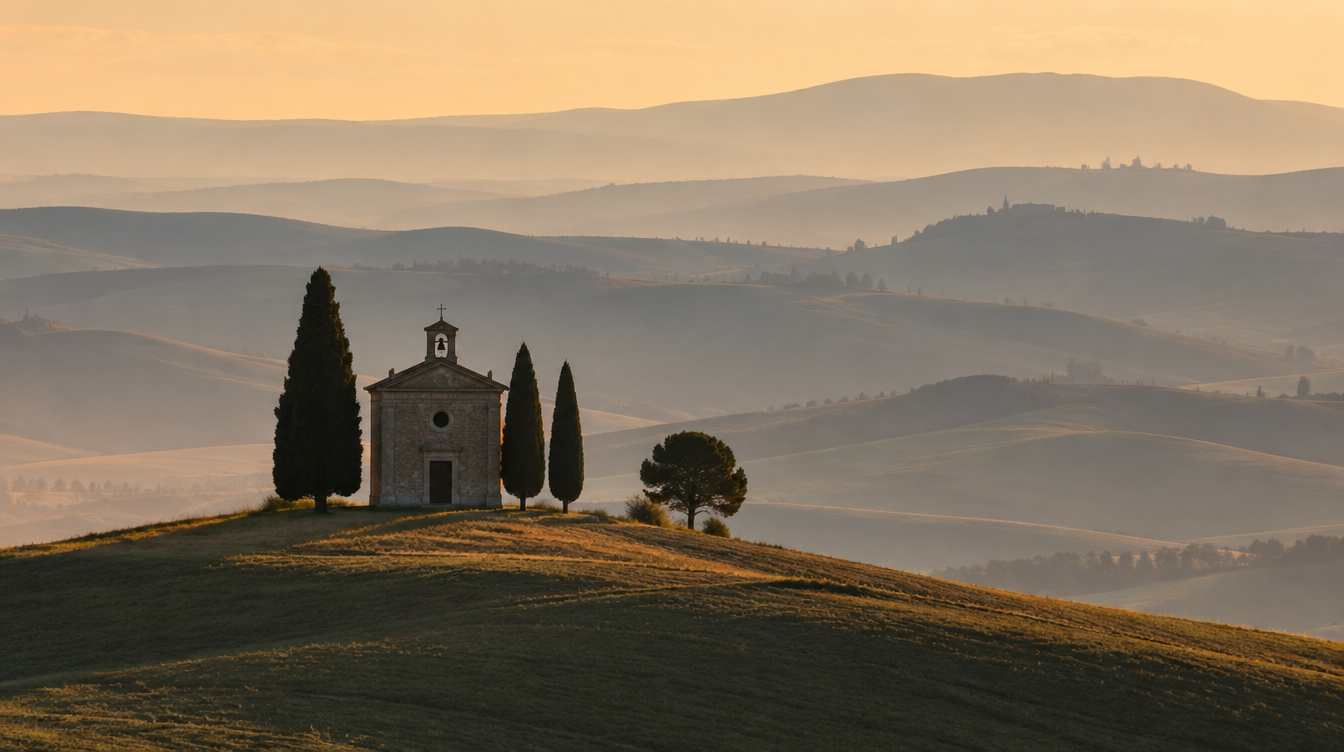
At Cappella Vitaleta, a tiny chapel sitting alone on a rise between rows of cypress, a telephoto lets you isolate the chapel as a clean silhouette against the hills behind it without the surrounding farm road or fence line creeping into the frame the way it would at a wider focal length. It is a textbook example of picking a single subject out of a scene that is only interesting in one specific, tightly framed slice.
At Crete Senesi, the badland hills south of Siena, the terrain itself has a sculpted, almost lunar texture. A telephoto compresses the ripples and gullies in those hillsides into a graphic pattern that is difficult to appreciate in a wide shot, where the texture gets lost against the scale of the whole landscape.
And along the cypress-lined farm roads near San Quirico, a telephoto lets you pick three or four trees out of a long row and let them repeat cleanly across the frame, rather than including the entire road, the cars that might be parked along it, and the buildings at either end.
Our Val d'Orcia photo tour visits Podere Belvedere, Cappella Vitaleta, Crete Senesi, and the San Quirico cypress roads on the same itinerary, alongside hilltop towns like Pienza, Montalcino, and Monticchiello. It is an easy seven day trip capped at seven photographers, built around the rolling hills, morning mist, and golden light that make a mid telephoto earn its keep every morning.
Common mistakes with telephoto landscapes
The most common mistake is skipping the tripod because a 70-200mm does not look as intimidating as a big prime, then wondering why a string of otherwise well composed frames come back slightly soft. The reciprocal rule above is not a suggestion; it is the actual physics of how much a given amount of hand shake shows up in the frame at a given focal length, and a telephoto magnifies that shake the same way it magnifies the subject.
A second mistake is shooting a layered scene wide open to save a stop of light, then losing depth of field across a composition that depended on multiple ridgelines staying sharp; give it the same f/8 to f/11 treatment you would give any other landscape composition, even if that means a slower shutter speed and a firmer tripod. A third, subtler mistake is forgetting that the same atmosphere that makes compression look beautiful, haze sitting between ridgelines, can also just mean a flat, washed out frame if the light is not cooperating. Plan telephoto ridgeline shots for the same low, warm, side lit light you would plan any landscape around, rather than assuming distance alone will make a midday haze look intentional.
Frequently asked questions about telephoto landscape photography
Does a telephoto lens really "compress" a scene, or is that a myth? Partly a myth as usually explained. Compression comes from camera-to-subject distance, not the lens. A telephoto's narrow field of view just forces you to stand farther back to frame a subject, and at that distance near and far elements shrink together. Shoot a wide angle from the same distance and you get the same perspective.
What is the best focal length for landscape photography? There isn't one. Wide angle (16-35mm) suits expansive scenes with strong foreground interest; a 70-200mm suits pattern, repetition, distant light, or isolating one element from clutter. Most serious landscape photographers carry both.
Telephoto vs wide angle for landscapes, which is better? Neither; they solve different problems. Wide angle exaggerates the space between foreground and background. Telephoto isolates, stacks, and simplifies, which matters when the real subject is a distant pattern rather than the whole landscape.
Can you actually use a 70-200mm for landscape photography? Yes, it is a legitimate landscape lens, not a portrait lens pressed into service. Since landscape work is usually shot at f/8 to f/11 rather than wide open, the lighter, cheaper f/4 version is often the smarter landscape buy over the f/2.8.
Do you need a tripod with a telephoto lens for landscapes? Strongly recommended. Camera shake scales with focal length, and the rule of thumb puts the minimum safe handheld shutter speed at roughly 1 over the focal length, about 1/200th of a second at 200mm. A tripod removes that limit and frees you to use the slower shutter speeds landscape work often wants.
How do I avoid camera shake with a telephoto lens on landscape shots? Use a stable tripod on firm ground, a remote release or built in timer to avoid shutter-press vibration, and if you must handhold, stay at or above roughly 1 over the focal length as a shutter speed floor, faster still in wind.
Is the f/2.8 70-200mm worth it over the f/4 version for landscape photography? Usually not. The extra stop mainly helps in low light at wide apertures, while landscape telephoto work is typically shot at f/8 to f/11 on a tripod, where the lighter f/4 version performs just as well and carries easier on a long day.
Plan your own telephoto landscape shoot
Every example above, the layered ridgelines at Podere Belvedere, the isolated silhouette of Cappella Vitaleta, the sculpted texture of Crete Senesi, and the cypress rows near San Quirico, is a stop on our own Val d'Orcia photo tour: seven days, capped at seven photographers, with departures running October 24 to 31, 2026 and again through spring and early autumn 2027, priced from $4,800. Two photographers guide you to these exact viewpoints at the hours the light works, with time to try a scene wide and then again with a telephoto. If you already own a 70-200mm and have never found the right landscape for it, Val d'Orcia was built for that lens.
Sources
- Cambridge in Colour: Understanding Camera Lenses, perspective and focal length
- Wikipedia: Perspective Distortion, the distance mechanism behind "compression"
- Wikipedia: Focal Length, the inverse relationship with angle of view and magnification
- Wikipedia: Telephoto Lens, the formal optical-design definition
- Wikipedia: Image Stabilization, camera shake and the reciprocal shutter-speed rule
- Wikipedia: Val d'Orcia, UNESCO World Heritage status and terrain