Which Lens Should You Bring to Photograph Tuscany? A Practical Comparison
Wide angle, standard zoom, or telephoto? A practical, use case driven comparison of the lenses that actually matter for photographing Val d'Orcia's rolling hills and villages.
Which Lens Should You Bring to Photograph Tuscany? A Practical Comparison
Every photographer packing for Tuscany asks the same question at some point while staring at an open camera bag: how many lenses do I actually need. The honest answer is fewer than most gear lists suggest, but the right ones matter more here than almost anywhere else you might shoot. Val d'Orcia is a landscape built entirely around layers, distance, and scale, and the lens on your camera decides which of those three elements a photograph is actually about.
This is not a generic "best travel lenses" roundup. It is a comparison built specifically around what Val d'Orcia asks of a lens: rolling hills that need either exaggeration or compression depending on the shot, narrow medieval streets that punish anything too long, and farmhouses on distant ridgelines that only become interesting subjects once you can pull them closer. Below is a breakdown of wide angle, standard zoom, and telephoto options, with honest use cases for each and a realistic recommendation for anyone who cannot justify checking a second bag.
Key Takeaways
There is no single correct lens for Tuscany, but there is a correct way to think about which one to bring for which shot.
| Point | Details |
|---|---|
| Most versatile single lens | A 24-70mm equivalent standard zoom covers roughly 80 percent of Val d'Orcia shots |
| Best for cypress roads and foregrounds | A wide angle in the 16-35mm range, used close to a strong foreground element |
| Best for layered hills and distant villages | A telephoto in the 70-200mm range, which compresses ridgelines into stacked bands |
| Realistic one bag kit | A standard zoom plus a compact telephoto covers nearly every shot on a typical week long trip |
| Most overpacked category | Ultra wide lenses below 16mm, which read as gimmicky on rolling hill terrain more often than they help |
| Village streets | Anything longer than 50mm becomes difficult to use in San Quirico's narrow lanes |
Table of Contents
- Why lens choice matters more here
- Wide angle lenses: 16-35mm
- Standard zoom lenses: 24-70mm
- Telephoto lenses: 70-200mm and beyond
- Side by side comparison
- What to bring into the villages
- The realistic one bag recommendation
- Primes vs zooms for this trip
- Frequently asked questions about lenses for Tuscany
Why lens choice matters more here
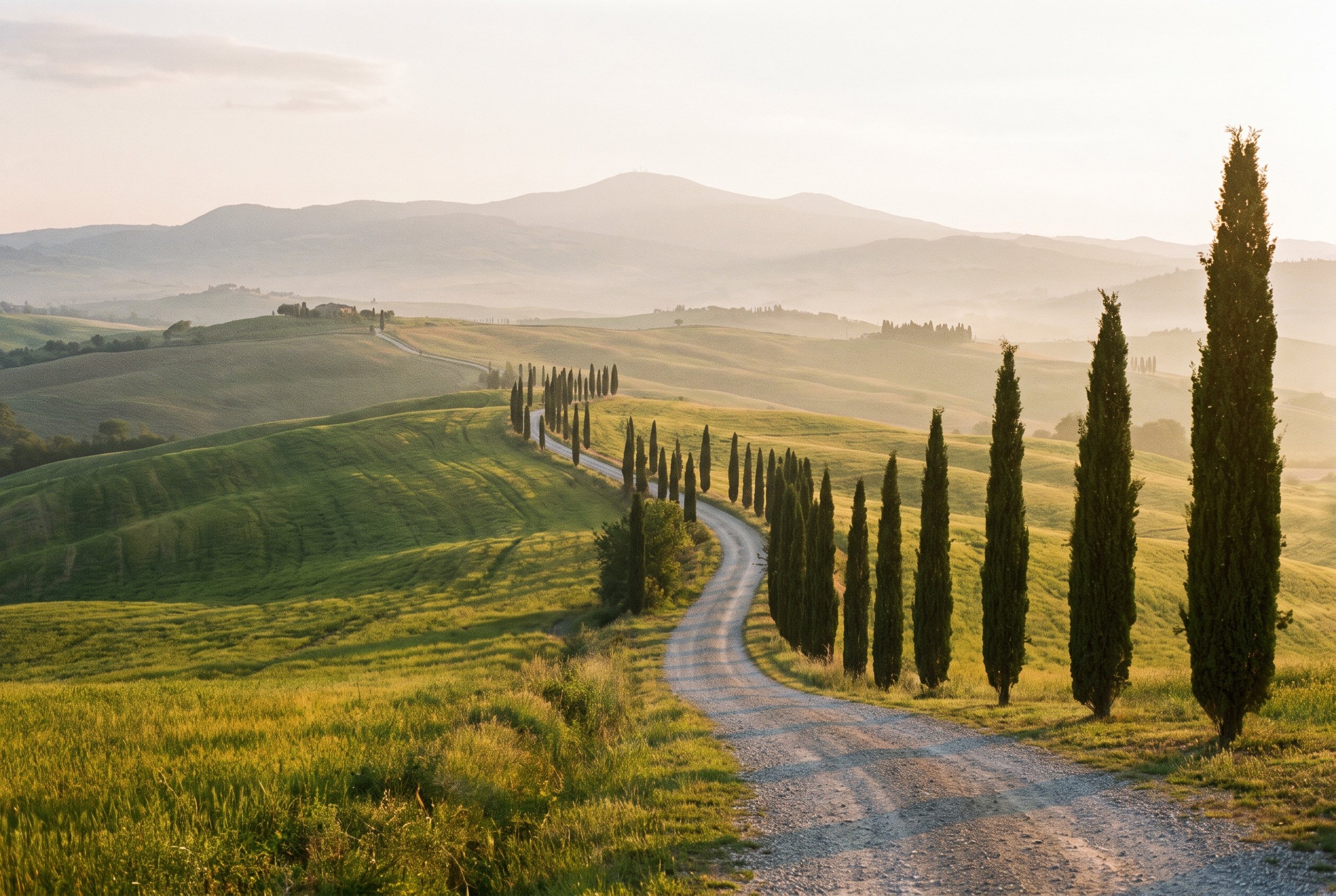
Most travel destinations forgive an imperfect lens choice because the subject carries the shot regardless. Val d'Orcia is less forgiving. The entire visual appeal of the region comes from the way its hills stack into layers that recede toward the horizon, and how a single cypress tree, farmhouse, or curve in a gravel road can anchor an otherwise empty frame. A lens that is too wide flattens those layers into a thin strip at the bottom of the frame. A lens that is too long isolates a single hillside and loses the sense of scale that makes the region recognizable in the first place. Getting the focal length right is not a technical nicety here, it is most of the composition.
Our companion piece on photographing rolling hills with real depth goes deeper into the composition theory behind foreground anchors and atmospheric layering. This guide picks up where that one leaves off and focuses purely on the hardware: which lens actually gets you the shot you have already planned.
Wide angle lenses: 16-35mm
A wide angle zoom, typically somewhere in the 16-35mm range on a full frame body, is the lens most people reach for first in Tuscany, and it earns that instinct in a handful of specific situations. It is the right choice when you have a strong foreground element close to the lens, such as a row of poppies, a stone wall, or the base of a cypress tree, and you want that element to feel large and immediate while the hills recede dramatically behind it. This is also the lens for interiors, like the vaulted ceilings of a village church or the thermal square at Bagno Vignoni, where a standard zoom simply cannot capture the full space from a normal shooting position.
Where a wide angle struggles is on open, gently rolling terrain without a clear foreground subject. Point a 16mm lens at a distant ridge of hills with nothing close to the camera and the result is usually a thin band of landscape sitting in the middle of an otherwise empty frame, which is a common mistake first time visitors make with their widest lens. If you find yourself standing in an open field with no foreground interest, that is almost always a signal to reach for a longer lens instead.
Pro Tip: Before raising a wide angle lens to your eye in an open field, walk ten or fifteen steps to see if a fence post, a lone tree, or a curve in the road can anchor the bottom third of the frame. Wide angle lenses need a foreground to justify their width, and Val d'Orcia rarely hands you one without a short walk.
Standard zoom lenses: 24-70mm
If you can only bring one lens to Val d'Orcia, this is the range that gets closest to covering everything. A 24-70mm equivalent zoom handles wide establishing shots of a hilltop town from a distance, moderate telephoto compression of a nearby ridge, and everything in between, including the walkable street photography that comes with a stop in San Quirico or Pienza. It is also the least conspicuous lens to carry through a piazza full of tourists, which matters more than most gear guides admit.
The trade off with a standard zoom is that it rarely produces the most dramatic version of any single shot. It will not compress a distant ridgeline the way a proper telephoto can, and it will not exaggerate a foreground the way a true wide angle can. What it offers instead is coverage and speed, which matters enormously on a trip where light changes by the minute and you do not always have time to swap lenses before the moment passes.
Telephoto lenses: 70-200mm and beyond
A telephoto zoom is the lens most first time visitors underpack, and it is often the one that produces the single strongest image of the trip. Val d'Orcia's hills are made for compression. A 70-200mm lens flattens the distance between successive ridgelines, stacking them into the tightly layered bands of light and shadow that show up in nearly every iconic photograph of the region. It is also the only practical way to isolate a distant farmhouse, a single cypress tree standing alone on a ridge, or a tractor working a field without walking miles across private land to get closer.
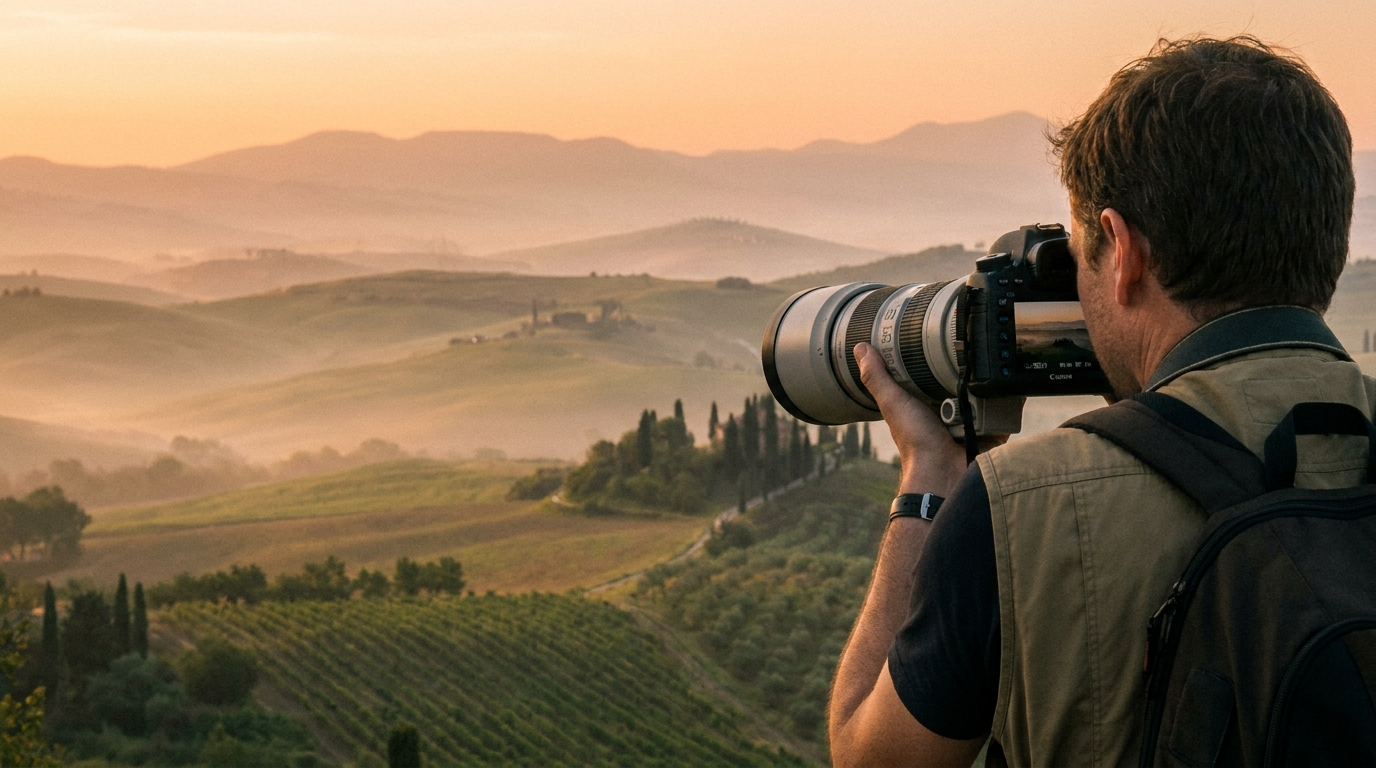
Fog mornings are where a telephoto earns its weight most clearly. When mist is pooling in the valley below a hilltop town, a longer lens lets you compress the scene into flat, graphic bands of hilltop, fog, and sky, which reads far more dramatically than the same scene shot wide. Anyone specifically chasing fog photography should treat a telephoto as close to mandatory rather than optional gear.
Side by side comparison
| Lens type | Typical range | Best for | Main downside |
|---|---|---|---|
| Wide angle | 16-35mm | Strong foregrounds, interiors, cypress roads shot close | Flat and empty without a foreground subject |
| Standard zoom | 24-70mm | Everyday coverage, villages, fast changing light | Rarely the most dramatic version of a shot |
| Telephoto | 70-200mm | Layered hills, fog compression, isolating a single subject | Heavier, needs more distance to compose |
| Super telephoto | 200mm+ | Extreme compression, distant details, wildlife-style patience shots | Overkill for most Val d'Orcia compositions |
What to bring into the villages
Location matters as much as focal length when deciding what to carry that day. Our guide to Val d'Orcia's geography and villages explains why the region's hilltop towns sit so close together yet feel so different from each other, and that difference extends to gear planning. San Quirico's medieval lanes are narrow enough that a long telephoto becomes genuinely awkward to use, since there is rarely enough physical distance between you and a building facade to let a 200mm lens do anything useful. A standard zoom, or even a wide angle for tight interior courtyards, is the practical choice inside any of the hilltop towns.
The moment you step back outside the town walls to shoot the classic elevated view over the valley, the calculation flips. That is where a telephoto compresses the scene into the tightly stacked layers that make these towns look so striking in photographs, floating above rows of hills and, in the right season, a bank of morning fog.
The realistic one bag recommendation
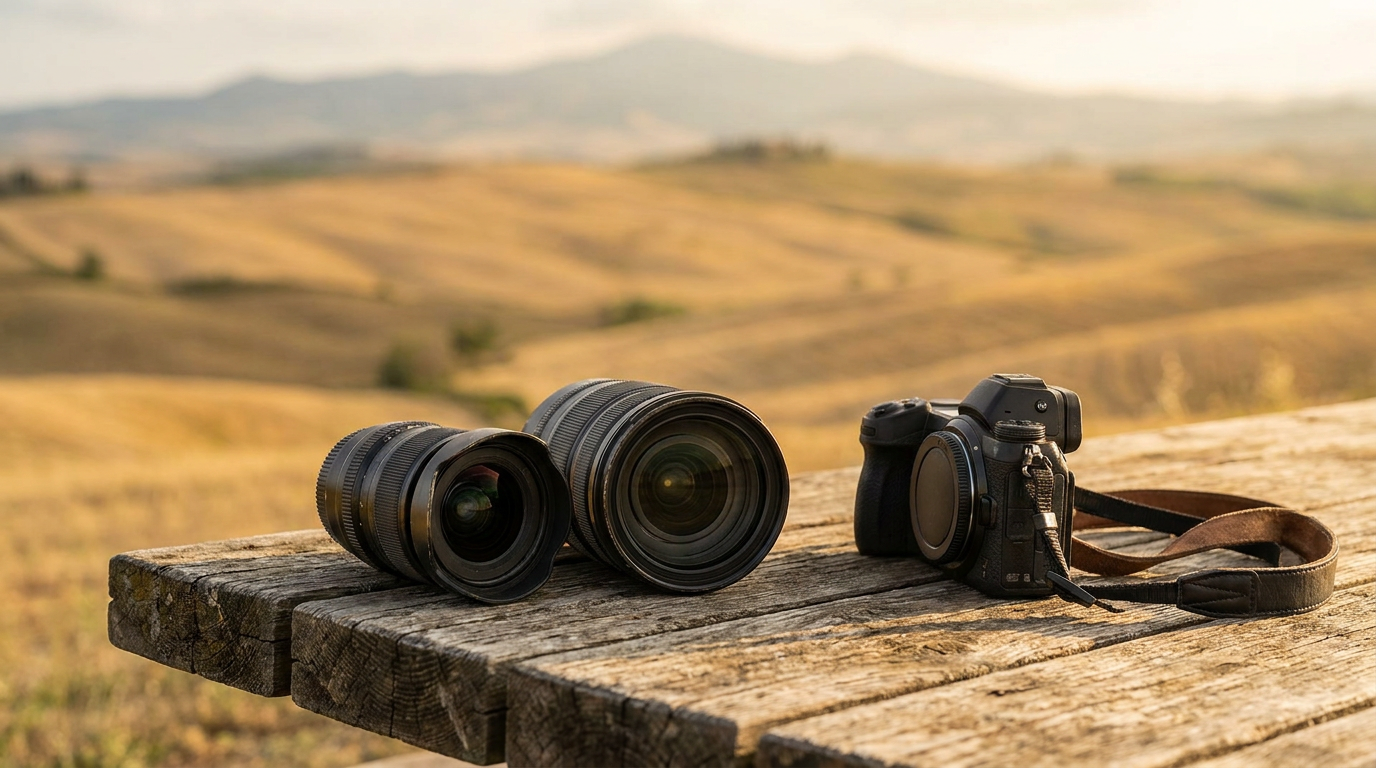
For a traveler who does not want to carry a full lens collection through airports and up hillsides, the most efficient two lens kit is a standard zoom in the 24-70mm range paired with a compact telephoto in the 70-200mm or similar range. That combination covers village streets, wide establishing shots, and compressed hill photography without needing a dedicated wide angle at all, since a standard zoom's widest setting is close enough to workable for most foreground heavy compositions.
Photographers who already know they want dramatic close foreground shots of cypress roads, or who plan to shoot interiors of churches and thermal squares, should still make room for a dedicated wide angle. But for a first trip to Val d'Orcia with limited luggage space, two lenses genuinely cover the large majority of the shots on a typical shot list.
Pro Tip: If weight is the deciding factor, prioritize the telephoto over the wide angle. Almost every visitor already owns something reasonably wide on their phone or a standard zoom's short end, but few people bring enough reach to compress Val d'Orcia's hills properly, and that compression is what separates a postcard shot from a forgettable one.
Primes vs zooms for this trip
Prime lens shooters will get sharper glass and often a stop or two of extra light gathering ability, which matters for the low light windows around sunrise and sunset. The trade off on a trip like this is speed. Val d'Orcia's light changes quickly, especially during a fog window or a fast moving cloud bank, and stopping to swap primes can cost you the shot entirely. Unless you are shooting a single focal length by deliberate creative choice, a pair of zooms that covers the full range from wide to telephoto is the more practical option for most travelers on a tight timeline with a guide or a group.
Frequently asked questions about lenses for Tuscany
Do I need an ultra wide lens under 16mm for Val d'Orcia? Generally no. Ultra wide lenses tend to exaggerate empty space on rolling hill terrain rather than add drama to it, and they see far more use in tight interiors than in open landscape shots. A 16-35mm range covers nearly every wide angle situation you will realistically encounter.
Is a 70-200mm lens too heavy to carry on a walking heavy trip? It is the heaviest lens most photographers bring, but it is also usually the one that produces the strongest single images of a Val d'Orcia trip, particularly for fog and layered hill photography. A compact f/4 version of this focal range cuts the weight significantly compared to an f/2.8 model without giving up much for daytime landscape work.
Can I get by with just my phone or a kit lens? You can capture recognizable images of the region with almost any camera, but a phone's fixed wide lens will consistently struggle with the compressed, layered hill shots that define Val d'Orcia's most iconic photographs. If you only own a kit zoom, prioritize learning to use its longer end well over buying new gear.
Should I rent a telephoto lens instead of buying one? For a single trip, renting a 70-200mm lens for the week is a reasonable way to test whether the focal range earns a permanent spot in your kit before committing to the expense and the extra weight on every future trip.
For a broader look at how gear reviewers evaluate landscape lenses across brands and price points, DPReview's buying guides are a useful reference point before making a purchase, particularly for comparing sharpness and weight across specific lens models this guide does not name individually.
Once your lens kit is settled, the next planning step is the rest of what goes in the bag. Our full Tuscany Photography Guide covers the wider trip planning picture, and a dedicated packing list for US travelers is coming soon with specifics on bag choice, batteries, and airline carry on rules.