Winter Light in Tuscany: The Season Most Photographers Skip
Why winter is Tuscany's most underrated photography season, with rare frost on the cypress trees, low soft light that lasts all day, and villages you can finally shoot without a crowd.
Winter Light in Tuscany: The Season Most Photographers Skip
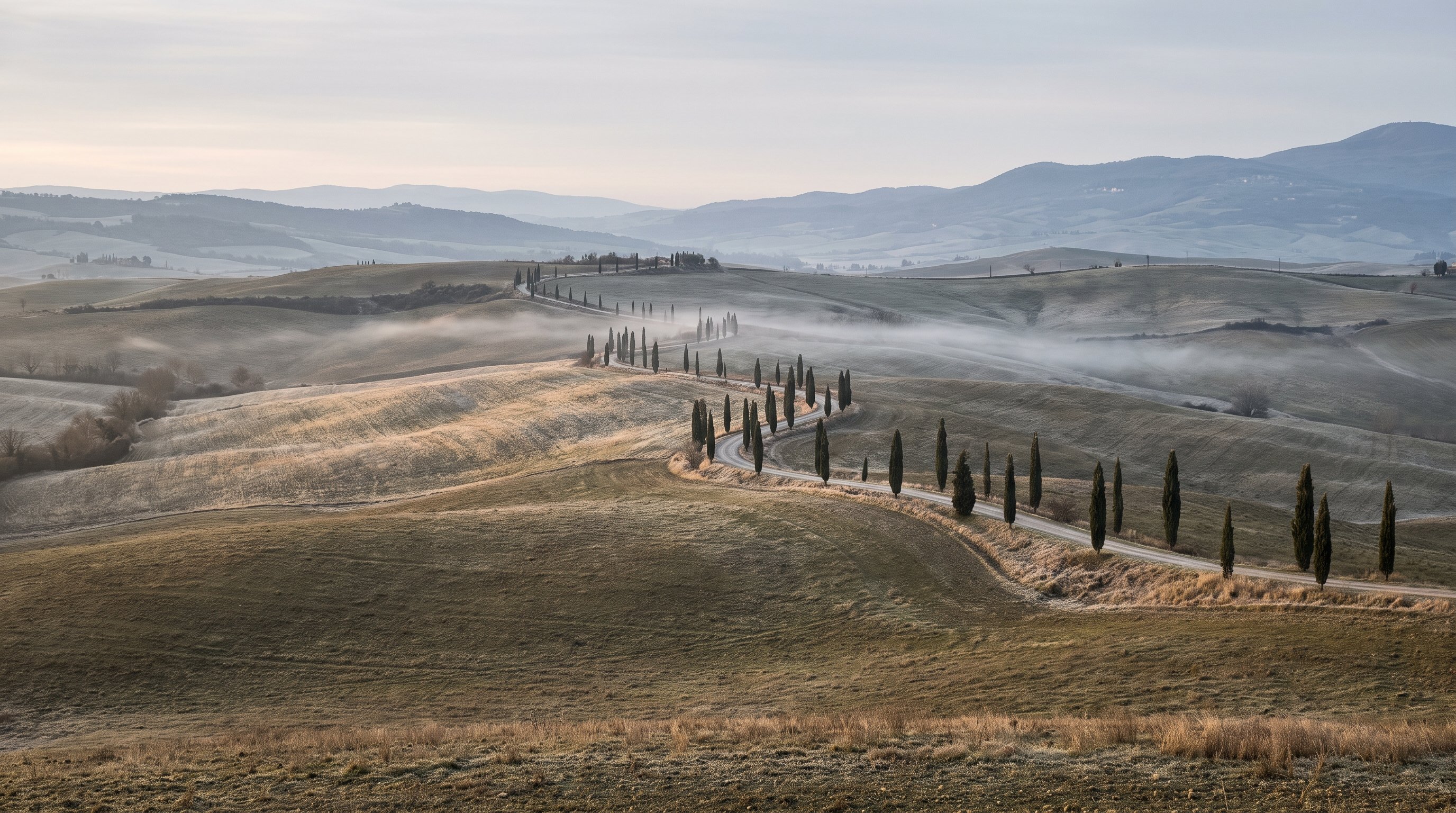
Every photographer I know has a mental list of places they are saving for "the right season." Tuscany usually gets filed under May for the green hills or October for the fog, and winter gets crossed off before it is even considered. I get why. Nobody plans a bucket list trip around a place's coldest, grayest months on purpose. But I spent a January week in Val d'Orcia a few years ago, mostly because it was the only window that fit my schedule, and it rearranged how I think about this region. The hills were not green or gold, they were this quiet olive brown I had never seen in a single photograph online. The streets in San Quirico were so empty at 9am that I could set up a tripod in the middle of the road and take my time. And on one genuinely freak morning, there was frost on the cypress trees that made them look like something out of a different country entirely.
This is not an argument that winter beats spring or autumn. It does not, at least not for the classic postcard shot. What it is, is an honest case for a season that gets dismissed for reasons that mostly have nothing to do with the actual photography, and everything to do with what people assume a Tuscany trip is supposed to look like. If you can get past that assumption, winter offers something the busier months simply cannot: light that stays low and workable for most of the day, and villages you can actually shoot without three tour groups walking through your frame.
Key Takeaways
Winter in Tuscany trades color and reliable weather for soft all day light, empty villages, and the rare chance of frost or snow that almost nobody else photographs.
| Point | Details |
|---|---|
| Best window | Mid December through late February, with January generally the quietest and coldest |
| Light quality | Low sun angle all day means workable directional light well outside the two golden hours |
| Snow and frost | Rare in Val d'Orcia itself, more likely on higher ground around Montalcino and Radicofani, never guaranteed |
| Crowds | The lowest of the year by a wide margin, particularly outside the Christmas and New Year week |
| Biggest tradeoff | Shorter days, higher chance of rain, and a duller base palette than spring or autumn |
| Who it suits | Photographers who value solitude and dramatic light over color and predictable weather |
Table of Contents
- The quick case for winter
- What winter light actually looks like
- Snow and frost on the cypress trees
- Empty streets in San Quirico, Pienza, and Montepulciano
- Winter fog: a different animal than autumn fog
- Camera settings and gear for cold weather shooting
- What to wear so you can actually stay out shooting
- Bagno Vignoni in the cold
- What is actually open in winter
- A realistic week in January
- Frequently asked questions about winter photography in Tuscany
The quick case for winter
If you have already read our guide to when to visit Tuscany month by month, you know winter comes up as a genuine dark horse rather than an afterthought, and I want to make that case in more detail here because it deserves more than a single paragraph. The core argument is simple. In Val d'Orcia, which sits at roughly 43 degrees north latitude, the sun never climbs much above 23 degrees over the horizon even at solar noon in December and January. Compare that to a summer midday sun sitting nearly 70 degrees up, blasting flat, contrasty light straight down onto the hills. In winter, you get something closer to a permanent golden hour angle, stretched out across most of the daylight hours instead of compressed into forty minutes at dawn and dusk.
That single fact changes how you can plan a shooting day. You are not racing the clock between 6am and 8am and then killing six hours until the light gets good again. You can shoot a hilltop composition at 11am and still get real shape and shadow across the terrain, something that simply is not possible in June or July. Add in the lowest crowd levels of the year and a handful of genuinely rare weather events, frost, occasional snow, heavy fog, and you have a season built for a different kind of photographer, one who wants images that look distinctly unlike what everyone else brings home from this region.
Pro Tip: Do not come to Val d'Orcia in winter expecting to replicate a May or October photograph with less crowding. Come expecting a genuinely different color palette and mood, closer to muted olive, brown, and gray than green or gold, and shoot for that mood instead of fighting it in post.
What winter light actually looks like
Sunrise in Val d'Orcia in late December lands around 7:40am and sunset around 4:50pm, roughly nine hours of daylight compared to nearly fifteen and a half in late June. That sounds like a disadvantage, and in terms of raw shooting time it is, but the quality of light across that shorter window makes up for a lot of it. Because the sun stays low, shadows stay long and directional through the entire day rather than disappearing into a flat overhead glare by 10am. Rolling hills, which rely on shadow and highlight to read as three dimensional rather than flat green carpet, benefit from this. A hillside that looks like a solid color block under a noon summer sun will show every fold and contour under a low winter sun at the same hour.
The color temperature of winter light also tends to run cooler and cleaner than the hazy, slightly yellow cast that builds up over a Tuscan summer. On a clear winter day, especially after rain has washed dust and pollen out of the air, visibility can stretch for miles, and distant ridgelines that would be lost in summer haze show up crisp and layered. That clarity is part of why some photographers who have shot here across every season quietly rank a clear January afternoon above a hazy August one, even without a single leaf of green in the frame.
Overcast days, more common in winter than any other season, are worth mentioning because they are genuinely useful rather than wasted. Flat, diffused light under heavy cloud is close to ideal for architectural detail in the villages, doorways, stonework, the geometry of Pienza's Piazza Pio II, without the harsh shadow lines direct sun throws across a scene. If the forecast shows overcast skies, point your camera at the towns instead of the landscape that day.
Snow and frost on the cypress trees
Let me manage expectations honestly here, because this is the image everyone wants and the one that is hardest to promise. Snow in Val d'Orcia proper, down in the valley where the famous cypress roads sit, is genuinely rare. Most winters see it once or twice at most, and it usually melts within a day or two. If snow is the entire reason for your trip, plan for higher elevation instead. The hills around Radicofani and the slopes toward Monte Amiata sit high enough that snow is a realistic, if still not guaranteed, possibility in January or February, and Montalcino's elevated position means it catches a dusting more often than the valley floor below it.
Frost is a more reliable substitute, and honestly, I think it photographs even better than snow in this landscape. A cold, clear night with high humidity leaves a fine white coating on the cypress needles and the dormant vine rows by morning, and it burns off within an hour or two of direct sun, which means you get roughly the same predictable window as fog chasing. Check for a forecast showing overnight temperatures dropping below freezing combined with calm wind and at least moderate humidity, and get to a cypress road at first light. The frost catches the low winter sun and lights up along every needle edge, which is a texture you simply do not get any other time of year.
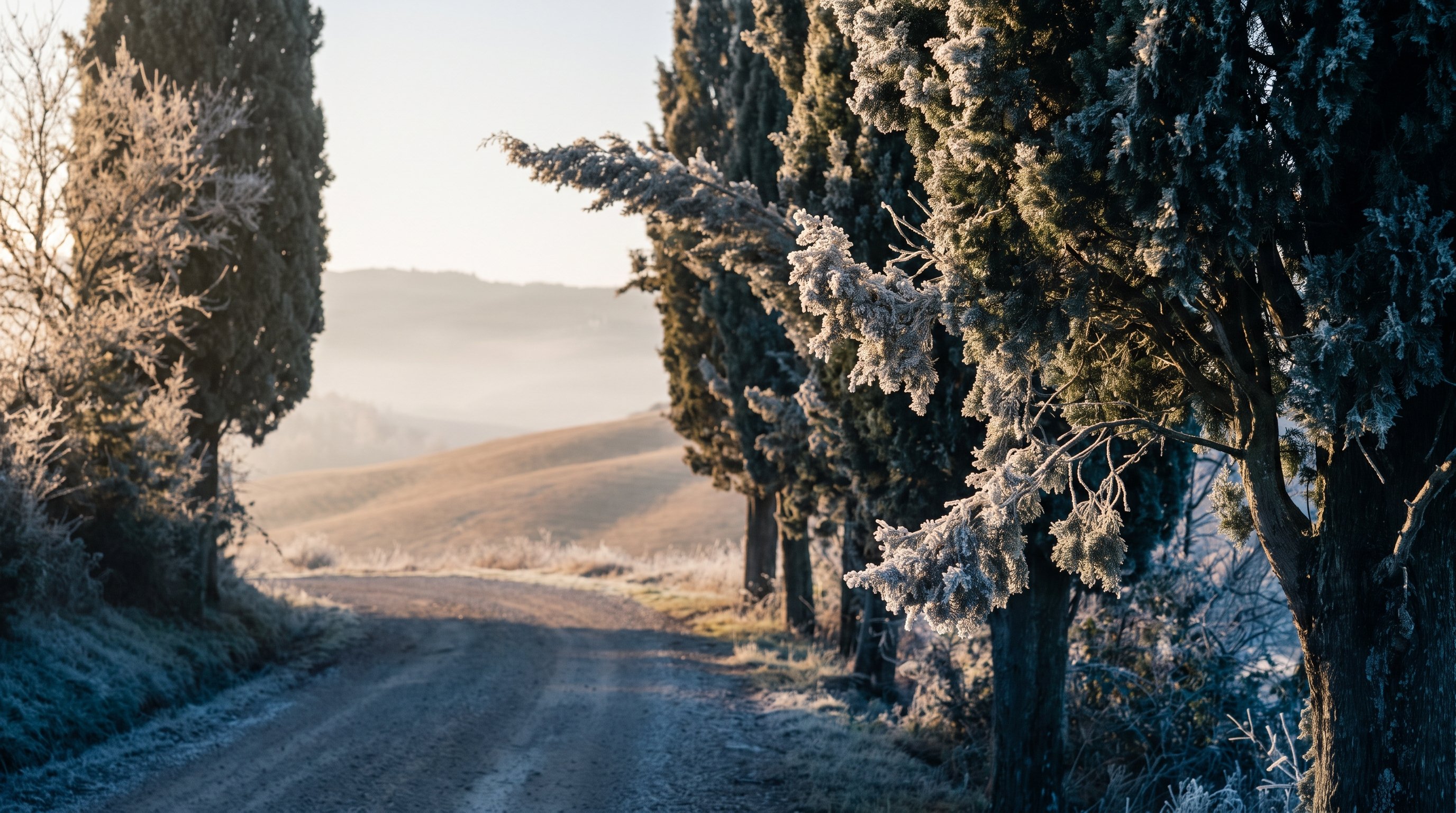
Pro Tip: If frost is on your shot list, shoot the shaded side of a cypress row first before the sun reaches it. Frost that is still in shadow holds its texture and definition much longer than frost already hit by direct light, which starts visibly melting within minutes.
Empty streets in San Quirico, Pienza, and Montepulciano
This is the part of winter photography that nobody talks about enough. Anyone who has tried to photograph Piazza Pio II in Pienza on a July afternoon knows the challenge is not finding a good composition, it is finding thirty consecutive seconds without a tour group crossing through it. In January, that same square can sit completely empty for ten or fifteen minutes at a stretch, especially in the mid morning after the handful of local shops have opened but before any day trippers have arrived.
San Quirico d'Orcia, which I have written about in more depth as a standalone walking guide, becomes almost a different town in winter. The medieval gates and the Horti Leonini gardens, normally busy with foot traffic through the warmer months, are quiet enough that you can work a composition slowly, check your histogram, reposition, and try again, without anyone else in frame or in your way. The same applies to Montepulciano's steep main street, the Corso, which climbs from the lower town gate to the fortress at the top. In summer it is genuinely difficult to get a clean shot of that street's converging lines without tourists filling it. In winter, on a weekday morning, you might have it entirely to yourself.
This matters for more than convenience. Empty streets change what kind of photograph is even possible. Long exposures at two or three seconds during blue hour, where any moving person would smear through the frame, become realistic without needing to wake up at an absurd hour to beat crowds that simply are not there in January. If architectural and street level work is a priority for your trip, winter is arguably the single best season for it.
Winter fog: a different animal than autumn fog
I have written a full guide dedicated to Val d'Orcia's autumn fog season, which peaks from mid October through November, and winter fog works on the same basic physics, a temperature inversion trapping cold, moist air in the valley overnight. But it behaves a little differently once you get into December and January. Fog forms less frequently in deep winter because the days are generally colder overall, which reduces the daytime warmth needed to build up a strong temperature swing by evening. When it does form, though, it tends to sit longer into the morning, since the low winter sun takes more time to generate enough heat to burn it off compared to a stronger autumn sun.
Practically, that means your odds of catching fog on any single winter morning are somewhat lower than in prime autumn weeks, but your window to actually shoot it once it appears is often longer, sometimes stretching past 9am instead of clearing by 8. Watch for the same three signals covered in the autumn fog guide, clear overnight sky, calm wind, and a meaningful day to night temperature drop, and check an hourly forecast the evening before rather than trusting a multi day outlook.
| Month | Avg. sunrise / sunset | Typical high / low (°F) | Frost or snow chance |
|---|---|---|---|
| December | 7:35am / 4:45pm | 50°F / 36°F | Frost common on clear nights; snow rare |
| January | 7:40am / 5:05pm | 48°F / 33°F | Coldest month; frost frequent, occasional light snow |
| February | 7:10am / 5:45pm | 53°F / 35°F | Frost still likely; first hints of early spring by late month |
Camera settings and gear for cold weather shooting
Cold weather shooting in Tuscany is mild compared to somewhere like Iceland or Scandinavia, but it still comes with real technical considerations, especially in the pre-dawn hours when temperatures sit just above or below freezing. Battery performance is the first thing to plan around. Lithium ion batteries lose a meaningful percentage of their usable charge in the cold, not permanently, but temporarily, so a battery that reads half full at room temperature can drain faster and cut out earlier than expected after twenty minutes in 35 degree air. I carry at least two spare batteries on any winter morning shoot and keep them in an inside jacket pocket, close to my body, swapping the cold one back in once it is depleted, since it often recovers charge as it warms.
Condensation is the second real issue, and it catches more photographers off guard than the cold itself. Moving a cold camera into a warm car or a heated apartment causes moisture to condense on and inside the body, a genuine risk to electronics if it happens repeatedly. Let your gear acclimate gradually. I keep my camera bag zipped closed for ten to fifteen minutes after coming back inside from a cold shoot, which lets the temperature equalize slowly instead of the camera hitting warm air directly. The same applies to your lens front element, since your own breath is often the actual cause of a fogged lens rather than ambient humidity, so shoot from slightly downwind of your own exhale when you are working close to the glass.
For actual exposure settings, winter's low sun angle means you are working with directional light for a much larger part of the day, so meter accordingly rather than defaulting to golden hour habits. I shoot most winter landscape work at f/8 to f/11 for depth of field across a rolling hill composition, ISO 100 to 200 given the decent available light, and rely on a tripod at dawn or dusk when shutter speeds drop. White balance on a cold, clear day tends to run cooler and bluer than summer, somewhere around 5200 to 5600K as a starting point, and I nudge it warmer selectively in post rather than fighting that natural coolness, since it is part of what makes winter images here look distinct from the warm gold tones everyone associates with Tuscany.
Pro Tip: Thin glove liners that still let you operate dials and buttons are worth more than thick ski gloves. I use a pair of touchscreen compatible liners under a pair of mittens I can pull off entirely for a few minutes at a time, which keeps my hands warm between shots without sacrificing the fine control a tripod head and manual focus ring both need.
What to wear so you can actually stay out shooting
Val d'Orcia winters are damp cold rather than dry cold, closer to a raw, bone chilling feeling than a sharp, crisp one, which surprises a lot of American visitors expecting something closer to a Midwest or Northeast winter. Layering matters more than any single heavy piece of clothing. I start with a base layer that manages moisture, add a mid layer fleece or light insulated jacket, and finish with a windproof and ideally waterproof outer shell, since a cold morning with any wind cuts through non windproof layers fast while you are standing still at a tripod rather than moving around. Waterproof boots with real tread matter too, since farm roads and hilltop viewpoints are often muddy in winter.
A proper winter hat that covers your ears is worth more than most people expect, since a huge amount of heat loss happens through your head and standing still for twenty minutes waiting on light is very different from walking briskly through a cold morning. For a full breakdown of what to actually pack for the whole trip, gear bags included, our complete Tuscany packing list covers the broader picture, though you will want to add the cold weather specific items above if you are traveling in the December through February window.
Bagno Vignoni in the cold
If there is one location where winter genuinely outperforms every other season, it is Bagno Vignoni, the small town built around a central square filled with naturally heated thermal water instead of a normal piazza. The water stays around 100°F year round regardless of the air temperature, which means the colder the morning air gets, the more dramatic the steam rising off the surface becomes. A summer morning at Bagno Vignoni might show a light haze over the water. A properly cold January morning, especially right around sunrise, can produce thick, rolling steam that catches the low sun and glows in a way that photographs unlike almost anywhere else in the region.
Get there before sunrise if you want the steam at its thickest, since the temperature differential between the warm water and the cold air is greatest right before the sun starts warming the surrounding stone. A telephoto lens compresses the steam and the medieval buildings nicely, while a wider lens captures the full square with the steam as an atmospheric layer across the whole frame. Either approach works, and honestly this is one location I would actively plan a winter trip around, rather than treat as a bonus stop along the way.
What is actually open in winter
This is a practical planning consideration that catches first time winter visitors off guard. Tuscany's smaller villages run on a genuinely different rhythm outside high season. Some family run restaurants and shops close entirely for a week or two around the January lull, particularly in the smaller hilltop towns rather than Montepulciano or Pienza, which stay reasonably active year round thanks to steady wine and cheese tourism. None of this affects the photography itself, since you are shooting streets and landscapes rather than relying on businesses being open, but it does affect trip planning around meals. Book dinner a day ahead rather than assuming you can walk in, and do not assume a specific place you researched online will be open on the exact day you show up. A rental car is close to essential in winter, since public transport between the smaller villages thins out even further outside peak months.
A realistic week in January
Here is roughly how I would structure a week long winter trip if solitude and light quality were the priority. Days one and two, base yourself near San Quirico or Pienza and walk the empty streets at a slow pace, since the light stays workable well past the usual golden hour cutoff. Day three, watch the overnight forecast for a frost or fog setup and get to a cypress road before sunrise if the conditions line up. Days four and five, day trip up to Montalcino and, conditions permitting, Radicofani for the higher elevation chance at real snow. Day six, dedicate a full sunrise session to Bagno Vignoni, since the steam effect is close to guaranteed on any properly cold morning. Day seven, keep it open as a buffer for whatever the week's forecast made you miss the first time.
This is also exactly the kind of trip where a guided approach earns its keep more than it might in a busier season. In peak months, the villages and viewpoints are well documented enough that a solo traveler can plan a solid route alone. In winter, with shorter days and unpredictable weather windows, having a guide who already knows which roads stay accessible after rain and which hilltop viewpoint catches frost first is worth more than usual. If a contrarian, off season trip like this appeals to you, it is worth reaching out to WeShoot directly about a private or small group photography tour built around a winter window, since a trip this weather dependent benefits enormously from local, day to day flexibility that a fixed solo itinerary struggles to match.
Frequently asked questions about winter photography in Tuscany
Is it worth visiting Tuscany in winter for photography? Yes, if you value low crowds and soft, all day directional light more than green hills or guaranteed sunshine. It is a genuinely different kind of trip from a spring or autumn visit, not a lesser version of one.
How likely is snow in Val d'Orcia? Snow in the valley itself is rare, typically once or twice a winter and usually melting within a day or two. Higher elevation areas around Montalcino and Radicofani see it more often, though it is still never guaranteed on any specific date.
What is the coldest month in Tuscany? January is typically the coldest, with average lows around the low 30s Fahrenheit and highs in the high 40s, though a specific cold snap can push temperatures lower for a few days at a time.
Do I need special gear for winter photography in Tuscany? Nothing extreme. A warm layered outfit, a couple of spare camera batteries kept warm in an inside pocket, and a tripod for the low light hours cover most of what you need. This is mild cold weather shooting compared to somewhere like Iceland or Scandinavia.
Is Bagno Vignoni better in winter than summer? For photography specifically, yes. The thermal water's steam effect is far more dramatic against cold air than warm air, making a cold winter morning genuinely the best time of year to photograph the town's famous water filled square.