The Complete Packing List for a Tuscany Photography Trip From the US
Everything a US traveler needs to pack for a Tuscany photography trip, covering carry-on camera rules, power adapters for Italy, filter and tripod choices, and the layers you actually need for a 5am shoot in Val d'Orcia.
The Complete Packing List for a Tuscany Photography Trip From the US
I have watched more than one photographer land in Rome, drag a rolling case the size of a small refrigerator through the train station, and then spend the first morning of a Tuscany trip discovering that half of what they packed was dead weight and the one thing they actually needed was sitting in a checked bag somewhere over the Atlantic. Packing for a photography trip to Val d'Orcia is a different exercise than packing for a normal vacation, and it is a very different exercise than packing for a photography trip somewhere domestic where you can just drive back to a camera store if you forgot something.
This is the packing list I actually give people before they fly to Tuscany from the US, built from a handful of trips where I either got it right or learned the hard way what to leave behind. It covers what goes in a carry-on versus a checked bag, the power situation, the clothing that actually matters for a 5am shoot in a wet field, and the gear that sounds essential in a forum post but never leaves the bottom of your bag once you are on the ground.
Key Takeaways
Pack your camera bodies, lenses, and batteries in your carry-on without exception, and treat everything else as replaceable.
| Point | Details |
|---|---|
| Camera gear | Always carry-on: bodies, lenses, memory cards, and batteries. Never check them. |
| Batteries | Spare lithium-ion batteries must go in carry-on luggage under US and EU aviation rules, not in checked bags. |
| Power | Italy runs on 230V with Type F (or compatible Type C) plugs. US devices need a plug adapter, and most modern chargers handle the voltage automatically. |
| Filters | A circular polarizer and a solid ND are worth their weight. A full graduated ND kit usually is not, for most travelers. |
| Clothing | Layers matter more than any single piece of gear. Early spring and autumn mornings in Val d'Orcia sit near freezing even when afternoons are warm. |
| What to skip | A second tripod, a full studio lighting kit, and more than two lenses beyond your core three are rarely worth the space. |
Table of Contents
- Carry-on vs. checked: the only rule that matters
- TSA and airline rules for camera gear
- Building the core camera kit
- Filters, tripod, and the rest of the bag
- Backing up your photos on the road
- Power, adapters, and charging in Italy
- What to wear for early morning shoots
- The complete packing checklist
- What to leave at home
- Frequently asked questions
Carry-on vs. checked: the only rule that matters
There is one rule in this whole list that I would consider non-negotiable, and everything else is a matter of taste. Every camera body, every lens, every memory card, and every battery goes in your carry-on. Not "probably goes," not "goes if there is room." It goes in the bag that never leaves your hands, from the moment you leave your house in the US to the moment you check into your hotel in Tuscany.
Checked bags get lost. They get delayed. They get opened and rifled through. None of that is catastrophic if the bag contains clothes and toiletries, because you can buy a t-shirt in Rome. It is catastrophic if the bag contains the camera you flew six thousand miles to use. I know a photographer who checked a second body as a backup, reasoning that his primary was in his carry-on anyway, and that checked bag never made it past a connection in Frankfurt. He shot the entire trip on a single body with no backup, which worked out, but only because nothing went wrong with it.
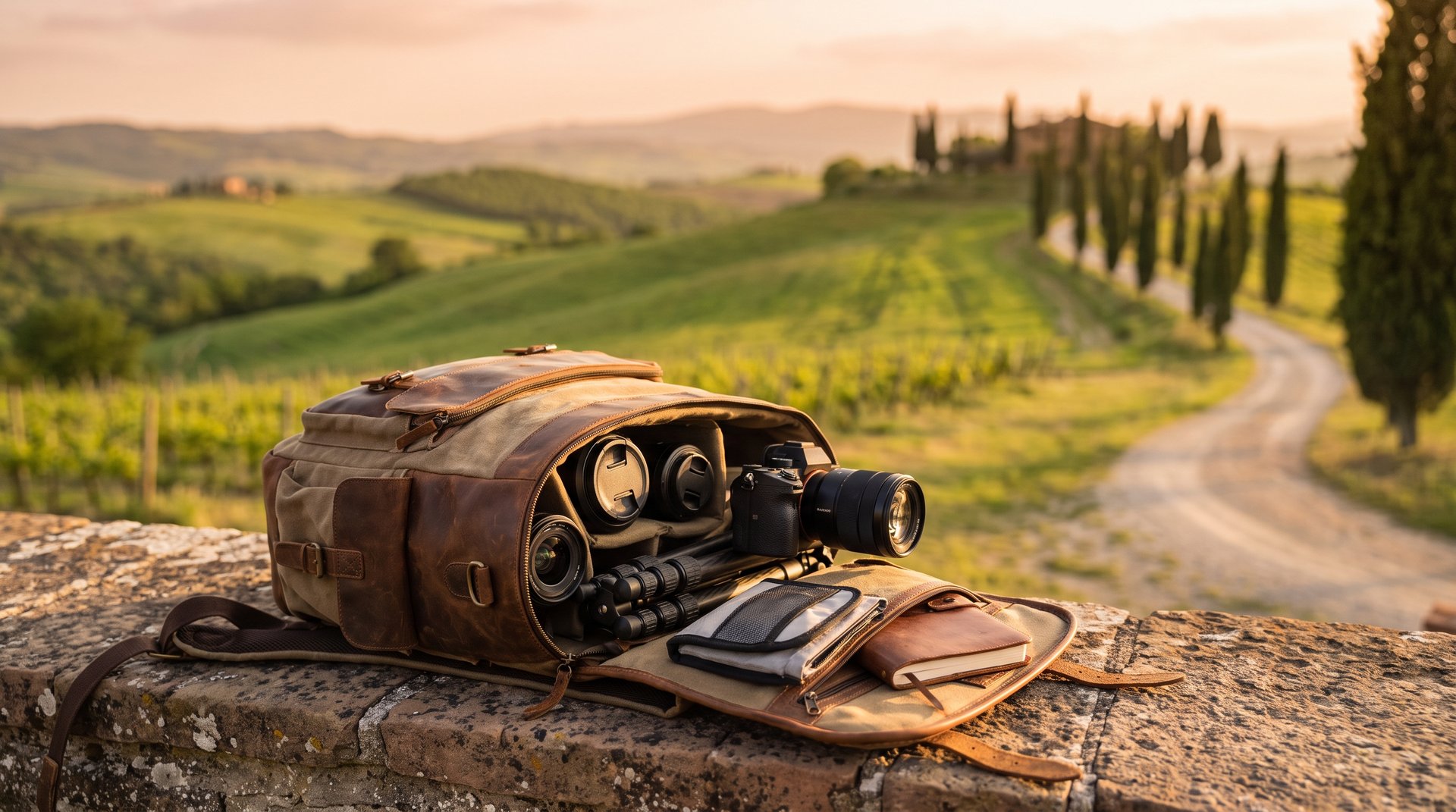
The practical upshot is that you need a carry-on bag built for camera gear, not a generic backpack with lenses stuffed into it. A proper camera backpack with customizable dividers protects your gear from the inevitable bumps of an overhead bin and, just as importantly, fits the sizing restrictions of the specific airline you are flying. European carriers, and especially the regional and budget carriers you might use for a connecting flight within Italy, tend to enforce carry-on dimensions more strictly than US domestic airlines do.
Pro Tip: Check your specific airline's carry-on dimensions before you buy or pack your bag, not after. A bag that easily clears US domestic sizing can get flagged for gate-checking on a European carrier, and gate-checking is exactly the scenario you are trying to avoid with your camera gear.
TSA and airline rules for camera gear
Camera gear moves through airport security more smoothly than most people expect, but a few specifics are worth knowing before you get to the airport rather than while you are holding up the line. Under TSA's own carry-on equipment guidance, cameras and lenses do not need to be removed from your bag for screening in most cases, though a TSA officer can always ask you to remove an item for a closer look, and large lenses sometimes trigger that request simply because of their density on the x-ray image.
Lithium-ion batteries, the kind in every modern camera body and most external chargers, are the part of the rule that actually matters. Both TSA and equivalent EU aviation authorities require spare lithium-ion batteries to travel in carry-on baggage, not checked baggage, because of fire risk in the cargo hold. This is not a suggestion you can quietly ignore. Airlines and security screening both enforce it, and a checked bag flagged for a battery violation can genuinely delay your entire flight while ground crew locates and removes it.
Tripods are the other gray area. A compact travel tripod almost always clears carry-on sizing and screening without issue. A full-size tripod, the kind that extends past about twenty-five inches folded, usually needs to go in checked luggage, and airline policies vary on whether it needs to be in a hard case. If you are checking a tripod, wrap the legs in clothing inside a duffel rather than trusting a thin tripod bag alone to survive baggage handling.
Airline baggage policies add another layer on top of TSA rules. Most major US carriers count a camera backpack as your one personal item or carry-on, the same as they would count a laptop bag, so check your specific airline's carry-on and personal item policy before you fly to confirm your camera bag's dimensions fit within their allowance, since a bag that is technically within TSA screening rules can still be too large for a particular airline's cabin storage limits.
Building the core camera kit
The temptation on a bucket-list trip is to bring every lens you own, and I understand the impulse, but Val d'Orcia genuinely rewards a tight kit over a heavy one. If you want the long version of this argument, I wrote a full comparison of the best lenses for Tuscany photography that walks through wide, standard, and telephoto use cases in detail. Here is the short version for a packing list.
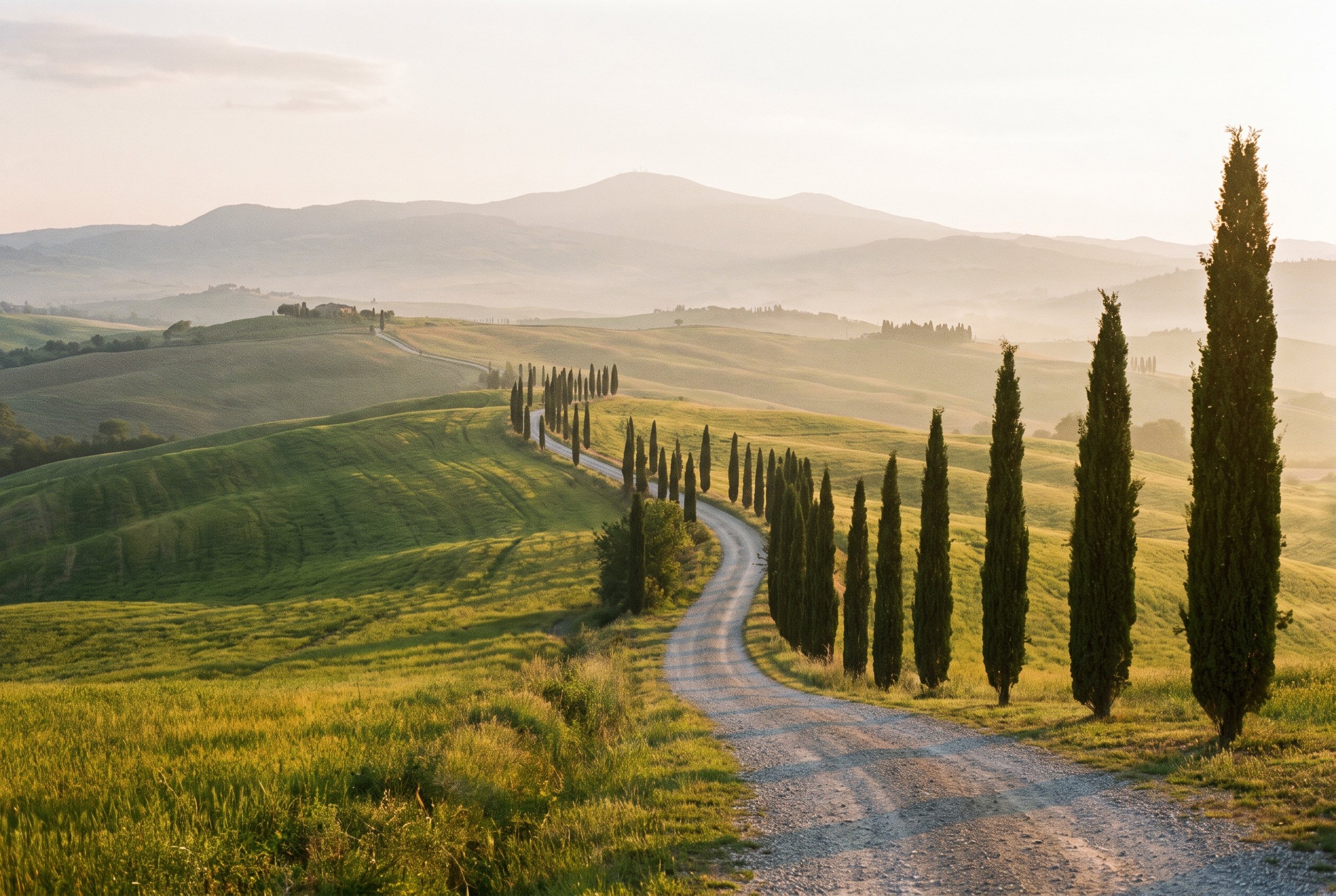
A wide angle zoom in the 16-35mm range, or the equivalent on a crop sensor, covers the sweeping hill and cypress road shots that most people associate with Tuscany. A standard zoom around 24-70mm handles villages, doorways, and the kind of mid-range compositions that fill the gaps between the dramatic wide shots. A telephoto in the 70-200mm range is the one most people leave at home and regret, because it is exactly what you need to compress layered hills into the stacked, almost flattened look that makes Val d'Orcia photographs instantly recognizable. If you can only bring two lenses, bring the wide and the telephoto. The standard zoom is the most skippable of the three if weight is genuinely tight.
On bodies, one primary and one backup is the right number for almost everyone. The backup does not need to match your primary. An older body you already own, even a crop sensor camera you have not touched in two years, is a perfectly good insurance policy against a failure on day two of a ten day trip. Bring two batteries per body minimum, plus a charger, and format your memory cards before you leave rather than discovering a corrupted card on your first morning shoot.
Filters, tripod, and the rest of the bag
Filters are where I see people either wildly overpack or skip something they will actually miss. A circular polarizer earns its place on almost every lens you own. It cuts the summer haze that flattens contrast in the hills, deepens the blue of a clear sky, and knocks the glare off wet stone streets after a morning rain in a village like Pienza. A single variable ND or a two or three stop solid ND is worth packing if you want any long exposure work at all, whether that is smoothing clouds over the hills or working a slower shutter on the fountain in Bagno Vignoni's historic baths.
Graduated ND filters are the one item I would push back on for most travelers. They solve a real problem, a bright sky against a dark foreground, but modern sensor dynamic range and a quick bracket-and-blend workflow in post solve the same problem without carrying a separate filter system, a holder, and the extra weight. If you already own a graduated ND kit and know how to use it quickly in the field, bring it. If you would be buying one specifically for this trip, spend that money on something else.
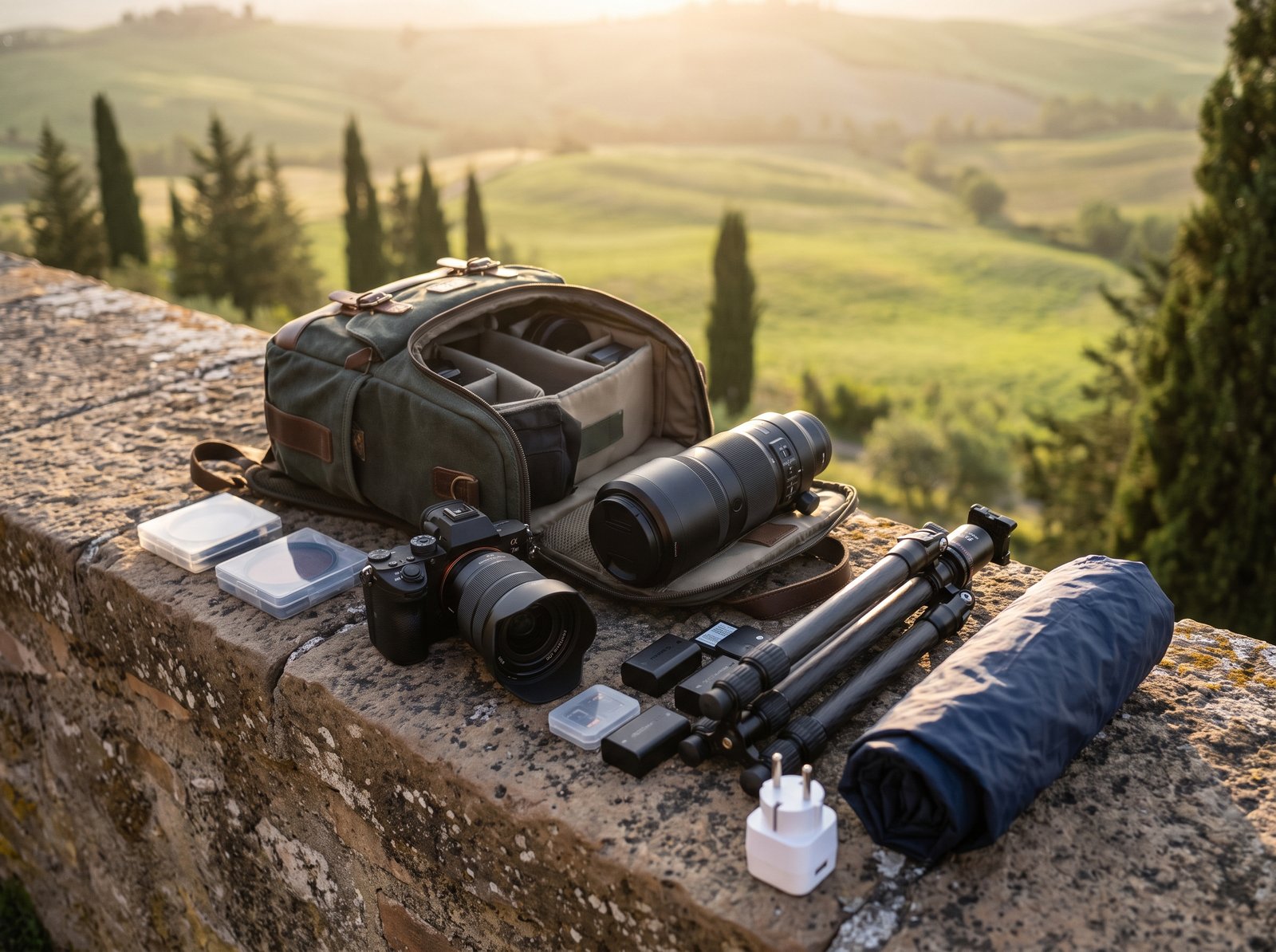
A tripod is close to mandatory if fog or blue hour shots are anywhere on your list, which they should be if you are coming to Val d'Orcia at all. A carbon fiber travel tripod in the three to four pound range is the sweet spot between stability in a breeze and something you will actually carry up a hillside at 5am rather than leaving in the car. Round out the bag with a rocket blower and a microfiber cloth for the dust that Tuscan farm roads kick up, spare card readers if your laptop lacks a built-in slot, and a small headlamp with a red light mode for setting up gear in the dark without ruining your night vision or another photographer's long exposure.
Backing up your photos on the road
Nobody plans for a corrupted card or a stolen bag, which is exactly why it is worth spending five minutes on a backup plan before you leave rather than improvising one after something goes wrong on day four of a ten day trip. My own system is simple and I have never had a reason to change it. I shoot on two memory cards simultaneously if my body supports dual slots, so every frame is written to two physical cards at the moment of capture. At the end of each shooting day, everything gets copied to a small portable SSD, the kind that fits in a jacket pocket and runs off USB-C power without needing its own charger.
If you are traveling with a laptop anyway, that becomes your second copy. If you would rather leave the laptop at home and travel lighter, a card-to-SSD backup device that copies files without a computer in the loop does the same job and saves real weight and bulk. Either way, the goal is the same: never let your only copy of a day's shooting exist on a single memory card sitting in a bag that could be lost, stolen, or simply dropped in a fountain in Bagno Vignoni. Bring enough card capacity that you are never forced to format and reuse a card before you have a confirmed backup elsewhere, and label your cards so you know which ones are cleared and which still hold unbacked images.
Power, adapters, and charging in Italy
Italy runs on 230 volts at 50Hz, compared to 120 volts at 60Hz in the US, and uses Type F sockets, sometimes called Schuko, which also accept the narrower Type C plug common across continental Europe. Almost every camera battery charger and laptop charger made in the last decade is dual voltage and will say so directly on the charger itself, usually printed as something like "INPUT: 100-240V." If your charger says that, you only need a plug adapter, not a voltage converter, and a simple Type C or Type F adapter from any travel section covers it.
Double check anything that is not obviously a modern electronic charger. Hair dryers, some older battery chargers, and a handful of specialty devices are not dual voltage and will need an actual step-down converter or should just be left at home and replaced locally. Bring at least one small power strip or a multi-port USB charger with a single adapter plug, because hotel rooms in smaller Tuscan towns often have fewer outlets than you would expect for the number of devices a photographer travels with.
Pro Tip: Pack one adapter per device you plan to charge overnight, or one small power strip plus a single adapter. Relying on a single adapter and hoping to rotate devices through it at 11pm after a long shooting day is exactly the kind of plan that falls apart in practice.
What to wear for early morning shoots
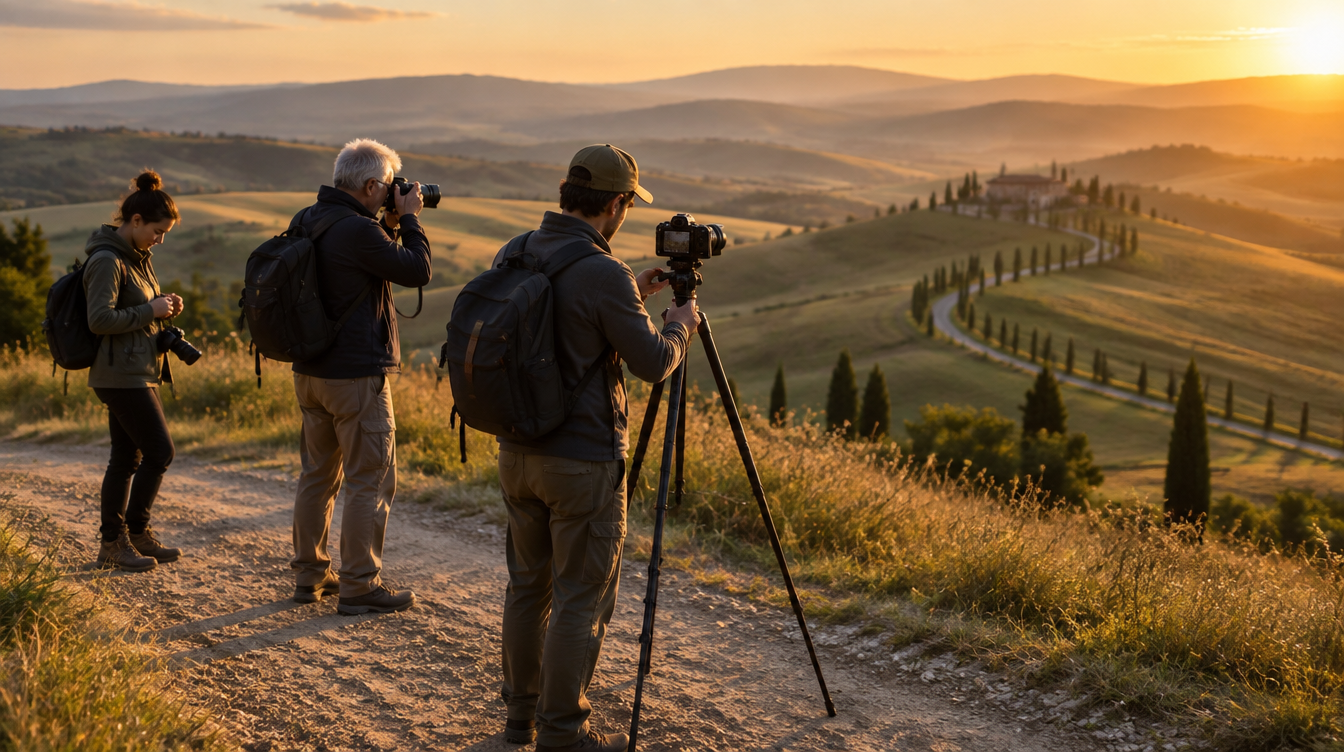
Clothing is the most underrated part of a Tuscany photography packing list, and it is the category where I see people get caught out most often. The daytime high in April or October might read a comfortable 65 or 70 degrees Fahrenheit, which sounds like light jacket weather, but that number says nothing about what a hilltop viewpoint feels like at 5:30am in the dark, waiting for fog to burn off, with dew soaking through your shoes.
Layers are the answer, and specifically layers you can shed quickly as the sun comes up and the temperature climbs ten or fifteen degrees in the space of an hour. A base layer, a fleece or light insulated mid layer, and a packable rain shell that also cuts wind covers nearly every morning you will face in spring, autumn, or winter. Summer mornings are milder, but even July can feel surprisingly cool before sunrise in the open farmland around Val d'Orcia.
Footwear matters more than most photographers plan for. You will be walking on wet grass, muddy farm tracks, and uneven gravel shoulders well before any trail has dried out, often in the dark with a headlamp and a full camera bag on your back. Waterproof hiking shoes or boots with real tread are worth the suitcase space. I have seen more than one photographer show up in sneakers and spend the whole trip picking careful, limited compositions from dry pavement because they could not follow the light to where the actual shot was.
The complete packing checklist
| Category | Item | Where it travels |
|---|---|---|
| Camera | Primary body + backup body | Carry-on, always |
| Camera | Wide, standard, and telephoto lenses | Carry-on, always |
| Camera | 4+ memory cards, formatted before departure | Carry-on |
| Camera | 3-4 batteries per body + charger | Carry-on (spare lithium batteries are required in carry-on by TSA/EU rules) |
| Support | Carbon fiber travel tripod | Checked, wrapped, or carry-on if compact enough |
| Filters | Circular polarizer + 2-3 stop solid ND | Carry-on |
| Power | Type F/C plug adapters (one per device) + small power strip | Carry-on or checked |
| Clothing | Base layer, fleece mid layer, packable rain shell | Checked |
| Clothing | Waterproof hiking shoes or boots | Checked (wear the bulkiest pair on the plane) |
| Extras | Rocket blower, microfiber cloths, headlamp with red mode | Carry-on |
| Backup | Portable SSD or extra memory cards for a second copy each night | Carry-on |
What to leave at home
Every packing list needs an equal and opposite list of what not to bring, because bag weight is a real cost on a trip with early mornings and a lot of walking. A full studio lighting kit has no place on a landscape trip to Val d'Orcia. A second full-size tripod is dead weight when a single carbon fiber tripod covers every scenario you will actually encounter. A complete graduated ND filter system, as covered above, is skippable for most people unless you already use one fluently.
Laptop-wise, resist the urge to bring a full desktop-grade editing rig. A lightweight laptop capable of culling and basic edits in the field, paired with a proper editing pass once you are home, is enough for almost every trip. And unless drone photography is specifically part of your plan, and you have already confirmed the registration and no-fly zone rules that apply to US visitors, leave the drone at home rather than carrying the extra bag, battery restrictions, and legal research for a device you might use twice. I cover exactly what those rules involve in a separate guide to drone photography rules for US visitors in Tuscany, and it is worth reading in full before you decide whether a drone earns its spot in your bag.
If working through this whole list feels like more logistics than you want to manage solo, it is worth considering a guided trip where the planning burden shifts elsewhere. On a WeShoot Tuscany photo tour, the itinerary, the sunrise locations, and the local logistics are already handled, so your packing list actually gets shorter rather than longer, since you are not the one scouting fog-prone viewpoints or figuring out which farm road to park on before dawn. It lets you focus the space in your bag entirely on the camera gear from this list rather than research materials and contingency plans.
Frequently asked questions
Can I bring camera batteries in checked luggage? No. TSA and equivalent EU rules require spare lithium-ion batteries to travel in carry-on baggage because of fire risk in the cargo hold. A battery installed inside a device is typically treated differently, but any spare battery should always go in your carry-on.
Do I need a voltage converter for Italy? Usually not for cameras and laptops. Check the fine print on your charger. If it lists an input range like 100-240V, you only need a plug adapter for the Type F or Type C socket, not a separate voltage converter.
How many lenses should I actually bring? Two to three covers almost every situation in Val d'Orcia: a wide angle for the classic hill and cypress shots, a telephoto for compressed layered landscapes, and a standard zoom if you have room for it.
Is a full-size tripod worth checking as luggage? Only if you already own one and have a way to protect it in a checked bag. For most travelers, a compact carbon fiber travel tripod that fits in a carry-on does everything a full-size tripod does for landscape work in this region.
What shoes should I pack for a Tuscany photography trip? Waterproof hiking shoes or boots with real tread. Early morning shoots happen on wet grass, muddy tracks, and gravel shoulders well before anything has dried out, and the right footwear is the difference between chasing the light and staying on the pavement.