Bagno Vignoni: Photographing Tuscany's Thermal Water Square
How to photograph the unusual water filled square at the center of Bagno Vignoni, from reflection techniques to chasing steam at sunrise in the cooler months.
Bagno Vignoni: Photographing Tuscany's Thermal Water Square
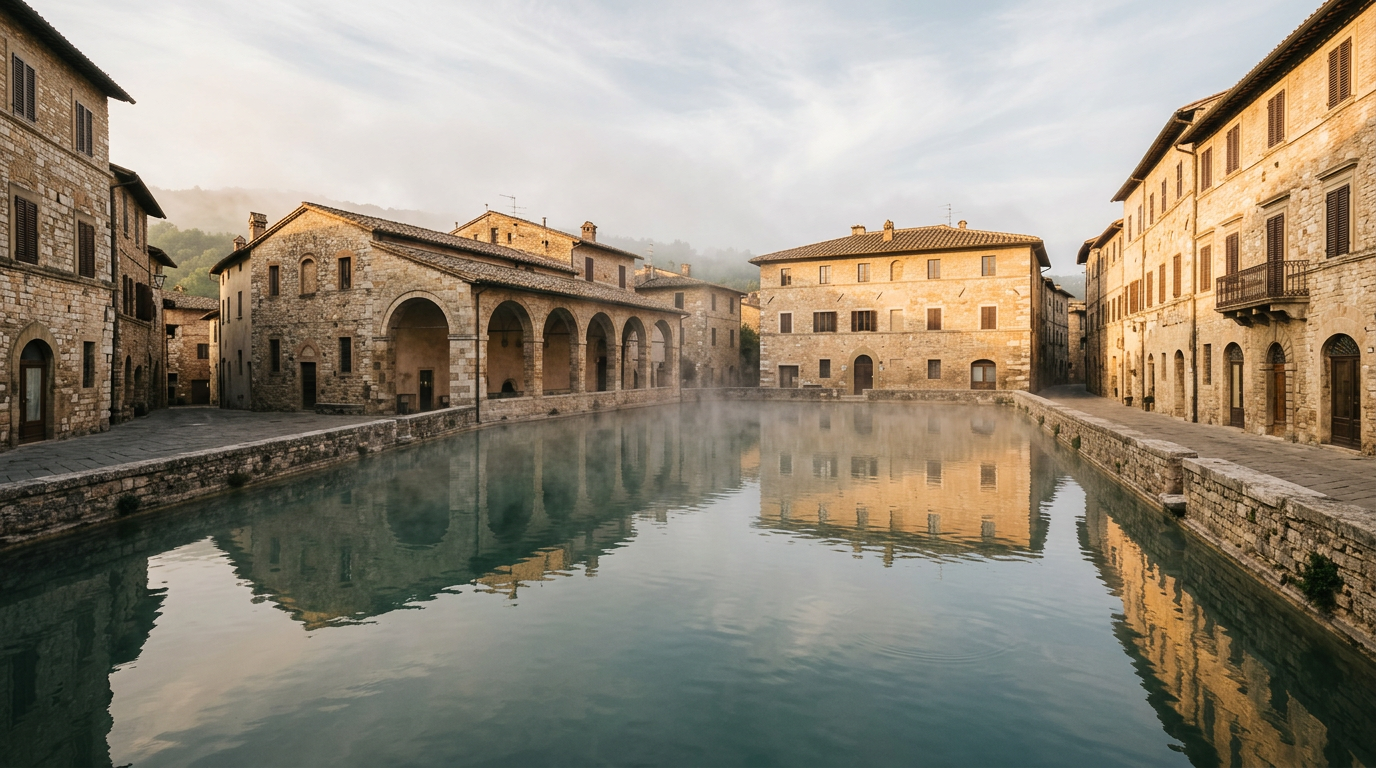
Most Tuscan hill towns build their main square around a fountain, a church, or a war memorial. Bagno Vignoni built its square around a bathhouse, and the result is one of the strangest and most photogenic sights in the entire Val d'Orcia. Instead of cobblestones, the historic center holds a long rectangular pool of steaming thermal water, ringed by medieval buildings that lean in as if they are watching their own reflection. It has been used since Roman times, and Saint Catherine of Siena is said to have bathed here in the fourteenth century.
For photographers, the appeal is obvious the moment you walk in. Where else can you shoot a flat, mirror still body of water inside a piazza, with stone arcades and a church tower reflected on its surface, and on the right morning, a low layer of steam drifting across the whole scene? This guide covers how the square actually works, when the steam shows up, the reflection techniques that make the most of the water, and where to stand to get the shot without fighting the crowds that arrive later in the day.
Key Takeaways
Bagno Vignoni rewards photographers who arrive early, understand the water, and know exactly where to stand.
| Point | Details |
|---|---|
| Best time of day | First light, roughly 30 to 60 minutes after sunrise, before day visitors arrive |
| Best season for steam | Late autumn through winter, when cold air meets the warm thermal water |
| Main subject | The rectangular Piazza delle Sorgenti, the water filled square at the town's center |
| Key technique | Low angle reflection shots using the pool's edge as a natural mirror |
| Access | Free and open at all hours, no ticket needed to view or photograph the square |
| Pairs well with | A pre dawn or post sunset visit combined with the wider Val d'Orcia itinerary |
Table of Contents
- What makes Bagno Vignoni different
- Getting there and when to go
- Reading the Piazza delle Sorgenti
- Reflection photography techniques
- Chasing steam at sunrise
- Best vantage points around the square
- Camera settings and gear
- Beyond the square: what else to shoot
- Frequently asked questions about photographing Bagno Vignoni
- Sources
- Recommended
What makes Bagno Vignoni different
Bagno Vignoni sits a short drive south of San Quirico d'Orcia, tucked into the same stretch of Val d'Orcia that gives the region its rolling clay hills and cypress lined roads. What sets it apart from every other town in the valley is what is missing from its main square: there is no piazza in the usual Italian sense, no open stone floor for evening passeggiata. Instead the entire center is occupied by a long thermal pool, fed by a spring that has been flowing at a near constant 52 degrees Celsius for thousands of years.
The pool itself, known locally as the Piazza delle Sorgenti, is fenced off from bathing today, but it remains fully open to view and photograph at any hour. Stone buildings with arched loggias line three sides, and a small church sits at one end. The combination of warm water, cool stone, and constant vapor gives the square a mood that shifts completely depending on the light and the season, which is exactly what makes it worth building a dedicated shoot around.
Getting there and when to go
Bagno Vignoni is roughly a ten minute drive from San Quirico d'Orcia and about twenty minutes from Pienza, which makes it an easy add on to a morning built around either town. There is a small free parking area just outside the historic center, and the walk in takes less than five minutes. Because the square has no gate and no opening hours, you can arrive whenever you want, which is the single biggest advantage this location has over almost anywhere else in the valley.
Day visitors tend to show up from mid morning onward, drawn by the cafes and the novelty of the water filled square, and by midday the reflections are often broken up by people leaning over the railings. Arrive within an hour of sunrise and you will likely have the entire square to yourself, with the added benefit of the low, warm light that hits the east facing stone facades first.
Pro Tip: Check sunrise and sunset times before you go, since the square sits low between buildings and loses direct light faster than open countryside. The usable golden hour window here is shorter than what you get on the open hills near San Quirico.
Reading the Piazza delle Sorgenti
The pool is longer than it is wide, running roughly along a north south axis, with the church of San Giovanni Battista anchoring the north end and the mouth of the village's main street opening onto the south end. Walking the full perimeter before you shoot anything is worth the extra ten minutes. The water's color and clarity change block by block depending on mineral deposits and depth, and the reflections shift with every few steps you take along the edge.
Steam rises most visibly near the inflow points, where the water is freshest and hottest, and thins out toward the far end of the pool. If steam is your main subject, work the section closest to the spring first, since that is where the effect reads most strongly against the cooler morning air.
Reflection photography techniques
The water in the Piazza delle Sorgenti is close to perfectly still on most mornings, since it is enclosed on all sides and shielded from wind by the surrounding buildings. That stillness is the whole reason to bring a wide or standard lens here rather than the long lens you might reach for on the open hills. Get low, close to the edge of the pool, and let the stone arcades and church tower fill the reflected half of the frame.
A few techniques consistently produce stronger results at this location:
- Shoot from as close to water level as the railing allows. A few extra inches of height above the surface can flatten out the reflection and weaken the mirror effect.
- Use the edge of the pool, not the center, as your horizon line, so the reflected buildings occupy roughly half the frame rather than a thin strip at the bottom.
- Underexpose slightly for the reflection rather than the sky, since the water tends to read brighter than the stone it is reflecting.
- Come back at two different times, once with steam and once without, since a clean, steam free reflection on a still morning can be just as striking as a misty one.
Pro Tip: A polarizing filter can work against you here. It is designed to cut reflections, so dial it back or remove it entirely when the water reflection is the actual subject of the shot, then use it selectively on the sky if you need to tame glare elsewhere in the frame.
Chasing steam at sunrise
Steam at Bagno Vignoni works on the same basic principle as the valley fog covered in our guide to reading light and layers in Val d'Orcia: a large temperature difference between a warm surface and the surrounding air produces visible vapor. Because the thermal water stays close to 52 degrees Celsius year round, the coldest mornings of the calendar produce the most dramatic steam, regardless of season.
In practice, that means late autumn through winter is the most reliable window. A cold, clear night followed by a still morning is the exact recipe that also produces fog on the open hills nearby, so a Bagno Vignoni sunrise pairs naturally with a fog chasing morning elsewhere in the valley. Summer mornings can still produce a thin ribbon of steam right at the water's surface in the hour before sunrise, but it burns off within minutes once the air warms, so timing matters even more than in winter.
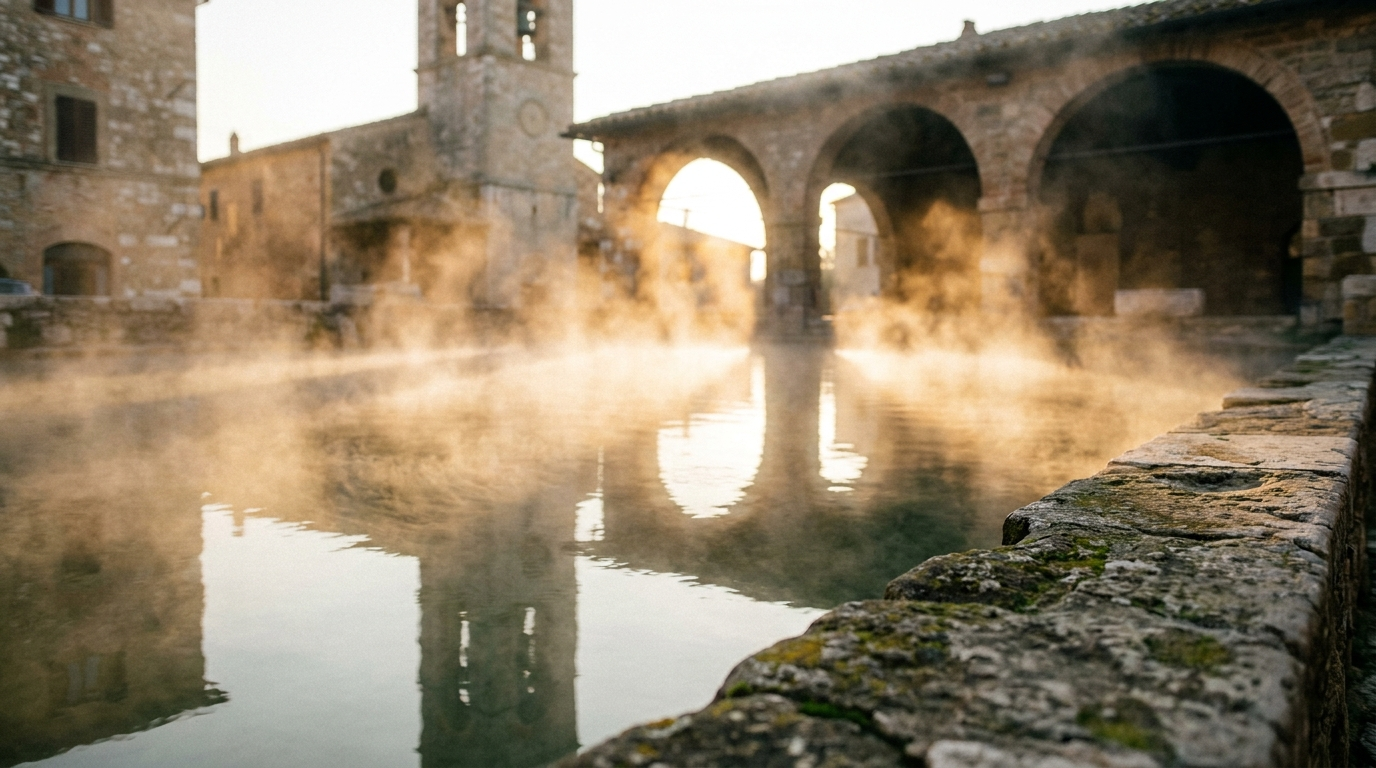
Backlight is the single biggest factor in how visible the steam reads in a photograph. Position yourself so the rising sun is behind or to the side of the steam rather than directly in front of you, which lights the vapor from within and separates it clearly from the darker stone buildings behind it. Shooting straight into flat, frontal light tends to wash the steam out almost completely.
Best vantage points around the square
Bagno Vignoni is small enough to fully explore in twenty minutes, but each side of the pool offers a genuinely different composition. The table below breaks down the main vantage points and what each one is best suited for.
| Vantage point | Best for | Notes |
|---|---|---|
| North end, near the church | Reflection of San Giovanni Battista and the bell tower | Strongest reflection early morning, before any wind picks up |
| East side arcade | Warm light on stone facades | Catches direct sun first after sunrise |
| West side railing | Backlit steam shots | Puts the rising sun behind the vapor for separation |
| South entrance | Wide establishing shot of the full pool | Best for showing the square's full unusual layout in one frame |
| Loggia del Santa Caterina | Framed views through stone arches | Use the arches as a natural frame around the water |
Camera settings and gear
A wide to standard zoom, roughly 16 to 50mm on a full frame body, covers nearly everything this location asks for. The square is compact, and a longer lens mostly compresses you out of the reflections that make the place worth photographing. A tripod is genuinely useful here, both for low light before full sunrise and for keeping your composition locked while you wait for a passerby to clear the frame.
Keep your aperture in the f/8 to f/11 range for most reflection shots, since you want both the foreground stone edge and the reflected buildings reasonably sharp. For steam shots, a slightly faster shutter, around 1/250 or quicker, freezes individual wisps of vapor with texture, while a slower shutter around 1/15 to 1/30 smooths the steam into a softer, more atmospheric blur. Both approaches work, and the difference comes down to the mood you are after rather than one being technically correct.
Beyond the square: what else to shoot
Once you have worked the main pool, the streets leading away from it are worth a slower walk. Bagno Vignoni is built almost entirely from the same warm travertine stone, and narrow alleys running uphill from the square catch dramatic side light in the early morning. The Rocca, a small ruined fortress on the hill above town, gives a wider elevated view back down over the pool and the surrounding countryside, and is a useful stop if you want a shot that places the thermal square within the broader Val d'Orcia landscape rather than isolated on its own.
Frequently asked questions about photographing Bagno Vignoni
Can you actually bathe in the main square pool? No. The historic Piazza delle Sorgenti pool is protected and fenced for viewing only. Several nearby spas and a free public thermal area outside the village center do allow bathing, but they are separate from the photogenic square covered in this guide.
Is Bagno Vignoni crowded? It gets busy from mid morning through the afternoon, particularly in summer, but it is one of the smaller villages in the valley and rarely feels as packed as Pienza or Montepulciano. An early arrival still makes the biggest difference.
Do you need a tripod? It is not required, since the square is well lit within an hour of sunrise, but a tripod helps with precise composition along the pool's edge and is useful for slower shutter steam shots before full daylight.
What is the best season to visit for photography? Late autumn and winter give the most reliable steam due to the larger temperature gap between the thermal water and the cold air. Spring and early autumn are more comfortable for a longer visit and still produce steam on cold, clear mornings.
How much time should I budget? An hour is enough to work the main vantage points around the pool. If you are combining it with the Rocca overlook and a walk through the side streets, plan for closer to ninety minutes.
Sources
- Comune di San Quirico d'Orcia: official municipal information covering Bagno Vignoni
- Bagno Vignoni: Wikipedia entry on history and the thermal pool