Autumn in Tuscany: Harvest Light, Fog, and Fewer Crowds
Why autumn might be the best season to photograph Val d'Orcia, with grape harvest color, softening light, the first fog of the year, and a realistic week by week breakdown for planning your trip.
Autumn in Tuscany: Harvest Light, Fog, and Fewer Crowds
Every spring I get emails from readers asking whether May is really the only month worth booking, and every autumn I get a much shorter list of emails from people who came in October and are already asking when they can come back. That gap tells you something. Spring gets the marketing, the poppy fields, the postcards. Autumn gets the photographers who actually shot both and picked a favorite. I am one of them, and after several years of working Val d'Orcia in late September, October, and November, I will make the case plainly: this is the season I would choose if I could only have one.
None of that means autumn is a secret nobody talks about anymore. Enough people have caught on that the fog viewpoints near San Quirico get a small crowd of tripods on the best mornings now. But compared to the wall to wall tour buses of a July afternoon in Pienza, "small crowd" is a relative term you will be grateful for. This guide walks through what actually changes in the light, the crops, and the crowd levels as the season moves from the tail end of summer heat into the first cold snaps of winter, with a realistic week by week breakdown so you are not guessing at where to land your trip.
Key Takeaways
Autumn compresses three of Tuscany's best assets, harvest color, softer light, and thinner crowds, into a single ten week window.
| Point | Details |
|---|---|
| Best overall window | Last week of September through the third week of October |
| Grape harvest | Mid September through early October around Montalcino and Montepulciano |
| Fog window | Mid October through late November, strongest after the harvest is largely finished |
| Crowd levels | Roughly a third of summer's foot traffic in the villages by late October |
| Light quality | Lower sun angle all day, longer golden hour, far less haze than July or August |
| Weather risk | Rain becomes a real factor by November, so build flexible days into a longer trip |
Table of Contents
- Why autumn quietly beats spring
- Late September: the hinge point
- October: harvest color and the best light of the year
- November: fog, rain, and the last quiet window
- A week by week breakdown
- What "fewer crowds" actually looks like
- Camera settings for autumn light
- What to pack for an autumn trip
- Mistakes people make planning an autumn trip
- Frequently asked questions about autumn in Tuscany
Why autumn quietly beats spring
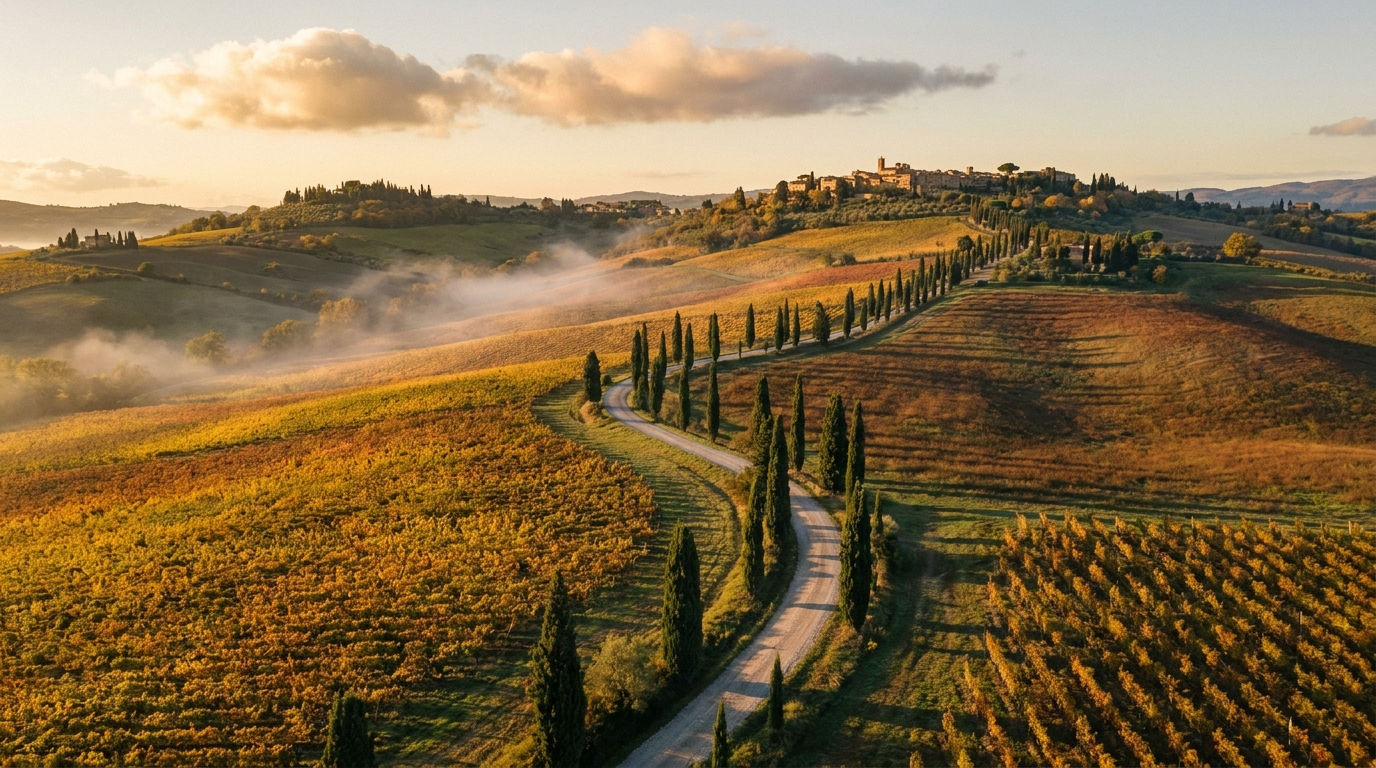
Spring wins the popularity contest because poppies photograph well on Instagram and everyone already knows what a poppy field looks like before they arrive. Autumn does not have a single iconic flower carrying its marketing, so it has to be discovered rather than scrolled past, and that is exactly why it stays quieter. What it lacks in a single hero image it makes up for with range. In one ten day trip in October you can genuinely catch grape harvest activity in the vineyards, the first proper fog of the season pooling below Pienza, golden light on freshly plowed fields that have gone from green to gold to brown since summer, and villages that still have enough visitors to keep the good restaurants open but not so many that you are shooting around strangers in every frame.
There is also a simple physics reason autumn light photographs better than summer light. By late September the sun's angle has dropped enough that even midday shooting becomes workable again, something that was basically off the table from June through August. Shadows lengthen, the harsh top down light of summer disappears, and the golden hour window itself stretches out, giving you closer to forty five minutes of genuinely usable warm light at each end of the day instead of the fifteen or twenty minutes you get in high summer before the color goes flat.
Pro Tip: If your trip has to be a single fixed week, aim for the week that straddles the end of September and start of October. You get a real shot at catching the tail of the harvest activity and the earliest fog mornings in the same trip, which almost never happens once you get into late October when the harvest is essentially finished.
Late September: the hinge point
The last week of September is a genuine hinge in the Tuscan calendar, and it is easy to underestimate how much changes in a matter of days. Temperatures that were still climbing into the mid eighties Fahrenheit in early September drop into the more comfortable seventies. The brutal midday haze that has been sitting over Val d'Orcia since July starts thinning noticeably, and by the final few days of the month you can shoot a genuinely clear, high contrast landscape photograph at two in the afternoon, something that would have looked flat and milky a month earlier.
This is also when the grape harvest, called the vendemmia, is in full swing around Montalcino, home of Brunello, and the vineyards closer to Montepulciano. If you time a visit right, you can photograph pickers working the rows early in the morning before the day heats up, tractors hauling crates of freshly cut grapes down narrow farm roads, and vineyards that have shifted from uniform green to a patchwork of yellow, orange, and deep red leaves depending on the grape variety. I shoot this with a 70-200mm compressing several rows of vines together, which reads far more dramatically than a wide shot that spreads the color out and dilutes it.
October: harvest color and the best light of the year
If I had to bet on a single best month for landscape photography anywhere in Tuscany, I would bet on October without much hesitation. The heat is gone entirely by the second week, the light stays soft and workable across most of the day rather than just at golden hour, and the fields around Val d'Orcia go through a color transformation that most first time visitors do not expect. Freshly plowed earth turns a rich, almost chocolate brown, contrasting hard against whatever green cover crop or stubble remains on the neighboring fields, and the result is a patchwork of tones across the hills that simply does not exist in the uniform green of May or the uniform gold of August.
October is also when the region's famous fog becomes a realistic target for the first time since the previous spring. I cover the mechanics of predicting and chasing it in detail in a separate guide on how to photograph the fog in Val d'Orcia, but the short version for planning purposes is that the odds improve steadily as the month goes on, from occasional in early October to genuinely likely by the back half of the month, once the overnight temperatures start dropping hard enough to trigger the temperature inversions that create it.
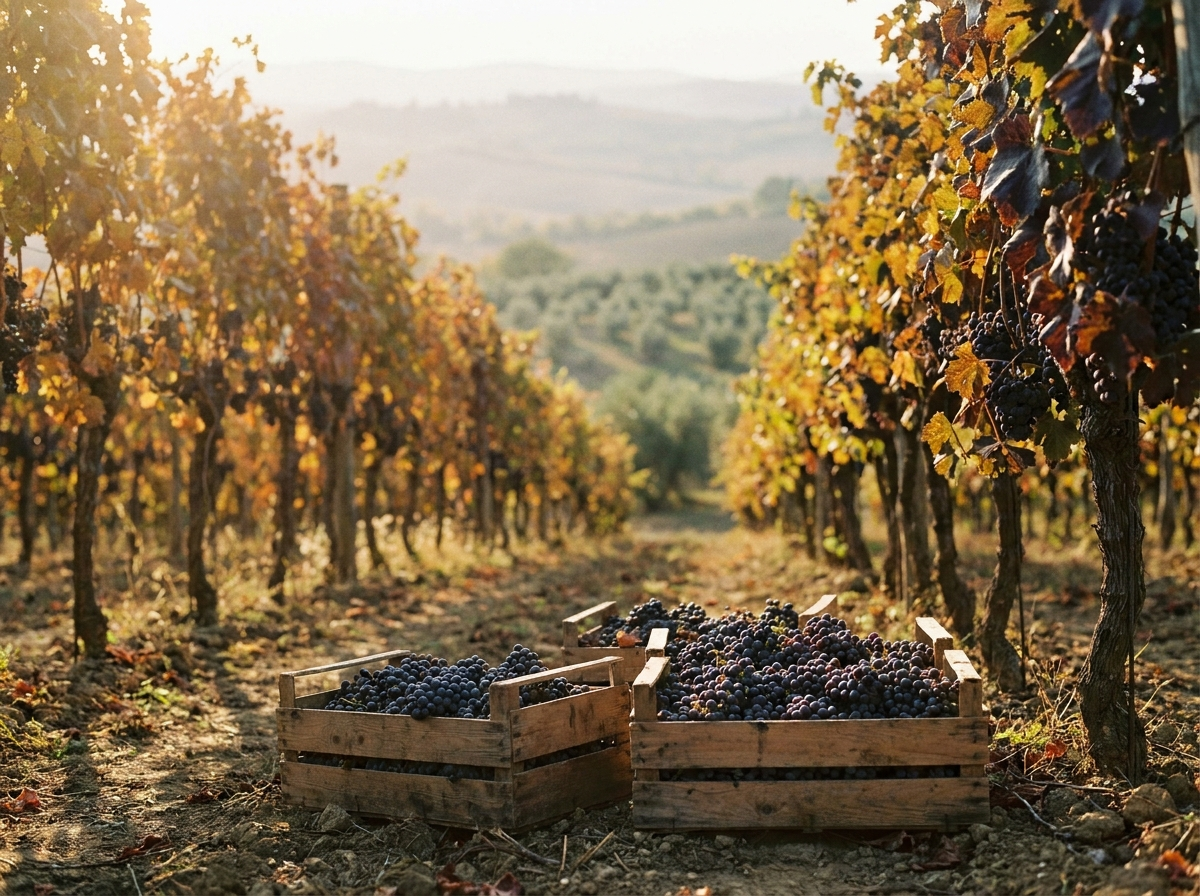
Golden hour in October is genuinely one of the best I have shot anywhere, warm without the orange oversaturation you sometimes get in high summer haze, and long enough that you are not sprinting between compositions trying to beat the clock. I regularly get thirty to forty minutes of strong directional light on a clear October evening, compared to the ten or fifteen rushed minutes you sometimes get in August once the haze burns off the sun entirely and the light goes flat almost immediately after a brief window of color.
November: fog, rain, and the last quiet window
November is the month most visiting photographers skip, and it is also the month with the single best odds of catching serious, thick, valley filling fog. The trade off is rain. Storm systems move through more frequently by November, and you should plan for at least a few washed out days if you are staying a week or longer. The upside of that instability is that clear nights following a passing front are exactly the setup that produces the strongest fog, since the rain clears out humidity and haze and leaves genuinely cold, clean air behind for the overnight temperature drop to work with.
Village life quiets down considerably by November too. Restaurants that ran two full seatings in October start trimming hours, some smaller agriturismi close for the season entirely, and you can walk the historic center of San Quirico or Pienza in the middle of a Saturday afternoon without dodging a tour group. If solitude matters more to you than guaranteed sunshine, November rewards that trade generously.
A week by week breakdown
| Window | What to expect | Best for |
|---|---|---|
| Last week of September | Cooling temps, thinning haze, active harvest | Vineyard work, transitional light |
| First two weeks of October | Peak harvest color, clear warm days | Golden hour, plowed field patchwork |
| Third and fourth week of October | Harvest winding down, first real fog chances | Fog mornings, quieter villages |
| First two weeks of November | Strong fog odds, cooler and shorter days | Dedicated fog trips, empty streets |
| Late November | Rain more frequent, occasional frost | Moody storm light, off season rates |
What "fewer crowds" actually looks like
"Fewer crowds" gets thrown around loosely in travel writing, so let me be specific about what changes on the ground. In July and August, the terrace viewpoint at Pienza looking south over Val d'Orcia regularly has ten to twenty photographers and just as many casual visitors during peak golden hour, and getting a clean composition without a stranger's elbow in the frame takes patience. By mid October, that same viewpoint at the same time of day typically has three or four other photographers on a good evening, and by mid November you can genuinely have it to yourself on a weekday. The famous cypress road near San Quirico follows a similar pattern, though it never gets fully empty since it has become recognizable enough to draw a steady trickle of visitors year round.
Restaurants and lodging follow the same curve, which matters more than most photographers plan for. Booking a table at a well reviewed spot in Montepulciano without a reservation is close to impossible in August and perfectly manageable by late October. If flexibility around meals and lodging matters to your trip, that alone might tip the decision toward autumn even before you factor in the light.
This is also the season where a guided trip pays for itself in ways that are hard to replicate solo. A local guide already knows which farm road has the cleanest sightline for that week's harvest activity, which restaurant still has a table on a Tuesday in late October, and exactly which morning the fog forecast is worth setting an early alarm for instead of guessing from an apartment with an unfamiliar weather app. Our Val d'Orcia photography tours are timed specifically around this window for that reason, built to put you in position for the harvest color, the fog, and the softer light without burning two or three mornings of a short trip figuring it out yourself.
Camera settings for autumn light
Autumn light is genuinely more forgiving than summer, but it still rewards a deliberate approach rather than relying on your camera's automatic modes. For the classic golden hour hillside shot, I shoot aperture priority at f/8 to f/11 to keep both a foreground element like a stone wall or cypress row and the distant hills reasonably sharp, with ISO pinned at 100 and a tripod handling whatever shutter speed the aperture and available light demand. As the sun gets low and the color starts to shift warm, I will often add a third to two thirds of a stop of positive exposure compensation, since evaluative metering tends to underexpose a scene with a bright sky and darker foreground hills, and I would rather protect shadow detail than clip the sky.
For harvest and vineyard work specifically, a 70-200mm is doing most of the heavy lifting for me by October. It compresses rows of vines and lets you isolate color and texture in a way a wide angle simply cannot, and it also lets you photograph pickers working a field respectfully from a distance without getting in anyone's way. A circular polarizer earns its place again this time of year too, cutting glare off waxy grape leaves and saturating the reds and golds of turning foliage noticeably more than an unfiltered shot, though I dial it back from a full polarizing effect at wide angles to avoid an uneven sky.
White balance is worth setting manually rather than trusting auto white balance once fog or heavy cloud enters the picture. I generally sit around 5200 to 5500K for a clean fog morning before sunrise and warm that up gradually as direct light starts hitting the scene, adjusting by eye on the histogram rather than chasing a single fixed number all morning.
Pro Tip: Bring a lens hood you actually use, not one buried in your bag. Low autumn sun sits directly in frame far more often than summer's high overhead sun, and stray light hitting an unshaded front element is one of the most common causes of a hazy, low contrast frame that looked fine on a small camera screen and disappointing once you got it onto a real monitor.
What to pack for an autumn trip
Layering matters more in autumn than in any other season here. A fog morning in early November can start close to freezing and finish in the mid sixties Fahrenheit by early afternoon, so I pack a base layer, a mid weight fleece, and a packable rain shell that also cuts wind on an exposed hilltop viewpoint before sunrise. Waterproof boots or shoes are worth the extra weight in your bag, since farm roads and field edges around the vineyards turn to mud quickly once the autumn rains start.
On the camera side, a rain cover for your bag and a couple of microfiber cloths kept dry in an inside pocket are non negotiable once you are shooting fog or working around drizzle. I also pack a small headlamp with a red light mode for the pre dawn walk to a viewpoint, since October and November mornings start noticeably darker than a May sunrise at the same clock time. If you want the fuller picture of what to bring for a Tuscany trip generally, not just the autumn specific items, our packing list covers the broader gear and clothing questions US travelers tend to have.
Mistakes people make planning an autumn trip
The most common mistake is booking too short a window and expecting to catch harvest color, fog, and clear golden hour evenings all in the same three or four days. Those three things do not always overlap neatly, and a trip under a week leaves very little room to adapt if the weather does not cooperate on your one flexible morning. Build in at least six or seven days if more than one of those is on your must have list.
The second mistake is treating late November like an extension of October. The light is still lovely, but rain becomes a real factor, days get noticeably shorter, and some smaller lodging and restaurants outside the main towns start closing for the season. Check specifically before booking rather than assuming the same options exist that were available in October.
The third, and the one I see most often from photographers coming from the northern hemisphere's own autumn season, is underestimating how differently Val d'Orcia's harvest colors read compared to the reds and oranges of a New England or Pacific Northwest fall. This is not deciduous forest color. It is subtler, more about plowed earth tones, vineyard leaf color, and dry grasses against the deep green of the cypress trees, and photographers expecting a maple tree palette sometimes miss the quieter version that is actually here.
Frequently asked questions about autumn in Tuscany
Is October or November better for photography in Val d'Orcia? October generally offers a better balance of reliable weather, harvest activity, and the first fog chances. November has a stronger overall chance of fog but more rain risk and shorter days, so it suits photographers specifically prioritizing fog over everything else.
Does the grape harvest happen everywhere in Tuscany at the same time? No. Timing shifts by grape variety and elevation, generally running from early September through mid October, with the Sangiovese grapes used for Brunello around Montalcino often among the later picks in the region.
Is autumn a good time for a first Tuscany trip? Yes, and arguably better than a first trip in peak summer, since the more comfortable temperatures and lighter crowds make it easier to actually enjoy the villages rather than just endure them between photo stops.
How much colder does it get by November compared to October? Expect overnight lows near freezing by early November in some years, compared to the mid fifties Fahrenheit typical of early October mornings, with daytime highs dropping from the mid sixties into the low fifties as the month progresses.
Do I need to book restaurants and lodging further in advance for autumn? Less than summer, but do not treat it as walk up availability everywhere either, especially during the peak harvest weeks in late September and early October when wine tourism adds its own demand on top of photographers.
Whichever week you land on, autumn in Val d'Orcia rewards patience more than any other season here. The light changes fast from one week to the next, the weather is genuinely variable in a way that spring and summer rarely are, and the photographers who come home with the strongest images tend to be the ones who built in enough days to wait out a bad forecast and catch the good one that follows it. For the broader picture of how autumn compares to the rest of the year and where else to point your camera once you land, our full Tuscany Photography Guide is the natural next stop, alongside our month by month breakdown of the best time to photograph Tuscany if you are still weighing autumn against another season.