Do You Need to Be a "Serious" Photographer to Join a Photography Tour?
No, you do not need advanced skills or expensive gear to get real value from a guided photography tour. Here is exactly how a good itinerary and two guides adapt to every skill level, beginner included.

Do You Need to Be a "Serious" Photographer to Join a Photography Tour?
I get some version of this question in almost every pre-trip call I take. Someone will have their finger hovering over the book now button on a tour page, and then they will type out a message that starts with "I don't want to waste your time, but..." and what follows is always the same worry. They shoot in Auto. They have never heard of a histogram. Their camera is three years old and they are not totally sure what half the buttons do. They want to know if they will be the person holding up the group, the one everyone else is quietly annoyed with on the second morning.
The honest answer is no, and I want to spend this whole article explaining why, instead of just saying it and moving on, because I think the "no" without the reasoning is what makes people not believe it. A guided photography tour, run well, is not a skills test. It is a structure built around getting you to the right light at the right place, and then meeting you wherever you already are as a photographer. Whether that means holding your hand through aperture priority for the first time or leaving you alone with a tripod and a stop-down filter while everyone else is still setting up, a good itinerary bends around the person, not the other way around.
Key Takeaways
No, you do not need advanced skills or expensive gear to get real value out of a guided photography tour. Here is the short version of why.
| Point | Details |
|---|---|
| Who actually joins | Most groups mix true beginners, enthusiasts, and a few advanced shooters in the same seven or eight people |
| What changes by skill level | How much hands-on camera coaching you get, not where you go or what you see |
| Gear requirement | Any camera with manual controls works; you do not need pro-grade bodies or a bag full of glass |
| Why two guides matters | One can work with beginners on settings while the other scouts composition with advanced shooters, at the same location |
| What never changes | Access to the light and locations, which is the actual reason people book a guided trip in the first place |
Table of Contents
- The short answer
- Where this hesitation actually comes from
- What "serious" even means, and why it is the wrong question
- How the itinerary actually adapts to every skill level
- What beginners actually get from having two guides
- What advanced shooters get that shooting solo does not
- The gear question: what you actually need to bring
- A real morning: how the group actually splits by skill
- Frequently asked questions
- So, do you need to be "serious"?
The short answer
No. A well-run photography tour is designed to work for a full range of experience, from someone who bought their first mirrorless camera two weeks before the trip to someone who has been shooting landscapes for fifteen years. The thing that actually determines whether you have a good week is not your skill level going in, it is whether the operator has built the itinerary, the group size, and the guiding around adapting to different people, rather than running one fixed program and expecting everyone to keep up.
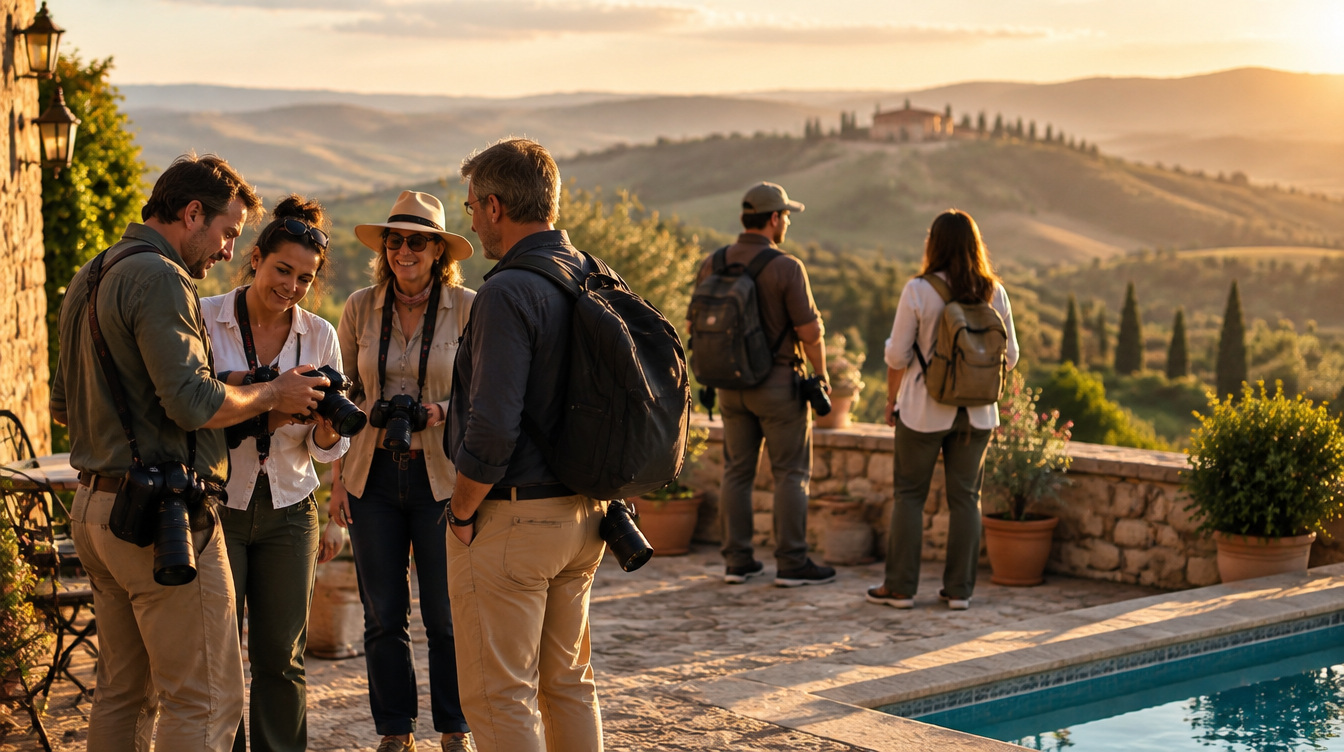
On our own Val d'Orcia trips, which run at a maximum of seven participants with two professional photographer guides per departure, the split is almost never all-advanced or all-beginner. A typical week has one or two people who shoot manual without thinking about it, three or four solid enthusiasts who know their camera but want to get better at reading light and composing a frame, and one or two true beginners who are there mostly because they love Tuscany and want to come home with photographs they are actually proud of, not because they consider themselves photographers yet. Every one of those people gets a good week, and it is not despite the mix, it is because the mix is normal and the guiding is built to handle it.
Pro Tip: If you are nervous about your skill level, say so when you book, not on the first morning. A guide who knows in advance that you want extra time on settings can plan the first sunrise around teaching, rather than trying to fit a lesson into a schedule built for people who already know their camera cold.
Where this hesitation actually comes from
I think this worry comes from a very reasonable place. Most of the photography content people consume online, including a lot of what we publish ourselves, is written by and for people who already know what an f-stop is. Photography Instagram is full of gear talk and technical breakdowns. Photography YouTube skews toward tutorials that assume you already understand exposure triangle basics. If that is your only exposure to what "photography people" are like, it is easy to assume a photography tour is going to be a week of being quietly judged by six strangers who all own more expensive lenses than you.
In practice, the opposite tends to be true. People who have been shooting for decades are usually the most relaxed and the least judgmental people on a trip like this, partly because they remember not knowing anything either, and partly because they are there to enjoy Tuscany and make pictures, not to run a competition. The person actually worried about being judged is almost always the beginner worrying about a judgment that, in my experience, essentially never happens. If anything, advanced shooters on our trips are often the ones who end up helping a beginner in the group with a composition tip over dinner, because they like talking about photography and a fresh set of eyes asking genuine questions is fun for them too.
What "serious" even means, and why it is the wrong question
Here is the thing that took me a while to figure out after guiding a lot of these trips: "serious photographer" is not really a skill level, it is a mindset. I have had guests who shot in Auto for their entire first day and were completely serious about wanting to learn and improve, asking sharp questions about why a shot worked and genuinely absorbing the answer. I have also had guests who owned every piece of gear imaginable and treated the whole week like a box to check off, barely looking up from the back of their camera to actually watch the light change. Given the choice between guiding those two people, I will take the curious beginner every time.
The better question to ask yourself is not "am I a serious photographer," it is "do I actually want to be here and learn something." If the answer is yes, your current skill level is close to irrelevant. The itinerary does not care whether you know what a circular polarizer does before you arrive. It cares whether you show up for the 5:45am departure and are willing to try something a guide suggests, even if it feels a little awkward the first time you do it.
How the itinerary actually adapts to every skill level
The locations, the timing, and the light do not change based on who is in the group. Everyone gets driven to the same hilltop for the same sunrise over the cypress-lined roads near San Quirico d'Orcia. What changes is how much coaching happens on the way there and while you are standing at the edge of the field waiting for the light. Here is roughly how that breaks down by experience level on a typical departure.
| Skill level | What changes for you | What stays exactly the same |
|---|---|---|
| Complete beginner, mostly shoots Auto | A guide walks you through aperture priority or manual mode on location, in plain language, tied to the actual scene in front of you rather than an abstract lesson | Where you go, when you go, and how much time you get at each location |
| Enthusiast, knows the basics | Coaching shifts toward composition, filter use, and reading changing light, rather than what the dials do | Same access, same hilltop viewpoints, same golden hour window |
| Advanced, shoots manual without thinking | Guides spend less time on your camera and more time flagging secondary compositions, alternate angles, or a five minute walk to a spot most visitors never find | Group meals, transport, and the overall week's structure |
| Non-photographer partner | A lighter, more flexible schedule that skips the pre-dawn departures if you want, joining for meals, the villa, and the wine tasting instead | Full access to the same villa, food, and trip experience as everyone else |
The image reviews built into the week work the same way. After dinner most evenings, guests can pull up a handful of shots from the day and get feedback, and that feedback looks completely different depending on who is asking. For a beginner it might be "your exposure is a full stop underexposed here, let's look at why," for an advanced shooter it might be a conversation about whether a slightly different crop strengthens the composition, or whether a graduated ND filter would have held more detail in that specific sky. Same review slot, same guide, completely different conversation, because it is built around the person, not a fixed curriculum.
What beginners actually get from having two guides
Running two professional photographer guides per departure instead of one is, honestly, the single biggest reason this works for mixed groups at all. With one guide and seven guests, a beginner who needs five minutes of help setting a custom white balance is competing for that guide's attention with someone who wants help finding a foreground element for a wide shot. Something gets shortchanged, and it is usually the beginner, because it is easier for a guide to give a thirty second answer than to actually teach in the moment.
With two guides, that tradeoff mostly disappears. One guide can stay with the two or three people who want more hands-on camera coaching, going through the actual mechanics of exposure compensation or manual focus on a cypress tree against a bright sky, while the second guide works the rest of the group on composition and light at the same location, at the same time. Nobody is standing around waiting for a turn, and nobody who wants deep technical coaching has to feel like they are holding the group hostage to get it. That structure is also why the post-processing masterclasses built into the week work, since a guide can sit with a beginner on basic Lightroom adjustments while the other runs a more advanced session on frequency separation or advanced masking for someone who is ready for it.
What advanced shooters get that shooting solo does not
I do not want to make this sound like a beginner-only pitch, because plenty of genuinely advanced photographers join our trips too, and the value proposition for them is different but just as real. It is almost never about learning camera settings. It is about local knowledge that would otherwise take multiple solo trips to build: knowing which farm road produces the cleanest layering of hills at sunrise without another tour van in frame, knowing that the fog over a specific valley near Pienza only forms under a fairly narrow set of overnight conditions, knowing which two weeks of a given month the light through a specific row of cypress trees actually lines up the way it does in the photograph that made you want to visit Tuscany in the first place.
That is knowledge built from guiding the same landscape across dozens of departures and seasons, and it saves an advanced shooter the wasted mornings that come with scouting blind. An advanced photographer traveling solo might spend their first two or three mornings figuring out where to be. On a guided trip, that scouting has already been done, which means every sunrise from day one is spent actually making pictures instead of finding your feet.
If you have been debating whether the guided structure is worth it for a photographer who already knows their gear, our own honest breakdown of what you are actually paying for on a guided trip covers that comparison in more depth, including where it genuinely does not make sense.

If any of this sounds like the thing that has been holding you back from actually booking, this is your sign to stop overthinking it. Our seven day Val d'Orcia photography tour is built exactly around this kind of mixed group, with a maximum of seven guests and two guides working the split I just described, across the villages, cypress roads, and fog windows that make this part of Tuscany one of the most photographed landscapes in Europe. You can see current departure dates and pricing on the Val d'Orcia photography tour page, and if you are still weighing group size against a private option, it is worth reading how group size actually changes what you come home with before you decide.
The gear question: what you actually need to bring
This is the other half of the "am I serious enough" worry, and it deserves a real answer instead of a vague "just bring what you have." You do not need professional gear to get real value out of a guided trip, but it helps to understand what actually matters so you are not carrying dead weight in your bag or missing something genuinely useful.
A camera with some form of manual or semi-manual control is worth having, meaning aperture priority (usually marked A or Av) and manual (M) modes, because most of what a guide teaches on location assumes you can control at least aperture and, ideally, shutter speed independently. That said, if you only shoot in Auto right now, that is exactly the kind of thing a beginner-focused guide will walk you through on day one, using your own camera rather than a generic tutorial. For lenses, a single mid-range zoom, something in the 24-70mm range on a full frame body or the equivalent crop-sensor focal length, covers the majority of Val d'Orcia's wide rolling-hill compositions and the tighter shots of village streets and doorways. A longer lens, 70-200mm or similar, earns its weight for compressing layers of hills at sunrise and isolating a single cypress tree or farmhouse against a soft background, and it is genuinely one of the most useful pieces of glass for this specific landscape.
A tripod matters more than people expect, not just for the obvious low-light and long-exposure shots but for slowing you down enough to actually think about a composition instead of firing off frames handheld. A circular polarizer helps cut haze and deepen the sky on clear days, which is common outside the winter months, and it is a cheap, light piece of gear that makes a bigger difference to a landscape shot than almost anything else you can buy. Graduated ND filters are useful but optional, mostly for holding detail in a bright sky over darker foreground hills at sunrise, and a guide can show you how to use one properly if you bring it without having ever used it before. None of this requires the newest camera body on the market. Some of the strongest images to come out of our groups have been shot on five or six year old entry-level bodies, because the light and the location matter far more than the sensor generation.
Pro Tip: Shoot in RAW rather than JPEG if your camera supports it, even if you have never edited a RAW file before. It gives you far more room to recover shadow and highlight detail during the post-processing masterclasses built into the trip, and a guide can walk you through opening and adjusting your first RAW file in about ten minutes.
A real morning: how the group actually splits by skill
It might help to walk through what an actual sunrise looks like rather than describing it abstractly. The van leaves the villa around 5:45am for a hilltop viewpoint outside San Quirico d'Orcia, everyone still half asleep with coffee in hand. On arrival, the group spreads out along maybe eighty meters of farm road, which is intentional, since it gives everyone their own angle on the same cypress-lined road below without anyone standing in someone else's frame.
One guide will usually stay near the two guests who want the most hands-on help, working through composition basics like where the horizon sits in the frame or how to use the road itself as a leading line, and helping set exposure manually as the light shifts quickly in the ten or fifteen minutes around actual sunrise. The second guide moves along the rest of the group, checking in briefly with the enthusiasts about their settings, then spending more time with the advanced shooters pointing out a slightly different vantage point twenty meters down the road where the layering of hills reads better, or flagging that the fog sitting in the valley below is starting to lift and there are maybe six good minutes left before the shot changes completely. Everyone is photographing the same sunrise. Nobody feels rushed, and nobody feels babysat. That is the whole model, repeated at a different location most mornings and afternoons of the week.
Frequently asked questions
Will I slow the group down if I am a beginner? No. Locations and timing are fixed regardless of who is in the group, and with two guides, coaching happens in parallel rather than making everyone wait for one person to catch up.
What if I only shoot in Auto right now? That is a completely normal starting point, and moving you off Auto and into aperture priority or manual is a standard part of the coaching a beginner-friendly guide builds into the first day or two of the trip.
Do advanced photographers get bored on a trip built for mixed skill levels? Generally no, because the actual draw for advanced shooters is local knowledge and access, not step by step instruction, and that value is there regardless of who else is in the group.
Can my non-photographer partner still come? Yes. Non-photographer partners are welcome at a different rate, and the schedule is flexible enough to skip a pre-dawn shoot in favor of sleeping in and joining for breakfast, the villa pool, or the Tassi winery tasting instead.
Do I need to know how to use Lightroom or similar editing software? No. Post-processing masterclasses are built into the itinerary and start from the basics for anyone who has never opened an editing program before.
So, do you need to be "serious"?
No, and I would push back gently on the word itself. You need to be curious, willing to show up early, and open to trying something a guide suggests even when it feels unfamiliar. That describes plenty of people who have never called themselves photographers and would never think to. The actual photographers in most of our groups, the ones who leave with genuinely strong images regardless of where they started the week, are the ones who treated the trip as something to learn from rather than something to perform for. Bring that attitude and the rest, gear included, works itself out.