Small Group vs Large Group Photo Tours: Why Group Size Changes Everything
What actually changes between a 7-person photography tour and a 20-person one: shooting position access, one-on-one guide time, van logistics, and the photographs you actually come home with.
Small Group vs Large Group Photo Tours: Why Group Size Changes Everything
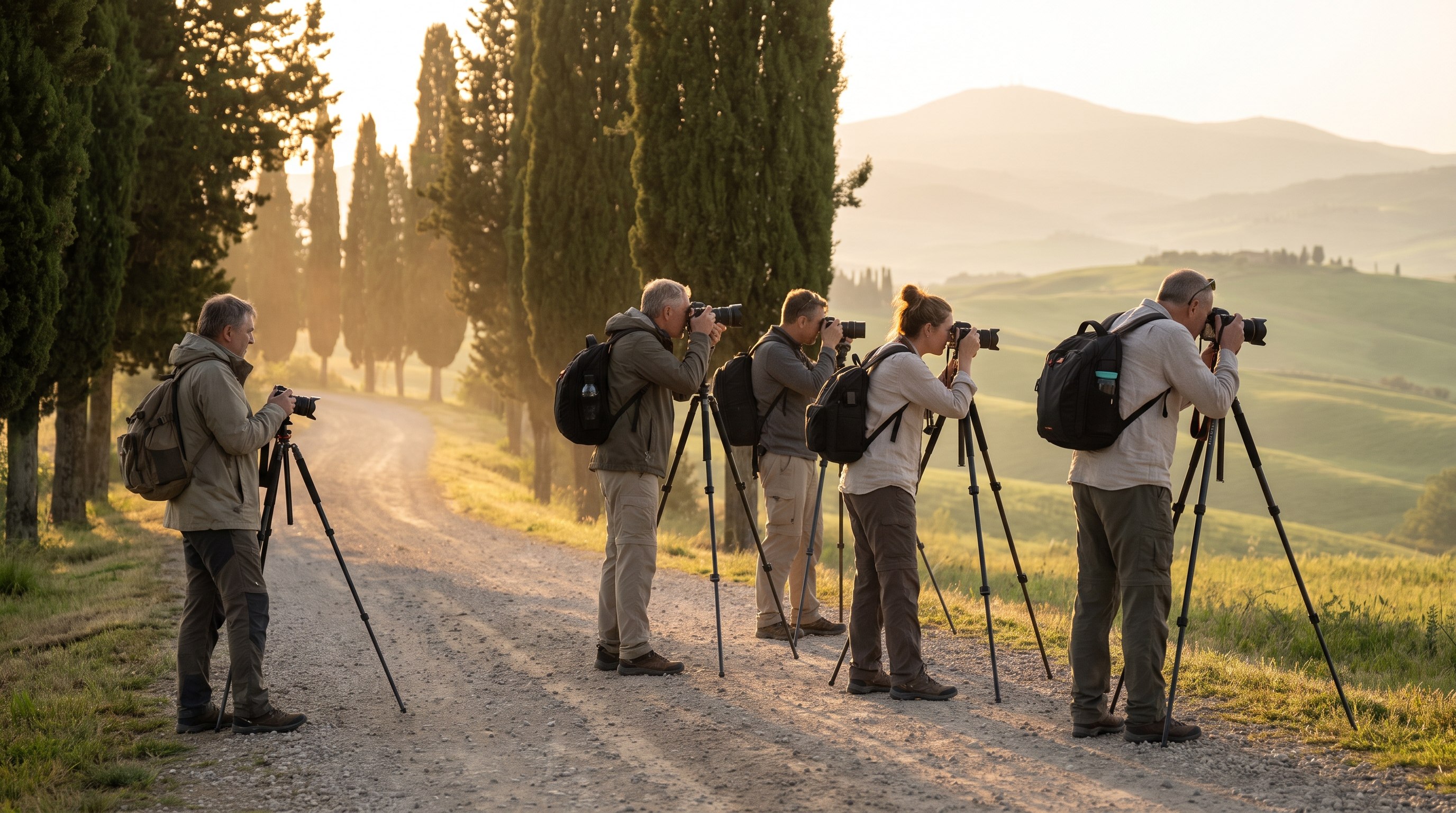
I have guided departures with seven people and I have tagged along as a second shooter on tours pushing twenty or more, and I want to be honest about something up front: the destination barely matters compared to the group size when it comes to what you actually walk away with. Two groups can visit the exact same cypress-lined ridge outside San Quirico at the exact same sunrise and come home with completely different photographs, not because one group is more talented, but because one group had room to work and the other didn't.
This is not an abstract preference. It shows up in specific, countable ways: how many minutes of actual one-on-one guidance you get during the twenty-minute window when the light is doing something worth photographing, whether you can plant a tripod where you want it or have to shoot from wherever there's a gap, and how quickly a guide can scrap the plan and move the whole group somewhere else when the fog burns off faster than expected. None of that is marketing language. It's just what happens when you add more bodies to a fixed amount of good light and a fixed amount of physical space.
I run small group tours for a living, so take that into account as you read this. But I'm not going to pretend a bigger group is some scam or that there's no place for it. There genuinely is a size where a photo tour stops functioning like a photo tour and starts functioning like a bus trip with cameras along for the ride, and I want to walk through exactly where that line tends to fall and why, with real numbers rather than vague reassurance.
Key Takeaways
Group size is not a soft preference, it is a hard constraint on how much shooting access, guidance time, and flexibility any single traveler actually gets.
| Point | Details |
|---|---|
| The real bottleneck | Golden hour lasts 20 to 40 minutes of genuinely usable light, and that window does not get longer because more people showed up |
| Guide time per person | A 7-guest, 2-guide tour gives roughly 3.5 travelers per guide; a 20-guest, 1-guide tour gives 20 per guide, an almost sixfold drop in attention |
| Physical space is finite | Most iconic Val d'Orcia viewpoints (a single farm gate, a narrow ridge, a thermal water square) genuinely fit only 4 to 8 tripods without people shooting over each other's shoulders |
| Decision speed matters | Small groups can abandon a fogged-in plan and relocate in minutes; a 30-person group with two buses cannot pivot nearly as fast |
| Bigger is not always wrong | Lecture-style workshops, classroom sessions, and wide open locations tolerate larger groups just fine, since the constraint there isn't physical space |
Table of Contents
- The quick answer
- What actually changes as a group gets bigger
- Shooting position access: the real cost of crowding
- How much one-on-one guide time you actually get
- Van logistics and the hidden time tax
- The pace and energy of a small group
- When a bigger group actually works just fine
- Group size at a glance
- Frequently asked questions about tour group size
- So what group size is right for you
The quick answer
Somewhere between 6 and 8 guests with 2 guides is the size where a photography tour still functions as a photography tour rather than a scenic bus trip. Above roughly 12 to 15 people per guide, you start losing meaningful one-on-one instruction, you start competing for the best tripod positions at the locations that only fit a handful of people comfortably, and the group's ability to change plans on short notice, which matters enormously when you're chasing fog or a break in the clouds, drops off fast. None of this means a larger tour can't be fun or worthwhile. It means the product you're buying quietly shifts from "guided photography instruction" to "guided sightseeing where you happen to bring a camera," and it's worth knowing which one you're signing up for before you pay a deposit.
Pro Tip: When you're comparing tour listings, don't just look at the headline group size. Divide it by the number of guides. A "maximum 16 guests" tour with one guide is a very different experience than a "maximum 16 guests" tour with three, even though the marketing copy sounds identical at a glance.
What actually changes as a group gets bigger
It helps to separate this into things that scale badly and things that scale just fine. Transportation between towns, for example, scales reasonably well. A bigger coach costs proportionally about the same per seat as a smaller van, and driving from Pienza to Bagno Vignoni takes the same twenty-some minutes whether there are seven people in the vehicle or twenty-five. Group meals scale fine too. A long table at an agriturismo can comfortably seat a dozen or more people, and a shared Tuscan dinner is arguably better with more voices around the table, not worse.
What does not scale is anything tied to a single, physically limited shooting location at a specific moment of light. That's the part of a photography tour that is genuinely different from a general sightseeing tour, and it's exactly the part that gets squeezed as headcount rises. A viewpoint over the Val d'Orcia hills near Monticchiello might comfortably fit six or seven photographers spread along a fifteen-meter stretch of farm track before people start setting up directly behind each other's tripods, at which point half the group is photographing the backs of the other half's jackets instead of the hills.
Guiding itself is the other thing that does not scale. Teaching someone to balance a two-stop graduated ND filter against a rising sun, or talking them through why a 24mm frame reads better than the 70mm they instinctively reached for on a rolling-hills composition, takes real minutes of a real person's attention. A guide can do that for two or three people during a twenty-minute golden hour window. They cannot meaningfully do it for eighteen.
Shooting position access: the real cost of crowding
Some of Val d'Orcia's best known compositions are, physically, quite small. The famous cypress-lined farm road near San Quirico has maybe three or four spots along its length where the road curves just right to get the trees layering correctly in a wide frame, and each of those spots realistically fits one, maybe two tripods before a third photographer is either shooting from an awkward angle or standing in someone else's frame. Bagno Vignoni's thermal water square is even more constrained: the reflection shots that make that location worth the detour depend on a handful of specific vantage points along the stone edge, and there simply is not room for fifteen people to line up shoulder to shoulder without half of them getting someone else's silhouette in their reflection shot.
This is where group size stops being about comfort and starts being about the actual photograph. If you are third in line for a spot that only fits two tripods, you are not getting your first-choice composition at first light. You're getting whatever is left once the first two people have set up, which might mean a slightly worse angle, a slightly later slice of the light, or a compromise focal length because your preferred position is occupied. None of that ruins a trip, but it is a real, measurable cost that scales directly with how many people are trying to use the same six square meters of farm track at 6:20am.
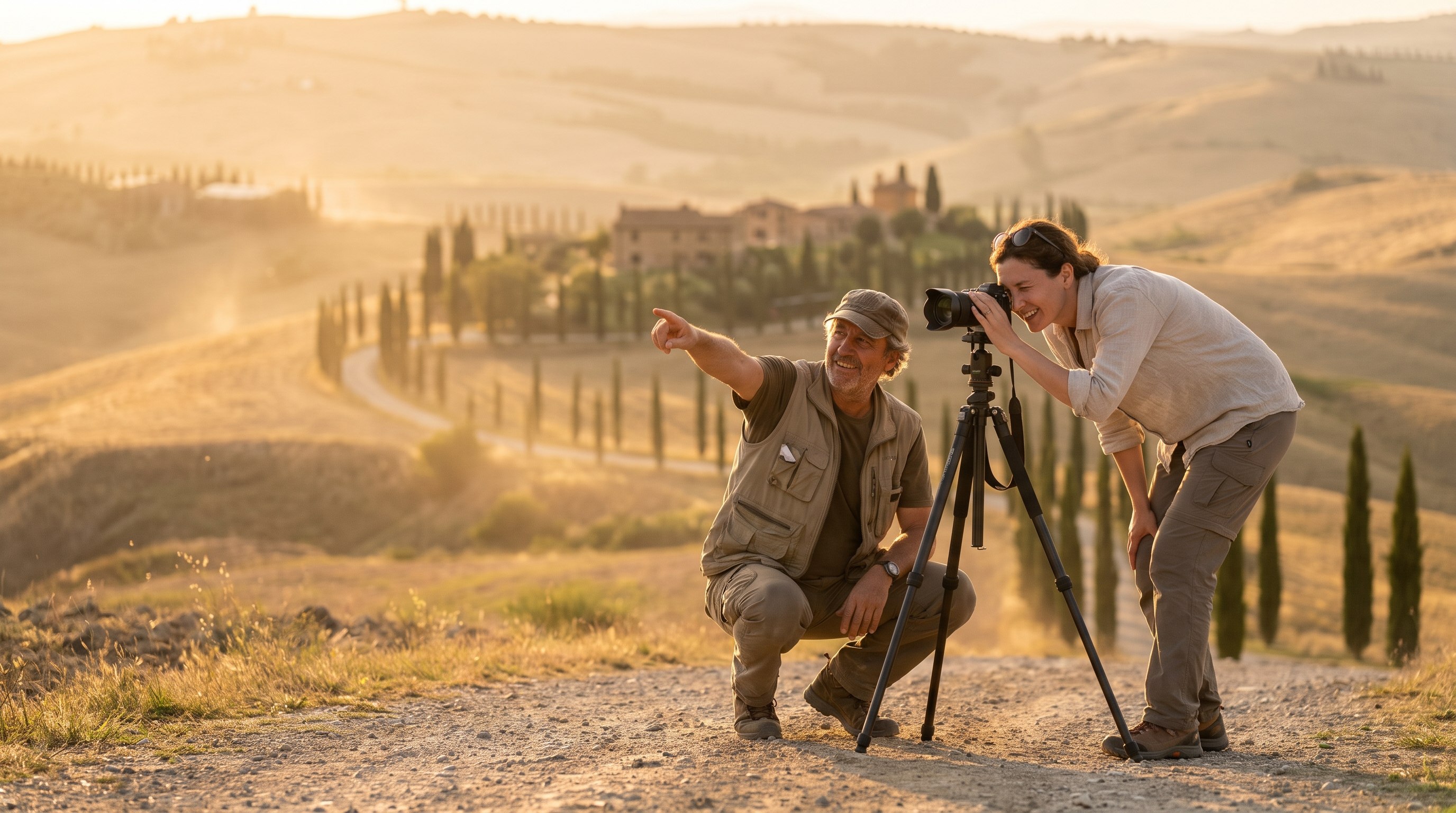
Smaller groups sidestep this almost entirely. With seven people and two guides, everyone gets a real shot at the two or three best positions across the course of a departure, because the guides know the locations well enough to rotate people through them and stagger arrival times by a few minutes so nobody is fighting for the same six feet of farm road at the same second.
There's a gear workaround worth mentioning here, since it's the kind of thing a good guide will suggest on the spot when a prime position is already taken. If the classic wide angle vantage point at 16mm to 24mm is occupied, stepping back thirty or forty meters and switching to a 70-200mm lets you compress the same rolling hills into a completely different, often equally strong composition, layering the cypress rows and farmhouses into a flatter, more graphic frame instead of the expansive wide shot everyone else is fighting over. It's not a consolation prize so much as a genuinely different photograph, but it only works if someone with experience is standing next to you pointing it out in the ninety seconds before the light shifts, which circles right back to how much one-on-one attention a guide actually has to give.
How much one-on-one guide time you actually get
Run the math on this one, because it is more dramatic than it sounds. A 7-guest tour with 2 guides works out to a ratio of about 3.5 travelers per guide. A 20-guest tour with a single guide, which is a genuinely common structure in this industry, works out to a ratio of 20 to 1, nearly six times worse. During a single golden hour session, a guide realistically has time to give focused, in-the-field feedback to maybe six or seven people if they're moving efficiently between tripods. At a 3.5-to-1 ratio, that means most guests get looked in on at least once, sometimes twice, during that window. At a 20-to-1 ratio, most guests get looked in on not at all on a given morning, simply because the math does not allow it.
That feedback is not a nice-to-have extra. It's the difference between someone shooting an entire trip at f/8 because that's the aperture their camera defaulted to on day one, versus someone who gets pulled aside on the second morning and shown why f/11 with a two-second shutter on a stable tripod actually resolves the layered hills better in hazy conditions. It's the difference between metering off the sky and blowing out the highlights for a week, versus someone catching that mistake on the first sunrise and fixing it for the other six. Multiply a handful of small corrections like that across seven mornings, and the gap in keeper rate between a well-guided small group and an under-guided large one becomes obvious the moment you compare the two sets of photos side by side back home.
Van logistics and the hidden time tax
Nobody puts "loading a vehicle" in the marketing copy for a photography tour, but it eats a surprising amount of the clock, and it scales badly with headcount. A single van carrying seven people and their tripod bags can load up and be rolling toward a pre-dawn location in under ten minutes. Scale that to two buses carrying thirty people, and you're realistically looking at twenty to thirty minutes of loading, headcounts, and coordinating two separate convoys before anyone moves, which is a genuinely painful amount of time to lose when you're racing a fog window that might only last ninety minutes total.
It gets worse when something changes at the last minute, which in landscape photography is constant. If a guide checks the forecast at 5:15am and decides the fog is going to be better twenty minutes down the road than at the planned location, redirecting a single van is a two-minute conversation with one driver. Redirecting two buses, each potentially with a different driver who doesn't have the same relationship with the guide, turns into a logistical negotiation that can easily burn the exact window you were trying to catch.
The pace and energy of a small group
There's a social dimension to this too that's easy to underrate until you've experienced both sides of it. On a seven-person tour, everyone tends to know everyone's name by day two, shooting styles and preferences become visible fast, and a guide can genuinely tailor the itinerary in real time, extending a session because the light is holding, or cutting one short because half the group is more interested in getting back for the wine tasting. That kind of responsiveness requires the guide to actually know what the group wants, which is only possible at a size where a guide can hold everyone's preferences in their head.
Larger groups don't lose this entirely, but the itinerary necessarily becomes more fixed and more schedule-driven, because coordinating twenty-five individual preferences in real time isn't realistic. That's not a criticism, it's just a structural consequence of scale, and it's worth knowing which experience you actually want going in. Some travelers genuinely prefer the more structured, less improvisational pace of a bigger tour. Most serious photographers, in my experience, prefer the version where the plan can bend around the light.
If flexibility around the light and real one-on-one feedback are what you're actually after, that's the exact model our Val d'Orcia photography tour is built around: a hard cap of 7 participants with 2 professional photographer guides for the full week, so the itinerary can genuinely bend around a fog forecast or a break in the clouds instead of running on rails. It's worth comparing that structure directly against whatever else you're considering, group size and guide ratio included, before you book anything.
When a bigger group actually works just fine
I don't want to overstate the case here, because there are real situations where a bigger group works perfectly well. Classroom-style sessions, like an evening lecture on post-processing workflow or a group critique of the day's images projected on a screen, scale fine up to quite large numbers, since the constraint isn't physical shooting space, it's just seats and a screen everyone can see. A wide open location like a broad hillside with room for thirty tripods spread across a hundred meters also tolerates a bigger group far better than a tight farm road or a small stone square.
Group meals, as mentioned earlier, are if anything better with more people. And for travelers whose main goal is a general Italy trip with photography as one part of a broader itinerary rather than the central focus, a larger, more structured tour with a lower per-person price can be a perfectly sensible choice. The mismatch only shows up when someone books a large-group tour expecting the individual guiding and shooting access of a small one, and that expectation gap is really what this whole comparison comes down to.
Group size at a glance
| Group size | Typical guide ratio | Golden hour position access | In-field feedback | Ability to change plans fast |
|---|---|---|---|---|
| 6 to 8 guests | About 3 to 4 per guide | Most guests get a top-choice position most mornings | Real, repeated one-on-one coaching | High, one van, one conversation |
| 12 to 16 guests | About 6 to 8 per guide | Rotation needed, some compromise positions | Occasional, brief feedback | Moderate, more coordination needed |
| 20 to 30 guests | Often 15 to 30 per guide | Significant competition for the best spots | Rare, mostly group-level instruction | Low, multiple vehicles and drivers |
Frequently asked questions about tour group size
Is a smaller group always more expensive? Usually, yes, and it's a direct cost driver rather than a pricing gimmick. More guides per traveler and more logistical flexibility cost more to run, which is why a 7-guest, 2-guide tour typically runs higher per person than a 20-guest, 1-guide version of a similar itinerary.
What's the ideal group size for a photography tour? Most experienced guides land somewhere between 6 and 8 guests per guide as the sweet spot: small enough that everyone gets real feedback and shooting access, large enough that the group still has some social energy and the per-person cost stays reasonable.
Do bigger groups see fewer locations? Not necessarily fewer, but often less time at each one, since a larger group takes longer to load, unload, and settle in at every stop, which eats into actual shooting time across the day.
Can a small group still visit the same iconic spots as everyone else? Yes, and often with better access, since a small group can slip into a tight vantage point at a quiet moment that a large group would need to time around or split into shifts to use.
What if I actually enjoy the energy of a bigger group? That's a legitimate preference, not a mistake. If the social atmosphere of a larger crowd matters more to you than individual shooting access and coaching, a bigger tour can genuinely be the better fit, as long as you're choosing it with clear eyes about the tradeoff rather than assuming you'll get both.
Does group size affect drone photography too? Yes, more than people expect. Most locations that allow recreational drone flights only clear a single operator to fly at a time for safety, so a larger group means a longer queue and a shorter window per person before the group needs to move on, while a small group can usually fit two or three flights into the same morning session.
So what group size is right for you
If you're the kind of photographer who wants to come home with images you couldn't have gotten on your own, because a guide put you in the right spot at the right minute and corrected your settings before the light disappeared, group size is not a minor detail to skim past on a tour listing. It's arguably the single most important spec, more important than the exact itinerary or even the destination. A tight guide ratio, something in the range of three to four guests per guide, is what actually delivers on the promise of a guided photography trip. Anything looser than that starts trading real instruction and shooting access for a lower headline price, which is a legitimate choice for some travelers but a very different product than what most people picture when they book a "photography tour."
If you want to see how this plays out in practice, our breakdown of what a Tuscany photography tour actually costs walks through exactly why a low guide-to-guest ratio shows up directly in the price, and our honest look at whether a guided photography tour is worth the money covers the broader value question this article has been circling around from a different angle.