Is a Photography Tour Worth the Money? An Honest Look
What you are actually paying for on a guided photography tour, weighed honestly against what you give up, so you can decide if it fits how you like to travel and shoot.
Is a Photography Tour Worth the Money? An Honest Look
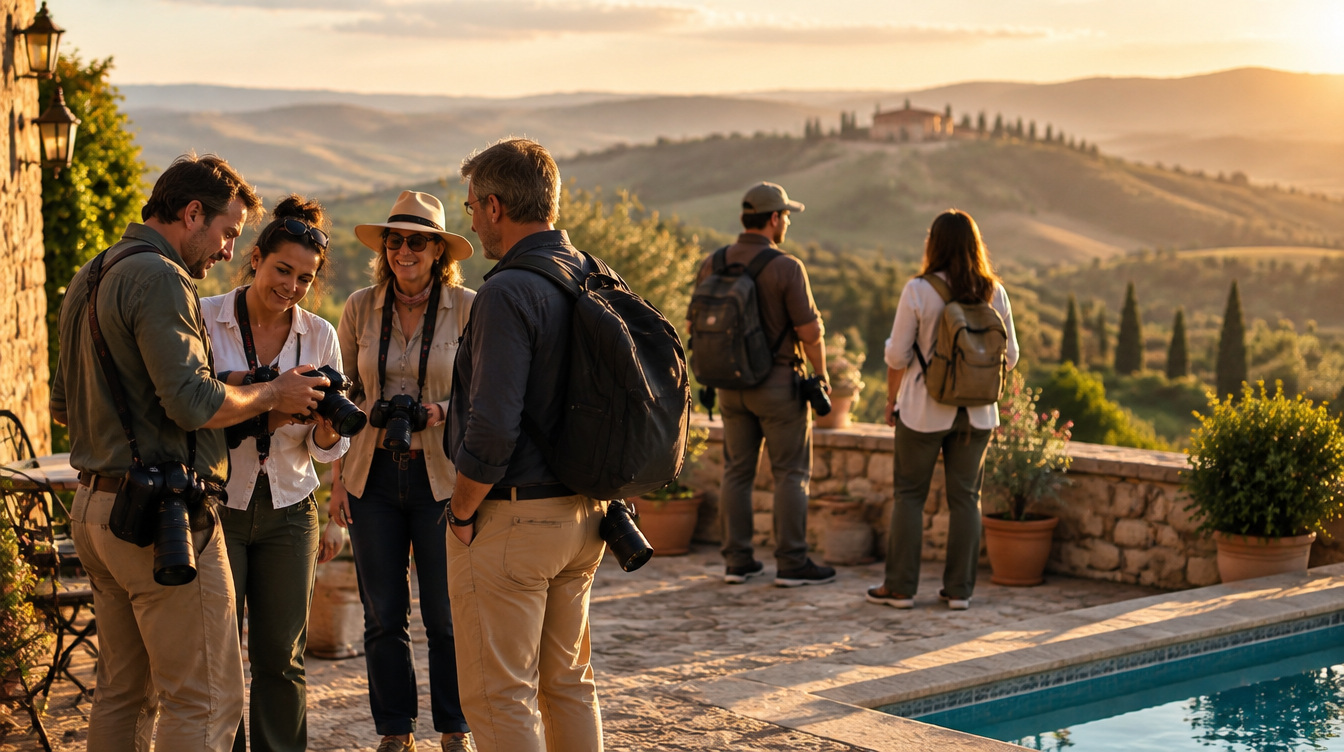
I get some version of this question in my inbox almost every week: "is it actually worth paying a few thousand dollars to have someone guide me around, or should I just go take the pictures myself?" It is a completely fair question, and I want to answer it honestly rather than give you the sales pitch you would expect from someone who runs photography tours for a living. There are real situations where a guided tour is clearly the better call, real situations where it is not, and a lot of middle ground where the answer depends entirely on what you actually want out of the trip.
I have taken the DIY route myself, more than once, long before WeShoot existed. I have also watched hundreds of guests go through a guided week and come home with a body of work they are genuinely proud of, sometimes for reasons that have nothing to do with the itinerary and everything to do with having someone standing next to them at 6am saying "try two stops lower on that ND filter." So let's actually dig into what you are paying for, what you are giving up, and who each option genuinely suits, instead of pretending there is one right answer for everyone reading this.
Key Takeaways
A photography tour is worth the money for a specific kind of traveler, and a bad fit for another kind. The value is real, but it is not universal.
| Point | Details |
|---|---|
| What you are really buying | Local light and location knowledge, real-time feedback on your images, and zero wasted mornings in the wrong spot |
| What you are giving up | Full control over your schedule, the freedom to linger or skip a location, and total spontaneity |
| Where it pays off most | First-time visitors, photographers who plateau shooting alone, and anyone who has ever driven home from a trip wondering if they missed the good light |
| Where it pays off least | Experienced photographers who already know the region, or travelers who genuinely prefer solo planning over guided structure |
| The honest price comparison | A comparable DIY week often lands within a few hundred dollars of the guided price once real guiding time is priced in, so the decision is rarely about raw cost alone |
Table of Contents
- The short answer
- What a guide actually buys you
- The technical improvement case
- What you give up
- A morning that makes the case
- Where solo travel genuinely wins
- Guided vs solo, at a glance
- Who should not book a guided tour
- The money question, again
- Frequently asked questions
- So is it worth it
The short answer
Yes, if what you value is local knowledge of light and access, faster technical improvement through real-time feedback, and not spending your trip on logistics instead of shooting. No, if what you value most is total freedom to change plans on a whim, or if you are already deeply familiar with the region and do not need someone else's local knowledge. Most people fall somewhere in between, which is why "is it worth it" deserves a longer answer than a yes or no.
I already broke down the raw dollar math of what a Tuscany photography tour actually costs in a separate piece, line item by line item. This one is different. This is about value, not price, because I think that distinction gets lost too often in how these decisions get framed online.
Pro Tip: If you are on the fence, ask yourself one question honestly: on your last solo trip, how many mornings did you wake up unsure whether you were in the right spot for the light? If the answer is more than one, that is exactly the problem a guide is priced to solve.
What a guide actually buys you
The most valuable thing a guide sells you is not access to a camera bag full of gear or a curated list of pretty spots you could find on Google Maps eventually. It is time. Specifically, it is the time you would otherwise spend scouting, second-guessing, and occasionally getting it wrong, compressed down because someone already knows which field has fog at 6:40am in October, which terrace catches the last usable light after the sun drops behind the ridge, and which cypress-lined road is public access versus private farmland where you would be trespassing without realizing it.
That knowledge is not something you can buy from a guidebook, because guidebooks are written for the average tourist and photography is not about the average view, it is about the specific fifteen minutes of light that makes an ordinary hillside look extraordinary. A guide who shoots a region year round has a mental calendar of which weeks the poppies bloom, which valleys hold morning fog longest into the season, and which villages get genuinely crowded by 9am versus which stay quiet all day. On a solo trip you are reconstructing that calendar from blog posts and Instagram geotags, most of which are outdated or simply wrong about timing.
There is also a practical access dimension that people underestimate. Some of the best compositions in Val d'Orcia sit on private agricultural land, and the difference between a guide who has a relationship with the farmer and a solo traveler pulling onto a dirt track uninvited is the difference between a legitimate shot and an uncomfortable confrontation. I have watched guests get turned away from spots our groups shoot from routinely, simply because nobody had ever asked permission on their behalf.
The technical improvement case
Here is the part of the value proposition that gets talked about least, and I think it matters more than the scenery access argument for a lot of photographers: a good guide makes you technically better, faster, than shooting alone does. Not because they hand you a formula, but because they catch mistakes in the field, while you can still fix them, instead of after you get home and pixel-peep a shot that is almost right.
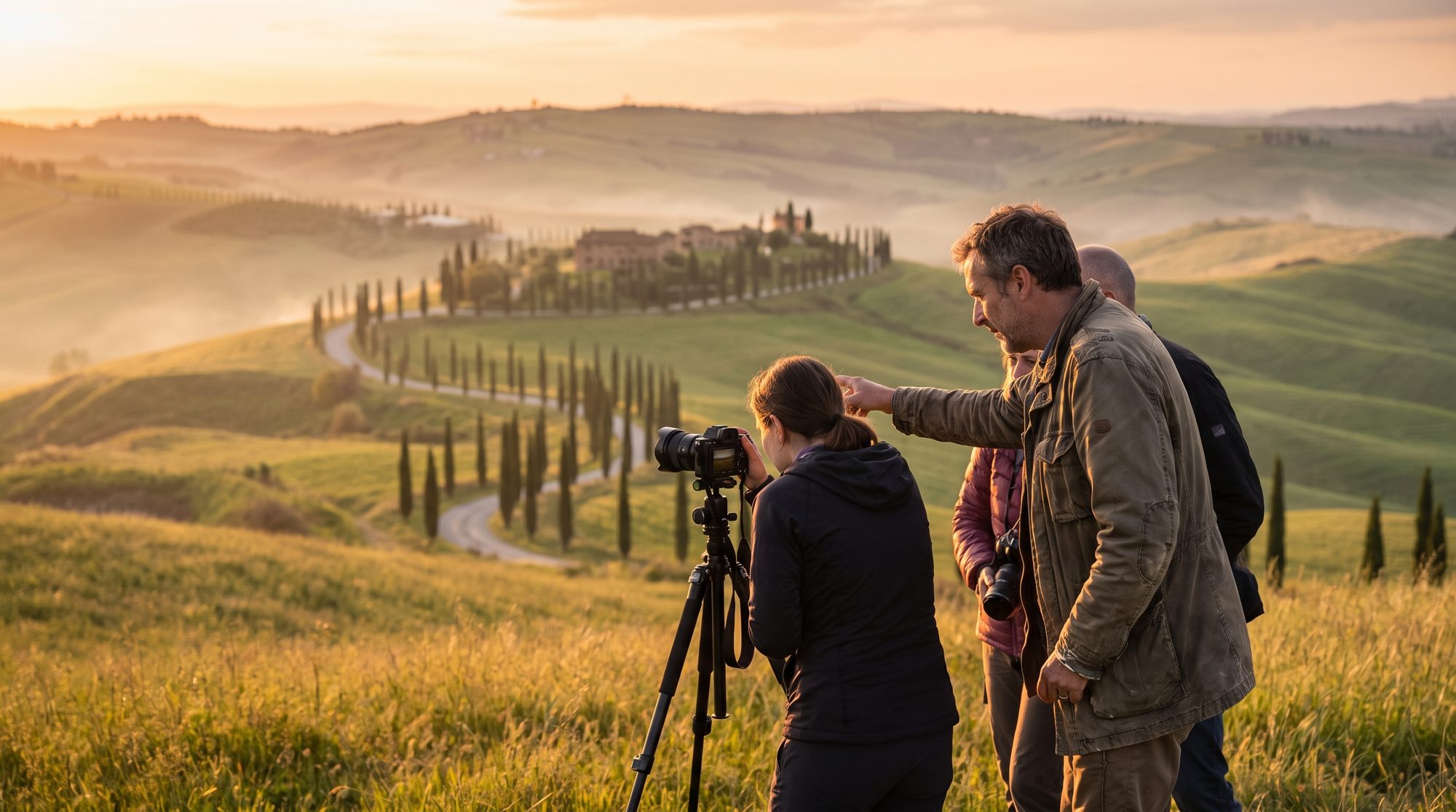
A concrete example. A guest is set up on a tripod at a cypress-lined road, camera on a 24-70mm at 45mm, aperture at f/8, metering off the bright sky and getting a foreground that reads two stops underexposed on the histogram. Alone, they take the shot, glance at the LCD, think it looks fine on a three-inch screen in direct sun, and move on. With a guide standing there, someone says "check your histogram, not your screen, and consider bracketing two frames a stop apart so you have a clean blend option later." That thirty-second correction, repeated across a week of golden hour shoots, adds up to a meaningfully higher keeper rate than the same photographer would get working entirely alone.
It compounds in the other direction too. Guides tend to push you toward decisions you would not have made instinctively: dropping from a 70mm compression shot to a 24mm wide angle because the wider glass actually sells the scale of the hills better, or switching from a circular polarizer to no filter at all once the sun gets low enough that the polarizer starts pulling unwanted color out of the sky. Those are small, specific calls that come from thousands of hours shooting the same light, and they are hard to absorb from a YouTube tutorial watched the night before a trip.
What you give up
None of this is one-sided, and I would be lying if I told you a guided tour has no real trade-offs. The most obvious one is schedule control. On a group tour, the itinerary is built around the light and the group as a whole, not around any single person's preference to spend three extra hours in one village or skip a location entirely because they are not feeling it that morning. If you are the kind of traveler who wants to wake up and decide the day as you go, a fixed structure, even a flexible one, will feel like a constraint.
There is also a genuine loss of spontaneity in the shooting itself. Part of the joy of solo travel photography is stumbling onto something nobody told you about: an odd shaft of light through a doorway, a market scene that has nothing to do with your planned itinerary, an hour spent chasing a single subject because you can. A group itinerary, by necessity, optimizes for the highest-probability shots at each stop rather than leaving room for that kind of wandering.
And then there is the group dynamic itself, which is a real variable even on a small tour. Seven participants and two guides is a low ratio, close to private guiding, but you are still sharing shooting positions, waiting your turn for individual feedback during the busiest golden hour windows, and traveling on someone else's clock for meals and transport. If you have a strong preference for shooting entirely alone with no one else in the frame or the conversation, that preference is worth taking seriously before you book.
A morning that makes the case
I want to describe one specific morning because I think it illustrates the value question better than any abstract argument. A group I was guiding a few seasons back arrived at a hilltop viewpoint near San Quirico about forty minutes before sunrise, expecting clear skies based on the forecast the night before. Instead we found a thick layer of ground fog sitting in the valley below, with the hilltop villages poking through it like islands. That is objectively the best possible outcome for that location, and it was not on the plan.
What happened next is the part that matters. Instead of everyone shooting the same wide establishing shot, we spent the next twenty minutes moving people to different vantage points based on their gear: a guest with a 70-200mm was repositioned to compress a distant hill town against the fog layer, someone with a 16-35mm was set up lower to get a strong foreground rock formation leading into the mist, and a third person was talked through switching their white balance from auto to a fixed daylight setting because the fog was reading blue-grey and flattening the warmth of the actual sunrise color. None of those three shots would have happened the same way if each person had been standing there alone, because none of it was planned, it was reactive, in-field decision-making based on what the morning actually gave us rather than what the itinerary said.
That is the honest version of what you are paying for. Not a guaranteed shot, because nobody controls the fog, but a guide who can react to changing conditions in real time and get seven different photographers to seven different, better versions of the same lucky morning. If a scene like that is what pulls you toward a guided trip, our Val d'Orcia photography tour runs exactly on that kind of flexible, light-driven itinerary rather than a fixed bus schedule, which is the only way mornings like that get turned into actual photographs instead of missed opportunities.
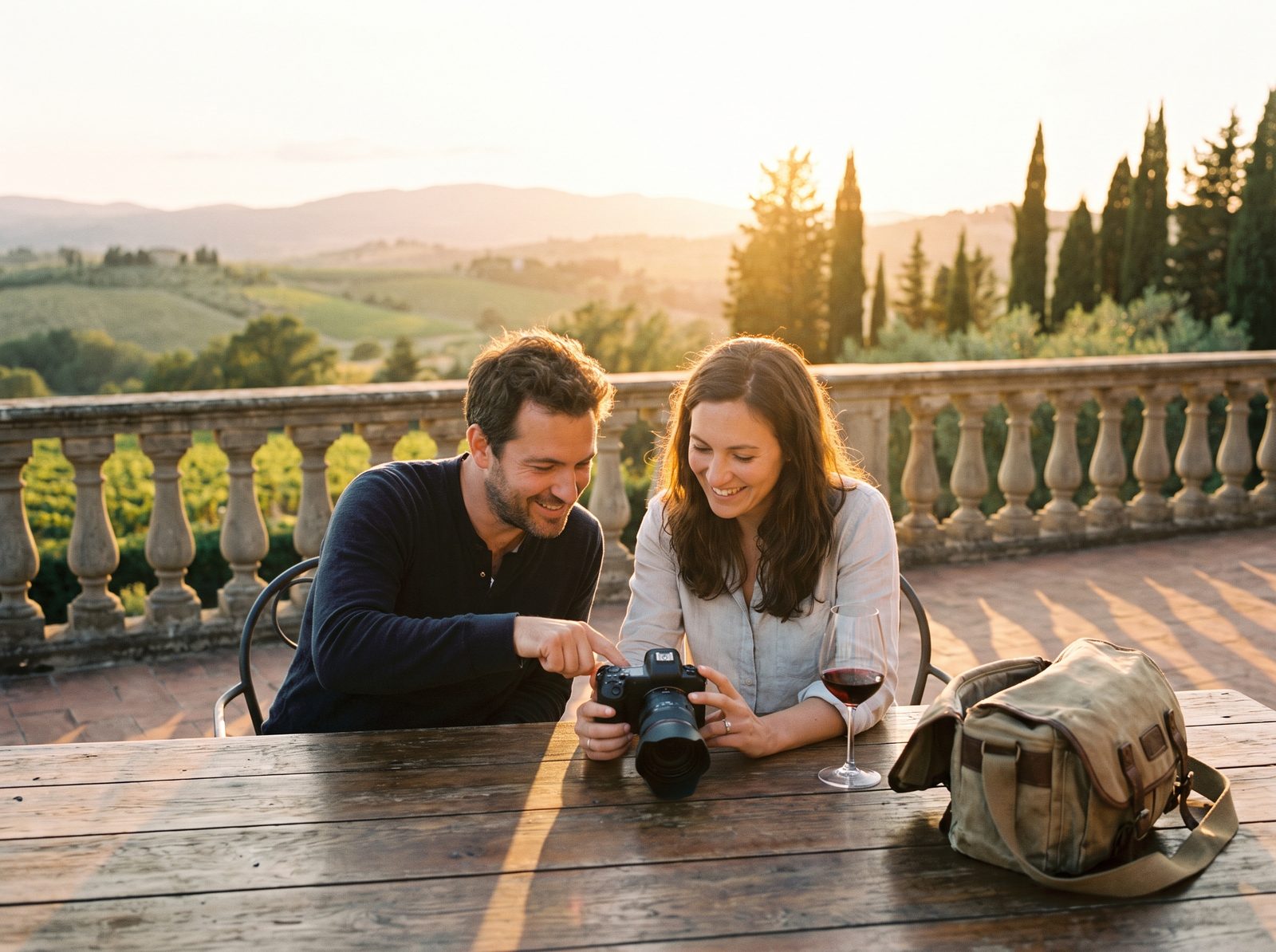
Pro Tip: If you do end up on a guided trip, ask for feedback on your worst shot of the day, not your best one. The best shot tells you what already worked. The worst one, reviewed with someone who knows the light and your gear, usually teaches you more in five minutes than an hour of shooting alone.
Where solo travel genuinely wins
I want to give equal weight to the other side, because a lot of "is it worth it" content is secretly written to talk you into a yes. If you have already spent real time in Tuscany, know the roads, and have your own working list of locations and timing, a guide is mostly paying you back knowledge you already have, and that math changes fast. Experienced photographers who prefer to work a single scene for hours, returning at different times of day to study how the light changes, will also find a group itinerary genuinely restrictive rather than helpful.
Budget matters too, honestly. If your primary constraint is cost rather than time or technical growth, and you are comfortable doing your own scouting and accepting a lower hit rate on the best light in exchange for total control over your schedule, a self-planned trip can absolutely deliver a satisfying set of images for less money. I compared this trade-off directly, cost side by side with itinerary side, in our piece on workshop versus self-guided travel in Tuscany, and the honest conclusion there is the same as here: it depends on what you are optimizing for, not which option is universally better.
There is also a category of photographer who does better working entirely solo for reasons that have nothing to do with skill level: people who shoot slowly and meditatively, who would rather spend two hours completely alone with one composition than move through five locations in a morning. If that describes how you actually enjoy working behind the camera, a group itinerary built around covering ground and catching specific light windows will fight against your natural pace no matter how good the guide is. Knowing that about yourself before you book is worth more than any cost comparison.
Guided vs solo, at a glance
| Factor | Guided tour | Solo trip |
|---|---|---|
| Local light and access knowledge | Built in, from guides who shoot the region year round | Self-researched, often outdated or incomplete |
| Real-time feedback on your images | Daily, in the field and during image reviews | None unless you seek it out afterward |
| Schedule flexibility | Limited, built around the group and the light | Total, change plans at will |
| Cost predictability | Fixed price, few surprises once booked | Variable, depends on how well you plan and price shop |
| Risk of missing peak conditions | Low, itinerary adapts to weather and light in real time | Higher, without local knowledge of timing |
| Spontaneity and wandering | Limited by the group itinerary | Unlimited |
| Best suited for | First-time visitors, photographers wanting faster growth | Experienced regional photographers, budget-first travelers |
Who should not book a guided tour
I would rather talk someone out of a bad fit than take a booking that leaves them disappointed. Skip a guided tour if you strongly prefer shooting completely alone with no conversation or company during golden hour, if you already know the region well enough that a guide's local knowledge would mostly be redundant, or if your priority for this specific trip is unstructured wandering rather than a maximized shot list. None of those are wrong ways to travel. They are just a different kind of trip than what a guided tour is built to deliver.
On the other hand, if you have ever come home from a photography trip with a memory card full of shots that are fine but not what you know you were capable of, and you suspect the gap was timing and positioning rather than technique, that gap is exactly what a guide is there to close.
The money question, again
It is worth repeating the honest version of the cost comparison one more time, because it changes how the "worth it" question should be framed. A guided week in Val d'Orcia runs $4,800 to $5,000 per person, and a comparable DIY week, once you add villa lodging, meals, a rental car, and even a few days of hiring a private local guide, often lands within a few hundred dollars of that number. That means the real decision is rarely "expensive tour versus cheap trip." It is closer to "pay roughly the same amount either way, and choose whether you want the guiding and instruction bundled in or not." Once the framing shifts that way, the answer tends to get a lot clearer for most people.
Frequently asked questions
Will a guide actually make me a better photographer, or just get me to prettier locations? Both, but the technical feedback matters more over time. Locations you can eventually find on your own with enough research. Real-time correction on exposure, composition, and gear choice in the actual field conditions is much harder to replicate without someone standing next to you.
Is it worth it if I am already an advanced photographer? It depends on whether you already know the specific region. An advanced photographer visiting Tuscany for the first time still benefits enormously from local timing and access knowledge. An advanced photographer who already knows Val d'Orcia intimately gets less marginal value from a guide and might prefer a self-guided return trip.
What if the group itinerary does not match what I want to shoot? A well-run small group tour builds in enough free time and flexibility that this is rarely an all-or-nothing conflict, but it is a fair question to ask any operator directly before booking, including how much say individual participants get over daily priorities.
Can I get some of this value without booking a full week-long tour? Some operators offer shorter guided days rather than a full itinerary, though the deeper value of a multi-day tour, an itinerary that adapts across the whole week rather than a single outing, is harder to replicate in a shorter format.
What camera gear do I need to actually benefit from a guided tour? You do not need a professional kit for the guiding to add value. A guide correcting your histogram reading or suggesting a different focal length helps just as much on an entry-level mirrorless body as it does on a full-frame flagship. The feedback is about decisions, not equipment, which is part of why the value holds up even for photographers who are still building out their gear bag.
So is it worth it
I think the honest answer is that a photography tour is worth the money for a specific, common kind of traveler: someone visiting a region for the first time, who wants to come home with a body of work they are proud of, and who would rather spend their vacation shooting than scouting. It is a worse fit for someone who already knows the region cold or who values total schedule freedom above almost everything else. Neither of those is a wrong way to travel, and I would rather you pick the one that actually matches how you like to work than book based on which article convinced you harder. If the value case above sounds like what you are looking for, our Val d'Orcia photography tour page has current departure dates and full details, and it is worth reading even if you end up deciding a self-guided trip is the better fit for you this time around.