What Camera Gear Do You Actually Need to Join a Photography Tour?
Gear anxiety keeps a lot of would-be travelers from booking. Here is the honest, specific breakdown of what's genuinely required for a photography tour and what's just nice to have.
What Camera Gear Do You Actually Need to Join a Photography Tour?
Almost every inquiry email I get before a Val d'Orcia departure has some version of the same nervous line buried in it. "I should mention, I'm shooting a five year old crop sensor camera, is that going to be a problem?" Or, "I only have one lens, will I be the odd one out?" Or my personal favorite, from a guest who booked anyway and turned out to be one of the sharpest shooters in the group: "I'm worried my gear isn't good enough to justify the trip." It never is a problem, and I want to spend this whole article proving that to you with specifics rather than just reassurance.
There is a real gap between what camera forums argue about and what actually matters on a seven day shoot through the Tuscan hills. Forums argue about sensor size, dynamic range charts, and whether you need the newest body on the market. Guides on the ground care about whether you can operate your camera in manual or aperture priority mode without fumbling for two minutes while the light changes, whether your tripod is sturdy enough to survive a breezy ridge at golden hour, and whether you brought a spare battery. That is basically the whole list. Everything else is optional, and most of it is a lot more optional than the gear industry wants you to believe.
Key Takeaways
The gear bar for joining a photography tour is lower than most people assume, and the money is better spent on a tripod and a spare battery than on a new camera body.
| Point | Details |
|---|---|
| Genuinely required | Any interchangeable lens camera (mirrorless or DSLR), one lens you know how to use, and a stable tripod |
| Not required | A full frame sensor, the newest camera body on the market, or more than one or two lenses |
| Most overlooked essential | A sturdy travel tripod, since low light golden hour and long exposure shots depend on it more than any lens does |
| Genuinely nice to have | A circular polarizer, a couple of spare batteries, and a lens you are comfortable shooting wide open |
| What guides actually notice | Whether you know your own camera's controls, not which brand or sensor size you brought |
| Common mistake | Buying a new body or lens right before a trip instead of practicing with the gear you already own |
Table of Contents
- The quick answer
- What's actually required: the bare minimum
- Do you need a full frame camera?
- The lens question: what you probably already own is enough
- The one piece of gear that is not optional: a tripod
- Filters and the other small extras worth packing
- Required vs nice to have, at a glance
- What our guides actually notice about your gear
- Frequently asked questions
- The bottom line
The quick answer
You need a camera where you can change lenses, one lens you already know how to use, and a tripod sturdy enough to hold still in a light breeze. That is the whole required list. Everything past that, a second lens, a polarizer, a graduated ND, a better tripod head, makes your kit more flexible but does not determine whether you can keep up with the group or come home with strong photographs. I have guided guests shooting a six year old APS-C body with a kit lens who out-shot people with two camera bags full of glass, simply because they knew their gear cold and reacted fast when the light did something interesting.
Pro Tip: If you are choosing between spending your remaining budget on a new lens or a proper tripod before a trip like this, buy the tripod. A mediocre lens on a rock solid tripod at golden hour will out-resolve a sharp lens on a shaky one.
What's actually required: the bare minimum
Strip away the marketing and the required list for a trip like our Val d'Orcia tour is genuinely short. You need a camera body with a viewfinder or a live view screen you can actually see in bright daylight, one lens in a reasonably useful focal range, roughly 24mm to 70mm on a full frame body or the crop sensor equivalent around 16mm to 45mm, a tripod that will not tip over in a stiff Tuscan wind, extra batteries, and enough memory card space that you are not deleting photos in the field to make room for more. That is it. That combination will let you shoot every single scene on the itinerary, from wide hillside vistas at sunrise to tighter compositions of cypress rows and village streets.
Notice what is missing from that list. No mention of megapixel count, no mention of autofocus point density, no mention of in body image stabilization generation. Those things matter if you are printing a billboard or shooting sports, they barely register for landscape and travel photography shot mostly on a tripod at f/8 to f/11. A ten year old 24 megapixel camera captures more than enough resolution for a large print or a strong online portfolio, and the actual limiting factor on image quality during golden hour is almost always technique and light, not sensor specs.
If you are shooting entirely on a phone, that is a slightly different conversation. Modern phone cameras are genuinely capable in good light, but the itinerary leans heavily on techniques, long exposures over the thermal pools at Bagno Vignoni, graduated filters for hillside silhouettes, manual exposure bracketing for foggy mornings, that are much harder to execute consistently without manual controls and a way to mount the camera securely. A basic mirrorless or DSLR body opens up the full week. A phone alone will limit what you can do on a handful of the mornings, though you would still come home with plenty of usable images.
Do you need a full frame camera?
No, and I say that as someone who shoots full frame myself. Sensor size affects a few real things: low light noise performance, depth of field at a given aperture and framing, and dynamic range headroom when you are recovering shadows in post. None of those differences are large enough to change whether you can get a strong shot of the fog pooling below San Quirico at sunrise. Crop sensor cameras from Canon, Nikon, Fujifilm, and Sony are all genuinely excellent at this point, and the files hold up perfectly well to the kind of editing most people do, moderate shadow recovery, a warmth adjustment, some contrast work, nothing extreme.
Where full frame does help is at the margins: shooting handheld in very low light without a tripod, or wanting an extremely shallow depth of field for a portrait style shot with the hills melting into soft blur behind a subject. Neither of those situations comes up often on a landscape focused itinerary where most shots happen on a tripod at f/8 to f/11 anyway, since that is the aperture range that keeps a rolling hillside sharp from foreground to background regardless of sensor size.
The honest calculation is this: if you already own a full frame body, great, you will not need to buy anything new for a trip like this. If you own a crop sensor body, or even a older four thirds system, you already have what you need. Do not spend eighteen hundred dollars on a new full frame body three weeks before a trip when that money is far better spent on the flight, a good tripod, or simply saved.
The lens question: what you probably already own is enough
We covered lens choice for Val d'Orcia specifically in an earlier deep dive on the best lens for Tuscany photography, but the short version bears repeating here because gear anxiety around lenses is even more common than anxiety around camera bodies. If you own a standard zoom in the 24-70mm range, or the kit lens that came with your camera, roughly 18-55mm on a crop body, you can shoot most of the trip on that single lens. Wide enough for the sweeping hillside shots near Pienza, long enough for a tighter composition of a single cypress row or a village facade in San Quirico.
A second lens genuinely adds value in two specific situations on this itinerary: a wider lens, in the 16-24mm range, for interior shots inside the historic town centers where space is tight, and a longer lens, 70-200mm or similar, for compressing a row of hills into that classic layered Tuscany look, or isolating a single tree on a ridge line without a wide lens dragging in distracting foreground. Neither is required. Guides on our tours routinely position guests for compositions that work with whatever focal length they have in hand, because composition and light matter more than focal length flexibility for the vast majority of the images that end up being someone's favorite from the week.
Pro Tip: If you can only bring one extra lens beyond your standard zoom, bring a short telephoto rather than an ultra wide. Ultra wide shots of rolling hills are dramatic but can look flat and generic. A telephoto compressed shot of layered hills or a single cypress against a foggy background is much harder to get with a phone or a basic kit lens, and it is the shot most likely to actually stand out in your portfolio.
One lens related habit matters more than which lenses you own: knowing how to change your aperture, ISO, and focus mode quickly without looking down at the camera. That single skill saves more shots during a fast moving fog window or a sunset that is only good for four minutes than any amount of extra glass in your bag.
The one piece of gear that is not optional: a tripod
If there is one item on this list I would call a hard requirement rather than a strong recommendation, it is a tripod. A meaningful share of the strongest images from any Val d'Orcia week come from situations where a tripod is not optional: pre dawn shots of fog in low light before the sun is up, long exposures over the thermal water at Bagno Vignoni where a slower shutter speed smooths the surface into something almost glassy, and blue hour shots of hilltop towns where the ambient light is too dim to hand hold a sharp frame at a low ISO.
You do not need an expensive tripod. You need a stable one. A cheap, flimsy travel tripod that flexes in the wind or cannot support your camera and lens without drifting is worse than no tripod at all, because it gives you false confidence in a shot that turns out soft when you get home and pixel peep it on a laptop screen. Look for a tripod rated to carry meaningfully more weight than your camera and lens combined, with legs that lock solidly and a head, ball heads are the most common and generally the most practical for this kind of shooting, that holds position without slowly sagging once you tighten it.
Carbon fiber tripods are lighter to carry on a week of early mornings and hillside walking, but a solid aluminum tripod in the same price range will hold a camera just as steadily, you just carry a bit more weight. If you are flying from the US, remember that a full size tripod needs to go in checked luggage or a bag built to protect it, since most airlines will not let you carry one on as hand luggage due to its length.
Filters and the other small extras worth packing
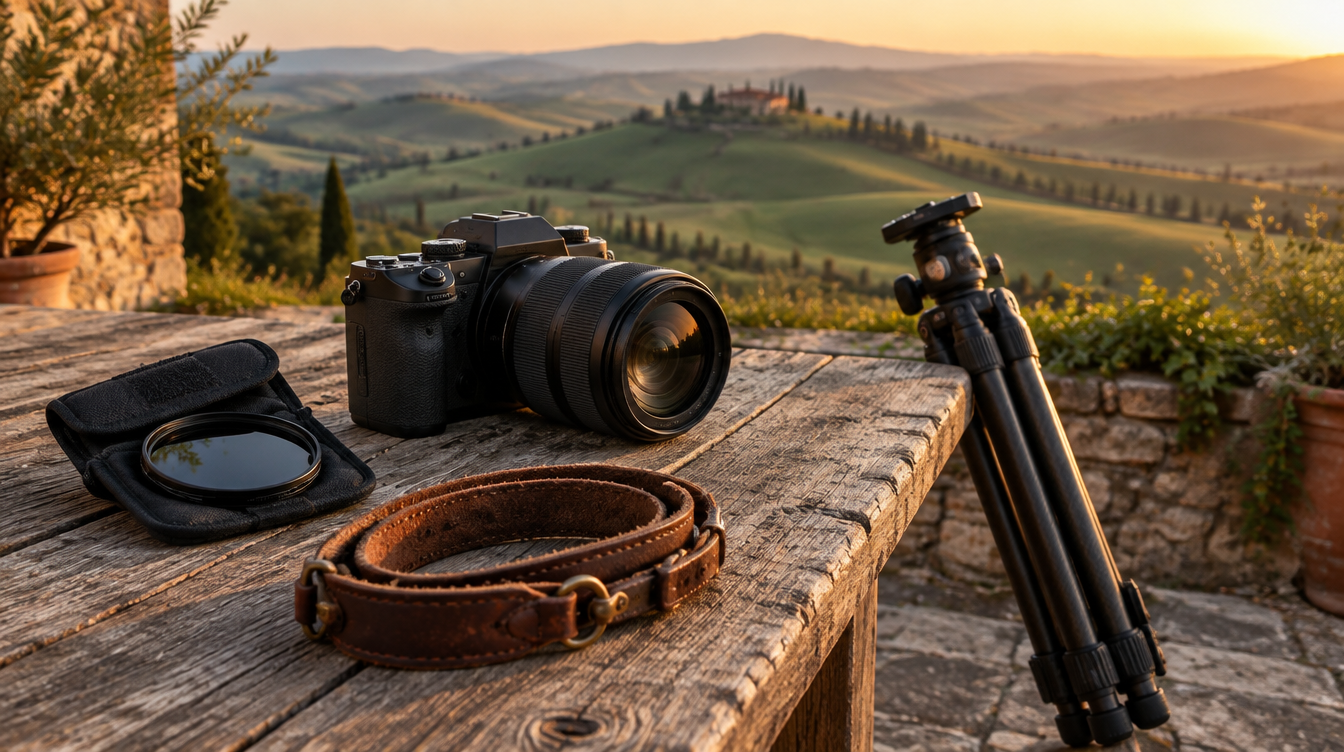
We wrote a full breakdown of this in our guide to the filters every Tuscany landscape photographer should own, but for the purposes of this article, filters sit firmly in the nice to have category, not the required one. A circular polarizer is the single most useful filter to bring: it cuts glare off foliage and water, deepens a blue sky, and helps manage the summer haze that can otherwise flatten contrast in a midday shot. A polarizer costs a fraction of what a new lens does and fits in a jacket pocket, which makes it one of the highest value additions to a kit that is otherwise minimal.
A graduated neutral density filter helps balance a bright sky against darker foreground hills in a single exposure, though most photographers on our tours get the same result with two or three bracketed exposures blended later in Lightroom, so consider it a convenience rather than a necessity. A solid ND filter, the kind that lets you stretch a shutter speed to several seconds even in daylight, is genuinely useful for the water at Bagno Vignoni but is a specialty tool most guests do not own and do not need to buy specifically for this trip.
Beyond filters, the extras that actually earn their weight in a bag are boring and unglamorous: two or three spare batteries, since cold pre dawn mornings drain them faster than you expect, a couple of high capacity memory cards rather than one, a rocket blower and a microfiber cloth for dust on farm roads, and a rain cover or simple plastic bag in case an April or November shoot gets caught in a passing shower. None of that shows up on anyone's dream gear list, and all of it saves a trip more often than a new lens ever would.
Required vs nice to have, at a glance
Here is the honest breakdown, grouped by what actually changes your ability to get the shot versus what just adds convenience.
| Gear | Required or nice to have | Why |
|---|---|---|
| Interchangeable lens camera (mirrorless or DSLR) | Required | Manual control over aperture, ISO, and shutter speed is used constantly across the week |
| One standard zoom or kit lens | Required | Covers the majority of compositions on the itinerary on its own |
| Sturdy tripod | Required | Fog, blue hour, and long exposure shots are not possible handheld |
| Spare batteries and memory cards | Required | Cold mornings and long shoot days drain batteries faster than expected |
| Full frame sensor | Nice to have | Modest low light and dynamic range benefit, not decisive for tripod based landscape work |
| Second lens (wide or telephoto) | Nice to have | Adds compositional options but is not needed to shoot every stop on the itinerary |
| Circular polarizer | Nice to have | Cuts haze and glare, genuinely useful but not required to get a strong photograph |
| Graduated or solid ND filters | Nice to have | Convenience over bracketed exposures or blended editing, not a hard requirement |
What our guides actually notice about your gear
After a lot of departures, I can tell you what our guides genuinely register about a guest's kit in the first morning of shooting, and it is almost never the brand or model on the strap. It is whether someone knows where their aperture and ISO controls live without hunting through a menu, whether they have their tripod set up and level within thirty seconds rather than fighting with a leg lock while the light changes, and whether they understand roughly what settings they need for a given scene, wide aperture and higher shutter speed for a handheld shot of a village street, narrow aperture and a tripod for a hillside vista at f/8 to f/11 around ISO 100. Comfort with your own gear beats expensive gear every single time.
That is really the whole thesis behind our approach to gear on a tour like this. We are not running a technical bootcamp where the newest sensor gives you an edge. We are running a seven day Val d'Orcia photography tour built around being in the right place at the right time with the right light, with two guides on the ground the whole week helping every guest, regardless of what is hanging around their neck, get into position for the shot. If your gear anxiety is genuinely about whether you will hold the group back, that concern usually disappears by the second morning once you see the actual mix of cameras in the group, which is almost always wider and more varied than people expect walking in.
If you are still weighing whether your current skill level is enough to justify booking at all, gear aside, we covered that question directly in our piece on whether you need to be a "serious" photographer to join a tour. The short version applies here too: the itinerary and the guiding adapt to where you are, not the other way around.
Frequently asked questions
Can I join with only a smartphone? You can join and you will get usable images, but several of the signature shots on this itinerary, long exposures, foggy blue hour scenes, controlled bracketed exposures, are meaningfully harder without manual control and a way to mount the phone securely. If a phone is all you have, bring a small tripod mount and lean on your guides for the techniques that work within those limits.
Do I need a mirrorless camera specifically, or is a DSLR fine? A DSLR is completely fine. Mirrorless bodies have some advantages, lighter weight and real time exposure preview through the viewfinder among them, but a well used DSLR shoots the exact same range of images this itinerary calls for.
Should I rent a lens or camera before the trip instead of buying? If you genuinely feel you are missing something specific, a telephoto for compression shots is the most common example, renting for the week is a smarter move than buying, since you avoid an expensive purchase for gear you may only use occasionally afterward.
What if my gear is older or considered outdated? It is not a problem. A five or eight year old camera body still produces images that print beautifully and hold up fine online. The techniques and the light in Val d'Orcia matter far more than how recent your sensor is.
Will I be the only one without the "good" gear? Almost certainly not. Every departure we run has a genuine mix, from guests with a single camera and one lens to guests with a full bag of glass. Nobody's trip is defined by which end of that range they land on.
The bottom line
The gear bar for a photography tour is lower than the internet makes it feel. Bring a camera you can control manually, one lens you trust, and a tripod that will not let you down at five in the morning on a windy ridge. Everything past that is a genuine but optional upgrade, not a prerequisite. The photographers who come home happiest are not the ones with the heaviest bags, they are the ones who spent the months before the trip practicing with what they already own rather than researching what to buy.