Vestrahorn and Stokksnes: Iceland's Moodiest Mountain
A location guide to Vestrahorn and Stokksnes: the access fee and gate hours, the tidal reflection shot everyone wants, and why this is Iceland's moodiest mountain.
Vestrahorn and Stokksnes: Iceland's Moodiest Mountain
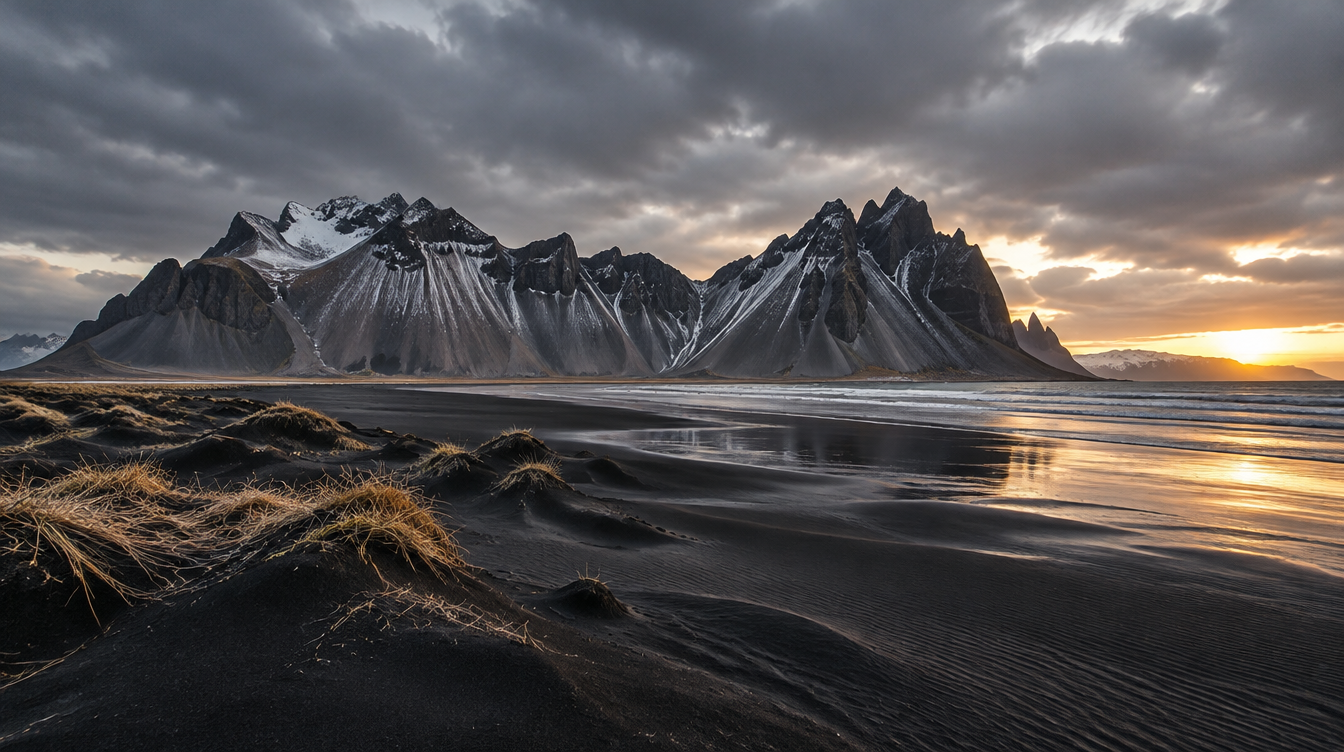
If you show ten Iceland photographers one single frame and ask them to name the location, more of them will say Vestrahorn than almost anywhere else in the country. It is the jagged black mountain that keeps showing up on camera club walls, in gallery prints, and in the "wish I'd shot that" folder of every photographer who has ever scrolled through an Iceland gallery. I have led small groups out to the headland at Stokksnes enough times now to know that the mountain itself is only half the story. The other half is a strip of flat black sand, a tide that comes and goes on its own schedule, and a few minutes of wind that decide whether you walk away with a postcard or a portfolio piece.
This guide covers the practical side of visiting Stokksnes, the access fee and gate hours that nobody quite agrees on, the odd little driftwood film set at the base of the mountain, and the geology that makes Vestrahorn look so different from the rest of Iceland's volcanic coastline. Then it gets into the shot everyone actually comes here for: the tidal reflection, how it forms, and how to put yourself in position to get it rather than standing on the beach wondering why your frame looks flat.
Key Takeaways
Vestrahorn rewards patience with tide and wind more than any particular piece of gear. Here is the short version before the long one.
| Point | Details |
|---|---|
| What it is | A private headland at Stokksnes, near Höfn in southeast Iceland, with Vestrahorn mountain as its backdrop |
| Access | Privately owned land with a small entry fee paid at the Viking Café; the exact figure and posted hours drift over time, so confirm them the day you go |
| The signature shot | A vertical composition of Vestrahorn mirrored in a thin sheet of water left behind on the flat sand by a receding wave, at a falling tide with little or no wind |
| Why the rock looks different | Vestrahorn is widely described as gabbro, a slow-cooling intrusive rock, rather than the fine-grained basalt that makes up most of Iceland |
| On the WeShoot itinerary | Day 4 of the Iceland Winter Aurora tour, "The East: Vestrahorn & Glacial Landscapes," built around this exact mountain |
Table of Contents
- Why Vestrahorn is Iceland's moodiest mountain
- Getting to Stokksnes: access, fee, and gate hours
- The Viking Village film set
- The geology: why Vestrahorn looks different
- The shot everyone asks for: the tidal reflection
- Winter at Stokksnes: ice, short light, and aurora odds
- How long to spend, parking, and logistics
- Frequently asked questions about Vestrahorn and Stokksnes
Why Vestrahorn is Iceland's moodiest mountain
Most of Iceland's famous peaks are smooth-shouldered volcanic cones or glacier-capped tables. Vestrahorn is neither. It rises in a serrated wall of dark ridgelines on the Stokksnes headland, near the fishing town of Höfn on Iceland's southeast coast, and it photographs like a torn piece of black paper propped up against the sky. On a clear day it looks severe. On an overcast one, with cloud snagging on its upper ridges, it looks genuinely ominous, which is exactly the word most of the photographers I travel with reach for the first time they see it in person.
Part of that mood comes from the foreground. Unlike most Icelandic coastal scenes, the beach at Stokksnes is extremely flat and made of fine, dark volcanic sand that holds water in a thin, continuous sheet rather than draining into channels. That flatness is the reason this single location produces one of the most requested frames out of an entire Iceland trip, which we will get into in detail further down. For now, treat the mountain and the sand as a single system: you are not just photographing a peak, you are photographing a peak and its own reflection, created by a beach shaped almost like a mirror. If you have photographed golden hour in other parts of the world, including on our Tuscany trips, Iceland's winter light behaves differently again, as we get into in our piece comparing golden hour in Tuscany versus Iceland, and Vestrahorn is one of the best places in the country to see that difference for yourself.
Getting to Stokksnes: access, fee, and gate hours
Stokksnes is privately owned land, not a national park or a free public beach, and that single fact explains most of the confusion you will find online about what it costs and when you can get in. Payment is made at or near the Viking Café at the base of the access road, either in person when it is staffed or through a card machine when it is closed. Reported figures for the entry fee have drifted upward over the years, and because different sources were written at different times, you will find several numbers quoted as if they were all current.
| Reported figure | Typical source era | Takeaway |
|---|---|---|
| Roughly 800 ISK | Older travel blog posts | Treat as historical, not current |
| Roughly 900 to 1,000 ISK | Mid-range dated posts | A reasonable ballpark to budget around |
| Roughly 1,000 to 1,100 ISK | More recent reports | Closest to what you should expect to pay today |
The trend is consistently upward, which is normal for a single, privately managed attraction with no competitor setting the price. Gate and café hours are reported just as inconsistently, with some sources listing roughly 9 a.m. to 6 p.m. and others listing something closer to 7:30 a.m. to 8 p.m. Rather than memorize a number that will likely be out of date by the time you read this, build in the expectation that you will confirm the current fee and hours on arrival, and carry a little cash as a backup to a card machine that may or may not be working on a cold, damp morning. In winter, treat the posted hours as a guideline rather than a guarantee, since weather on this stretch of coast can affect staffing and access at short notice.
The Viking Village film set
At the base of Vestrahorn sits an odd, weathered cluster of driftwood buildings known locally as the Viking Village. It is not a real settlement and never was. It is a constructed film set, built to look convincingly ancient against the black sand and dark ridgeline behind it, and it has become a photographic subject in its own right, especially for anyone who wants a human-scale foreground against the enormous backdrop of the mountain.
You will see confident claims online that specific blockbuster productions were filmed here, and some of those claims are harder to pin down than the internet suggests. A 2015 Bollywood film did shoot a sequence in Iceland that same year, and Stokksnes is widely associated with that production, though the film's own production record does not pin the shoot to this exact headland by name. Other titles you will see mentioned in connection with this set are reported even more loosely, with at least one widely repeated streaming production actually recording its filming location elsewhere entirely. My advice as someone who brings photographers here regularly: enjoy the set for what it unquestionably is, a striking, photogenic piece of built scenery, and treat any specific movie title attached to it as folklore worth double-checking rather than a verified fact worth repeating with confidence.
The geology: why Vestrahorn looks different
If you have spent any time photographing Iceland's coastline, you will have noticed that most of its mountains and cliffs share a similar dark, fine-grained, almost uniform texture. That is basalt, the fast-cooling volcanic rock that dominates the country's surface geology. Vestrahorn looks different because it is widely described as gabbro, a rock that forms through essentially the same chemistry as basalt but under completely different conditions. Gabbro forms when magma cools slowly, deep below the surface, over a long enough span of time for large, visible mineral crystals to grow, rather than cooling almost instantly at the surface into the fine, smooth texture of basalt.
In practice, that geological difference is exactly what gives Vestrahorn its jagged, multi-toned, almost crystalline ridgeline instead of the smoother profile of a typical Icelandic peak. The mountain you are looking at is effectively the exposed, eroded core of a much older volcanic system, a slow-cooled intrusion that has had thousands of years to be carved by wind and water into the serrated wall you see today. You do not need to understand igneous petrology to get a good photograph here, but knowing why the rock looks the way it does will change how you read the light on it. Those crystalline faces catch and scatter low sun in a way that smoother basalt does not, which is part of why Vestrahorn looks genuinely different in every change of light rather than just darker or lighter.
The shot everyone asks for: the tidal reflection
Here is the frame that brings most photographers to Stokksnes in the first place: Vestrahorn, mirrored almost perfectly in a thin film of water sitting on the black sand, shot low and vertical so the mountain and its reflection fill the frame as a single symmetrical image. It is, without exaggeration, the single most requested shot on an Iceland photography trip, and it is also the shot that most visitors fail to get, because they treat it as a matter of luck rather than a matter of reading the beach correctly.
The mechanism is simple once you understand it. The beach at Stokksnes is unusually flat, so when a wave recedes it leaves behind a continuous, almost perfectly level sheet of water rather than draining into channels the way a sloped beach would. On a falling tide, this happens again and again as the water retreats further down the beach with each cycle, repeatedly re-wetting flat sand and creating a fresh mirror. The two conditions that make or break the shot are tide state and wind. You want the tide falling, not rising, so the wet sand you are standing near keeps expanding rather than disappearing under incoming water, and you want the air close to still, because even a light ripple breaks the reflection into texture instead of a clean mirror.
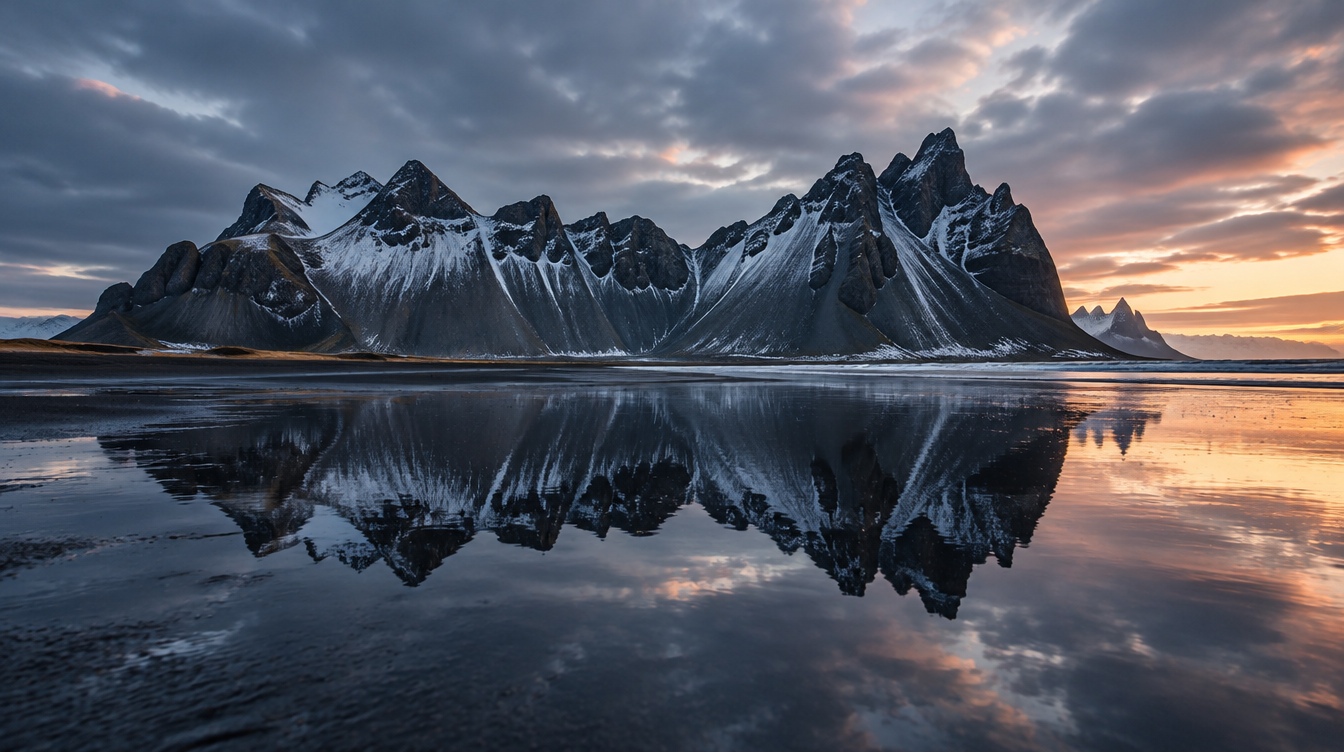
Pro Tip: Do not chase the biggest wave. Watch the last wave that just receded and shoot the thin sheet of water it left behind before it either drains into the sand or the next wave disturbs it. That window often lasts only a few seconds per cycle, so set your composition and focus in advance and wait for the water, rather than scrambling to recompose every time the beach changes.
For gear, I shoot this with a wide to standard zoom, usually somewhere in the 24 to 35mm range on a full-frame body, low to the ground, sometimes with the camera only a foot or two above the sand so the reflection reads as large as the mountain itself. A polarizing filter is a mixed blessing here: it can deepen the sky nicely, but it can also cut the very reflection you are trying to capture, since reflected light is partially polarized, so I often shoot this particular frame without one, or rotate the polarizer to its weakest setting and check the reflection in the live view before committing. A sturdy tripod matters more for stability on uneven, occasionally wet sand than for long exposures, since the reflection itself usually calls for a fast enough shutter speed to freeze the water's surface rather than smooth it into blur. If you want to extend a dull sky into something more dramatic, a two or three stop graduated neutral density filter can help balance a bright sky against the darker mountain and foreground, but it is optional, not essential, for the main event.
Winter at Stokksnes: ice, short light, and aurora odds
Winter changes this location more than almost anywhere else on an Iceland itinerary. The flat sand that makes the reflection shot possible can also hold patches of ice on a cold morning, which is beautiful underfoot in a photograph but genuinely slippery in person, so good traction on your boots is not optional. Daylight hours this far into winter are short, as we cover in detail in our guide to just how little daylight Iceland gives you in December and January, and the golden hour window stretches out for longer than it would at other times of year, which actually works in your favor: you get a longer stretch of low, warm, directional light rather than a brief ten minute window at sunrise or sunset.
Vestrahorn also sits far enough from Iceland's main towns, and far enough from significant artificial lighting, that it is a genuinely good spot to wait for the northern lights after the sunset shoot wraps up, with the mountain's silhouette available as a dramatic foreground if the aurora forecast cooperates that night. This is exactly why our Iceland Winter Aurora photo tour builds an entire day around this single mountain. Day 4 of that itinerary, titled "The East: Vestrahorn & Glacial Landscapes," is written specifically to put a small group here with enough time to work the tide for the reflection shot in the afternoon light and still have the evening open for aurora chasing, rather than rushing through on a tight day-trip schedule the way most independent travelers have to. If you are weighing whether to attempt this location on your own or with a guide who already knows the tide and weather patterns here, that built-in flexibility is the practical difference a guided trip adds on exactly this kind of weather-dependent shot.
How long to spend, parking, and logistics
Stokksnes sits a short drive from Höfn, which is itself roughly 455 to 458 kilometers, or about 283 to 285 miles, from Reykjavík by road. That distance alone tells you this is not a Reykjavík day trip. It is a stop on a longer, multi-day route along the south and southeast coast, which is exactly how most serious photography itineraries, guided or independent, actually treat it.
Plan for at least thirty minutes to an hour if you are only walking through the Viking Village and taking a quick look at the beach. If you are here to actually work the tide and light for the reflection shot, build in a full sunrise or sunset block, closer to an hour or more, because the best window within that block can be unpredictable and you do not want to be packing up your tripod just as the tide and wind finally line up. Parking is at the base of the access road near the café, and from there it is a flat, easy walk out onto the headland, which makes this one of the more physically accessible locations on an Iceland itinerary even in winter conditions, provided you have proper footwear for ice and wet sand.
Pro Tip: Bring a second lens cloth and keep it dry in an inside pocket. Low-angle shooting right at the waterline means wind-blown spray and condensation on your front element more often than almost any other spot on this coast, and a damp cloth just smears the problem across the glass instead of clearing it.
Frequently asked questions about Vestrahorn and Stokksnes
How much does it cost to visit Stokksnes and Vestrahorn? Multiple independent travel sources report a small private-land entry fee that has drifted upward over time, with more recent reports landing somewhere around 1,000 to 1,100 ISK. Confirm the current price when you arrive, since this is privately owned land and the operator sets and adjusts it.
What does the entrance fee include? It is commonly reported to cover beach access, the Viking Village set, and parking at the base of the headland.
What are the gate and café hours? Reported inconsistently across sources, roughly 9 a.m. to 6 p.m. in some, closer to 7:30 a.m. to 8 p.m. in others. Hours likely shift seasonally, and in winter you should treat any posted hours as a guideline rather than a guarantee, since weather on this stretch of coast can affect staffing.
What is the Viking Village at Stokksnes? A constructed, driftwood-built film set at the base of Vestrahorn, built to look like an ancient settlement. It is widely associated with international film productions, though specific title claims you will see online are not all equally well sourced, so treat them with some caution.
Why does Vestrahorn look different from other Icelandic mountains? It is widely described as gabbro, a slow-cooling intrusive rock with large visible crystals, rather than the fine-grained basalt that makes up most of Iceland's coastline, which gives it a jagged, multi-toned ridgeline that catches light differently than a typical Icelandic peak.
When is the best time to get the reflection shot of Vestrahorn? Look for a falling tide and calm wind. The reflection forms in the thin sheet of water a receding wave leaves on the flat sand, and it holds best when there is little to no ripple on the surface. There is no substitute for reading the beach in person on the day, since tide and wind both shift daily.
Is a drone allowed at Stokksnes? Policies at this privately owned site can change, and are not something to assume either way. Check current drone rules directly with the landowner or café staff before you fly, rather than relying on an old blog post.
How long should I plan to spend at Stokksnes? Thirty minutes to an hour covers a casual visit to the Viking Village and beach. Photographers working the tide for the reflection shot should budget a full sunrise or sunset block, closer to an hour or more, since the best window within that block is not fully predictable in advance.
How far is Stokksnes from Höfn and from Reykjavík? Stokksnes sits a short drive from Höfn, which is itself roughly 455 to 458 kilometers, or about 283 to 285 miles, from Reykjavík by road, making this a multi-day trip stop rather than a day trip from the capital.
Is this really the most requested shot on an Iceland trip? In my experience leading these trips, yes. The vertical, mountain-plus-reflection composition at Stokksnes is consistently one of the first images people show me when they describe the Iceland photograph they most want to come home with.
Sources
- Stokksnes: Wikipedia entry on the headland, Vestrahorn, and the H-3 radar station
- Gabbro: Wikipedia entry on the formation of this slow-cooling intrusive rock
- Höfn: Wikipedia entry on the nearest town and its distance from Reykjavík
- Dilwale (2015 film): Wikipedia entry confirming Iceland filming in August 2015
- The Witcher: Blood Origin: Wikipedia entry on the series' filming locations