Kirkjufell Without the Cliché: How to Shoot Iceland's Most Photographed Mountain
Everyone has the same waterfall-foreground shot of Kirkjufell. Here is that classic composition done properly, then the Grundarfjörður harbor and town angles almost nobody tries.
Kirkjufell Without the Cliché: How to Shoot Iceland's Most Photographed Mountain
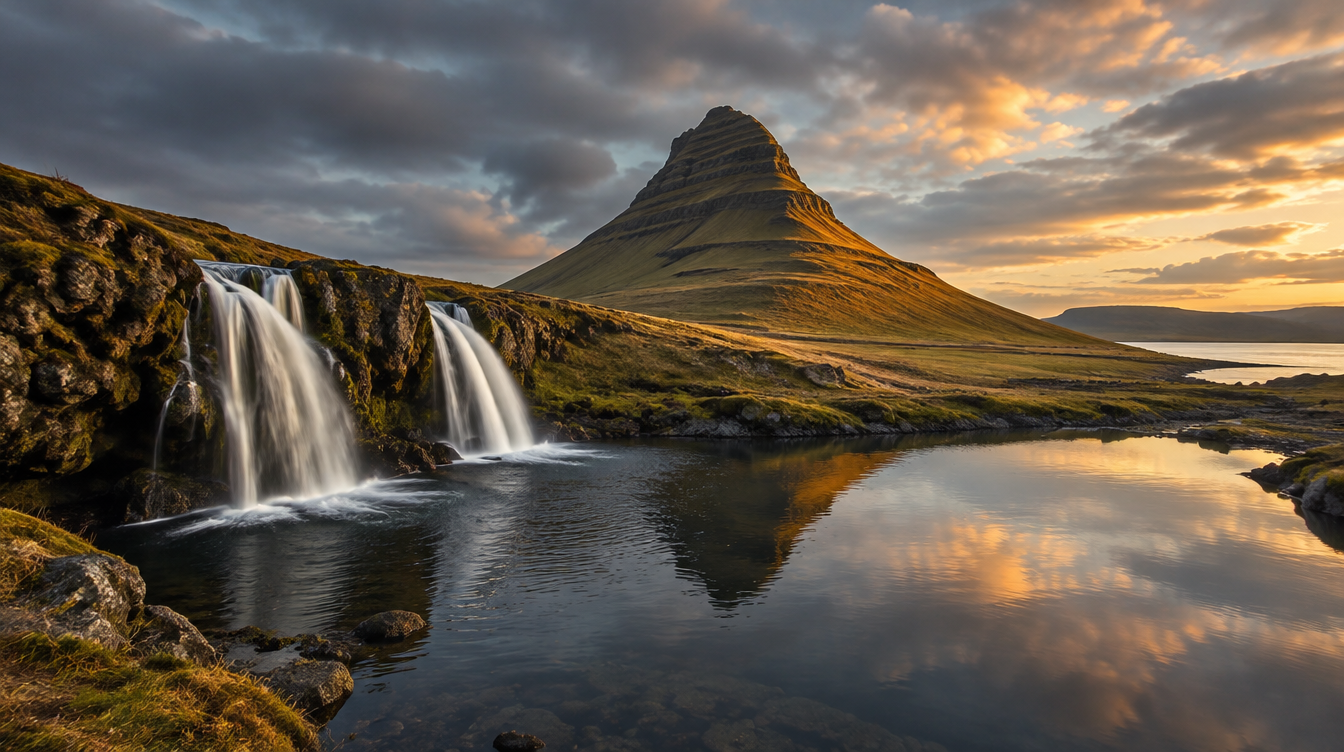
If you have spent any time at all scrolling Iceland photography accounts, you have seen this frame a hundred times without even trying. A pointed, church shaped peak sitting behind a small cascading waterfall, shot from a footbridge a few steps off the Ring Road near the town of Grundarfjörður. It is a genuinely great composition, which is exactly why so many photographers never look past it. I have led groups past that same bridge more times than I can count, and every single time, a cluster of tripods is already lined up in the same six feet of gravel, pointed at the same angle, waiting for the same light.
This guide covers that classic shot honestly, because you should absolutely get it if you are standing there anyway. But it spends more time on what almost nobody tries: the harbor and the town streets of Grundarfjörður itself, sitting right beside the mountain, which give you a version of Kirkjufell that does not look like everyone else's. Along the way we will get into the geology that makes this peak so graphic in a photograph, the practical winter logistics of actually getting there, and the gear worth packing for a shoot that can swing from calm golden light to sideways sleet in the space of an hour.
Key Takeaways
Kirkjufell rewards photographers who go past the obvious footbridge shot, and the town right beside it is the easiest way to do that.
| Point | Details |
|---|---|
| The classic shot | Kirkjufellsfoss waterfall framing the mountain, shot from the footbridge, still worth getting once |
| Best underused angle | Grundarfjörður harbor, using fishing boats and quay structures as foreground |
| What it actually is | A nunatak, a peak that stood above the ice sheets of the last glaciation, not a volcano |
| Access | On Route 54, a short walk from parking, with no climb required for any of the compositions in this guide |
| Winter planning tool | The Icelandic Met Office's aurora and weather forecasts, not a fixed "best hours" claim |
| Where it fits a trip | A Snæfellsnes Peninsula stop, easily combined with Arnarstapi, Hellnar, and Londrangar on the same day |
Table of Contents
- The classic shot, done properly
- What's wrong with only getting that shot
- Alternative angle: Grundarfjörður harbor
- Alternative angle: the town and the north side
- What Kirkjufell actually is
- When to go, season by season
- Winter logistics: driving, daylight, and safety
- Gear and settings checklist
- Frequently asked questions
The classic shot, done properly
Let's deal with it first, because you should not skip it out of principle. Kirkjufellsfoss is a small, two tiered waterfall a short walk from the parking area off Route 54, and the footbridge just below it lines up the falls in the foreground with the mountain rising behind. It works because the composition is genuinely sound: a strong foreground subject, a clean mid-ground, and a graphic peak as the anchor. That is not an accident of popularity, it is good composition, which is exactly why thousands of photographers before you have found the same spot.
A wide lens in the 14 to 16mm range on a full frame body gives you enough room to include both waterfall tiers without cropping the mountain's peak awkwardly. Mount the camera on a tripod, since you will likely want a shutter speed slow enough to soften the moving water without turning it into a flat white smear, somewhere in the quarter second to one second range depending on how much flow is coming over the falls that day. Overcast, diffused light actually suits this scene better than a hard blue sky, since it keeps detail in both the dark rock and the white water without blowing out highlights.
Pro Tip: Get to the footbridge before the light gets good, not after. The handful of minutes right before sunrise, when there is often nobody else around yet, is worth more than perfect golden light shared with fifteen other tripods jostling for the same two feet of gravel.
What's wrong with only getting that shot
The honest problem with the footbridge composition is not the composition itself, it is that it is the only shot almost anyone brings home from Kirkjufell. Search for Kirkjufell photography anywhere online and you will find page after page explaining lens choice and tripod technique for this exact same frame, with barely a mention of anything else to try once you have it. If your goal is a photograph that looks like your own trip rather than a stock image you could have bought before you left home, getting only this one shot and moving on is a missed opportunity.
There is also a practical crowd problem. Kirkjufell has become enough of a fixture on Iceland itineraries that the footbridge area gets genuinely busy in peak travel windows, and barrier fencing has gone up around parts of the falls in recent seasons to manage foot traffic and protect the ground from erosion. None of that ruins the shot if you time your visit for early morning or off season, but it does mean you are sharing a very small physical space with a lot of other photographers chasing the exact same frame. The good news is that every other composition in this guide sits a short drive or walk away, with almost nobody else trying them.
Alternative angle: Grundarfjörður harbor
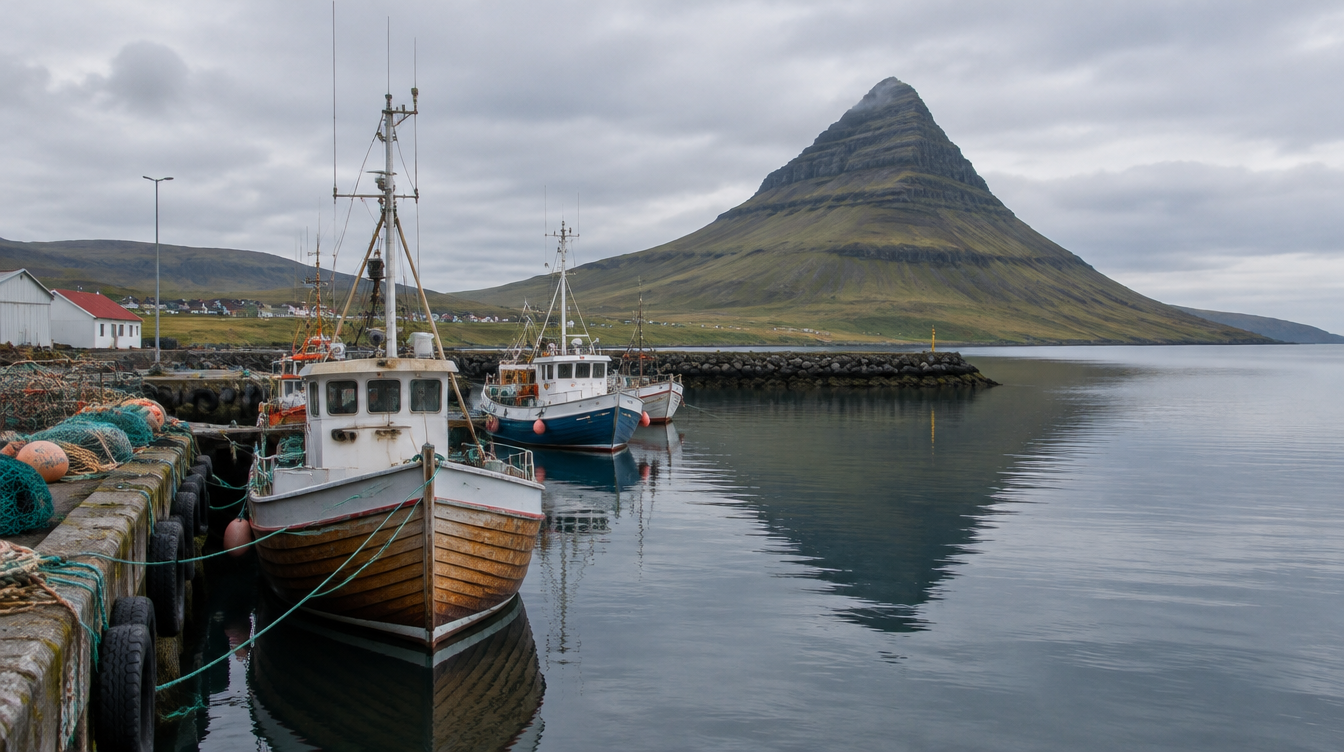
This is the gap nobody else seems to cover, and it is sitting in plain sight. Kirkjufell lies just to the west of Grundarfjörður and forms a small peninsula of its own, which means the town's working harbor has a direct, unobstructed view of the mountain from the water's edge (en.wikipedia.org). Grundarfjörður's harbor ranks among the ten largest quota fishery ports in the country and lands the largest demersal catch in West Iceland, so there are real working fishing boats tied up here, not tourist props (en.wikipedia.org). That gives you mooring lines, hulls, nets, and quay structures as foreground options that put the mountain in an entirely different kind of frame than the waterfall shot, one that reads as a place people actually live and work rather than a postcard viewpoint.
Walk the harbor edge in the hour after sunrise and look for a boat angled so its bow or hull leads your eye toward the mountain rather than sitting flat and parallel to the frame. A mid-range zoom, something in the 24 to 70mm range, lets you isolate a single boat against the peak without needing the wide, everything-in-frame approach that the footbridge shot demands. If the water is calm, which happens more often in the stillness of early morning, you can pick up a reflection of both the boats and the mountain in the harbor water itself, which is a frame almost nobody else from your trip will have.
Alternative angle: the town and the north side
Beyond the harbor, Grundarfjörður's streets themselves give you low, close vantage points on the mountain that strip out the waterfall entirely and let Kirkjufell's shape carry the frame on its own. A side street with a row of colorful Icelandic rooftops in the foreground, shot with the mountain filling the background, tells a different story than the classic nature shot: this is a lived-in town of under a thousand residents with one of the country's most recognizable peaks as its backdrop (en.wikipedia.org).
If you have more time, driving a little further around toward the north side of the peninsula changes the mountain's silhouette noticeably, since its distinctive stepped profile reads differently depending on which face you are looking at. A telephoto in the 70 to 200mm range is genuinely useful here, letting you isolate just the peak against sky or sea without any of the surrounding flatland pulling focus from its shape. This is also where you have the best chance of having a composition entirely to yourself, since almost every visitor never drives past the footbridge parking lot at all.
What Kirkjufell actually is
It helps to know what you are actually looking at, partly because it is good material for the inevitable "what mountain is that" question from everyone who sees your photo, and partly because getting it right changes how you think about the shape. Kirkjufell rises 463 meters on the north coast of the Snæfellsnes peninsula, and despite containing volcanic rock, it is not a volcano (en.wikipedia.org). It is a nunatak, meaning it is a peak that stood above the surrounding ice sheets during past glaciations while everything around it was buried, which is also the general definition of the term (en.wikipedia.org). Its strata alternate between Pleistocene lava and sandstone, capped with tuff at the summit, which is exactly why it has that distinctive layered, stepped profile that reads so cleanly in a photograph, the layering is not a trick of light, it is literally built into the rock (en.wikipedia.org).
The name itself translates to "Church Mountain" in Icelandic, a fitting description for its pointed, almost architectural shape, and it is commonly described as the most photographed mountain in the country, which checks out given how often you will have seen it before ever setting foot in Iceland (en.wikipedia.org). Fans of a certain fantasy series might also recognize it without realizing: it served as a filming location for two seasons of Game of Thrones, appearing as the "arrowhead mountain" north of the Wall (en.wikipedia.org).
Pro Tip: Leave the climb alone. Kirkjufell can technically be ascended in roughly three hours in summer and fall, but the steep upper sections turn dangerous fast when wet, and recorded fatal falls go back to 1945 with more recent incidents in 2017, 2018, and 2022 (en.wikipedia.org). None of the compositions in this guide require getting anywhere near that climb, and no photograph is worth the risk it carries.
When to go, season by season
There is no single wrong season to photograph Kirkjufell, but each one gives you a different mountain. Summer brings the Midnight Sun and long, soft light that lingers near both sunrise and sunset since the sun barely dips below the horizon at this latitude, which is forgiving for photographers who do not want a 4am alarm. Autumn adds color to the grass and hillsides around the base and thins out the summer crowds considerably. Winter is the aurora season and also the harbor season, since the low, short days mean you get usable light for most of the hours you are actually awake, and the harbor compositions work just as well under a slate grey winter sky as they do in summer gold.
| Season | What you get | Worth knowing |
|---|---|---|
| Summer | Long, soft light near the Midnight Sun; green surrounding hills | Busiest season at the footbridge, best handled with an early start |
| Autumn | Color in the grass and hillsides; thinner crowds | Variable weather, pack for rain and wind |
| Winter | Aurora potential; harbor and town shots work all day in flat light | Short daylight windows and icy roads, plan around official forecasts |
| Any season | The waterfall shot and the harbor shot, in that order | Check current road and weather conditions before you commit to a visit day |
For aurora specifically, resist the urge to lock onto a fixed "best hours" claim you might see floating around online. Conditions change night to night, and the only reliable way to plan is to check the Icelandic Meteorological Office's own aurora forecast, which rates expected activity on a zero to nine scale and layers it over a cloud cover map, since you need both solar activity and a clear sky to actually see anything (en.vedur.is). Our own long-form technical breakdown of northern lights settings and forecasting covers the camera side of this in more depth if you want to go further than planning alone.
Winter logistics: driving, daylight, and safety
Grundarfjörður sits roughly two and a half hours from Reykjavík by car, and the drive out along the Snæfellsnes Peninsula is straightforward in good weather but genuinely demanding in a winter storm. The Icelandic Meteorological Office issues region specific winter warnings that regularly flag slippery surfaces across the country, including around the capital area, and checking that forecast the morning of your drive, not days in advance, is the single most useful habit you can build for a winter Iceland trip (en.vedur.is).
Daylight in winter is short, which sounds limiting until you realize it actually compresses your shooting day into one long, usable golden hour bracketing a brief midday rather than forcing you to choose between two narrow windows the way a summer trip would. That short window is exactly why I build Kirkjufell into the second day of our Iceland Winter Aurora photo tour, alongside the rest of the Snæfellsnes Peninsula at Arnarstapi, Hellnar, and Londrangar. It is a seven night, fully guided trip for a maximum of ten photographers, led by either Lorenzo Ranieri Tenti or Marco Carotenuto depending on the departure, with all ground transportation, airport transfers, most meals, and structured image review and post processing sessions built into the price, so you are not trying to parse Icelandic winter road warnings alone at 6am while also figuring out composition. If a guided trip is more your pace than a rental car and a weather app, our current March departure still has spots open, and it is worth checking the tour page directly since dates and availability shift.
Drone rules deserve an honest mention rather than a confident, specific claim. Icelandic drone regulations are layered, combining general aviation rules with location specific restrictions, and they are the kind of thing that changes with enough regularity that any number I gave you here could be outdated by the time you read this. Kirkjufell and the surrounding Grundarfjörður area sit outside the boundaries of Snæfellsjökull National Park, which is a slightly different permission question than the park's interior spots, but general Icelandic aviation rules still apply regardless. Check current regulations before you fly, not after you have already packed the drone case.
Gear and settings checklist
You do not need an enormous kit for this location, but a few specific pieces earn their weight in your bag.
- A wide lens, 14 to 16mm equivalent, for the classic footbridge composition and any full mountain context shot
- A mid-range zoom, 24 to 70mm, for the harbor and town alternatives, where isolating a single boat or building matters more than including everything
- A telephoto, 70 to 200mm, if you make it around to the north side and want to isolate the mountain's shape against open sky
- A sturdy tripod for the waterfall's slow shutter speed and for any winter aurora attempt after dark
- A polarizing filter for the harbor water, useful for cutting glare off the surface when the sun is low and you want the reflection of the boats and mountain to stay clean
- Warm, waterproof layers and grippy footwear for footing on the footbridge area and the harbor quay, both of which get wet and slick in Iceland's weather regardless of season
For the waterfall itself, a quarter second to one second shutter speed at a narrow aperture, somewhere around f/8 to f/11, usually balances a soft water blur against enough depth of field to keep both the falls and the mountain sharp. For the harbor shots, you have much more freedom, since you are not fighting moving water, so a standard landscape setting of f/8 and a shutter speed fast enough to hand-hold if you leave the tripod behind works fine.
Frequently asked questions
What's the best time of day to photograph Kirkjufell? Early morning, both for the quality of light and because it is genuinely the quietest the footbridge area gets all day. In summer, the sun stays low enough near both sunrise and sunset that you get a long, forgiving golden hour on either end of the day.
What's the best time of year to shoot Kirkjufell? Summer for long light and green surroundings, autumn for color and thinner crowds, winter for aurora potential and harbor shots that work all day under flat light. Check the official aurora forecast rather than planning around a fixed "best hours" claim.
How do you get to Kirkjufell? It sits on the north side of the Snæfellsnes Peninsula, just west of Grundarfjörður town, reachable by self-drive along Route 54 or as a stop on a guided Snæfellsnes or West Iceland tour.
Is there a parking fee at Kirkjufell? Expect a modest parking or access fee at the footbridge area, typically paid on-site or through a parking app. Amounts and payment methods change, so confirm the current figure locally rather than relying on an old number from a blog post.
Is the classic waterfall shot overused? Yes, by a wide margin. Nearly every photography guide to Kirkjufell centers on the exact same footbridge composition, which is the entire reason this guide spends more time on the harbor and town alternatives than on the shot you have probably already seen a hundred times.
Can you fly a drone at Kirkjufell? Icelandic drone rules are strict and change often, combining general aviation regulations with location specific restrictions. Kirkjufell sits outside Snæfellsjökull National Park's boundaries, but that does not exempt it from general rules. Check current regulations before flying.
Is it safe to climb Kirkjufell for a better angle? No, and you do not need to. The mountain can technically be climbed in around three hours in summer and fall, but steep sections turn dangerous when wet, and recorded fatal falls date back to 1945 with more recent incidents in 2017, 2018, and 2022 (en.wikipedia.org). Every composition in this guide is shot from level ground.
What lens should I bring? A wide lens around 14 to 16mm covers the classic shot, a mid-range zoom around 24 to 70mm is the most useful single lens for the harbor and town alternatives, and a telephoto helps if you make it to the north side of the peninsula.
Kirkjufell rewards exactly the kind of curiosity this guide is built around: get the shot everyone comes for, then spend the rest of your time at that stop looking somewhere nobody else bothered to point a camera. The mountain is not going anywhere, and neither is the harbor beside it. If a trip built around this kind of thinking, going deeper than the obvious frame at every stop, sounds like your pace, our Iceland Winter Aurora photo tour is built around exactly that approach across a full week of Iceland's west and south coast.
Sources
- Wikipedia: Kirkjufell, geology, naming, and history
- Wikipedia: Grundarfjörður, population, harbor, and geography
- Wikipedia: Snæfellsnes Peninsula, regional geography and towns
- Wikipedia: Nunatak, general definition
- Icelandic Meteorological Office: weather forecasts and winter road warnings
- Icelandic Meteorological Office: aurora forecast and cloud cover map