Seljalandsfoss and Skógafoss: Shooting Iceland's Most Photographed Waterfalls Differently
Seljalandsfoss and Skógafoss show up identically in every Iceland feed. Here is how to shoot both differently, plus the quieter Kvernufoss nearby.
Seljalandsfoss and Skógafoss: Shooting Iceland's Most Photographed Waterfalls Differently
Open any Iceland photography feed and you will see the same two waterfalls within the first ten images. Seljalandsfoss from the mouth of its walk-behind cave, backlit and glowing. Skógafoss straight on, wide angle, rainbow arcing through the spray. Both are genuinely spectacular falls and both are worth every minute you spend there. The problem is not the subject. The problem is that thousands of visitors a year line up for the exact same two compositions, so your version of a world famous waterfall ends up looking identical to everyone else's.
I have led groups through this stretch of Iceland's South Coast enough times to know the obvious shots cold, and I still take them, because they work. But I have also learned where each fall opens up into something more personal: a quieter angle at Skógafoss that does not need a drone, a second composition at Seljalandsfoss once you are past the cave, and a third waterfall a short walk away that almost nobody on a day trip ever sees. This guide covers all three, plus the gear decisions that actually matter when you are standing in a wall of glacial spray trying to keep a lens clean.
Key Takeaways
Seljalandsfoss and Skógafoss reward photographers who go past the first obvious frame, and Kvernufoss nearby is the quiet third stop almost no one plans for.
| Point | Details |
|---|---|
| Seljalandsfoss height | About 60 m (197 ft) in a single drop, fed by the Seljalands River from the Eyjafjallajökull glacier |
| Skógafoss height | About 60 m (200 ft) tall and 25 m (82 ft) wide, one of the largest single-drop falls in Iceland |
| Kvernufoss height | About 40 m (130 ft), reached on foot in under a kilometer from the Skógar Museum car park |
| Walk-behind access | Possible at both Seljalandsfoss and Kvernufoss, but condition dependent, especially when the ground is icy or snow covered |
| Skógafoss alternative view | A 527 step staircase climbs to a platform at the top of the falls, a genuine drone-free alternative angle |
| Gear priority | A microfiber cloth and a lens hood matter more here than any single lens choice |
Table of Contents
- Why everyone's photo looks the same
- Seljalandsfoss: the walk-behind angle
- Beyond the cave: other Seljalandsfoss compositions
- Skógafoss without a drone
- Lens choice and gear protection for spray
- Kvernufoss: the quiet third waterfall
- When to go: season, light, and crowds
- Shoot all three with a guide
- Frequently asked questions
Why everyone's photo looks the same
Both falls sit directly off Iceland's South Coast road system, which is exactly why they are so heavily photographed. Seljalandsfoss is right beside Route 1 and the road toward Þórsmörk, close enough to the parking area that you can be standing under it ten minutes after pulling off the Ring Road, as its own Wikipedia entry notes. Skógafoss sits a short drive further east, at a cliff that marked Iceland's actual coastline before the sea receded roughly 5 kilometers from the nearby village of Skógar, according to the same Skógafoss entry, a fact corroborated independently by Wikipedia's page on Eyjafjallajökull, which names Skógafoss as the best known of the waterfalls left behind on that old shoreline.
That ease of access is a gift and a trap. It means you do not need a long hike or a guide to see either waterfall, but it also means every tour bus on the South Coast circuit stops at the same two pull-offs and every visitor walks the same thirty meters to the same viewpoint. If you only shoot from where the path naturally leads you, your frame will look like everyone else's frame. The fix is not complicated. It is choosing where you stand, what time you arrive, and which of the two falls you treat as the "easy" shot versus the one you actually work for.
Pro Tip: Arrive at whichever waterfall you are shooting at least thirty minutes before the light you actually want. Both parking areas fill fast in high season, and the walk from an overflow lot eats into the exact window you came for.
Seljalandsfoss: the walk-behind angle
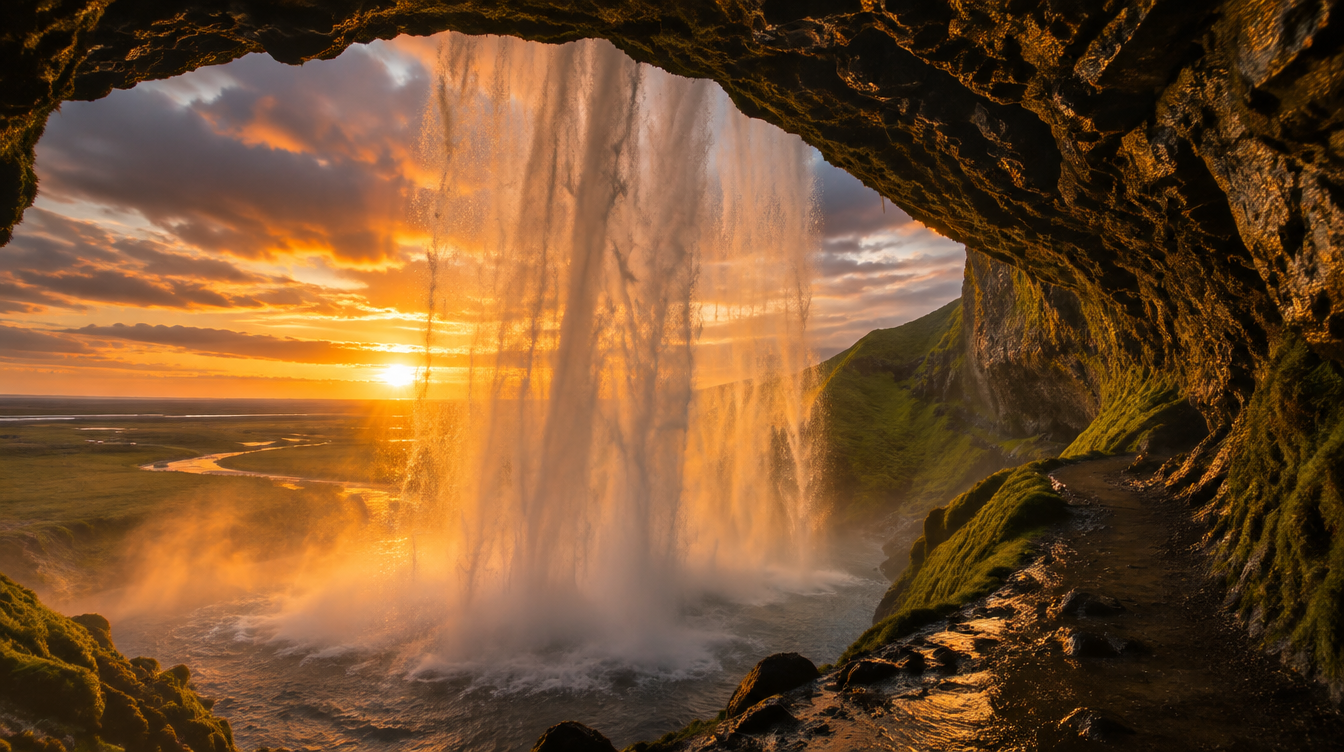
The reason Seljalandsfoss is one of the most photographed falls in Iceland, and the reason it has turned up as a filming location for projects ranging from The Amazing Race to a season of Star Trek: Discovery, is the walk-behind cave. You can circle fully around the back of the drop, which turns the waterfall itself into a backlit curtain between you and the sky. Shot in the late afternoon or evening with the sun low behind the falls, this is the frame that defines Seljalandsfoss, and it genuinely earns its reputation.
What most visitors miss is how much that shot changes depending on where inside the cave you stand. Close to the rock wall, you get a tighter, more graphic silhouette with less visible spray. Closer to the opening, you get a wider view with more atmosphere but also far more water in the air, which means far more water on your front element. A 16 to 24mm equivalent focal length comfortably frames the full curtain of water from most positions inside the cave, while anything longer forces you to back up against the wet rock behind you.
Access to the path behind the falls depends entirely on conditions on the day you visit. Ice and snow can make the walkway behind the falls unsafe or closed outright, which is true of the smaller, quieter Kvernufoss as well, where Wikipedia notes that walking behind the falls is possible when the area is free of snow. Do not plan your entire shot list around a walk-behind composition in winter. Check conditions when you arrive and have a backup plan ready from the front of the falls instead.
Beyond the cave: other Seljalandsfoss compositions
Once you have the walk-behind shot, keep moving. Seljalandsfoss drops about 60 meters (197 feet) in a single fall, fed by the Seljalands River, which itself originates at the Eyjafjallajökull glacier, the same ice cap famous for its 2010 eruption, as confirmed by the falls' Wikipedia page. That height and the open grassy field in front of it give you a composition most visitors skip entirely: a wide straight-on shot from well back in the field, with the full drop visible and enough foreground grass or a small stream to anchor the frame. It is a quieter, more classical landscape composition, and it is the shot to take if you want an image that does not immediately read as "that cave photo everyone has."
A separate waterfall list on Wikipedia puts Seljalandsfoss's height closer to 65 meters rather than 60, a reminder that even well documented Icelandic waterfalls have figures that vary slightly between sources depending on how and where the drop is measured. Either number is a useful ballpark for framing decisions. What matters more for your composition is that the fall is tall enough and isolated enough on its cliff face that a vertical frame, shot from roughly 40 to 50 meters back, lets you include the full curtain of water top to bottom with a clean strip of sky above it, something the walk-behind shot physically cannot give you.
Skógafoss without a drone
Skógafoss is, by most measurements, roughly the same height as Seljalandsfoss at around 60 meters (200 feet), but it is 25 meters (82 feet) wide and genuinely one of the largest waterfalls in Iceland by volume, according to its Wikipedia entry. The standard shot is the straight-on view from the gravel plain in front, usually with a rainbow in frame, since the heavy spray produces a single or double rainbow on sunny days according to the same source. It is a strong composition and worth taking. It is also, by a wide margin, the single most duplicated image out of this entire stretch of coastline.
The genuinely different angle does not need a drone at all. A 527 step staircase climbs the slope beside the falls to a viewing platform at the top, per Wikipedia, and that climb changes your entire relationship to the waterfall. From the top you are looking down the length of the drop toward the gravel plain, the parking area, and the coastal plain beyond, with the Skógá river disappearing into the valley below you. It is a workable angle for a wide zoom in the 16 to 35mm range, and because so few visitors make the climb with a camera in hand, you will often have the platform largely to yourself even when the base of the falls is crowded.
The staircase also connects to something most day-trip visitors never consider: a longer trail from the top of Skógafoss toward the Fimmvörðuháls pass, the route that threads between the Eyjafjallajökull and Mýrdalsjökull ice caps before descending toward Þórsmörk, as described on the same Wikipedia page. You do not need to hike the full pass to benefit from this. Even the first twenty minutes of that trail gives you elevated views back toward the falls and the coast that nobody shooting from the gravel plain below will ever get.
Pro Tip: If you only have time for one elevated shot, climb partway up the Skógafoss staircase rather than trying to find a drone-legal launch point. The view from the stairs changes meaningfully every fifty or so steps, so you do not need to reach the very top to get a composition nobody else at the base is shooting.
There is also a quieter piece of local history worth knowing while you are there. Local legend holds that the Viking settler Þrasi Þórólfsson hid treasure in a cave behind Skógafoss, and a ring believed to be from that chest is said to be the old church door ring, now kept in the Skógar museum at the base of the falls, per the same Wikipedia source. It will not change your composition, but it is the kind of detail worth knowing if anyone in your group asks why the museum sits exactly where it does.
Lens choice and gear protection for spray
Seljalandsfoss and Skógafoss put water in the air in two different ways, and treating them as the same problem is the most common mistake I see visiting photographers make. Inside the Seljalandsfoss cave, the spray is relatively contained and directional, so a lens hood and a quick wipe between frames is usually enough. At Skógafoss, the spray is a sustained, wind-driven mist that covers a much larger radius, and visitors standing close to the base routinely get soaked, as Wikipedia's own description confirms. That is not an exaggeration from a travel blog. It is simply what the volume of water at a fall that size does to the surrounding air.
For both locations, a wide zoom somewhere in the 16 to 35mm range covers the vast majority of useful compositions, from the full-frame walk-behind shot to the wide straight-on view at Skógafoss. A longer lens, in the 70 to 200mm range, is worth carrying for compressed details: the texture of the rock face beside Seljalandsfoss, or an isolated section of Skógafoss's curtain from partway up the staircase where you are far enough back that a telephoto crop becomes useful rather than redundant.
| Location | Typical lens range | Main spray challenge | Gear priority |
|---|---|---|---|
| Seljalandsfoss (walk-behind) | 16-24mm | Contained, directional spray inside the cave | Lens hood, quick wipe between frames |
| Seljalandsfoss (field view) | 24-50mm | Minimal at distance | Polarizer for sky contrast |
| Skógafoss (base) | 16-24mm | Heavy, wind-driven mist over a wide radius | Microfiber cloth, rain cover, lens hood |
| Skógafoss (staircase) | 16-35mm, 70-200mm for detail | Low once above the first third of the stairs | Secure camera strap on the steps |
| Kvernufoss | 16-24mm | Similar to Seljalandsfoss, contained inside the canyon | Lens hood, snow-dependent footing care |
The single piece of gear that matters more than any lens is a supply of clean microfiber cloths, because you will use more of them than you expect. A lens hood genuinely helps keep direct spray off the front element, and a basic rain cover or even a plastic bag with a hole cut for the lens is worth packing for Skógafoss specifically. None of this needs to be expensive or specialized. It needs to be in your bag before you are already standing in the mist wishing you had brought it.
Kvernufoss: the quiet third waterfall
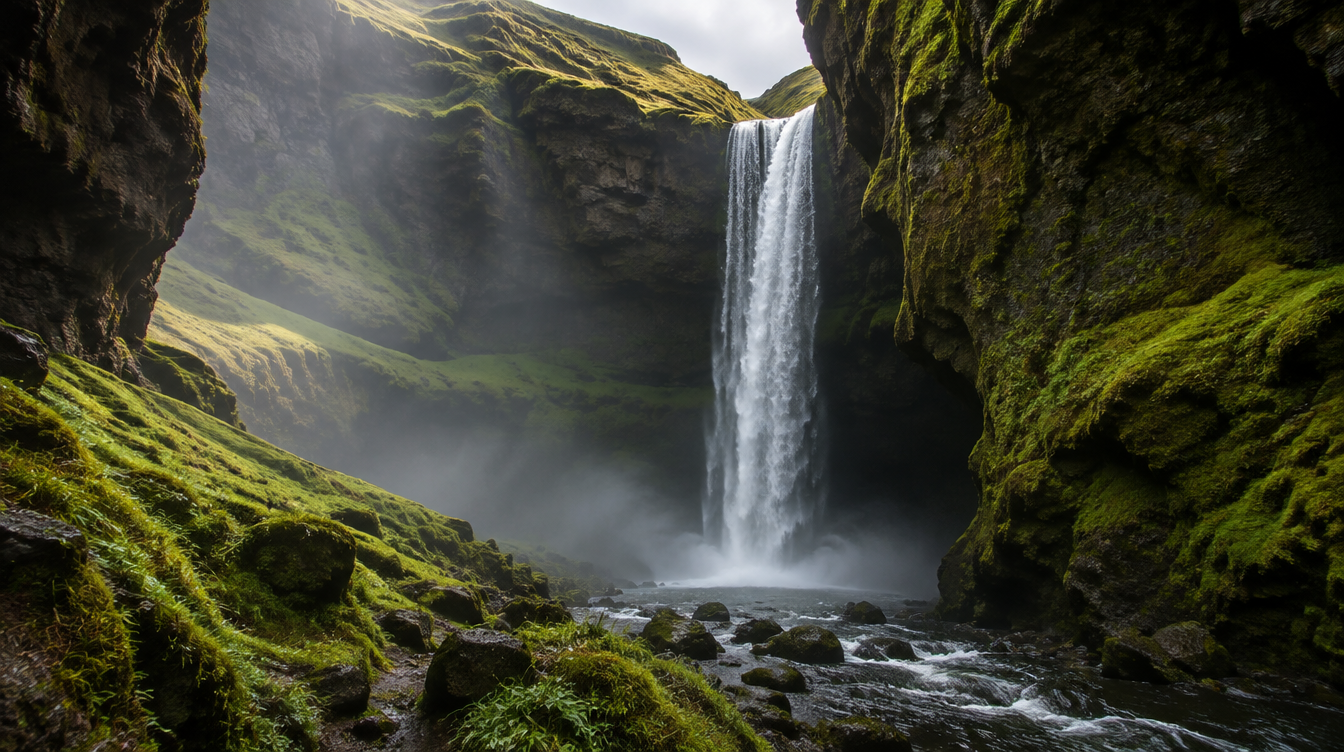
If Seljalandsfoss and Skógafoss are the two names every visitor already knows, Kvernufoss is the one almost nobody plans a stop for, and that is exactly its appeal. It drops about 40 meters (130 feet) in a single fall, tucked inside the Kvernugil canyon near the village of Skógar, and it is reachable on foot in under a kilometer from the car park at the Skógar Museum, according to its Wikipedia entry. That is a five to ten minute walk for a waterfall that, on an average day, you will likely have almost entirely to yourself.
Kvernufoss also has a walk-behind path, like Seljalandsfoss, though the same source is specific that this is possible only when the area is free of snow. The canyon setting changes the character of the shot considerably. Instead of standing in an open field or a wide gravel plain, you are inside a narrow rock corridor, which compresses your compositions and makes a wider lens, again in the 16 to 24mm range, almost mandatory if you want the full canyon walls in frame alongside the fall itself.
Because it sits in the shadow of its two famous neighbors, Kvernufoss rarely makes it onto a rushed South Coast itinerary. If you are building your own shot list for this stretch of coastline, treat it as the stop you add once you have already covered the obvious two, not an optional extra to skip if you are running behind schedule. It is often the single frame in a traveler's Iceland album that nobody else in their group chat has seen before.
When to go: season, light, and crowds
All three waterfalls sit within Iceland's South Region, an area covering nearly 31,000 square kilometers with a year-round population of roughly 34,000 people, operating on UTC+00:00 with no daylight saving time shift, per Wikipedia's regional entry. That fixed time zone matters more than it sounds. In the depths of winter, daylight hours shrink dramatically, which compresses your entire shooting window into a narrow band either side of a short day, something we cover in more depth in our guide to how short Iceland's winter days actually get.
Winter brings genuine tradeoffs at these specific waterfalls. The walk-behind paths at Seljalandsfoss and Kvernufoss become condition dependent, sometimes closed outright when ice makes the footing unsafe, and the Skógafoss staircase can turn into a slow, careful climb rather than a quick scramble. What you gain in exchange is low, long sidelight for most of the limited daylight you do have, far thinner crowds than the summer months, and, with clear enough skies after dark, a real shot at the aurora back at your accommodation. The Icelandic Meteorological Office runs a public aurora forecast on a zero to nine intensity scale alongside a live cloud-cover map, useful for deciding whether tonight is worth staying up for, as explained on their aurora forecast page, and the same meteorological office publishes general forecasts, satellite imagery, and active weather warnings for the whole country on its main forecasting site, worth checking the night before any shoot on this coastline regardless of season.
If you want the full seasonal picture before committing to travel dates, our season by season guide to photographing Iceland breaks down daylight hours, aurora visibility, and road access month by month. For this specific stretch of coastline, the practical summary is simple: summer gives you long, soft evening light and the easiest physical access, while winter gives you dramatic low light, thinner crowds, and aurora potential, at the cost of occasionally closed walk-behind paths and a shorter window to work with each day.
Shoot all three with a guide
All three of these waterfalls sit on the itinerary of our Iceland Winter Aurora photo tour, a 7 day, 7 night trip that puts a maximum of 10 participants under the guidance of one professional photographer, either Lorenzo Ranieri Tenti or Marco Carotenuto depending on the departure. Seljalandsfoss, Skógafoss, and Kvernufoss are grouped together on the same day of the itinerary, with the walk-behind shot at Seljalandsfoss specifically framed as conditional on safety rather than guaranteed, which matches exactly what this guide has walked through above. The tour runs $4,500 per person with a $1,350 deposit, meets at Keflavík International Airport, and includes all ground transportation and transfers, all breakfasts plus five dinners, professional coaching, image review sessions, and a dedicated post-processing workshop, with 3 published reviews averaging a perfect 5.0.
The real value of shooting this stretch of coastline with a guide is not access you could not get on your own. All three falls are open to any visitor who drives the Ring Road. It is timing. A guide who has made this drive dozens of times knows whether today's ice conditions behind Seljalandsfoss are worth the wait, whether the Skógafoss staircase is passable, and whether to push the group toward Kvernufoss first while the light at Skógafoss is still flat, then double back once the sun drops. That is the difference between a day of good photographs and a day spent guessing. If this stretch of the South Coast is the trip you have been planning, you can see current departure dates and full details on the Iceland Winter Aurora tour page.
The itinerary does not stop at these three falls either. The same trip continues on to Kirkjufell, the Snæfellsnes Peninsula, Vestrahorn, the Jökulsárlón and Fjallsárlón glacier lagoons, Diamond Beach, and Reynisfjara, all of which we cover in more depth elsewhere in this journal, including our guide to photographing Jökulsárlón and Diamond Beach.
Frequently asked questions
Can you still walk behind Seljalandsfoss in winter? It depends on conditions on the day. Ice and snow can make the path behind the falls unsafe, the same reason Wikipedia notes that walking behind the nearby Kvernufoss is only possible when its area is free of snow. Always check conditions on arrival rather than assuming access.
How tall is Seljalandsfoss? Sources place it at roughly 60 to 65 meters (197 to 213 feet) in a single drop, depending on exactly where the measurement is taken.
How tall is Skógafoss, and how do you get to the top? About 60 meters (197 feet) tall and 25 meters (82 feet) wide. A 527 step staircase climbs the slope beside the falls to a viewing platform at the top.
Where is Kvernufoss, and is it hard to find? It sits in the Kvernugil canyon near the village of Skógar, reachable on foot in under a kilometer from the Skógar Museum car park, making it an easy add-on to a Skógafoss stop.
What's the legend behind Skógafoss? Local legend holds that the Viking settler Þrasi Þórólfsson hid treasure in a cave behind the falls, and a ring believed to be from that chest is said to be the old church door ring, now kept at the Skógar museum.
What river feeds Seljalandsfoss? The Seljalands River, which originates at the Eyjafjallajökull glacier, the same ice cap known for its 2010 eruption.
Sources
- Wikipedia: Seljalandsfoss, height, location, and walk-behind access
- Wikipedia: Skógafoss, height, geology, staircase, and local legend
- Wikipedia: Kvernufoss, height, location, and walk-behind condition
- Wikipedia: List of waterfalls of Iceland, alternate height figures
- Wikipedia: Eyjafjallajökull, former coastline geology
- Wikipedia: South Iceland (Suðurland), regional facts
- Icelandic Meteorological Office: weather forecasts and warnings
- Icelandic Meteorological Office: aurora forecast and cloud cover map