Travel Insurance for a Photography Tour: What to Actually Look For
Photography tours mean insuring two very different things: the trip itself and thousands of dollars of camera gear. Here is exactly what to check in a policy before you buy one.
Travel Insurance for a Photography Tour: What to Actually Look For
I used to think travel insurance was one thing. You buy a policy, you check a box, you move on. Then a few years ago a guest on one of our tours had a lens slide off a stone wall in Bagno Vignoni (long story, slippery tufa, nobody's fault really) and I watched him spend the next hour on the phone with his insurer trying to figure out whether his policy actually covered the $2,200 telephoto he'd just cracked. It did not. His "travel insurance" covered trip cancellation and a lost suitcase. It said nothing about a dropped lens, because it was never built to.
That is the thing nobody explains clearly before you book a photography trip: you are not shopping for one insurance policy, you are shopping for two, and they solve completely different problems. One protects the money you spent on the trip itself. The other protects the gear you are bringing to shoot it. A lot of travelers buy the first one, assume it covers the second, and find out the hard way that it does not. This guide walks through both, what to actually check line by line, and how to avoid ending up on a phone call like my guest in Bagno Vignoni.
Key Takeaways
Trip insurance and gear insurance are two separate products that solve two separate problems, and most travelers only think to buy one of them.
| Point | Details |
|---|---|
| Two things to insure | The trip cost (cancellation, delay, medical) and the camera gear (theft, damage, loss) are almost always separate policies |
| Trip insurance covers | Non-refundable deposits and payments, emergency medical care abroad, evacuation, and often baggage delay |
| Gear insurance covers | Accidental damage, theft, and in the better policies, "mysterious disappearance" of your camera body, lenses, and drone |
| Where gear coverage comes from | A rider on a homeowners or renters policy, or a standalone policy from an insurer that specializes in photo and video equipment |
| Cheapest mistake to avoid | Assuming a basic travel medical plan covers your $6,000 kit bag, when it almost never does |
| When to buy | Trip insurance within about two weeks of your deposit, for the best cancellation-reason coverage; gear insurance any time before you fly |
Table of Contents
- Two different things to insure
- Trip insurance: what it actually covers
- "Cancel for any reason": is it worth the extra cost
- Medical and evacuation coverage abroad
- Camera gear insurance: the part most people skip
- Where gear coverage actually comes from
- The fine print that actually matters
- What to actually do if something happens mid trip
- A quick comparison: trip insurance vs gear insurance
- How I would actually set this up before a Tuscany trip
- Frequently asked questions
Two different things to insure
Before you open a single insurance website, it helps to separate the two problems you are actually trying to solve. The first is financial: you have paid a deposit and probably the balance on a trip that costs several thousand dollars, and you want to get that money back if something outside your control stops you from going. The second is physical: you are packing a camera body, two or three lenses, maybe a drone and a laptop, into a bag and carrying all of it through airports, vans, and hillside shoots for a week or more, and you want to replace it if it gets stolen, dropped, or lost.
Almost nobody sells a single product that solves both problems well. Trip insurance companies are built around cancellation, delay, and medical scenarios. Gear insurers are built around theft, drops, and equipment failure. You will occasionally see a travel policy that bundles in a small amount of "baggage" coverage, usually a few hundred dollars per item with a low overall cap, which sounds like it might cover a camera until you read the per-item limit and realize your 70-200mm lens alone would blow through it.
Pro Tip: Before you buy anything, add up the replacement value of everything you are actually packing, camera bodies, every lens, drone, batteries, a laptop if you're editing on the road, and use that number, not a guess, to shop for gear coverage. Most people underestimate this by a few thousand dollars.
Trip insurance: what it actually covers
A standard trip insurance policy, the kind you would buy for any international trip, is built around a handful of core benefits. Trip cancellation reimburses your non-refundable deposits and payments if you have to cancel for a covered reason before you leave, things like a sudden illness or injury, a death in the family, a natural disaster at your destination, or your tour operator ceasing operations. Trip interruption does the same thing if something forces you to cut the trip short after it has already started. Both of these matter a lot for a photography tour, where you are usually paying a meaningful deposit months in advance to hold one of a limited number of spots.
Beyond cancellation, most policies also include travel delay coverage, which reimburses reasonable expenses if your flight is delayed long enough to miss a connection or the start of your tour, and baggage delay or loss coverage, which is real but usually capped low enough that it should not be your plan for camera gear. Read the covered reasons list carefully rather than assuming. "Covered reasons" policies list out specific triggers, a hurricane, a documented illness, jury duty, and if your reason for cancelling is not on that list, a standard policy will not pay out.
"Cancel for any reason": is it worth the extra cost
This is the upgrade almost every trip insurance company will try to sell you, and for a photography tour booked months in advance, it is worth seriously considering. A standard "covered reasons" policy only pays out if your cancellation fits one of the listed triggers. A Cancel For Any Reason, usually shortened to CFAR, add-on lets you cancel for literally any reason, a work conflict, a change of heart, a trip you simply do not feel ready for, and still get reimbursed, typically 50 to 75 percent of your trip cost rather than the full amount.
CFAR coverage usually costs somewhere between 40 and 50 percent more than the base policy, and it comes with two strict requirements almost every insurer enforces: you have to buy it within a specific window after your initial trip deposit, often 14 to 21 days, and you have to cancel at least a set number of days before departure, often 48 hours, to qualify. If you are the type of traveler who books a photography tour on a whim four months out and there is any real chance your plans could change, CFAR is worth pricing out at the same time you buy the base policy, since you cannot add it later once that initial window closes.
Medical and evacuation coverage abroad
This is the part of trip insurance that has nothing to do with your camera and everything to do with you, and it is the one I would never skip on an international trip. Most US health insurance plans, including Medicare, provide little to no coverage once you leave the country. If you twist an ankle scrambling down a hillside near Monticchiello for a sunset shot, or need any kind of hospital care in Italy, you are looking at an out of pocket bill without a travel medical policy in place.
Two numbers matter here. Emergency medical coverage pays for treatment abroad, and you want at least $50,000 to $100,000 in coverage for meaningful protection, since even routine care overseas can run higher than you'd expect once you're paying as a foreign visitor rather than through a local health system. Emergency medical evacuation is separate and arguably more important: it covers the cost of getting you to an appropriate medical facility, or home, if you need care beyond what's available locally, and evacuation flights can run into six figures without coverage. The U.S. Department of State's page on overseas insurance is a good starting point for understanding why domestic health coverage does not travel with you and what a supplemental policy should include.
Pro Tip: Check whether your policy's evacuation benefit is for "medically necessary" evacuation only or also covers a security evacuation. For a Tuscany trip this distinction rarely matters, but it is worth understanding before you buy the same policy for a trip somewhere less stable.
Camera gear insurance: the part most people skip
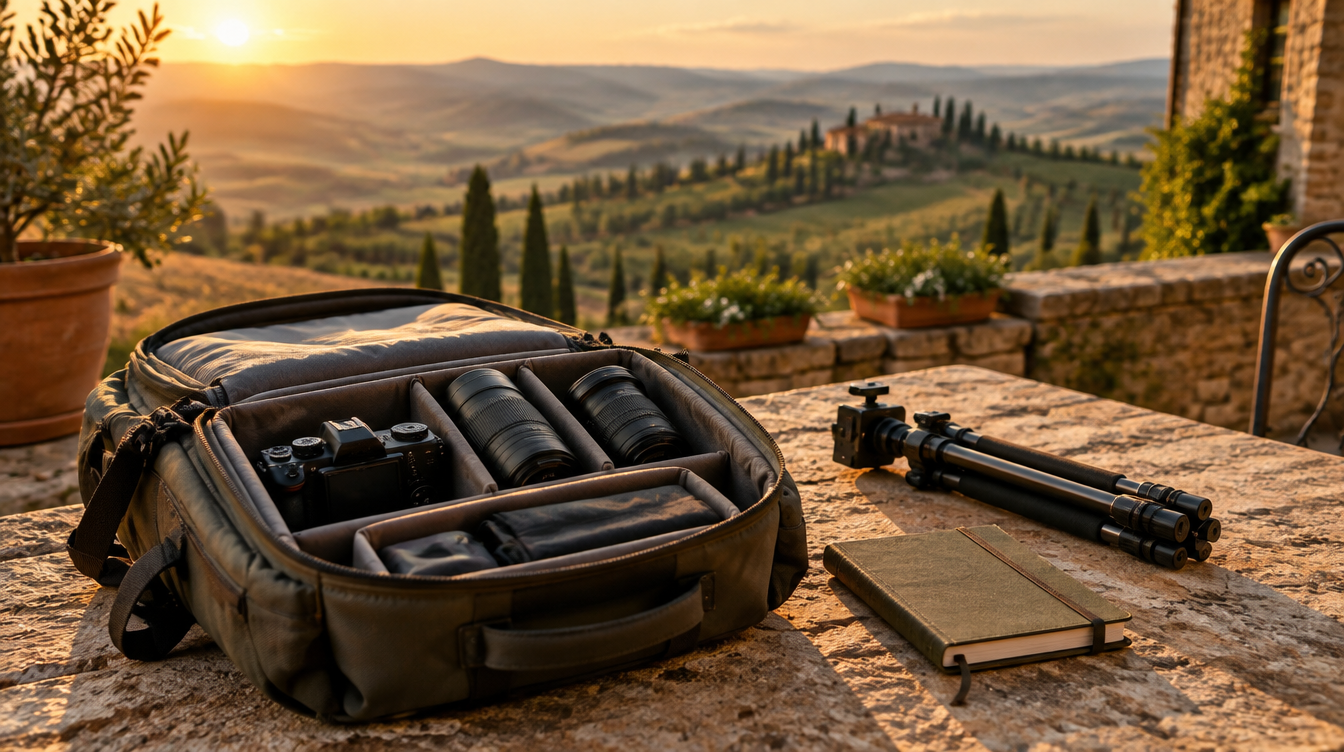
Here is the part of this guide that actually matters most for a photography tour specifically, because it is the part general travel advice never covers. If you are bringing a mirrorless body, two or three lenses, spare batteries, filters, a tripod, and maybe a drone, you are traveling with somewhere between $3,000 and $10,000 of equipment, and in almost every case your regular homeowners or renters insurance either does not cover it away from home, or covers it with a deductible so high it is not worth filing a claim.
I have watched this play out on our own tours more than once. A camera bag left on a van seat for two minutes while someone runs back for a forgotten lens cap. A tripod that gets knocked over on cobblestones outside Pienza. A drone that clips a branch on a windier day than the forecast promised. None of these are dramatic disasters, they are the ordinary wear and tear of shooting outdoors for a week straight, and a policy built specifically for photo and video gear is the only kind of coverage that treats them as routine claims instead of exceptions. We have a full breakdown of how this works in the US at Camera Gear Insurance: A Practical U.S. Guide for Photographers, but the short version for a tour specifically is below.
Where gear coverage actually comes from
There are really two paths. The first is a "scheduled personal property" rider, sometimes called a personal articles floater, added to an existing homeowners or renters policy. You list your gear item by item, serial numbers and all, and the rider extends worldwide coverage for accidental damage, theft, and loss, usually with no deductible or a very small one. This is often the cheapest route if you already have homeowners or renters coverage, since you are adding to an existing relationship rather than starting a new policy from scratch.
The second path is a standalone policy from an insurer built specifically around cameras, lenses, and video gear, aimed at working photographers and serious hobbyists who either rent rather than own a home, or simply want gear coverage decoupled from their homeowners policy entirely. These policies tend to be faster to adjust as you buy and sell equipment, and several are built to be purchased and activated within a day or two of a trip, which matters if you are reading this a week before departure and realize you never got around to it.
Either way, the same principle applies: an unscheduled, generic policy that just says "personal property" is not the same thing as a policy that has your 24-70mm f/2.8 and your camera body listed by make, model, and serial number. Scheduled coverage is what actually pays out cleanly when you file a claim, because there is no argument about value or ownership.
The fine print that actually matters
Once you have a policy in front of you, whether it is trip insurance or gear insurance, there are a handful of specific things worth checking rather than skimming past. For trip insurance: the full list of covered cancellation reasons, the "pre-existing condition" exclusion window (many policies require you to buy within a set number of days of your deposit to waive this), and whether medical evacuation is included by default or sold as an add-on. For gear insurance: the per-item and total coverage limits (make sure your most expensive lens alone does not exceed the per-item cap), the deductible per claim, whether "mysterious disappearance" is covered (this is the clause that pays out when something simply goes missing with no clear theft or accident, which covers more real-world scenarios than people expect), and whether the policy pays replacement cost or actual cash value, since actual cash value on a three year old camera body can be a fraction of what a replacement actually costs today.
Pro Tip: Photograph or video your gear, model numbers and serial numbers visible, the week before you travel, and save the file somewhere other than the camera itself. It sounds excessive until you are the one on the phone with an adjuster trying to prove you actually owned the lens that just went missing.
What to actually do if something happens mid trip
Knowing you have coverage and knowing how to use it while you are standing in a piazza in Pienza with a cracked lens are two different things, so it is worth walking through the actual sequence once before you travel rather than figuring it out under stress. If gear is stolen, the first call is not to your insurer, it is to the local police, because almost every policy requires a police report filed within a set window, often 24 to 72 hours, before they will even open a claim. In Italy that means finding the nearest Carabinieri or Polizia station and asking for a "denuncia," a formal report, and getting a copy before you leave. Our guides can point you to the nearest station in any of the towns we stay in if this ever comes up, but the report itself has to come from you.
If gear is damaged rather than stolen, photograph the damage immediately, from multiple angles, before you pack it away or attempt any kind of repair, and hold on to that documentation along with your original purchase receipt or the serial number list you photographed before leaving home. Most insurers want to see the item, the damage, and proof of ownership before they authorize a repair or replacement, and trying to reconstruct that evidence two weeks later from memory is a much harder conversation than sending three clear photos the same afternoon it happened. For a medical claim, keep every receipt, even small ones like a pharmacy visit, since reimbursement generally requires an itemized bill rather than a card statement showing a charge.
Pro Tip: Save your insurer's international claims phone number, not just an email address, to your phone before you fly, and check whether they offer a WhatsApp or app-based claims line. Standard international calling rates and time zone gaps make a phone-only claims process painfully slow to start from abroad, and starting the claim promptly matters more than most travelers expect.
A quick comparison: trip insurance vs gear insurance
| What it covers | Trip insurance | Camera gear insurance |
|---|---|---|
| Non-refundable deposit and trip cost | Yes, for covered reasons or with CFAR | No |
| Emergency medical care abroad | Yes, usually a core benefit | No |
| Medical evacuation | Yes, sometimes an add-on | No |
| Dropped, cracked, or water damaged lens | Rarely, and only with a very low cap if at all | Yes, this is the core benefit |
| Stolen camera bag | Limited "baggage" coverage, low per-item cap | Yes, at full scheduled value |
| Where you typically buy it | A dedicated trip insurance company at booking | A homeowners/renters rider or a specialty gear insurer |
How I would actually set this up before a Tuscany trip
If you have booked, or are close to booking, a week-long photography trip like our Val d'Orcia photography tour, here is the order I would actually do this in. Buy trip insurance within a couple of weeks of your deposit, since that is the window most insurers use to waive pre-existing condition exclusions and to qualify for a CFAR upgrade if you want one. Separately, get your gear scheduled on a rider or a standalone policy at least a few weeks before departure, not the night before, since some insurers require a short waiting period after a policy starts before certain claims are payable. Our Val d'Orcia trip runs seven days with two guides and a maximum of seven participants, so you are shooting from before sunrise most mornings, which is exactly the kind of trip where gear gets used hard, packed and unpacked daily, and occasionally set down somewhere it should not be. That is not a reason to worry, it is just a reason to have both policies actually in place before you land in Italy rather than figuring it out after something goes wrong.
It is also worth timing this against the two things you are already budgeting for the trip itself, listed out in our breakdown of what's actually included in a photography tour price, and the deposit and cancellation questions worth asking before you book. Between the two, you will usually find the exact date your deposit was charged, which is the number you need to start the trip insurance shopping clock.
Frequently asked questions
Does my credit card's travel insurance cover camera gear? Some premium travel credit cards include a small amount of baggage delay or loss coverage, but the per-item and total caps are almost always too low to meaningfully protect a real camera kit, and cards vary enormously on this, so check your specific card's benefits guide rather than assuming.
Do I need gear insurance if I am only bringing one camera and one lens? It depends on the replacement value. If your total kit is worth a few hundred dollars, the cost of a policy may not be worth it. If you are traveling with a modern mirrorless body and even a single mid-range zoom, you are usually well past the point where a rider or standalone policy pays for itself the first time something goes wrong.
Will my tour operator's insurance cover my personal gear? No. A tour operator's liability insurance protects against operational issues like an accident during a group activity, not your personal belongings. Always assume your camera gear is your own responsibility to insure.
Can I buy gear insurance for just the week of the trip? Some standalone photo and video insurers do offer short-term policies. A scheduled rider on an existing homeowners or renters policy, by contrast, is typically an annual add-on rather than something you turn on and off for a single week, so factor that into which route makes more sense for how often you travel with gear.
What is the single most common claim on a photography trip? Based on what I have seen across our own tours, it is accidental drops, a lens or body knocked off a wall, a table, or a tripod that was not quite as stable as it looked on uneven ground, followed by theft from an unattended bag in a public space.
None of this needs to be complicated once you separate the two problems. Insure the trip cost through a standard travel policy, insure the gear through a rider or a specialty policy, check the fine print on both before you buy, and you can spend the actual week in Val d'Orcia thinking about light and composition instead of what happens if something goes wrong.