Camera Gear Insurance: A Practical U.S. Guide for Photographers
Protect your valuable cameras and lenses
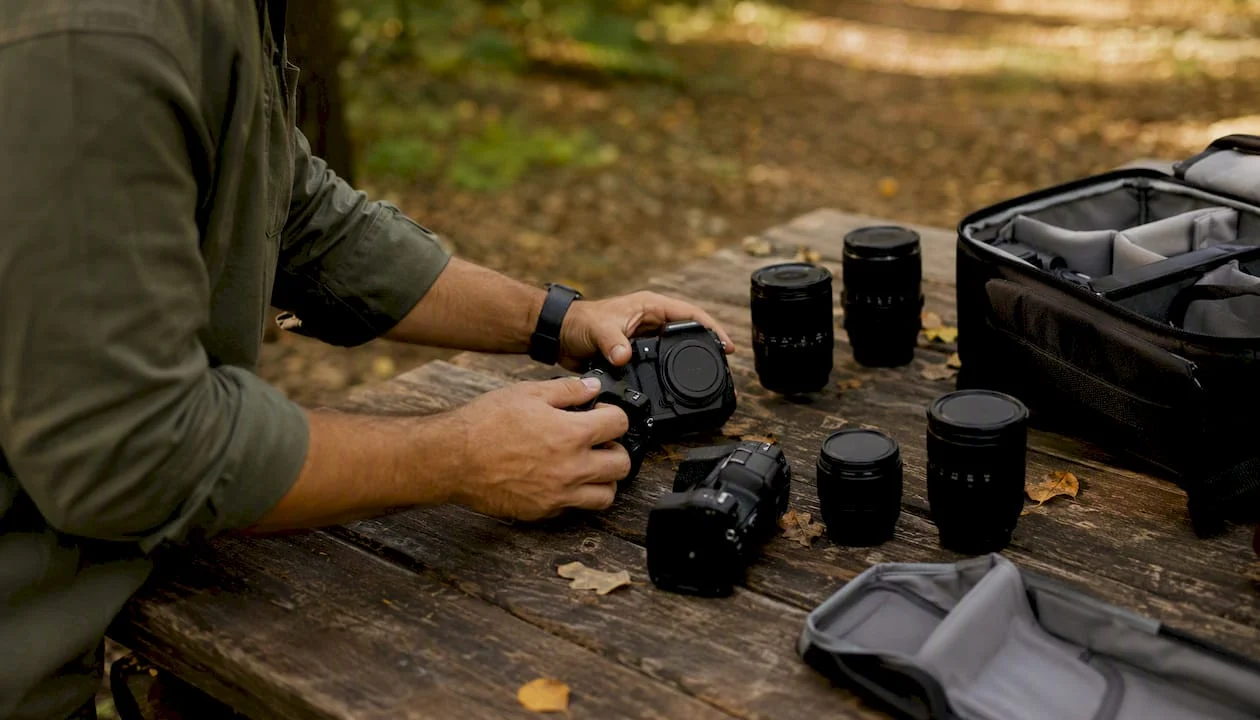
If your kit is worth more than a few thousand dollars, insuring camera gear with a specialist policy is worth the modest monthly cost. However, the real threshold is tiered: hobbyists with a single camera body and a kit lens below roughly $3,000–$5,000 in total value can often rely on a scheduled endorsement added to a homeowners or renters policy, but above that—or if you accept paid work—a specialist or standalone camera insurance policy is usually more appropriate. Photographers carrying substantial gear value, anyone shooting paid work, and anyone traveling internationally should look beyond that.
Three steps to take right now:
- Inventory your gear. Write down every item’s serial number, model, and current replacement value. Total it up.
- Check your existing policy. Call your homeowners or renters insurer and ask about sub-limits on electronics, business-use exclusions, and whether you can schedule individual items.
- Get at least one specialist quote. If your total kit value exceeds $3,000–$5,000, or if you earn income from photography, request a quote from a standalone camera insurance provider before deciding whether your home policy is enough.
Key Takeaways
Specialist camera insurance is the financially sound choice for any photographer whose kit value, travel frequency, or paid work creates real replacement risk.
| Point | Details |
|---|---|
| Inventory first | Record every item’s serial number and replacement cost before requesting any quote. |
| Know your threshold | Once total kit value exceeds roughly $3,000–$5,000, a specialist inland marine policy is typically more appropriate than a home policy endorsement. |
| Replacement cost matters | Specialist policies pay what a new item costs today; many home policies pay depreciated value, which can be far less. |
| Pros need a policy stack | Working photographers benefit from inland marine for gear, a BOP for liability, and E&O coverage for contracted assignments. |
| Weshootphototours reduces field risk | Guided tours with secure logistics and small groups lower the day-to-day equipment risks that insurance is designed to cover. |
Primary sources and where to read official insurer or industry program details
- PPA PhotoCare — Verify membership requirements, flat deductible terms, and worldwide transit language for the PhotoCare inland marine program.
- Full Frame Insurance — Review per-item and aggregate limit tiers, sample monthly prices, and Annual+ plan structures.
- Insureon — Compare inland marine and BOP options for small photography businesses; useful for average-cost benchmarks.
- USAA Camera Insurance — Understand how scheduled personal property programs work and what replacement-cost payouts look like in practice (USAA members only).
- Insurify — Read the premium range analysis and policy feature summaries for personal camera coverage.
- DPReview Insurance Guide — A practical overview of decision factors: kit value, travel frequency, and business use.
This article is general information, not a substitute for advice from a qualified financial advisor. Consult a qualified financial professional about your own circumstances before acting on anything here.
Table of Contents
- What camera insurance is and the common U.S. policy types you’ll encounter
- What camera insurance typically covers, and the exclusions that catch photographers off guard
- How much camera insurance costs, what drives the premium, and example price points
- Does your homeowners or renters policy cover camera gear?
- Insurance options and thresholds for professional photographers
- A step-by-step checklist for choosing and buying the right policy
- U.S. insurers and programs worth checking
- Research-backed guidance, PPA standards, and the tax angle
- The real tradeoff between self-insuring and buying formal coverage
- How Weshootphototours reduces equipment risk on every tour
- Sources
What camera insurance is and the common U.S. policy types you’ll encounter
Camera insurance is a broad term for coverage that protects photographic equipment against loss, theft, and physical damage. The formal industry term is inland marine insurance, a category that dates to cargo policies and now covers any property that moves. Unlike a standard homeowners policy, which is anchored to a fixed location, an inland marine or equipment floater “floats” with your gear wherever it goes, including on location, in transit, and abroad.
You will encounter five main policy types in the U.S.:
- Homeowners or renters scheduled endorsement. You add individual high-value items to your existing policy. Each item gets its own limit and, often, broader perils coverage. USAA’s camera insurance program is a well-known example of this approach, offering itemized, replacement-cost payouts for scheduled gear.
- Standalone electronic device or personal property policy. Offered by companies like Worth Ave. Group and Lemonade, these cover cameras as personal electronics. Useful for hobbyists who want simple, low-cost coverage without a home policy attachment.
- Inland marine / equipment floater. A dedicated policy for photographic equipment, typically offering worldwide coverage, replacement-cost payouts, and broader perils. PPA’s PhotoCare program is built on this model and is designed specifically for photographers.
- Business Owner Policy (BOP) with inland marine. A commercial package combining property, general liability, and equipment coverage. Suited to studio owners and working professionals.
- Travel insurance. General travel policies can include some camera coverage, but per-item limits are often low. Squaremouth’s guidance notes that many travel policies cap individual items well below the replacement cost of a professional camera body, making them a supplement rather than a primary solution.
Pro Tip: Always check whether a policy pays replacement cost or actual cash value (ACV). Replacement cost pays what a new equivalent item costs today. ACV deducts depreciation, which on a three-year-old camera body can mean a payout far below what you need to replace it.
What camera insurance typically covers, and the exclusions that catch photographers off guard
Most specialist camera policies cover a reassuringly wide range of perils. Theft is the most commonly claimed, but accidental damage, water exposure, and transit loss are equally important for working photographers.
Commonly covered perils:
- Theft (including from a locked vehicle, though some policies restrict this)
- Accidental physical damage (drops, impacts, crush damage)
- Water and liquid damage
- Fire and smoke damage
- Vandalism
- Loss in transit or checked baggage
Common exclusions to read carefully:
- Wear and tear or mechanical/electrical breakdown
- Mysterious disappearance (you cannot account for where the item went)
- Intentional damage
- Drone or UAS coverage (often requires a separate endorsement or policy)
- Business-use exclusions under personal policies
That last point deserves attention. If you use your camera for paid work and you file a claim under a personal homeowners policy, your insurer may deny it on the grounds that the gear was in commercial use at the time of loss.
Replacement cost vs. actual cash value is the single most consequential policy detail for photographers. A $3,000 camera body purchased three years ago might have an ACV of $1,200. A replacement-cost policy pays the $3,000 it takes to buy a comparable new body. Backcountry Insurance makes this point clearly: many homeowners and renters policies settle on a depreciated basis, whereas specialist camera policies typically offer full replacement cost.
A practical claim example: a photographer on a coastal shoot drops a 70–200mm lens into shallow water. Under a specialist inland marine policy with replacement-cost coverage, the insurer pays the current retail price of a replacement lens minus the deductible. Under a standard renters policy with ACV, the payout reflects the lens’s depreciated value, which may cover only a fraction of a new purchase.
How much camera insurance costs, what drives the premium, and example price points
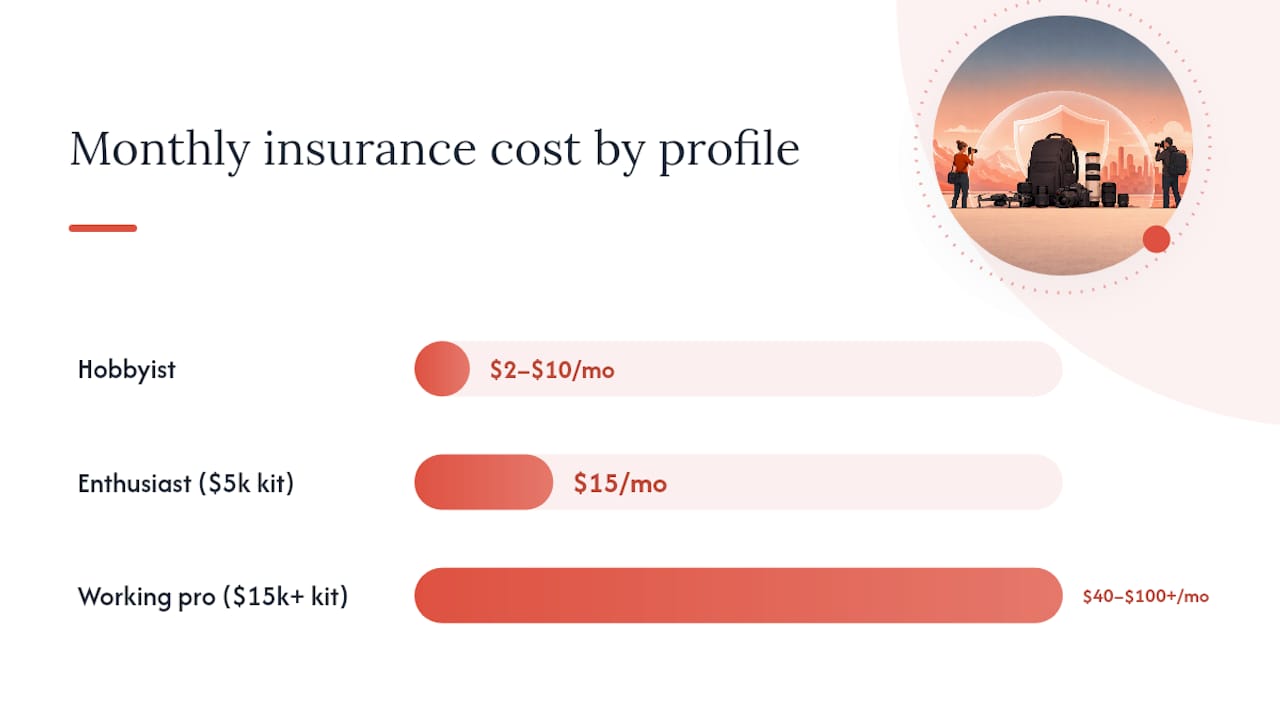
Premiums vary widely depending on the total declared value of your gear, your location, how you use the equipment, and the deductible you choose. Insurify’s analysis reports a range from roughly $2 per month at the low end for minimal personal coverage to more than $100 per month for large professional policies.
Primary cost factors:
- Total declared (insured) value of all equipment
- Per-item limits and aggregate policy limit
- Deductible size (higher deductible = lower premium)
- Worldwide transit coverage vs. domestic only
- Business vs. personal use classification
- Prior claims history
- Bundling with liability or other commercial coverages
| Coverage profile | Policy type | Approximate monthly cost | Notes |
|---|---|---|---|
| Hobbyist, modest-value kit | Scheduled endorsement / personal | $2–$10/month | Added to existing home policy; actual cash value (ACV) coverage is common |
| Enthusiast, $5,000 kit | Standalone equipment floater | $15/month | Replacement cost; worldwide transit available |
| Working pro, $15,000+ kit | Inland marine / BOP | $40–$100+/month | Flat deductible; liability add-on common (typical industry range) |
| Travel photographer | Bundled travel + equipment | Varies by trip/annual | Full Frame Insurance offers bundled annual plans |
Full Frame’s equipment coverage tiers illustrate how per-item limits change cost: a plan with a $2,500 per-item limit costs less than one with a $5,000 per-item limit, even when the aggregate insured value is similar. Choosing the right per-item limit for your most expensive single piece of gear is often the most important pricing decision you will make.
Does your homeowners or renters policy cover camera gear?
Standard homeowners and renters policies do cover personal property, including cameras, but with meaningful limitations. Most policies apply a sub-limit to electronics or high-value items, meaning your $4,000 mirrorless body might be covered only up to $1,500. They also typically pay ACV rather than replacement cost, and they almost universally exclude business use.
Scheduling an item on your policy removes the sub-limit and often upgrades coverage to replacement cost for that specific item. You will usually need to provide a receipt, a recent appraisal, or a serial number. USAA’s camera program shows how scheduled personal property can deliver itemized, replacement-cost payouts that differ substantially from what an unscheduled claim would yield.
Questions to ask your agent before deciding:
- What is the per-item sub-limit for cameras and electronics under my current policy?
- Does scheduling an item upgrade me to replacement cost?
- Is there a deductible per scheduled item or per claim?
- Does coverage extend worldwide and while the gear is in transit?
- Are there any business-use exclusions, even for occasional paid work?
- What documentation do you require to file a claim?
If the answers reveal low sub-limits, ACV payouts, or any business-use exclusion that applies to your situation, a standalone specialist policy is worth pricing out.
Insurance options and thresholds for professional photographers
Once your total kit value crosses roughly $10,000, the case for specialist coverage becomes clear. Adorama’s guidance puts this threshold plainly: home policies frequently underinsured high-value kits, and the gap between what a standard policy pays and what replacement actually costs can be financially damaging for a working photographer.
Professionals typically need a layered approach:
- Inland marine / equipment floater for the gear itself, with flat deductibles (a percentage-based deductible on a $20,000 kit can be painful) and worldwide transit language
- BOP or commercial package policy for studio property, general liability, and business interruption
- Professional liability or Errors and Omissions (E&O) when you are contracted for weddings, commercial shoots, or any assignment where a missed deliverable creates financial exposure for a client
Insureon’s inland marine data cites an average monthly cost of around $43 for inland marine coverage for small photography businesses, though actual premiums vary by kit value, location, and coverage scope.
Pro Tip: Multi-photographer studios should add additional insureds to their inland marine policy for each photographer who carries gear under the studio’s umbrella. For one-off events or destination shoots, short-term event coverage is often cheaper than extending an annual policy and then canceling it.
For drone operators, verify that your inland marine policy includes UAS coverage or purchase a separate drone policy. Most standard equipment floaters exclude drones by default.
A step-by-step checklist for choosing and buying the right policy
Buying camera insurance is methodical when you approach it in order. Here is a practical sequence:
- Build a complete gear inventory. List every item: body, lenses, flashes, tripods, bags, filters, and accessories. Record the model, serial number, purchase date, and current replacement cost for each. Store this list offsite or in cloud storage.
- Decide between replacement cost and ACV. For any item you would need to replace immediately to keep working, replacement cost is the right choice. ACV is acceptable only for gear you could afford to replace slowly or not at all.
- Get quotes from at least three different policy types. Compare a scheduled endorsement on your home policy, a standalone equipment floater, and (if you earn income from photography) an inland marine or BOP quote.
- Read the exclusions before the coverage summary. Check for business-use language, mysterious disappearance clauses, transit restrictions, and drone exclusions.
- Choose your deductible deliberately. A $500 deductible on a $15,000 kit is reasonable. A $2,500 deductible on a $5,000 kit means you are effectively self-insuring most losses.
- Confirm worldwide and in-transit language. If you travel, your policy must explicitly cover gear while checked, in a rental car, or on a tour bus.
- Document serial numbers and back up receipts. Full Frame Insurance notes that claims are frequently delayed when ownership documentation is incomplete. Photograph serial number plates, scan receipts, and store both in a cloud folder your insurer can access quickly.
Questions to ask any insurer during the quote process:
- How do you handle partial losses (damaged but repairable gear)?
- What is the average time from claim filing to payment?
- Do you require a police report for theft claims?
- Is there a waiting period before coverage begins?
U.S. insurers and programs worth checking
The providers below represent a range of approaches. Each suits a different photographer profile, so treat this as a starting map rather than a ranked list.
- Progressive. Offers camera equipment coverage as part of its personal articles policy. Suited to hobbyists who want to add coverage without switching home insurers. Verify per-item limits and whether replacement cost is standard or an upgrade.
- Full Frame Insurance. Designed specifically for photographers and videographers, with bundled travel and equipment packages and customizable per-item limits. Their travel photographer plans are a practical benchmark for anyone shooting internationally.
- PhotoCare (PPA). The Professional Photographers of America’s member insurance program, built on inland marine principles. PPA recommends PhotoCare for its replacement-cost payouts, flat deductibles, and on-location and travel coverage. Membership is required, but the combined membership and insurance cost is often competitive with standalone policies.
- Worth Ave. Group. A specialist in personal electronics and camera coverage, with straightforward online quotes. Popular with hobbyists and students. Check per-item limits carefully; they can be lower than what professional-grade gear requires.
- Lemonade. Offers renters and homeowners policies with the option to schedule high-value items. Fast claims process via its app. Best for hobbyists who already use Lemonade for renters insurance and want to add camera coverage without managing a separate policy.
- The Hartford. A strong option for professional photographers who need a BOP combining general liability, commercial property, and equipment coverage. Insureon works with The Hartford and similar carriers to provide inland marine quotes for small photography businesses.
Research-backed guidance, PPA standards, and the tax angle
The professional photography industry’s most cited guidance on equipment insurance comes from the PPA, which administers the PhotoCare program. PPA’s position is that inland marine coverage is the appropriate vehicle for photographers because it is designed to travel with the gear, covering it on location, in transit, and internationally. The program’s flat deductibles and replacement-cost payouts address the two most common complaints about standard home policies.
Insurify’s premium analysis confirms the wide spectrum: basic personal coverage can cost as little as $2 per month, while professional policies with high aggregate limits and liability add-ons exceed $100 per month. The $40–$43 per month range cited by Insureon for inland marine coverage represents a reasonable midpoint for a working photographer with a mid-range kit.
For business-use photography, insurance premiums are generally deductible as an ordinary and necessary business expense under IRS guidelines. This applies to inland marine policies, BOPs, and professional liability coverage when the gear or coverage is used in your photography business. The deduction does not apply to personal-use coverage. Consult a tax professional to confirm how this applies to your specific situation, particularly if you split gear between personal and professional use.
DPReview’s practical guide frames the decision around three factors: the replacement value of your kit, how frequently you travel or work on location, and whether photography generates income. When all three are present, dedicated coverage is almost always the financially sound choice.
The real tradeoff between self-insuring and buying formal coverage
Most photographers who skip insurance do so for one of two reasons: they assume their home policy covers everything, or they decide to self-insure by setting aside a small emergency fund. Both approaches have merit in the right circumstances, and neither is automatically wrong.
Self-insuring works when your total kit value is low enough that a total loss would not disrupt your finances or your ability to keep shooting. A hobbyist with a $1,200 mirrorless kit and a solid emergency fund can reasonably absorb that loss. The math changes fast, though. A working photographer with $18,000 in bodies and glass cannot replace that kit from savings without pausing their business, and a business pause has costs that extend well beyond the gear itself.
| Approach | Best for | Key advantage | Key risk |
|---|---|---|---|
| Self-insure | Low-value kits, infrequent use | No premium cost | Full replacement cost comes from your own pocket |
| Specialist policy | High-value kits, travel, paid work | Replacement cost, fast recovery | Monthly premium; requires documentation |
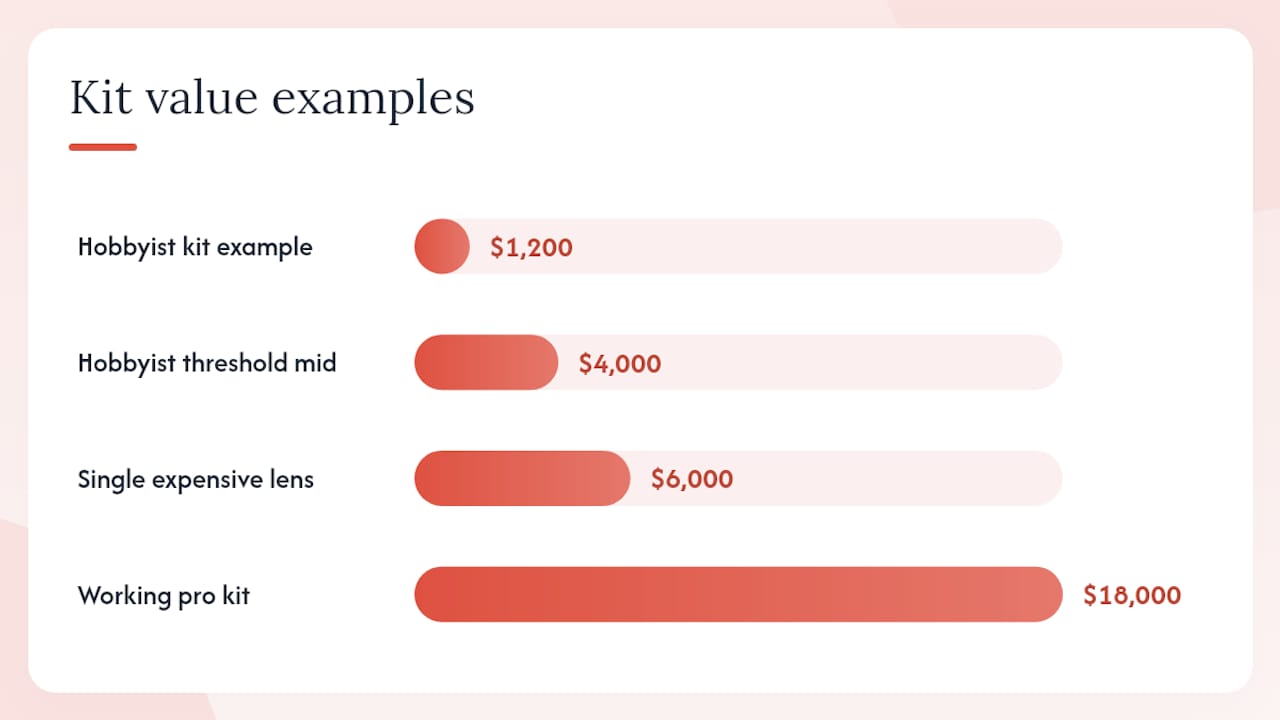
The conventional wisdom says “just add it to your home policy.” That advice is fine for a $500 point-and-shoot. For a photographer carrying a $6,000 telephoto lens on a tour, it is genuinely inadequate. Home policies were not designed for gear that travels internationally, gets used in rain and dust, and represents a working professional’s primary income tool. A specialist inland marine policy was.
The hobbyist threshold is roughly $3,000–$5,000 in total kit value: below that, a scheduled endorsement on a home policy is usually sufficient. Above that range, or the moment you accept your first paid assignment, a standalone equipment floater or inland marine policy is the more deliberate choice.
How Weshootphototours reduces equipment risk on every tour
Photography tours carry their own form of equipment risk management built into the experience. When you join a Weshootphototours private photo tour, the logistics that typically expose gear to damage or theft are handled by experienced guides who have spent years working in the field.
- Gear is transported in coordinated, secure vehicles rather than left in rental cars or unfamiliar accommodations.
- Small group sizes mean your equipment is never lost in a crowd, and instructors notice when something is at risk before it becomes a problem.
- Boutique accommodations are selected with security in mind, reducing the overnight theft risk that catches solo travelers off guard.
Insurance covers what goes wrong. A well-run tour reduces how often things go wrong in the first place. Browse the full photography tours and expeditions catalog to find a destination that fits your schedule, and reach out to discuss how the tour’s logistics work before you book.
Sources
- Photographer Insurance | Camera Equipment & Liability | PPA | Professional Photographers of America
- Travel Photographer Insurance | Full Frame Insurance
- Camera Equipment Coverage: Secure Your Gear Anywhere
- Insurance: Is It Worth It? (Insurify device-insurance/cameras)
- Camera insurance (Adorama Learning Center)
- Equipment insurance for photographers and videographers (Insureon)
- Camera Insurance | USAA
- Protect your gear: a photographer’s guide to insurance (DPReview)
- Camera travel insurance (Backcountry Insurance)