Deposit, Payment Plans, and Cancellation Policies: What to Ask Before You Book a Photo Tour
The deposit, payment plan, and cancellation questions worth asking before you put money down on any photography tour, walked through plainly with real numbers.

Deposit, Payment Plans, and Cancellation Policies: What to Ask Before You Book a Photo Tour
A few years ago I watched a friend lose about $600 on a trip that never happened. Not to us, to a different operator entirely, one running a workshop in a completely different part of the world. Work fell apart three weeks before departure, she asked for a refund, and the answer she got back was some version of "the deposit is non-refundable, you should have read the terms." She had read the terms. They just were not written in a way that made the actual risk obvious until the moment it mattered. That is the story that comes to mind every time someone tells me they are "just about to put down a deposit" on a tour, ours or anyone else's, without asking a single question first.
This is not a scare piece. Most photography tour operators, including us, run honest, well-structured booking processes. But a deposit is real money changing hands months before you get anything in return, and the questions that protect you are almost always the ones nobody asks out loud because they feel awkward to bring up. I would rather you ask me these questions directly than find out the hard way that you should have. So this is the list I would want a friend to run through before booking any photography tour, with our own Val d'Orcia tour used as the concrete, real-numbers example throughout.
I want to be clear about the framing here. This is not a "gotcha" list designed to make every operator look shady. It is a normal, healthy set of questions that a well-run tour company should be able to answer without hesitation, in writing, before you pay anything. If an operator gets cagey about any of the questions below, that reaction is more useful information than the answer itself would have been.
Key Takeaways
A deposit and a cancellation policy are the two places where the real financial risk of a tour lives, and both are usually spelled out clearly if you know which questions to ask.
| Point | Details |
|---|---|
| Typical deposit size | Around 30 percent of the total price is common; on our own Val d'Orcia tour that is $1,440 on the current $4,800 rate |
| Balance timing | Ask for the exact calendar date the remaining balance is due, not a vague "before departure," and get it in your written confirmation |
| Payment plans | Many operators, including us, offer installment options if you ask, even when it is not advertised on the main booking page |
| Cancellation tiers | A fair policy scales the refund down in steps as departure approaches rather than jumping straight from "full refund" to "nothing" |
| Operator-side cancellation | Ask what happens to your money if the operator cancels the departure, not just what happens if you cancel |
| Travel insurance | The one tool that can cover you when neither the deposit nor the cancellation policy will, and it is worth pricing before you book |
Table of Contents
- The quick answer
- Why this question feels awkward to ask
- What a deposit actually buys you
- When is the balance due, and what happens if you miss it
- Are payment plans actually available
- The cancellation question most people skip
- What happens if the operator cancels instead of you
- Six questions to ask before you pay a deposit
- How this works on our own Val d'Orcia tour
- Why travel insurance is not optional
- Red flags worth walking away from
- Frequently asked questions
- So what should you actually do
The quick answer
Before you pay any deposit on a photography tour, get four things in writing: the exact deposit amount, the exact date the remaining balance is due, whether an installment plan exists even if it is not advertised, and what the refund looks like at each point between booking and departure, both if you cancel and if the operator does. On our own Val d'Orcia tour, that deposit is 30 percent of the tour price, which works out to $1,440 on the current $4,800 rate. None of this is unusual or aggressive. It is just the kind of detail that is easy to skip past when you are excited about a trip, and the exact place where a vague answer should slow you down.
Pro Tip: Ask for the cancellation policy and payment schedule in writing, over email, before you pay the deposit, not after. A verbal "don't worry, we're flexible" from a sales call means nothing once money has changed hands. A written policy, even a short one, is something you can actually hold the operator to.
Why this question feels awkward to ask
I get why people skip this. You have just spent weeks getting excited about golden hour over Val d'Orcia, you have found a departure date that works with your schedule, and asking about worst-case cancellation scenarios feels like inviting bad luck into a good decision. There is also a social awkwardness to it that does not exist when you are buying, say, a lens. Nobody feels rude asking a camera store about a return policy. Asking a photography guide, someone you might already be following on Instagram and quietly hoping to become friendly with over a shared table in Tuscany, about refund percentages can feel like you are accusing them of something.
You are not. A tour operator who has run departures for any length of time has answered this question dozens of times, and a clear, calm answer is not a red flag, it is the baseline. The awkwardness only becomes a real problem when it stops you from asking at all, because the deposit and cancellation terms are exactly the two places where a genuinely bad month, a job loss, a family emergency, a torn ACL two weeks before a trip built around hiking to hilltop viewpoints at dawn, turns into a financial problem on top of everything else.
What a deposit actually buys you
A deposit is not just a formality. On a small group tour capped at seven participants, like ours, a booked spot is a real seat that stops being available to anyone else the moment you pay. That matters more than it might seem, because a departure with two guides and a group cap needs a certain number of paid bookings to actually run. Your deposit is doing real work for the operator: it converts an interested lead into a committed traveler, and it lets the operator start locking in the villa, the local guiding arrangements, and the wine tasting reservation with confidence that the numbers will hold.
That is a fair trade, but it only stays fair if the deposit percentage is reasonable relative to the total price and the timeline for the balance is clear. A 30 percent deposit on a $4,800 tour is $1,440, which is real money but not the whole trip. If you ever come across an operator asking for 50 percent or more up front, months before departure, with no clear justification, that is worth a direct question about why, rather than an assumption that it is standard.
When is the balance due, and what happens if you miss it
This is the single most commonly skipped question, and it should not be. "Balance due before departure" is not an answer, it is a placeholder for one. You want an actual calendar date, or a fixed number of days before the trip, written into your booking confirmation. You also want to know what happens if that date slips by a few days because your bank flagged an international wire or a card got declined while you were traveling for work. A reasonable operator has a grace period and a way to reach you before canceling your spot outright. An operator who cannot answer this clearly, or who treats a missed deadline as an automatic forfeiture with zero warning, is telling you something about how the rest of the relationship will go if anything unexpected comes up during the trip itself.
I would also ask what currency the balance is charged in and whether the price is locked at booking or subject to change based on exchange rates closer to departure. Most reputable operators lock the U.S. dollar price at the time of booking specifically so a traveler is not blindsided by a currency swing eight months later. If that is not explicitly stated, ask.
Are payment plans actually available
A lot of operators, us included, offer some form of installment payment even when the main booking page only shows "pay 30 percent now." It is worth asking directly rather than assuming the deposit-plus-one-lump-sum structure is the only option, especially if spreading a $4,800 trip across three or four payments over several months would make the difference between booking now and waiting for next year's departure. The existence of a payment plan is not always advertised prominently, partly because it adds a layer of complexity that most booking pages are not built to explain cleanly, but a quick email usually gets you a straight answer.
If a payment plan exists, ask the same balance-due questions about each installment that you would ask about a single lump sum: exact dates, what happens on a missed payment, and whether any installment is treated differently from the initial deposit if you need to cancel partway through the schedule. A payment plan that quietly forfeits every dollar paid so far on a missed third installment is a very different arrangement from one that simply pauses and reaches out to you first.
The cancellation question most people skip
Almost everyone asks "can I get a refund if I cancel." Fewer people ask the more useful version: "what does the refund look like at each point between now and departure." A fair cancellation policy is almost never a single number. It is a tiered structure that scales down as the departure date gets closer, something like a full or near-full refund far out, a partial refund in a middle window, and a smaller or no refund in the final weeks when the operator has already committed to non-refundable costs like the villa and local guiding arrangements on your behalf.
Ask specifically whether cancellation credit can be applied to a future departure instead of a cash refund, and whether that option exists even inside the window where a cash refund would not be available. Plenty of travelers who cannot get their money back due to timing are perfectly happy to shift to a departure six months later, and a reasonable operator should offer that flexibility even when a strict cash refund policy says no.
What happens if the operator cancels instead of you
This is the question I almost never hear anyone ask, and it deserves at least as much attention as the reverse scenario. Tours occasionally get canceled by the operator, not the traveler, whether due to low enrollment, a genuine weather or force majeure event, or something happening on the ground that makes the planned itinerary unsafe. In that situation, the deposit and balance you have already paid should come back to you in full, or convert cleanly to credit for a future departure, without you having to fight for it. Ask this directly before booking: "if you cancel this departure, what happens to the money I've already paid?" A confident, specific answer here tells you a lot about how the company is actually run.
Weather and force majeure clauses matter more for an outdoor photography tour than for a lot of other travel, since a trip built around specific golden hour and fog windows genuinely can be affected by conditions outside anyone's control. A well-written policy separates "the operator changed the itinerary because of weather," which is normal and does not warrant a refund, from "the operator canceled the entire departure," which does.
Six questions to ask before you pay a deposit
Here is the condensed version, the six questions I would actually type into an email before paying anything. None of these should feel confrontational to ask, and a good operator will not treat them that way.
| Question | Why it matters |
|---|---|
| What is the exact deposit amount, in dollars? | Turns a percentage into a real number you can budget against today |
| What is the exact date the balance is due? | Removes the ambiguity in "before departure" and gives you a hard deadline |
| Is a payment plan available, even if not advertised? | Can materially change whether the trip fits your budget this year |
| What is the refund schedule if I cancel, at each time window? | Shows whether the policy is a single cliff edge or a fair, tiered structure |
| What happens to my payments if you cancel the departure? | Protects you from the scenario almost nobody thinks to ask about |
| Is the price locked in USD at booking? | Prevents a surprise balance increase from currency movement |
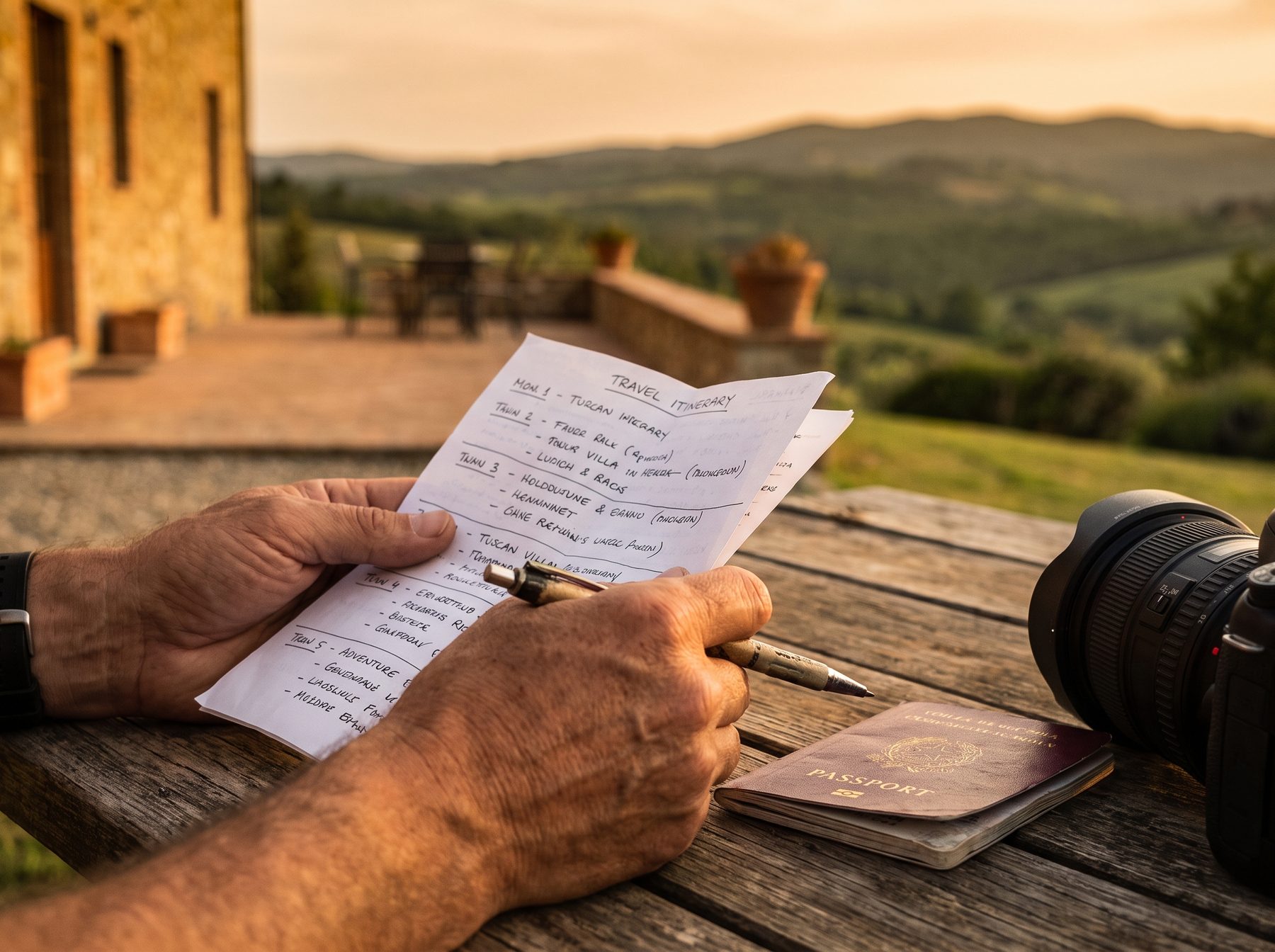
How this works on our own Val d'Orcia tour
I would rather show you our own numbers than talk in generalities, since it is easy to write a list of "ask this" advice without ever demonstrating what a real answer sounds like. Our current Val d'Orcia departures run $4,800 per person, and the deposit to hold a spot is 30 percent of that, which is $1,440. Installment payment options exist if the full deposit or balance timing does not fit your cash flow cleanly, and that is something we would rather explain over email than bury in a PDF nobody reads before booking. If a departure genuinely cannot run, whether from low enrollment or a serious weather event affecting the region, what you have paid comes back to you or converts to credit toward a future departure, not silently forfeited.
I am telling you this not because our policy is unusually generous compared to every other operator out there, but because it is a reasonable baseline, and I would rather you use it as the yardstick you compare other tours against than take my word for it that "our policy is fair" without seeing what that actually means in dollars and dates. If you are weighing whether to book, our Val d'Orcia photography tour page has current departure dates and pricing, and I would genuinely rather answer a direct question about deposits or cancellations by email before you pay anything than have you find out the details after the fact.
Why travel insurance is not optional
Even the fairest cancellation policy in the world has limits, and travel insurance is the tool that covers the gap. A tour operator's refund policy is designed around the operator's own costs and commitments, not your flight, your camera insurance, or a medical emergency that has nothing to do with the tour itself. A separate travel insurance policy, ideally one with a "cancel for any reason" upgrade if your budget allows it, protects the parts of the trip that no tour operator's policy was ever designed to cover, including the international flight that is usually the single largest non-tour expense on the whole itinerary.
This matters even more on a photography-specific trip, since you are also likely traveling with several thousand dollars of camera gear. A policy that covers trip cancellation and also covers gear loss or damage in transit is worth the extra cost, especially given how much of a Val d'Orcia trip depends on having a working wide angle lens and a sturdy tripod ready at 6am on the morning the fog actually rolls in.
If you want to see the full picture of what a Val d'Orcia trip costs beyond the tour price itself, including where travel insurance and other line items fit into a realistic budget, our full cost breakdown walks through every piece with real numbers rather than vague categories.
Red flags worth walking away from
A few specific answers should give you real pause, regardless of how appealing the itinerary looks. A refund policy that only exists verbally, with nothing in writing anywhere on the booking page or in your confirmation email, is the biggest one. So is an operator who gets defensive or vague when you ask what happens if they cancel the departure, since that is the one scenario entirely within their control to answer clearly. Pressure to pay the full balance immediately rather than following a stated deposit-then-balance structure is another one worth questioning, particularly for a trip many months out. None of these automatically mean an operator is dishonest, but they are exactly the kind of soft signals that are easy to explain away in the excitement of planning a trip and much harder to explain away after something goes wrong.
Pro Tip: If an operator's cancellation policy is not published anywhere on their own website, ask them to send it to you in writing before you pay. If they hesitate to put it in an email, treat that hesitation as your answer.
Frequently asked questions
Is a 30 percent deposit normal for a photography tour? Yes, that is a fairly common range across small group tours, though it varies by operator. What matters more than the exact percentage is whether the balance timeline and cancellation terms tied to it are clearly written down.
Can I get a full refund if I cancel far enough in advance? On most well-structured policies, yes, cancellations made well ahead of departure typically qualify for a full or near-full refund, since the operator has not yet committed to non-refundable costs on your behalf. Ask for the exact cutoff date rather than assuming a specific number of months.
What if I need to cancel two weeks before departure? This is usually the least forgiving window on any tour, since lodging, guiding, and other arrangements are already locked in by that point. A transferable credit toward a future departure is often available even when a cash refund is not, so ask about that option specifically rather than assuming a total loss.
Does travel insurance replace the need to ask about cancellation policy? No, they cover different things. The tour's own cancellation policy governs what the operator owes you. Travel insurance covers what neither the operator nor you can control, like a medical emergency, a canceled flight, or lost gear.
Should I be worried if an operator asks for the full amount up front instead of a deposit? It is worth asking why. Some smaller or newer operators structure things differently, and that alone is not automatically a problem, but you lose some flexibility and it is a fair reason to ask more questions about their cancellation terms before committing the full amount.
So what should you actually do
Send one email before you pay anything. Ask for the exact deposit amount, the exact balance due date, whether a payment plan exists, and what the refund looks like if either you or the operator cancels, at every relevant point on the calendar. A good operator will answer all of it directly and probably within a day. That single email costs you nothing and takes the guesswork out of what is, for most people, one of the larger single purchases they will make all year. Once you have those answers in writing, you are in a genuinely informed position to decide, not just an excited one.