How Much Does a Tuscany Photography Tour Really Cost?
A transparent, line-item breakdown of what a Tuscany photography tour actually costs, what the price includes, and what you will still pay for out of pocket.
How Much Does a Tuscany Photography Tour Really Cost?
Every time I mention the price of our Val d'Orcia photography tour to someone who has not been on a guided trip before, I get the same reaction: a slight pause, then some version of "for a week?" It is a fair question. A number in the four to five thousand dollar range sounds steep until you actually sit down and add up what it replaces. I have done that math more times than I can count, both for my own trips and for readers who email me asking whether a guided tour is worth it compared to booking everything themselves. This is the honest, line by line answer.
I am going to use our own Val d'Orcia tour as the working example, because I know its numbers cold and because the structure of the cost, guiding plus lodging plus meals plus instruction, is close to what you will find on most reputable small group photography tours anywhere in the world. If you are trying to decide whether a guided trip makes sense for your Tuscany plans, or whether you would rather build the trip yourself, this breakdown should give you real numbers to work with instead of vague reassurance.
I want to be upfront about something before we get into the numbers. I run photography tours for a living, so I am not a neutral third party writing a generic "tours versus DIY" listicle. What I can offer instead is the actual math, the same math I would walk a friend through if they called me asking whether $4,800 for a week in Tuscany made any sense. You can take the line items below and plug in your own estimates for flights, gear insurance, and how much you value not spending your evenings researching restaurants, and decide for yourself.
Key Takeaways
A Tuscany photography tour price is not just a guiding fee. It bundles several trip costs you would otherwise pay separately, and a few genuine extras stay outside the price no matter which tour you book.
| Point | Details |
|---|---|
| Typical price range | $4,800 to $5,000 per person for a 7 day / 6 night small group tour, with a 30 percent deposit to reserve your spot |
| What is bundled in | Lodging, all meals, ground transport, two professional photographer guides, and structured editing sessions and image reviews |
| What stays separate | Flights, travel insurance, wine tasting and other beverages beyond the included meals, and personal spending |
| Group size that sets the price | A cap of 7 participants with 2 guides keeps the ratio low, which is a real cost driver, not just a marketing line |
| DIY comparison | A self-planned week with comparable lodging, a rental car, and a few paid local guiding days often lands within a few hundred dollars of the guided price, once you value your own planning time at anything above zero |
Table of Contents
- The quick answer
- What the price actually covers
- The accommodation line item
- The meals line item
- The guiding and instruction line item
- What is not included
- Included vs not included, at a glance
- The DIY math: what a self-planned week actually costs
- Hidden costs that sneak up on a DIY trip
- Why a small group costs more than a big one
- When to book for the price you want
- Frequently asked questions about the cost
- So is it worth it
The quick answer
Our Val d'Orcia tour runs $4,800 to $5,000 per person depending on the departure, which covers seven days and six nights of villa accommodation, every meal, ground transport between locations, two professional photographer guides, and built in editing sessions and image reviews. It does not cover your flight to Italy, travel insurance, wine tasting or beverages beyond what is served at meals, or personal spending. Once you price out a comparable DIY trip, guided or not stops being an obvious answer either way, and becomes a real decision about how you want to spend your time and whether you value having two working photographers guiding your light and your compositions every single day.
Pro Tip: Before you compare any two tour prices, check the group size and guide ratio first. A $4,200 tour with 14 guests and one guide is not actually cheaper than a $4,800 tour with 7 guests and two guides, once you count how much shooting time you will spend waiting your turn for feedback.
What the price actually covers
It helps to think of a photography tour price as five separate costs bundled into one number: a place to sleep, food to eat, transport between locations, professional guiding, and structured learning. On a DIY trip you would be paying for every one of these anyway, just separately and usually less efficiently, since you do not have local knowledge of which agriturismo has the best light on its terrace or which back road avoids the tour bus traffic near the hilltop towns. A guided tour is not adding a mysterious markup on top of your trip. It is consolidating costs you would pay regardless and adding the guiding and instruction on top.
Let's go through each piece with real numbers rather than vague categories, since that is the only way to actually judge whether $4,800 to $5,000 is fair for what you get. I will also flag the costs that are easy to forget when you are pricing out a DIY version of the same trip, because those are usually where the real gap between "cheaper on paper" and "cheaper in practice" shows up.
The accommodation line item
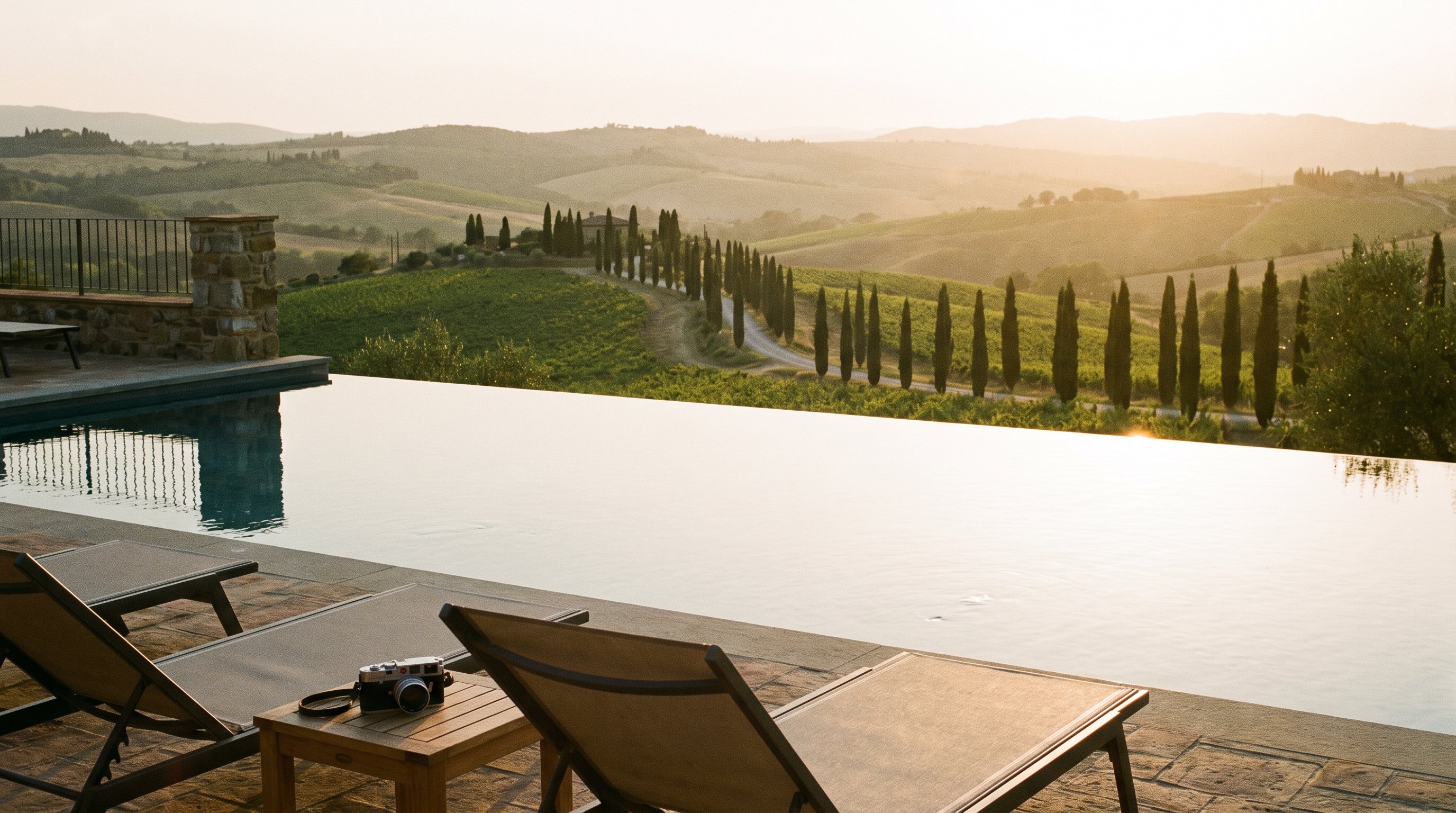
Our group stays in a high level villa or agriturismo set in the countryside, with a pool and full amenities, for the full six nights. If you priced that kind of property yourself for a solo or small group booking during peak season, a comparable countryside villa with a pool in the Val d'Orcia area commonly runs somewhere in the $150 to $300 per night range depending on the property and how far in advance you book, which puts six nights in the neighborhood of $900 to $1,800 on its own. That is before you factor in that a villa like this is genuinely hard to book solo, since many of the best properties are set up for groups and require a minimum stay or a full-property rental that does not pencil out for one or two travelers.
The meals line item
All meals are included in the tour price, prepared with authentic Tuscan ingredients, though wine and other beverages beyond what comes with the meal are extra. If you were feeding yourself for seven days in the Val d'Orcia region, even eating modestly at trattorias rather than tourist restaurants, you are realistically looking at $50 to $70 per person per day once you count breakfast, lunch, and a proper Tuscan dinner, which works out to roughly $350 to $500 for the week. The quality difference matters too. Home cooked meals at a villa, often using produce from the surrounding farm, are simply not something you can replicate by picking restaurants off a map from your hotel room every night.
The guiding and instruction line item
This is the piece that is genuinely hard to price against a DIY trip, because there is no clean substitute for two working professional photographers adjusting your itinerary in real time based on light, weather, and fog forecasts, plus running structured post-processing masterclasses and one-on-one image reviews throughout the week. If you tried to hire a private photography guide for even three or four days of a solo Tuscany trip, day rates for an experienced local photography guide commonly run $300 to $600 or more per day, which alone can approach or exceed a large share of the entire tour price before you have paid for a single night of lodging or a single meal.
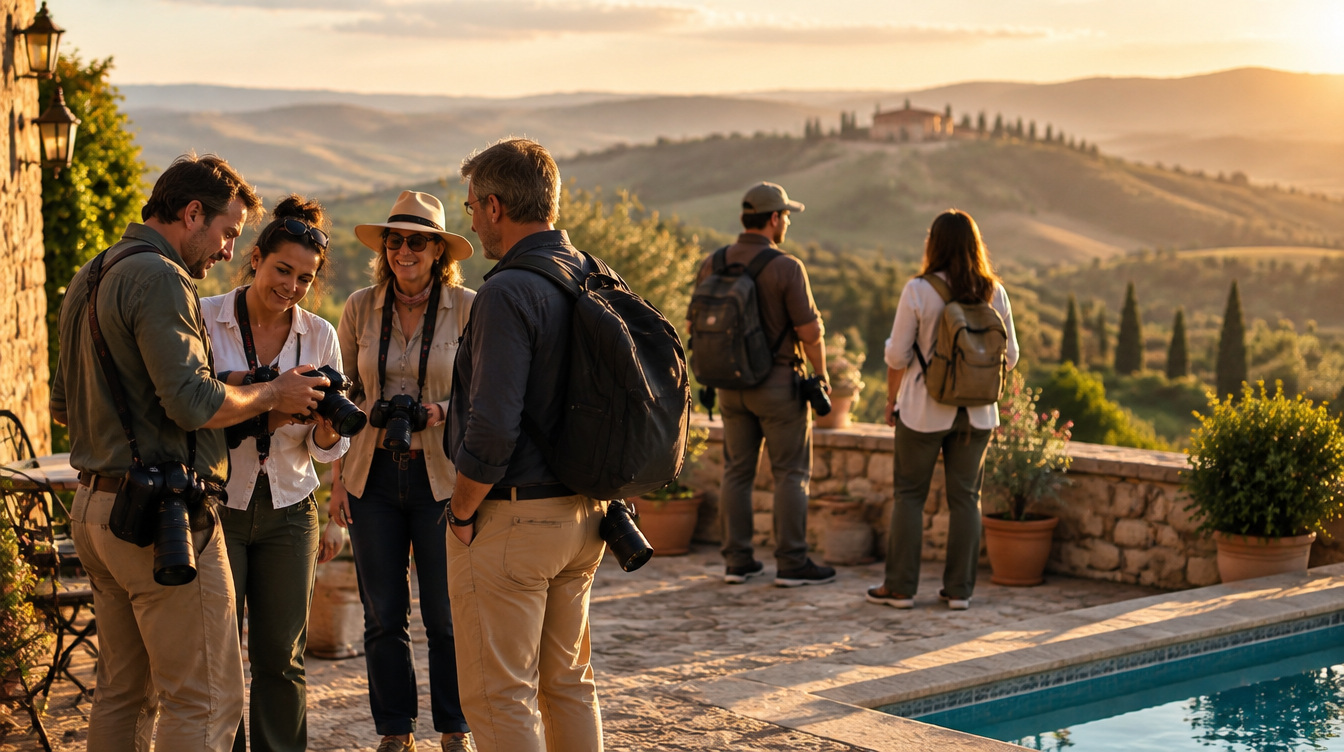
In practical terms, that guiding shows up as things like a guide setting up next to you at 6:15am to walk through exactly how to balance a two stop graduated ND filter against a rising sun so the sky does not blow out while the foreground stays readable, or someone checking your composition on a cypress road shot and suggesting you drop to a 24mm instead of the 70mm you grabbed out of habit, because the wider glass is what actually sells the scale of the hills. Small adjustments like that, repeated daily for a week, add up to a real jump in your keeper rate that is hard to replicate from a blog post or a YouTube tutorial watched the night before your trip.
If you are weighing whether this kind of structured, in-field instruction is what you actually want out of a Tuscany trip, our Val d'Orcia photography tour is built exactly around that idea: two guides, a maximum of seven participants, and an itinerary that bends around the light rather than a fixed bus schedule. It is worth a look even if you end up deciding a self-guided trip is the better fit for you, just so you can compare the real itinerary against your own plan.
What is not included
A transparent breakdown has to be honest about the gaps, and there are real ones. International and domestic flights are not included, and neither is personal travel insurance, which I would consider close to mandatory for any international trip involving expensive camera gear. Wine tasting is a specific example worth calling out by name: our tour includes a tasting at Tassi, one of the region's most respected wineries, but it runs an additional $30 per person rather than being folded into the base price. Beverages beyond what is served with meals, personal expenses like souvenirs and laundry, and any optional activities outside the planned itinerary are also on you. If weather forces a change to the itinerary that affects a planned meal, that is handled on a case by case basis rather than guaranteed as included.
Pro Tip: Budget an extra $150 to $250 beyond the listed tour price for the week to comfortably cover the Tassi wine tasting, a few extra glasses of wine with dinner, and incidental spending in the hilltop towns. It is a small number relative to the total trip cost, but it is the number people most often forget to plan for.
Included vs not included, at a glance
| Included in the $4,800 to $5,000 price | Not included, budget separately |
|---|---|
| 6 nights villa or agriturismo lodging, pool and full amenities | International and domestic flights |
| All meals, authentic Tuscan cuisine | Personal travel insurance |
| Ground transport between locations | Wine tasting at Tassi winery ($30) |
| Two professional photographer guides | Wine and beverages beyond what is served at meals |
| Post-processing masterclasses and image reviews | Personal expenses (souvenirs, laundry, extras) |
| Flexible, weather-responsive itinerary | Optional activities outside the planned itinerary |
The DIY math: what a self-planned week actually costs
If you added up the villa lodging estimate, the meal estimate, and even just three days of hiring a private local guide from the ranges above, a self-planned week in Val d'Orcia with a comparable level of comfort and instruction can land surprisingly close to the guided tour price, sometimes within a few hundred dollars either direction depending on how aggressively you shop for lodging and how many guided days you actually book. Where the guided tour pulls ahead is not necessarily the raw dollar total, it is what you get for that total: a fixed, low guest to guide ratio for the entire week rather than a few isolated guided days, an itinerary built by people who shoot this specific region year round and know which back road has fog at 6:40am in October, and zero time spent on logistics like booking each night's lodging, arranging transport between towns, and researching restaurants.
None of that is a knock on the DIY route. Plenty of photographers genuinely prefer planning their own trip, and if that is you, treat the numbers above as a starting budget rather than talking yourself out of it. The point of this comparison is not that one option is objectively better, it is that the guided price is not the premium it first appears to be once you price out the alternative honestly.
Hidden costs that sneak up on a DIY trip
A few costs rarely make it into anyone's back of napkin DIY budget, and they are worth naming specifically since they change the comparison. A rental car for a week in Italy, with the insurance coverage you actually want given that you will be driving unfamiliar mountain roads, commonly runs $300 to $500 depending on the season and the vehicle class, before fuel, which is not cheap in Italy, and before tolls on the autostrada if you are covering ground between regions. If your route touches any historic center with a Zona a Traffico Limitato, a restricted traffic zone, an accidental drive through the wrong gate can trigger a fine that arrives by mail months later, something a local guide routing your group avoids automatically.
Then there is gear logistics. Checking a tripod as sports equipment, renting a local SIM or an international data plan so you can actually use GPS and translation apps, and the odd taxi or transfer between towns when the rental car plan falls through all add small amounts that rarely get written down in advance but show up on the credit card statement afterward. None of these individually break a budget, but stacked together over a week they can easily add another few hundred dollars to a DIY trip that looked cheaper in the initial spreadsheet.
Why a small group costs more than a big one
A tour capped at seven participants with two guides is a meaningfully different cost structure than a bus tour with thirty guests and one guide, and it shows up directly in the price. Two guides for seven people means one guide for roughly every three and a half travelers, which is close to what you would get from a private guiding arrangement, not a typical group tour ratio. That ratio is what makes it realistic to get individual feedback on your compositions in the field and a real one-on-one image review rather than a generic group critique. If a competing tour is priced noticeably lower, the group size and guide ratio is usually the first place to check for why.
When to book for the price you want
Departures fill on a rolling basis, and popular windows like early September sell out well ahead of the trip itself. A 30 percent deposit reserves your spot on a specific departure, with the remaining balance due before travel. If you are working with a fixed budget, booking earlier does not usually change the listed price, but it does mean a wider choice of departure dates and a better chance of traveling during the season, spring for green hills and poppies or autumn for harvest color and fog, that matters most for the photographs you actually want. Current departure dates and availability for our own Val d'Orcia tour are always up to date on the tour page itself, which is worth checking directly rather than relying on a screenshot from a few months ago.
Frequently asked questions about the cost
Does the tour price include flights? No. You are responsible for booking your own flights to and from Italy, which lets you use miles, points, or your preferred airline rather than being locked into a group booking.
Is travel insurance required? It is not required by the tour, but I would strongly recommend it for any trip involving international travel and camera gear. The cost is modest relative to the value of the gear you are likely bringing.
Is the wine tasting really not included? Correct, and it is worth calling out specifically since it surprises people. The Tassi winery tasting is a $30 add-on rather than bundled into the base price, even though all meals themselves are included.
Can a non-photographer partner come along? Yes. Non-photographer companions are welcome to join at a special discounted rate, which is worth asking about directly if you are traveling with a partner who is not planning to shoot.
Is a guided tour actually cheaper than planning it myself? It depends entirely on how you value your own planning time and how much you weight the guiding and instruction. On raw lodging, meals, and transport alone, a careful DIY trip can come close to the guided price. Once you add real photography guiding time to the DIY side of the ledger, the two options tend to land much closer together than most people expect going in.
What if I only want part of the trip, not the full seven days? Most small group tours, including ours, are sold as a complete package rather than a la carte days, mainly because the itinerary is built around a specific sequence of locations and light. If a full week does not fit your schedule, it is worth reaching out directly to ask about upcoming departures rather than assuming a shorter version exists.
So is it worth it
I am obviously not a neutral party here, but I have tried to lay out the real numbers rather than just assert that the tour is worth it. If what you want out of a Tuscany trip is genuinely just a place to sleep and a rental car, a guided tour is probably not the right fit and you should build your own itinerary. If what you want is two working photographers adjusting your days around the light, real feedback on your images while the memory of shooting them is still fresh, and zero time spent researching which agriturismo has decent WiFi, the math above should make it clear that $4,800 to $5,000 is not padding on top of a normal trip. It is close to what a comparable DIY trip costs, with the guiding and instruction essentially layered on for the difference. If you want to see exactly what a week like this looks like day by day, our sample 7 day Val d'Orcia itinerary walks through the whole trip village by village.