Black Sand and Big Waves: Shutter Speed and Safety at Reynisfjara
The shutter speed choices that actually work for Reynisfjara's waves, how far back is genuinely safe to stand, and how to set up a tripod on sand that is trying to swallow it.
Black Sand and Big Waves: Shutter Speed and Safety at Reynisfjara
I have stood on the black sand at Reynisfjara more mornings than I can count, and almost every one of them starts the same way. A guest sets up a tripod, points a sixteen millimeter lens at the surf, fires off a frame at whatever shutter speed the camera landed on last, and gets back a photo of gray mush. Not a wave, not mist, just a smear with no shape to it. The fix is not complicated, but it does require making an actual decision about shutter speed instead of letting the camera guess, and it requires understanding how this particular beach behaves before you plant your tripod legs anywhere near the water.
This is a narrower article than most of what we publish about Iceland. It is not a general tour of Reynisfjara, its basalt columns, or why the beach looks the way it does. Our deep dive on Reynisfjara already covers that ground well. This piece is about one narrow, practical problem: which shutter speed actually produces the photograph you want, how far back you genuinely need to stand to shoot it safely, and how to set up a tripod on sand that is actively trying to swallow it.
Key Takeaways
Wave photography at Reynisfjara comes down to two deliberate exposure choices, a safety distance you treat as a floor rather than a target, and a tripod setup that respects wet, sinking black sand.
| Point | Details |
|---|---|
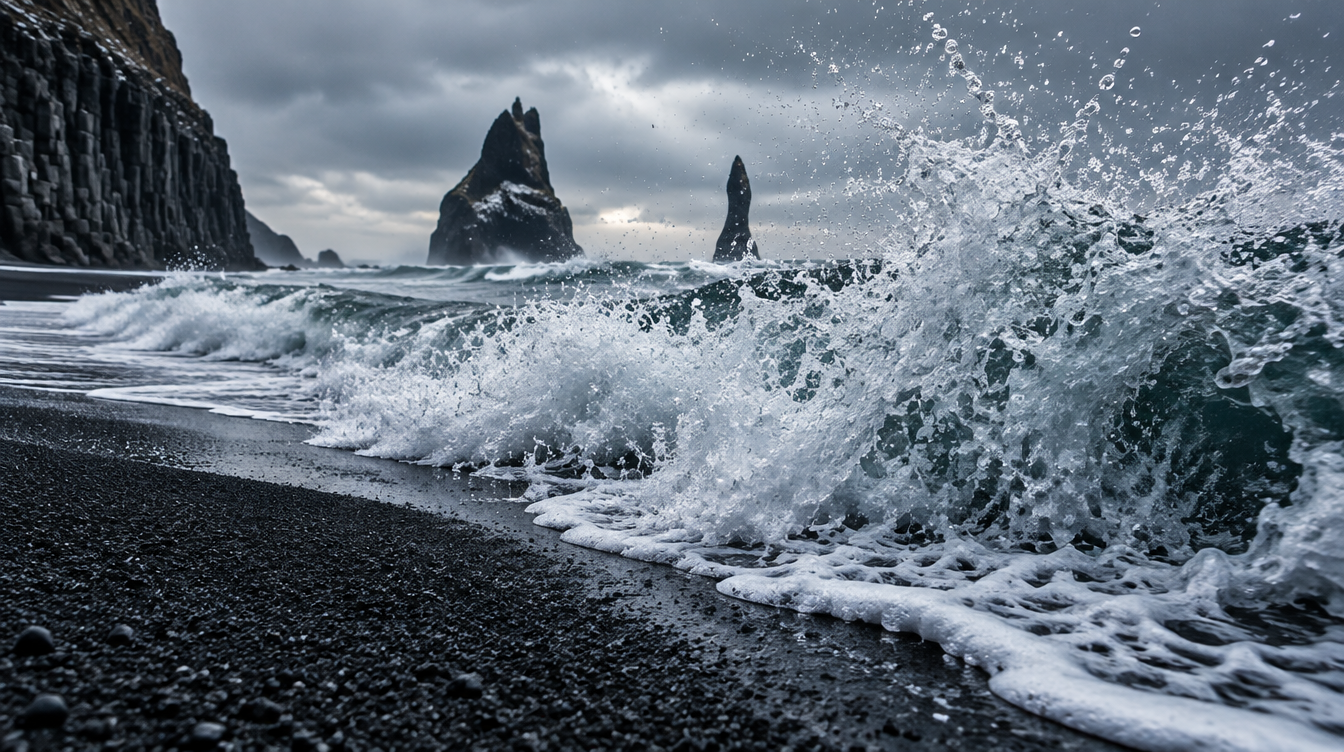
| Freeze the spray | Roughly 1/250s or faster keeps individual droplets sharp; the U.S. National Weather Service and detailed shutter speed testing both put the transition to visible motion blur right around 1/125s |
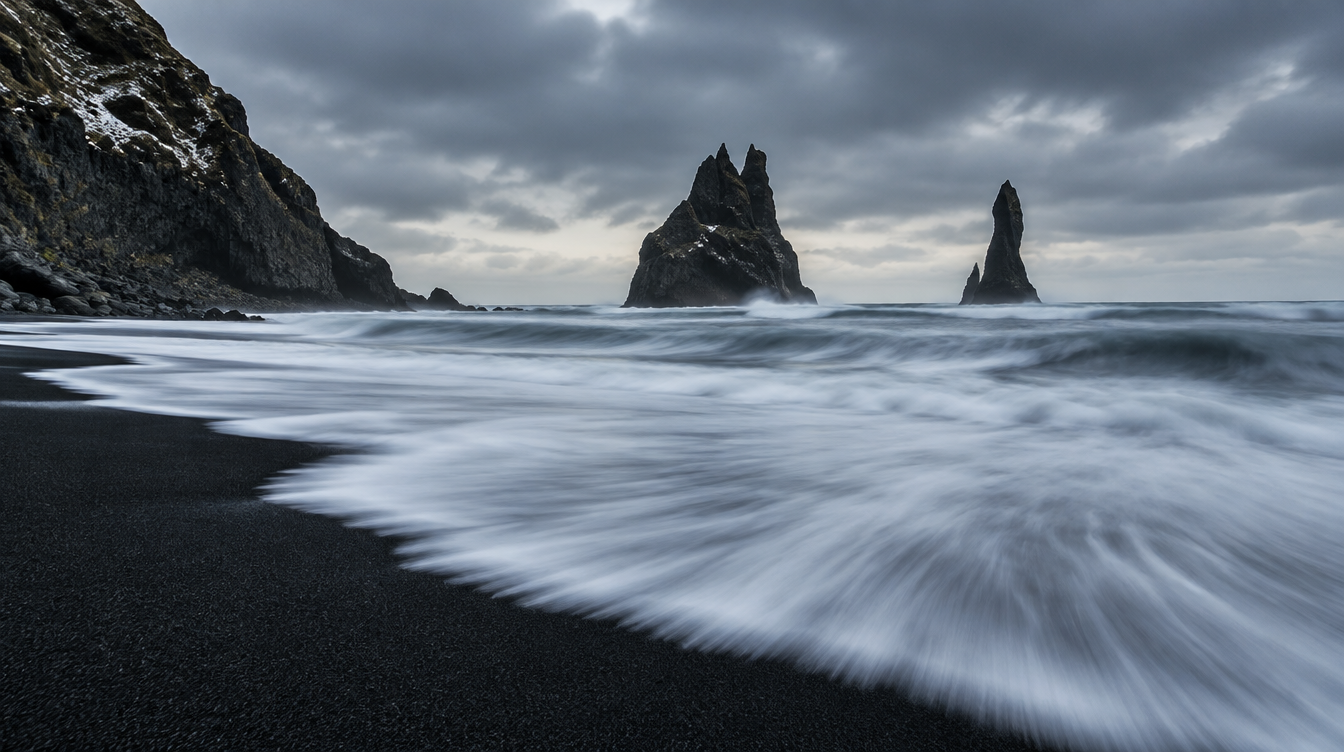
| Silk out the wash | Around half a second or slower turns moving water into a smooth, misty blur, which in daylight usually means reaching for a neutral density filter |
| The dead zone | Roughly 1/125s to 1/15s tends to produce the mushy, half frozen, half blurred look that ruins more wave photos than any other single mistake |
| Safe distance | Treat 45 meters (about 150 feet) as the floor a sneaker wave can reach, not a safe working distance, and watch the surf for a full set before committing a tripod closer than that |
| Tripod setup | Spread the legs wide on the black sand, press them in rather than letting them sink unevenly, and recheck your footing every few minutes as waves rework the sand under you |
Table of Contents
- Why Reynisfjara punishes the wrong shutter speed
- Two looks, two shutter speeds
- Reading the surf before you commit a tripod
- How far back is actually safe
- Setting up on wet, sinking black sand
- Protecting your gear from salt spray
- A simple settings starting point
- Frequently asked questions about shooting Reynisfjara's waves
Why Reynisfjara punishes the wrong shutter speed
Most beaches are forgiving. A gentle swell rolling onto sand gives you a wide window of shutter speeds that all look reasonably intentional. Reynisfjara is not that beach. The surf here is powerful, the waves arrive at irregular intervals rather than a predictable rhythm, and the dark sand gives you almost no tonal separation between the water and the beach once a wave loses its white foam. That combination means the margin for a shutter speed that "sort of works" is much narrower than it is at a typical sandy beach back home.
When testers have photographed the exact same breaking wave across a full range of shutter speeds, the pattern holds steady no matter where you point the camera. Every speed from roughly 1/250s up through the fastest settings a camera offers freezes the spray and texture with no visible blur. Blur first becomes noticeable around 1/125s, and by 1/15s the motion reads as clearly intentional rather than accidental. Speeds in between, roughly 1/125s to 1/30s, tend to produce a half frozen, half smeared look that neither reads as sharp nor as a deliberate long exposure. That dead zone is exactly where an automatic exposure mode likes to land on an overcast Icelandic afternoon, which is why so many casual photos of this beach look the same disappointing way.
Two looks, two shutter speeds
Once you accept that the middle ground rarely works, the decision gets simpler. There are really only two looks worth committing to at Reynisfjara, and each one has a shutter speed range that reliably delivers it.
The first look freezes the wave at the moment it breaks: individual droplets sharp in the air, texture visible in the foam, the kind of frame that shows exactly how violent the water is. This needs a fast shutter, generally 1/250s or quicker. If you are working with a longer lens and compressing the wave against the basalt sea stacks offshore, push even faster, toward 1/500s or 1/1000s, since a telephoto exaggerates any residual motion blur far more than a wide angle does.
The second look does the opposite: it smooths the incoming and outgoing wash into something closer to mist than water. This needs a shutter speed of roughly half a second or longer, and running water rendered at that speed takes on the pale, almost fog like look that makes long exposure seascapes feel calm rather than violent. The practical problem is that half a second of light is usually too much for a correctly exposed daylight frame even at a narrow aperture and low ISO, which is why a neutral density filter earns its place in your bag for this exact shot. Stack a six or ten stop ND filter and you can comfortably push a well lit Icelandic afternoon down to one or two seconds without blowing out the highlights in the surf.
Pro Tip: Decide on your look before you walk toward the water, not after. Freezing spray and silking out the wash require opposite settings and different standing positions relative to the light, so switching your mind mid shoot usually means missing both.
Everything in between those two ranges is the trap. A shutter speed of 1/60s or 1/30s shows just enough motion to look unintentional, without showing enough to read as a deliberate choice. If your camera's exposure meter wants to land there on a gray Icelandic day, override it. Either go faster to freeze the spray or add an ND filter and go slower to smooth it, and skip the middle entirely.
Reading the surf before you commit a tripod
Before any of those settings matter, you need to actually watch the ocean. Reynisfjara's danger is not that the waves are obviously enormous. It is that a run of smaller, unremarkable waves can precede a much larger one with no visible warning, a pattern well documented at beaches with this kind of coastal geometry. The U.S. National Weather Service's guidance on sneaker waves describes exactly this behavior: there can be ten to twenty minutes of smaller waves immediately before a disproportionately large one arrives, which is part of why casual visitors get caught off guard even when the surf looks calm when they first arrive.
The practical habit that experienced surfers and lifeguards use, and that the Weather Service recommends anyone near breaking surf adopt, is to simply watch the water for a sustained period, at least twenty minutes, before trusting any read on how far it is reaching. At Reynisfjara that means standing well back from the wash line when you first arrive, timing a few full sets of waves with your phone or a watch, and only then deciding where it is reasonable to set up. Never turn your back on the ocean once you are within reach of the surf, even while you are checking a histogram or wiping a lens. A wave that reaches your ankles one minute can reach your knees or further the next, and the formal definition of a sneaker wave specifically describes a wave that appears in a normal wave train without the kind of warning a trained eye would otherwise catch.
How far back is actually safe
The single number worth remembering is 45 meters, or about 150 feet. The National Weather Service states that sneaker waves can run up the beach at least 150 feet into dry sand, and adds plainly that no place on a beach exposed to this kind of surf is too high or too far back to be reached. Reynisfjara has its own well documented record backing that caution up. Wikipedia's summary of the beach's safety history notes at least twelve serious emergency rescues and five fatalities between 2007 and 2024, with a further fatal incident recorded in 2025, which is why Icelandic authorities installed a condition based warning system at the beach in the first place.
Treat 45 meters as a floor, not a target distance. It is the minimum reach of an unusually large wave under normal conditions, not a guarantee of safety at that exact line. On a day with a bigger swell running, or when the tide and wind are working together, waves have reached noticeably further. Build in margin rather than measuring out exactly 150 feet with a rangefinder and setting your tripod there. The same applies to the basalt cave at the beach's eastern end: it is a beautiful frame, and it is also a known rockfall and wave trap that is worth photographing from a distance with a longer lens rather than from directly underneath.
Keep an escape route in mind at all times, the same advice the Weather Service gives for any rip current or surf hazard: know which direction is uphill and away from the water before you need it, and avoid standing near large rocks or driftwood that a wave could pin you against. If Reynisfjara is flying a colored warning light or flag that day, treat red or the most restrictive setting as non negotiable regardless of how calm the water looks from the car park. A longer exposure means your attention is split between your camera and the water for a longer stretch of time, which is exactly the situation that distance is meant to protect you through.
Setting up on wet, sinking black sand
Reynisfjara's sand is fine, dark basalt, and it behaves differently underfoot than the pale sand most visitors are used to. It compacts when dry and turns soft and shifting the moment it gets wet, which is most of the beach within reach of the surf. A tripod planted on that kind of sand does not sit still the way it would on packed earth or rock.
Spread your tripod legs wider than you normally would, and press each leg in firmly rather than letting its own weight slowly sink it unevenly over the course of a shot. An uneven sink is worse than an even one, since it tilts your horizon mid exposure without you noticing until you check the frame. On a long exposure in particular, even a few millimeters of one leg settling faster than the others shows up as a soft, double edged blur across the entire frame rather than just in the water. Check your level before every long exposure, not just the first one of the session, since the sand under you has usually shifted since your last check.
Stay mobile rather than treating your first spot as permanent. The wash line at Reynisfjara creeps forward and back by several meters over the course of ten or fifteen minutes as sets of waves come through, and a position that was comfortably dry when you set up can be underwater by the time you are three frames into a sequence. If you notice the sand around your tripod legs getting visibly wetter between shots, that is your signal to move back before you are forced to move back in a hurry.
Protecting your gear from salt spray
Salt spray is the quiet damage that shows up weeks after the trip rather than on the beach itself. It settles on front elements and filter glass as a fine mist you often cannot see through the viewfinder, dulling contrast in a way that looks like a focus problem until you clean the lens and the image sharpens right back up. Worse, salt residue left to dry on a lens barrel or filter thread can corrode metal parts over time, which is a real risk on a coastline this exposed.
Keep a dry microfiber cloth in an easily reachable pocket, not buried in your bag, and wipe the front element after every set of waves that sends spray your way, not just at the end of the shoot. A clear protective filter is worth using here specifically because it is far cheaper to wipe salt off a filter repeatedly than to risk doing the same to a coated lens element over and over. If you are shooting with an ND filter for the long exposure look, check it for water droplets before every single frame, since a single drop in the corner of a ten second exposure will show up as an obvious soft blemish you cannot fix in post.
Pro Tip: Pack your gear away between setups rather than leaving it on the tripod while you walk the beach scouting the next angle. A gust carrying spray can reach gear ten or fifteen meters further inland than you would expect, especially with wind coming straight off the water.
A simple settings starting point
These are starting points, not fixed rules. Icelandic winter light changes quickly, and you will adjust ISO and aperture to the actual light on the day, but the shutter speed targets below hold up regardless of the specific exposure.
| Look | Shutter speed | Aperture | Extra gear |
|---|---|---|---|
| Freeze the spray | 1/250s to 1/1000s | f/5.6 to f/8 | None required; raise ISO before dropping shutter speed below 1/250s |
| Silk out the wash | 0.5s to 2s | f/8 to f/11 | 6 or 10 stop ND filter for daylight; tripod and remote or self timer shutter release |
| The dead zone to avoid | 1/125s to 1/30s | n/a | No gear fixes this; change the shutter speed instead |
| Blue hour or dusk long exposure | 2s to 8s | f/8 to f/11 | Often no ND filter needed once ambient light has dropped |
If you are shooting during the darker winter months on an Iceland winter photography tour, the lower ambient light actually works in your favor for the silk look, since you need less neutral density to reach a usable shutter speed than you would under a bright summer sky. That is one of the quieter advantages of shooting Reynisfjara in winter rather than June, alongside the obvious benefit of far fewer people standing in your frame.
Frequently asked questions about shooting Reynisfjara's waves
What is the best shutter speed to photograph waves at Reynisfjara? There is no single best speed, only a best speed for the look you want. Use 1/250s or faster to freeze spray and texture, or half a second or slower, usually with a neutral density filter in daylight, to render the wash as smooth motion. Avoid the range in between, roughly 1/125s to 1/30s, which tends to produce blur without intent.
How far back should I stand from the water at Reynisfjara? Treat 45 meters, about 150 feet, as the documented minimum reach of a sneaker wave, not a safe working distance. Watch the surf for a full set of waves before deciding how close to set up, and always leave yourself a clear path away from the water.
What is a sneaker wave, and how do I spot one before it hits? A sneaker wave is an unusually large wave that can appear within an otherwise normal set without obvious warning. The reliable habit is not spotting the wave itself but watching the pattern: a run of smaller waves lasting ten to twenty minutes often precedes a larger one, so continuous observation matters more than trying to predict a single wave.
Is it safe to set up a tripod on the sand at Reynisfjara? Yes, well back from the wash line, with the legs spread wide and pressed firmly into the sand rather than left to sink unevenly. Recheck your footing and your level every few minutes, since the sand shifts as waves rework it.
Do I need an ND filter to get a long exposure of the waves in daylight? In most daylight conditions, yes. A six or ten stop neutral density filter lets you reach the half second to two second range needed for the silky wash look without overexposing the frame. In the lower light of early morning, dusk, or Icelandic winter afternoons, you may not need one at all.
How do I keep my camera and lens safe from salt spray? Wipe the front element or filter after every set of waves that throws spray your way, use a clear protective filter so you are not wiping the actual lens coating repeatedly, and pack gear away between setups rather than leaving it exposed while you scout the next composition.
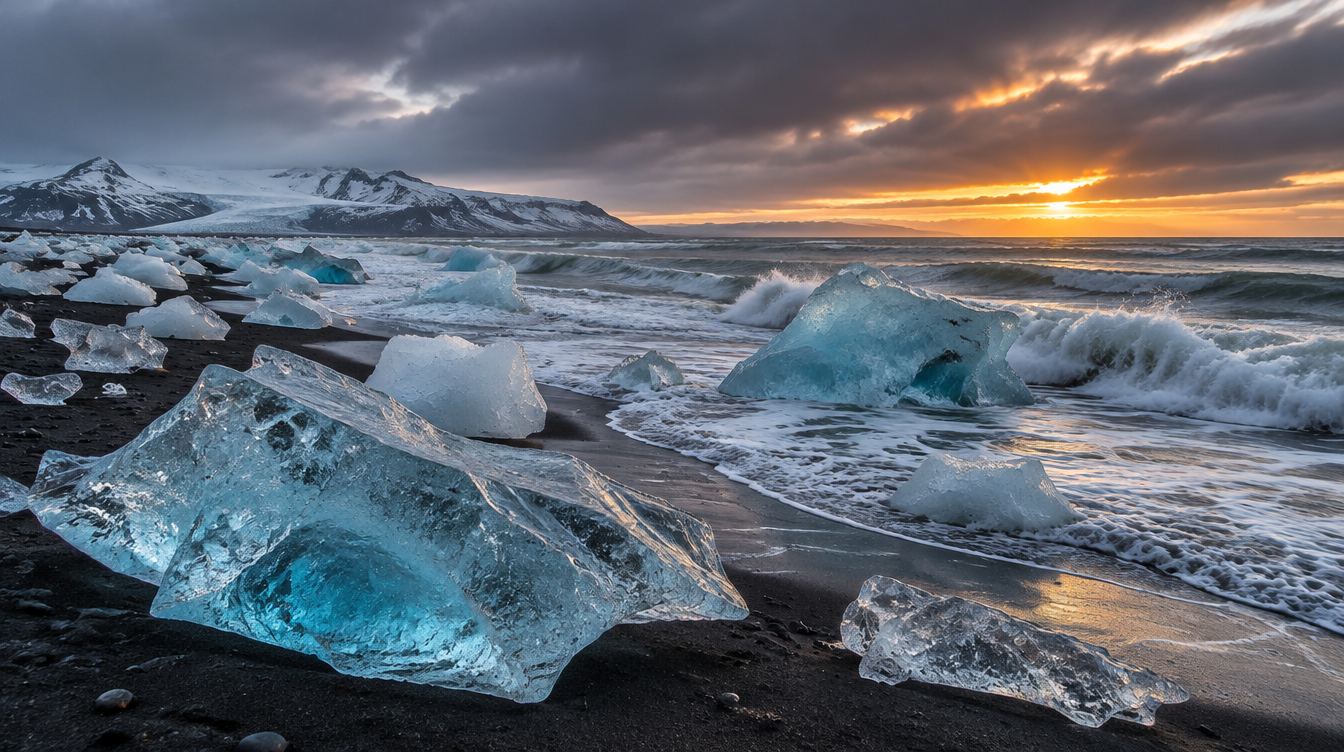
Is Reynisfjara different from Diamond Beach for wave photography? Yes. Reynisfjara's dark basalt sand and more exposed open coastline make its surf heavier and less predictable, while Diamond Beach's ice chunk strewn sand adds a compositional element and its own separate hazards around approaching ice. Both still call for the same shutter speed logic, just applied to different foreground subjects.
This is exactly the kind of decision we spend time on in the field with guests on our Iceland Winter Aurora photography tour, a seven day, seven night trip capped at ten participants with one professional photographer guide, either Lorenzo Ranieri Tenti or Marco Carotenuto depending on the departure. Reynisfjara sits on Day 6 of the itinerary alongside Dyrhólaey, the Reynisdrangar sea stacks, and the town of Vík, so you get a guide standing next to you reading the exact conditions that day, helping you choose between freezing the spray and silking out the wash before you commit a tripod to the sand. The trip runs $4,500 per person with a 30 percent deposit, includes all ground transportation, most meals, and built in image review sessions, and meets at Keflavík International Airport.
For the wider context on why this stretch of coastline photographs the way it does, our guide to Dyrhólaey and the Reynisdrangar sea stacks covers the two landmarks that bookend Reynisfjara on the same stretch of coast, and our tripod buying guide goes deeper on which tripod features actually matter for unstable ground like this. Our Iceland Photography Guide is the right starting point if you have not read it yet, since it ties this article and the rest of our Iceland winter cluster together into one itinerary level overview.
Sources
- U.S. National Weather Service: sneaker wave safety guidance, including surge distance and the 20 minute observation rule
- U.S. National Weather Service: rip current and surf hazard safety, escape route planning
- Wikipedia: Sneaker wave, formal definition and surge distance
- Wikipedia: Reynisfjara, safety history and warning system
- Wikipedia: Shutter speed, motion blur thresholds for moving water
- Wikipedia: Vík í Mýrdal, climate context for the nearest town to Reynisfjara
- PetaPixel: side by side shutter speed comparison for wave and splash motion