Reynisfjara: Photographing Iceland's Black Sand Beach Safely
Reynisfjara's basalt columns and sea stacks make it one of Iceland's best compositions and one of its most dangerous beaches. Here is how to shoot it safely.
Reynisfjara: Photographing Iceland's Black Sand Beach Safely
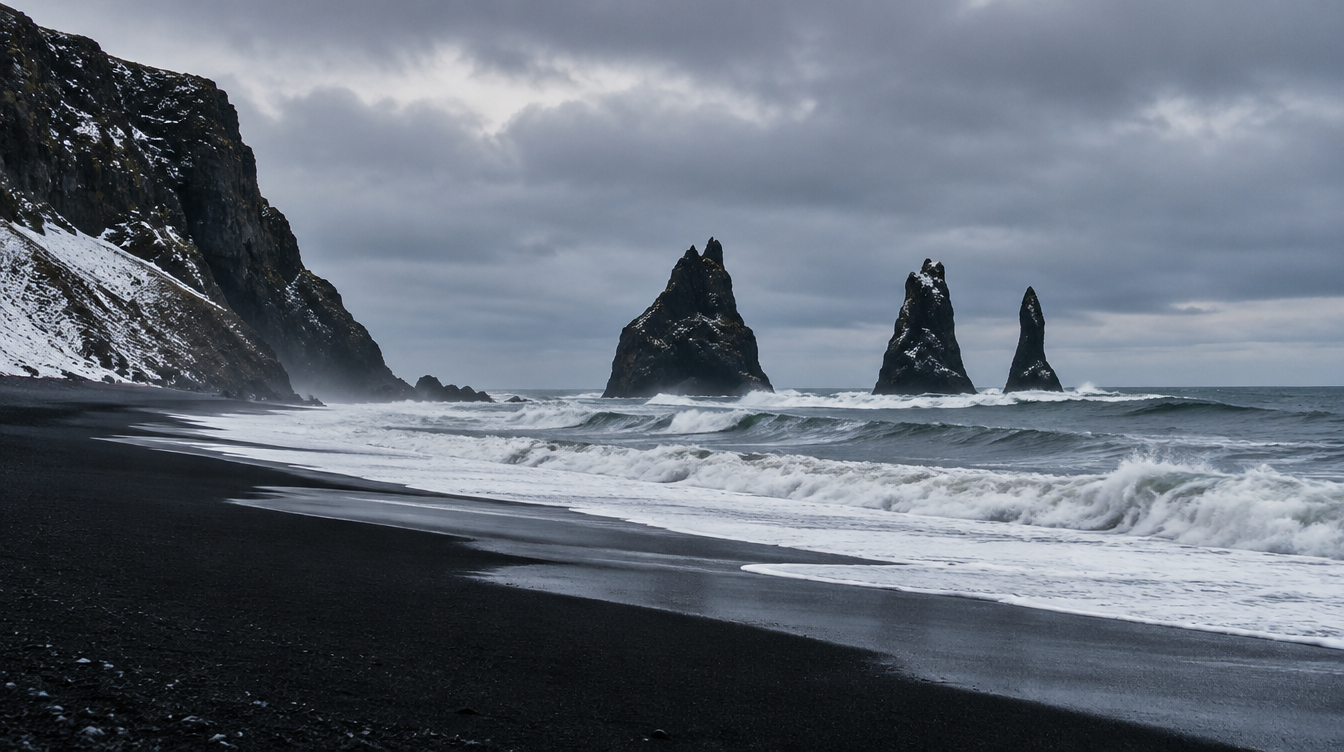
Reynisfjara shows up on almost every Iceland photography shot list, and it earns the spot honestly. Black volcanic sand runs out toward the open North Atlantic, the hexagonal basalt columns of Hálsanefshellir Cave rise at the eastern end of the beach like something built on purpose, and the three sea stacks of Reynisdrangar sit offshore looking exactly like the trolls local folklore says they are. It is also, by a wide margin, the most dangerous beach most visiting photographers will ever stand on.
That is not a line thrown in for drama. Reynisfjara is a documented sneaker wave hazard with a real history of rescues and fatalities, and the same ocean that makes the composition dramatic is the thing you need to manage correctly before you even think about a foreground rock or a shutter speed. This guide walks through what makes the beach dangerous, how to read the warning status before you go, where to actually stand, how the basalt columns formed, and when the light works best for photographing them. Treat the safety section as the real content of this article, not the preamble before the fun part.
Key Takeaways
Reynisfjara rewards photographers who respect it and has hurt photographers who didn't. Here is the short version before the full guide.
| Point | Details |
|---|---|
| The core hazard | Sneaker waves: unusually large waves that can surge far up the beach after several minutes of calmer, ordinary-looking surf |
| Safety record | At least twelve serious rescues and six fatalities tied to Reynisfjara between 2007 and 2025, per Wikipedia's sourced account |
| Before you go | Check current beach status on SafeTravel.is; Iceland uses warning signage at the beach itself that can change day to day |
| Safe distance | Stay well back from the wet sand line and never turn your back on the ocean, per NWS sneaker wave guidance |
| Best light | Low winter sun raking in from the side brings out the texture of the basalt columns better than flat midday light |
| The cave and columns | Can be closed entirely during red weather warnings following a 2025 fatality at the cave |
Table of Contents
- Why Reynisfjara is one of Iceland's most photographed, and most dangerous, beaches
- The sneaker wave risk, explained
- How to check the warning status before you go
- Safe shooting distance: where to stand and why
- The basalt columns: how they actually formed
- Best light and time of day for the columns and Reynisdrangar
- Nearby: Dyrhólaey and the Reynisdrangar sea stacks
- Access, parking, and winter footing
- How we shoot Reynisfjara on the Iceland Winter Aurora tour
- Frequently asked questions about photographing Reynisfjara
Why Reynisfjara is one of Iceland's most photographed, and most dangerous, beaches
Reynisfjara sits on the south coast near the village of Vík í Mýrdal, with the dramatic Dyrhólaey promontory visible to the west and the volcano Eyjafjallajökull in the distance on a clear day. The beach lies within the Katla UNESCO Global Geopark, a roughly 954,200 hectare designation covering much of Iceland's south coast, and UNESCO's own page on the geopark singles out Reynisfjara by name as a dark sand beach known for its striking columnar basalt formations. The land itself is privately owned, which is worth knowing if you are used to beaches defaulting to public access.
The composition is genuinely rare: black sand, a sea cave lined with near-perfect hexagonal columns, and three sea stacks standing just offshore that locals have always called Reynisdrangar. Icelandic folklore holds that the stacks are trolls caught by sunlight while trying to drag a ship ashore and turned to stone, which is the kind of backstory that makes a strong photograph even stronger once you know it.
None of that changes what the ocean is doing in front of you. The same open Atlantic swell that built this coastline also makes it unpredictable in a specific, well-documented way, and that is the subject of the next section.
The sneaker wave risk, explained
A sneaker wave is, in the plain language of the US National Weather Service, a potentially deadly wave that surges further up the beach than expected and catches people unaware. The term is informal, and according to Wikipedia's entry on sneaker waves, scientists do not yet fully understand exactly what causes them, though researchers at Oregon State University have linked them to offshore storms that transfer wind energy to the ocean surface, with the resulting swell arriving onshore even on a day that looks calm where you are standing.
What makes sneaker waves genuinely dangerous for photographers is not their size on its own, it is their timing. They are not obviously larger than the waves around them until the moment they break, and they can follow ten to twenty minutes of smaller, ordinary looking surf, according to the same Wikipedia summary of the research. A photographer who has been standing in the same spot for fifteen minutes without incident has not learned anything about whether that spot is safe. The surge from a sneaker wave can travel more than 150 feet, around 46 meters, past the normal wet sand line, which at Reynisfjara is often much further inland than the line you would guess by eye.
Pro Tip: Set a timer or count your own time at the water's edge out loud. Fifteen quiet minutes feels like safety, and that feeling is exactly the trap. The NWS specifically recommends watching the ocean for at least twenty minutes before you let your guard down at all, and even then, never stop watching completely.
This is not a Reynisfjara-specific quirk of marketing copy designed to sound serious. It is the same hazard the US National Weather Service warns Pacific coast beachgoers about, applied to an Icelandic coastline that happens to be one of the most photogenic places on the itinerary. Treat the warning the same way you would treat it at home.
How to check the warning status before you go
Iceland's search and rescue association runs SafeTravel.is specifically to keep visitors current on road and coastal hazards, and Reynisfjara is exactly the kind of location where the posted status can change from one day to the next depending on swell and weather. Check it the morning of your visit, not the week before you fly. The beach itself also uses warning signage that is updated for current conditions, and the right habit is to treat whatever is posted at the beach that day as the final word, not whatever you read in a blog post written months or years earlier, including this one.
The stakes for ignoring that advice are real and documented. Wikipedia's entry on Reynisfjara, citing published research and local news reporting, records at least twelve serious emergency rescues and five fatalities tied to sneaker waves at the beach between 2007 and 2024, with a sixth fatality in August 2025 when a visitor was swept from inside Hálsanefshellir Cave itself. Following that death, the cave and the basalt column area are set to be closed entirely during red weather warnings. That single fact changes the plan for a lot of visitors: if your trip lands on a red warning day, the famous cave shot simply is not available to you, and no composition is worth arguing with that closure.
Safe shooting distance: where to stand and why
There is no single magic number that is safe at every tide and every swell, which is exactly why "stay back further than feels necessary" is the actual NWS guidance rather than a specific distance. Given that a sneaker wave's surge can reach more than 150 feet past the normal foam line, the honest, uncomfortable advice is to assume the dry-looking sand well above the current waterline is not automatically safe either, particularly near the cave and the base of the columns where the beach narrows.
Practically, that means composing from higher, drier ground whenever the shot allows it, using a longer lens to bring in the columns or the sea stacks rather than walking closer to get the same framing with a wide angle, and treating the open black sand in front of the cave as a zone you pass through quickly rather than a spot you set up a tripod and wait in. A 24-70mm or 24-105mm standard zoom covers most of the compositions here from a reasonably safe working distance, and a 70-200mm is genuinely useful for isolating the Reynisdrangar stacks without getting any closer to the water than you have to.
Pro Tip: Never shoot with your back fully to the ocean, even for a few seconds to check a histogram or change a lens. If you need to look down at your camera, turn sideways so the water stays in your peripheral vision. This single habit, straight out of US National Weather Service guidance for sneaker wave beaches generally, is the one piece of advice every photographer at Reynisfjara should actually follow.
Also give any driftwood or debris fields a wide berth. The NWS flags logs and debris near the surf line as a specific secondary hazard, since a sneaker wave can set heavy material in motion with no warning at all, and a piece of driftwood moving at speed is its own injury risk independent of the water itself.
The basalt columns: how they actually formed
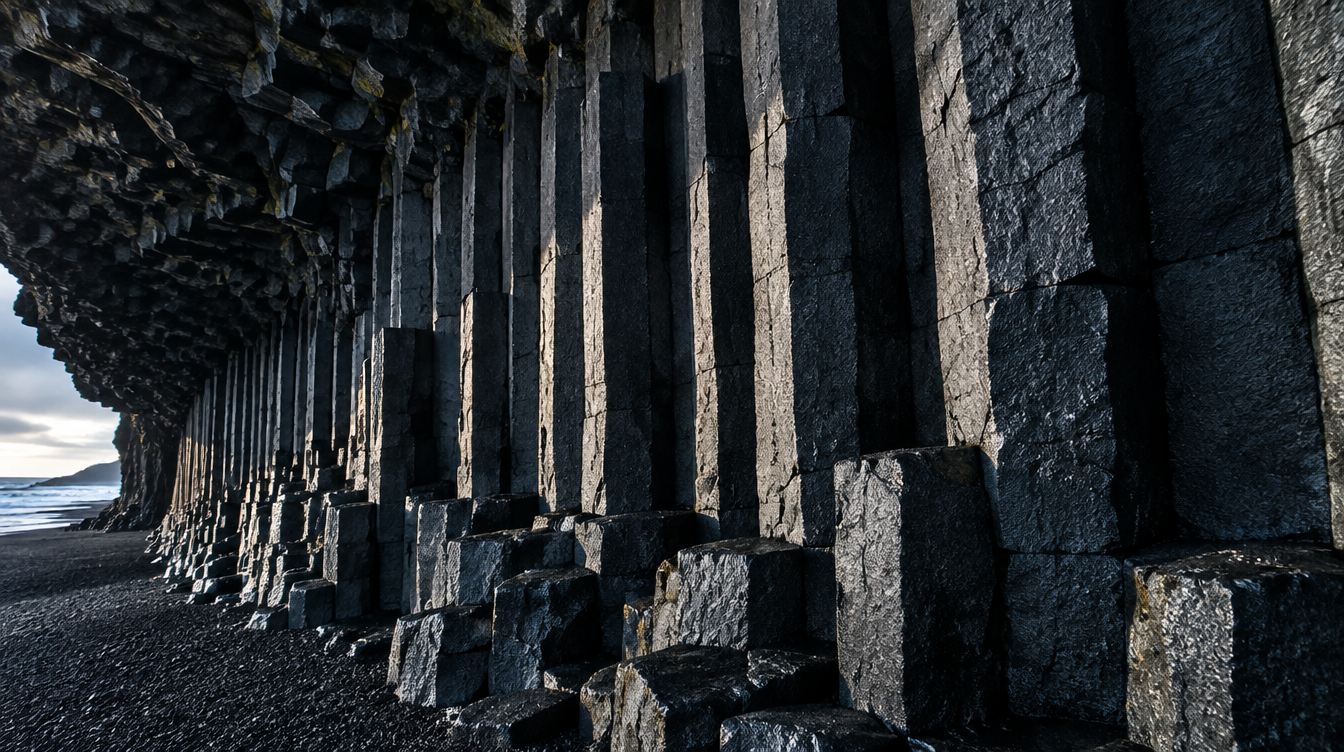
Most articles on Reynisfjara describe the columns with a single hand-wavy sentence about lava cooling and cracking. The actual mechanism is more specific and, once you know it, changes how you look at the rock face. According to the US National Park Service's explanation of columnar jointing, the columns form as a lava flow cools and contracts, with fractures starting at the top and bottom of the flow and growing inward, perpendicular to the cooling surface. Hexagons are the most common cross-section because contractional stress is most efficiently relieved by three fractures meeting at 120 degree angles, though individual columns can end up with anywhere from three to seven sides depending on local variation in the rock.
The speed of cooling matters too. Rapid cooling is what drives the jointing in the first place, and a single lava flow can show a lower colonnade of regular, well-formed columns, an irregular middle section called an entablature, and sometimes an upper colonnade, all reflecting different cooling rates within the same original flow. That is the structure you are actually looking at inside Hálsanefshellir Cave: not a random jumble of basalt, but the physical record of exactly how fast different parts of an ancient lava flow lost heat.
Knowing this changes how you compose. The columns read most clearly as individual geometric shapes when light rakes across them at a low angle, since that is what reveals the subtle variation in width, angle, and spacing between neighboring columns. Flat, overhead light flattens all of that structure into a uniform gray wall.
Best light and time of day for the columns and Reynisdrangar
Winter is the season that makes Reynisfjara's light interesting rather than difficult. Iceland's winter days are short enough that the sun barely climbs above a low arc across the sky for much of the visit, which, as covered in our guide to how short Iceland's winter days actually are, compresses your whole shoot into something close to one extended golden hour either side of a short midday. At Reynisfjara that works entirely in your favor: the low sun rakes directly across the face of the basalt columns for far more of the day than it would in summer, bringing out the texture described above instead of the single hour you would get at a lower latitude.
If the sun is out, a sidelight direction, with the sun low and to your left or right rather than behind you, does the most to separate individual columns from each other inside the cave mouth. For the Reynisdrangar sea stacks themselves, a late afternoon approach with the sun behind the stacks can turn them into strong dark silhouettes against a lit sky and ocean, which suits their craggy, troll-like shape better than a fully front-lit version does. Compare this to the very different warm, low light that defines golden hour across the rest of Iceland, which we cover in detail in our piece on mastering golden hour photography in Iceland: the same physics apply here, just filtered through black sand and gray basalt instead of green valleys.
Overcast days are not a loss here either. Flat, diffuse light removes harsh shadow lines from the columns and can work well for a clean, graphic black and white treatment of the cave interior, especially if a storm system offshore is adding texture to the sky and surf without yet making the beach itself unsafe to approach from a distance.
| Subject | Best light direction | Why |
|---|---|---|
| Basalt columns, cave mouth | Low sidelight, early or late in the short winter day | Reveals the individual column faces and spacing described by the NPS cooling model |
| Reynisdrangar sea stacks | Backlit, late afternoon | Produces strong silhouettes against sky and water |
| Wide beach scene with black sand | Overcast, diffuse | Even tonal range across sand, surf, and sky without blown highlights on wet sand |
| Storm swell / dramatic surf | Any, shot from a safe elevated distance | Drama comes from the water's motion, not the light; safety distance matters more here than light direction |
Nearby: Dyrhólaey and the Reynisdrangar sea stacks
Dyrhólaey sits a short drive west of Reynisfjara and gives you a second, elevated vantage point on the same stretch of coastline, including a view of the Reynisdrangar stacks from above rather than from beach level. It is a natural pairing for a single day: shoot Reynisfjara's cave and columns at beach level, then drive to Dyrhólaey's clifftop viewpoint for a wider perspective on the same sea stacks and the arch the promontory is known for. If the weather only gives you a usable window at one of the two, Reynisfjara's close-up basalt detail is the harder shot to replace elsewhere on the south coast, so prioritize it first if you have to choose.
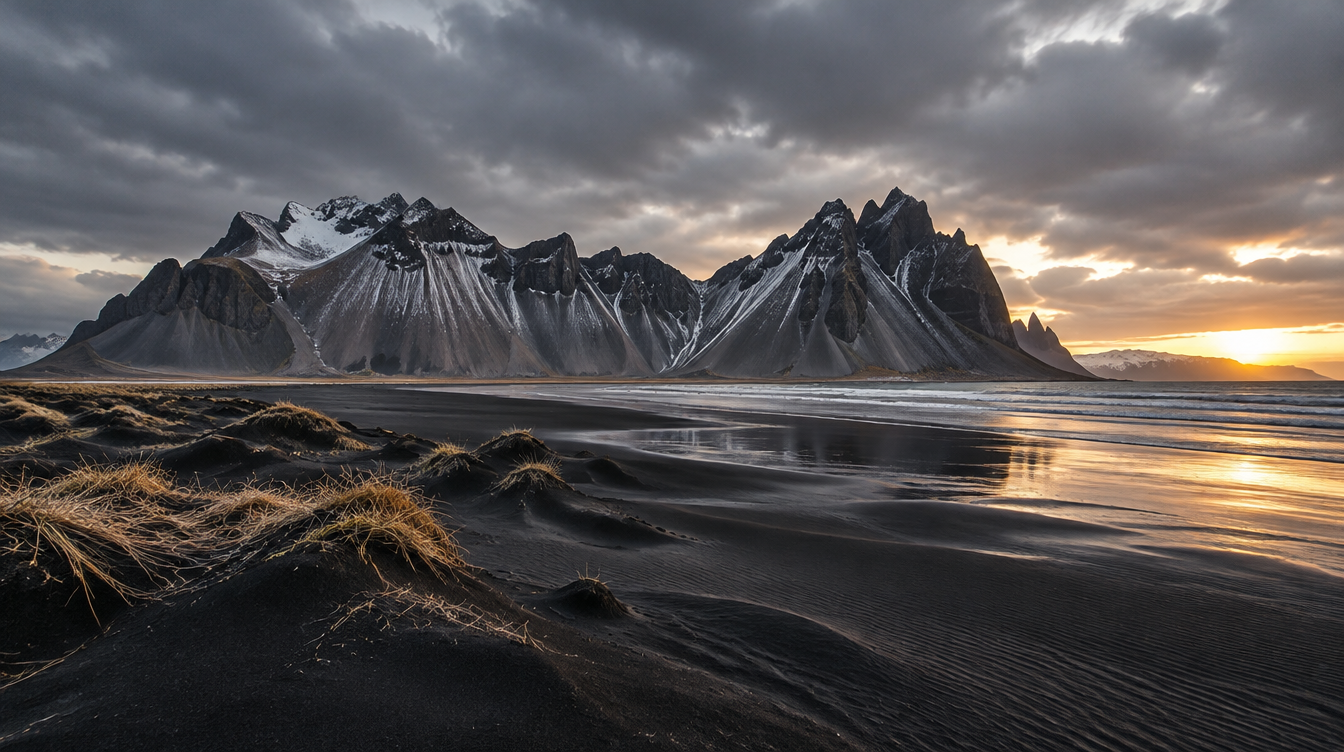
If you are building a south coast day around this stretch, it also sits reasonably close to two of the destinations covered elsewhere in this series: the glacier lagoon at Jökulsárlón and Diamond Beach, and the dramatic reflection shot at Vestrahorn and Stokksnes, both further east along the same coast road.
Access, parking, and winter footing
Reynisfjara has a dedicated parking area close to the beach, and policies around any parking fee at Icelandic natural attractions have shifted in recent years as visitor numbers have grown, so check current signage or the official tourism channels for Iceland's south coast before you go rather than assuming last year's information still applies.
Winter adds a footing hazard that a summer guide will not warn you about. The approach path and the sand itself can carry patches of ice, especially in shaded areas near the cave entrance where standing water freezes overnight and does not fully clear during a short winter day. Spiked ice grips over your boots are worth packing specifically for this stop, in addition to whatever waterproof footwear you are already bringing for the trip. Black volcanic sand also holds onto spray and moisture longer than it looks like it should, so expect your gear bag's base and your knees, if you crouch for a low angle, to pick up damp sand regardless of how dry the surface looks.
How we shoot Reynisfjara on the Iceland Winter Aurora tour
Reynisfjara is built into Day 6 of our Iceland Winter Aurora photo tour, as part of a return loop west to Vík í Mýrdal that also covers Dyrhólaey's sea arch and the Reynisdrangar stacks, timed for sunset from the cliffs with a possible aurora chance over the ocean afterward. The tour runs 7 days and 7 nights with a maximum of 10 participants and one professional photographer guide per departure, Lorenzo Ranieri Tenti or Marco Carotenuto depending on the date, so there is always someone on the beach watching conditions and calling the safe shooting positions in real time rather than leaving every photographer to make that call alone on unfamiliar terrain.
That guided judgment matters more at a location like this than almost anywhere else on the itinerary. A guide who has stood on that sand dozens of times across different seasons reads the swell differently than a first-time visitor does, and that experience is exactly what lets the group get the cave and column shots without anyone treating "it looks calm" as permission to get closer than is safe. All ground transportation, airport transfers, professional coaching, image review sessions, and a post-processing workshop are built into the trip price, starting from Keflavík International Airport, so the logistics around getting to a hazard-aware guided visit are handled before you land.
Frequently asked questions about photographing Reynisfjara
Is Reynisfjara actually as dangerous as people say, or is that overstated? It is real. Wikipedia's sourced account lists at least twelve serious rescues and six fatalities tied to sneaker waves at the beach between 2007 and 2025, and the US National Weather Service treats sneaker waves as a genuine, documented coastal hazard rather than a tourism scare story.
How far back should I stand? Further than feels necessary. The NWS notes a sneaker wave's surge can travel more than 150 feet, roughly 46 meters, past the normal wet sand line, so treat dry-looking sand close to that line as part of the hazard zone, not a safe buffer.
Does a calm looking ocean mean it's safe to get closer? No, and this is the single most important point in this guide. A sneaker wave is not obviously larger than the surrounding waves until the moment it breaks, and it can follow ten to twenty minutes of smaller, ordinary surf. Calm water for several minutes tells you nothing about the next wave.
Where do I check current conditions before I go? SafeTravel.is, run by Iceland's search and rescue association, is the standing resource Icelanders and tour operators use for current road and coastal hazard status. Check it the morning of your visit, and follow whatever warning signage is posted at the beach itself over anything written in advance, including this article.
Can the cave and columns be closed entirely? Yes. Following a fatality at Hálsanefshellir Cave in August 2025, the cave and basalt column area are set to close during red weather warnings. If your visit falls on a red warning day, plan on the wider beach and the view toward Reynisdrangar instead.
How did the basalt columns form? Through columnar jointing: a lava flow cooled and contracted, fractures grew inward from the cooling surface, and hexagonal cross-sections formed because three fractures meeting at 120 degree angles most efficiently relieve the contraction stress, per the US National Park Service's explanation of the process.
What's the best time of year to photograph the columns? Winter's low sun arc keeps a raking, texture-revealing sidelight on the columns for much more of the day than summer's higher sun angle allows, which is one of the reasons this guide sits inside our winter-focused Iceland cluster rather than a general travel guide.
What else is nearby worth photographing? Dyrhólaey's clifftop viewpoint and sea arch, a short drive west, gives you an elevated view of the same Reynisdrangar sea stacks you see from the beach, and makes a natural second stop on the same day.
Sources
- Wikipedia: Reynisfjara, including UNESCO Geopark status, land ownership, and the sourced rescue and fatality history
- Wikipedia: Sneaker wave, definition and formation research
- US National Weather Service: sneaker wave safety guidance
- US National Park Service: columnar jointing, the geology behind basalt columns
- UNESCO: Katla UNESCO Global Geopark, including Reynisfjara's designation
- Icelandic Meteorological Office: nightly aurora activity forecast