Winter Waterfall Photography: Shooting Ice, Spray, and Freezing Temperatures
How partial freezing reshapes a waterfall's composition, how to choose shutter speed when part of the frame is ice and part is flowing water, and the field routine that stops spray from freezing on your lens.
Winter Waterfall Photography: Shooting Ice, Spray, and Freezing Temperatures
I have stood in front of Skógafoss in July with three hundred other people and a phone selfie stick six inches from my ear, and I have stood in front of the same waterfall in February with nobody else in sight, breath freezing on my scarf, watching ice creep up the rock face on either side of the falling water. Those are not the same waterfall. Winter does something to a waterfall that no other season does: it starts turning parts of it solid while the rest keeps moving, and that single fact changes almost every decision you make with a camera in your hands.
Most waterfall photography advice online was written for a warm afternoon in Oregon or Wales. It tells you to use an ND filter, pick a slow shutter speed, and enjoy the silky water. All true, and all incomplete the moment you are standing at Seljalandsfoss or Skógafoss in December or January, looking at a frame that is half ice curtain and half churning water, with spray actively freezing on your front element while you try to decide on an exposure. This guide is about that specific problem: how partial freezing changes composition, how to pick a shutter speed when only part of your frame is actually moving, and how to keep your gear working while you do it.
Key Takeaways
Winter waterfalls are not just colder versions of summer waterfalls. Ice changes the composition, the exposure math, and the gear routine all at once.
| Point | Details |
|---|---|
| Core problem | A partially frozen waterfall has both a static subject (ice) and a moving one (flowing water) in the same frame, and shutter speed only controls one of them |
| Shutter speed logic | Expose for the moving water first; the ice renders however it renders at that speed, since no shutter setting changes something that is not moving |
| Spray freezing fix | Lens hood plus a water repellent filter coating as the first barrier, then check the front element after every exposure, never after the whole sequence |
| Iceland's real winter climate | Coastal south Iceland averages close to freezing in winter, not deep cold; the bigger hazard is day to day storminess, not one extreme low |
| Never do this | Breathe on a fogged or icy lens, since the moisture in your breath can refreeze as a film of ice on the glass |
| Where this happens on a real trip | Seljalandsfoss, Skógafoss, and Kvernufoss on Iceland's South Coast, a stop on day three of WeShoot's Iceland Winter Aurora tour |
Table of Contents
- Why winter changes every waterfall you already know
- How partial freezing reshapes the shot
- One frame, two speeds: shutter speed for ice vs. flowing water
- The spray freezing problem: keeping your front element clear
- Reading Iceland's winter weather before you go
- Gear and clothing that actually hold up at the falls
- Frequently asked questions about winter waterfall photography
- Shoot Iceland's waterfalls in winter with WeShoot
Why winter changes every waterfall you already know
Every waterfall photography tutorial you have ever read assumes the subject is entirely liquid. Pick a shutter speed, decide how much you want the water to blur, done. Winter breaks that assumption quietly and without warning. As temperatures sit near or below freezing for days at a stretch, the slower moving edges of a waterfall, the spray that lands on nearby rock, and sometimes the shallow pools at the base start to freeze while the main flow keeps moving. You end up with a single frame containing a subject that is both frozen solid and actively falling, often just a few feet apart.
This is not a hazard to work around. It is the most interesting thing about shooting a waterfall in winter, and almost nobody treats it that way. If you have already photographed Seljalandsfoss or Skógafoss in summer, a winter visit to the same two falls is the natural next step, and worth reading alongside our dedicated guide to shooting those two waterfalls differently, which covers the angles and crowd patterns that apply in any season before this article layers winter specific technique on top.
How partial freezing reshapes the shot
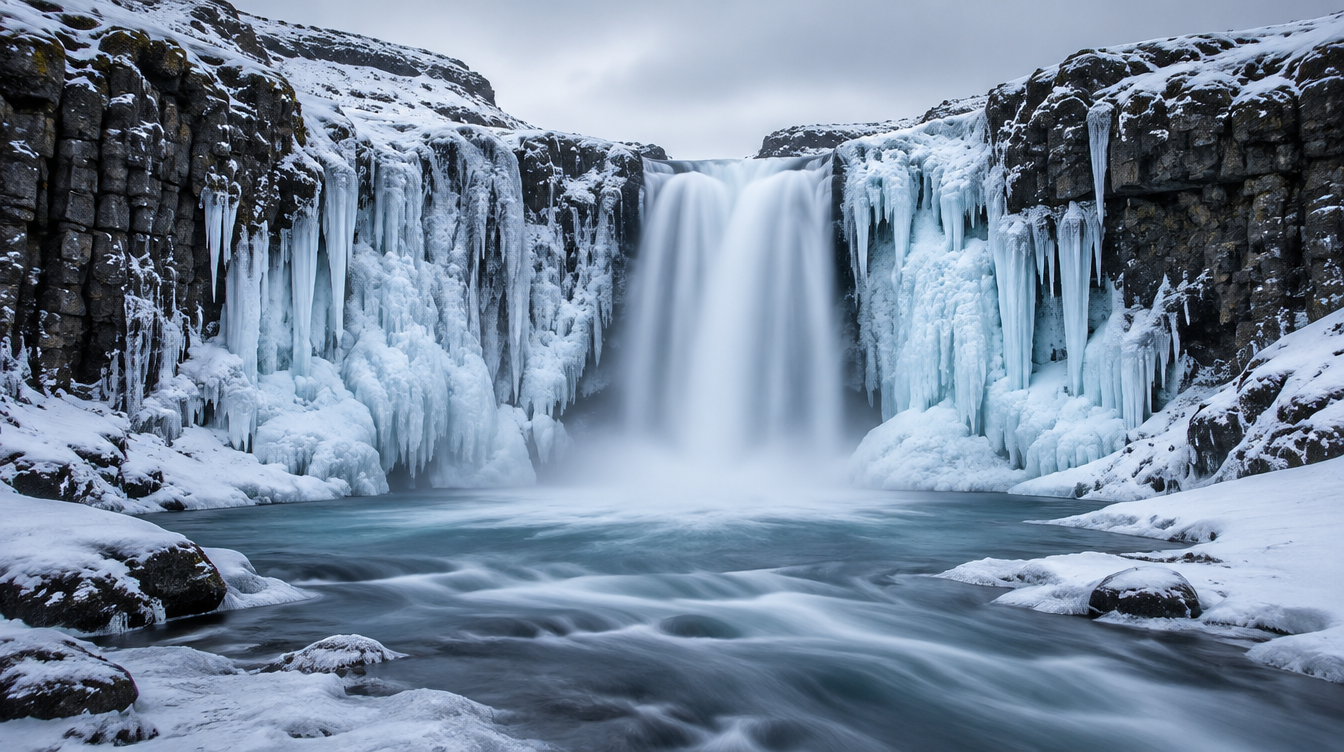
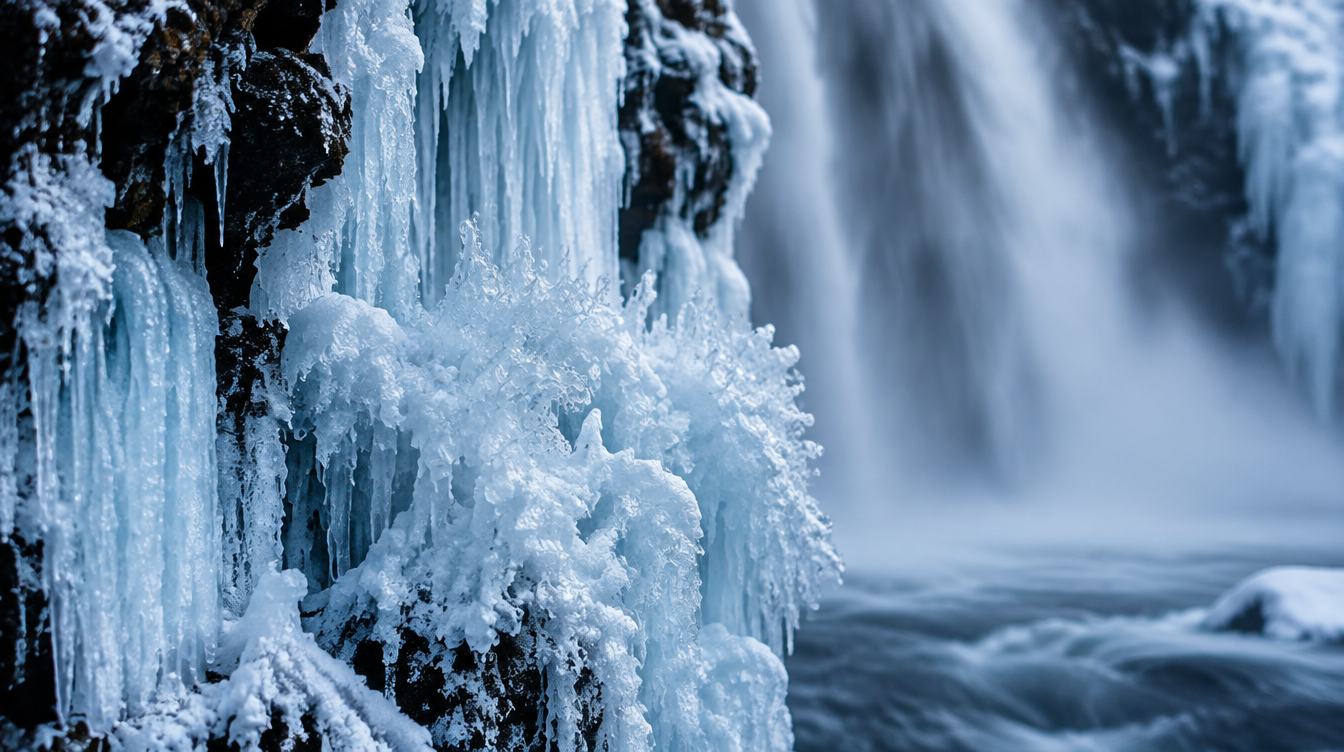
A frozen or half frozen waterfall does not just add texture, it rewrites the composition. Ice curtains form along the sides where spray lands and refreezes repeatedly, building up pale, almost sculptural columns that were not there in July. Flow channels narrow as ice builds along the banks, concentrating the moving water into a tighter ribbon than you would see in warmer months. At the base, shallow pools and side channels can sheet over with ice while the main plunge pool stays open, giving you a genuinely different foreground than the one every summer tourist photo shares.
Treat the ice as a fixed compositional anchor rather than an obstacle. A static ice formation in the foreground or along one edge of the frame gives you something summer visitors never get: a sharp, textured, completely motionless element to balance against the blurred motion of the falling water. Some of the strongest winter waterfall images use the ice the way a landscape photographer uses a rock in a river, as the stable thing the eye rests on before it travels into the motion. Walk the accessible viewpoints slowly before you set up a tripod. The ice formation that makes the best foreground this week may be completely different from the one that was there two weeks ago, because how much ice builds up depends entirely on that stretch of weather, not a fixed seasonal calendar.
One frame, two speeds: shutter speed for ice vs. flowing water
Here is the part that almost no waterfall photography guide addresses directly, because almost none of them are written with a half frozen subject in mind. In a normal waterfall shot, you pick one shutter speed and the entire frame responds to it. In a partially frozen waterfall, you are really making two decisions at once, and only one of them is under your control through shutter speed.
The ice does not care what shutter speed you choose. It is not moving, so a quarter second exposure and a thirtieth of a second exposure render it identically, sharp either way. The flowing water is the only part of the frame that shutter speed actually affects. That single fact should drive your entire exposure decision: pick your shutter speed based on how you want the moving water to look, and accept that the ice will look the same regardless. Trying to find one universal "correct" setting for both elements is the wrong framework entirely, because there is no setting that changes the ice.
In practice, a slower shutter speed, broadly in the range photographers commonly use for silky waterfall motion, will blur the flowing section into that classic soft ribbon while the ice around it stays crisp with zero extra effort. If you are not sure which look you want yet, bracket two frames: one slower exposure for the silky water look, and one faster exposure, closer to a fraction of a second, that freezes texture in both the spray and the water's surface so you have the option to blend or choose later in Lightroom. Winter light in Iceland is also naturally dimmer and flatter than summer light, so you often need less neutral density filtration to hit a slow shutter speed than you would at the same location in June. A midrange ND filter, commonly rated at a three or six stop light reduction, is usually enough to hold a slow shutter speed on a bright winter day without stacking filters the way you might in high summer sun, and the physics behind that stop math is well documented if you want the exact numbers behind why an ND8 or ND64 filter behaves the way it does on moving water in motion.
Pro Tip: Compose with the ice formation touching one third of the frame, not the center, so the eye has a clear static anchor to rest on before it follows the blurred water through the rest of the image. A dead center ice feature tends to split the photograph into two competing halves instead of working with the motion.
The spray freezing problem: keeping your front element clear
This is the problem nobody warns you about until it happens to you. You set up a long exposure a reasonable distance from a waterfall in sub zero air, fire the shutter, and when you check the frame there is a faint white haze creeping across one corner. Spray from the falls has landed on your front element or filter and started to freeze on contact, because the air around you is cold enough that water does not stay liquid for long once it lands on cold glass.
The fix is a routine, not a single trick. Start with a lens hood extended as far as it goes, since it is genuinely the first line of defense against spray and snow landing directly on the front element rather than being deflected past it. A water repellent or nano coated filter helps the next stage: spray beads up and runs off instead of sheeting across the glass and freezing in place. From there, the habit that actually saves a shoot is checking the front element after every single long exposure, not after you think you have the shot. A long exposure can take several seconds, which is more than enough time for spray to land and begin freezing while the shutter is open, and you will not see it happening through the viewfinder.
The single most important rule: never breathe on a fogged or icy lens to try to clear it. It feels like the obvious fix, and it is the fastest way to make the problem permanent for the rest of the session, because the moisture in your breath can refreeze as a thin film of ice directly on the glass in sub zero air. Carry a dedicated lens cloth kept in an inner jacket pocket against your body, not in an outer camera bag pocket where it will stiffen and become useless exactly when you need it. Wipe gently, check again, and if ice keeps forming faster than you can clear it, that is your sign to reposition slightly further from the spray zone rather than fighting the conditions from the same spot.
Pro Tip: Keep your camera inside your jacket, not just your bag, between shots when you are standing still in spray for more than a minute or two. It buys you real time before the next element check, and it slows how fast your battery drains in the cold at the same time.
Reading Iceland's winter weather before you go
A lot of planning advice for an Iceland winter trip assumes brutal, Arctic style cold, and that assumption is mostly wrong for the coastal South Coast locations where Seljalandsfoss and Skógafoss sit. Iceland's climate is moderated by a branch of the Gulf Stream running along the southern and western coasts, which keeps the south and west noticeably milder than the latitude would suggest. The Icelandic Meteorological Office itself describes a winter climate shaped less by extreme cold and more by constant change: mild Atlantic air meeting colder Arctic air produces what the agency plainly calls "frequent changes in weather and storminess". That variability, not a single terrifying low temperature, is the real planning hazard for a winter photography trip.
The numbers back this up. Reykjavík's winter daily mean temperatures sit right around freezing, roughly 0.5 to 0.8 degrees Celsius across December, January, and February, with mean daily minimums only dipping to around minus two degrees Celsius in a typical year, according to climate normals compiled from the Icelandic Meteorological Office. That is why a South Coast waterfall is usually partially frozen rather than a solid block of ice: the ambient air hovers right at the edge where ice and liquid water coexist, which is exactly the condition that produces the mixed ice and flowing water compositions this whole guide is built around.
| What you might expect | What actually happens on Iceland's South Coast |
|---|---|
| Deep sub zero cold every day | Winter daily means hover close to freezing, roughly 0.5 to 0.8°C in Reykjavík |
| A single brutal cold snap defines the trip | Short, regional cold spells happen, but a whole month can run close to or above average |
| Predictable, steady weather | Frequent, fast changing weather and storminess, driven by Atlantic air meeting Arctic air |
| Fully frozen waterfalls everywhere | Partial freezing at flow edges and spray zones, with the main channel usually still moving |
That does not mean genuine cold snaps never happen. In a recent recorded Icelandic winter, the coldest reading of the entire December was minus 31 degrees Celsius at Mývatn in the northeast, a single short lived event the Icelandic Meteorological Office itself noted was followed by temperatures returning close to average within a few days, in a winter where the following January ranked among the ten warmest since records began in the nineteenth century. The lesson for a photography trip is to pack for genuine cold and watch the forecast closely for the days immediately before you shoot, rather than assuming either extreme as the default.
Gear and clothing that actually hold up at the falls
Modern cameras handle cold better than most photographers expect. Nikon has documented bodies operating normally at temperatures as extreme as minus 42 degrees, describing "operation as normal as if I was shooting at 60 degrees" in that field report, with cold weather glove compatible control modes built into current camera menus specifically for this kind of shooting. The camera body is rarely the weak link. Batteries are: cold temporarily reduces how much charge a battery can deliver, even though it does not permanently damage it, so carry spares in an inner jacket pocket against your body rather than in an outer bag pocket, and swap in a warm one the moment you notice performance dropping.
A sturdy tripod matters more in winter than any other season, because you are often setting up on wet rock, packed snow, or thin ice right at the edge of a spray zone, exactly where you most need stability for a long exposure. Check your footing before you commit to a position, and choose a tripod with rubber or spiked feet that bite into ice rather than smooth feet that slide the moment the spray refreezes under them. Gloves are a genuine trade off: thick insulated gloves keep your hands functional for longer, but most photographers end up switching to thin glove liners or fingerless gloves with a flip back mitten shell for the actual moments of adjusting dials and checking focus, since thick gloves make fine camera controls close to impossible.
This is also where the long exposure fundamentals you already know still apply, they are just complicated by the cold rather than replaced by it. If you have not already worked through the core long exposure decisions, our guide to long exposure photography in Val d'Orcia covers the filter strength and shutter speed logic that forms the baseline here, before winter adds ice, spray, and battery drain on top of it.
Frequently asked questions about winter waterfall photography
What shutter speed should I use for a partially frozen waterfall? Expose for the moving water, not the ice. A slower shutter speed, using a neutral density filter if the winter light is still bright, will blur the flowing section into a silky look while the frozen parts of the frame stay sharp automatically, since shutter speed cannot affect something that is not moving. Bracket a faster frame too if you want to keep texture in both the spray and the ice to decide on later.
How do I stop spray from freezing on my lens in winter? Use a lens hood as the first barrier, keep a water repellent or nano coated filter on the front element so spray beads off instead of sheeting and freezing, and check the glass after every long exposure rather than after the whole sequence. Never breathe on a fogged or icy lens, since the moisture in your breath can refreeze as a film of ice on the glass.
How cold does it actually get at Iceland's waterfalls in winter? Coastal South Coast locations like Seljalandsfoss and Skógafoss typically hover close to freezing, with winter daily means around 0.5 to 0.8 degrees Celsius in nearby Reykjavík. The bigger planning factor is Iceland's day to day weather variability and storminess, driven by Gulf Stream air meeting Arctic air, rather than one extreme low temperature.
Will a waterfall actually be frozen when I visit in winter? It depends on flow volume and that specific week's weather. Smaller, slower sections of a falls are more likely to show ice curtains and frozen edges than a high volume main channel, and the same location can look noticeably different just a few days apart given how variable Icelandic winter weather is.
Do I need special gear for winter waterfall photography? No special winter only gear is required. The same neutral density filters used for summer long exposures work in winter, though you will often need less filtration since winter light is naturally dimmer. The main additions are a water repellent filter coating and a lens hood to manage spray, plus spare batteries kept warm and a tripod that will not slide on ice.
What is the biggest mistake photographers make shooting frozen waterfalls? Treating the whole frame as a single exposure decision. A mixed ice and water scene needs you to decide what the moving water should look like first, then accept that the ice renders however it renders at that shutter speed. Searching for one universal setting that handles both elements perfectly is the wrong framework from the start.
Shoot Iceland's waterfalls in winter with WeShoot
Reading about partially frozen ice curtains is one thing. Standing in front of one with someone beside you who already knows which viewpoint has the best foreground ice that particular week is another. Our Iceland Winter Aurora photo tour runs seven days and seven nights, with luxury accommodation throughout and a maximum of ten participants per departure, led by photographer Lorenzo Ranieri Tenti or Marco Carotenuto depending on the date. Day three of the real itinerary is built around exactly the locations in this article, Seljalandsfoss, Skógafoss, and the quieter Kvernufoss, with professional coaching and image review sessions built into every stop rather than a bus pulling up for twenty minutes and leaving. Ground transportation, airport transfers from Keflavík, all breakfasts, and five dinners are included, with international flights and travel insurance left for you to arrange separately. The tour is $4,500 per person with a $1,350 deposit to hold your spot.
Sources
- Icelandic Meteorological Office: Climate in Iceland
- Icelandic Meteorological Office: The weather in Iceland 2013
- Wikipedia: Climate of Iceland
- Wikipedia: Neutral-density filter
- Nikon USA: Tips for Shooting in Cold Weather
- Nikon USA: Tips for Photographing Winter Landscapes
- National Weather Service: Cold Weather Safety and Wind Chill Chart