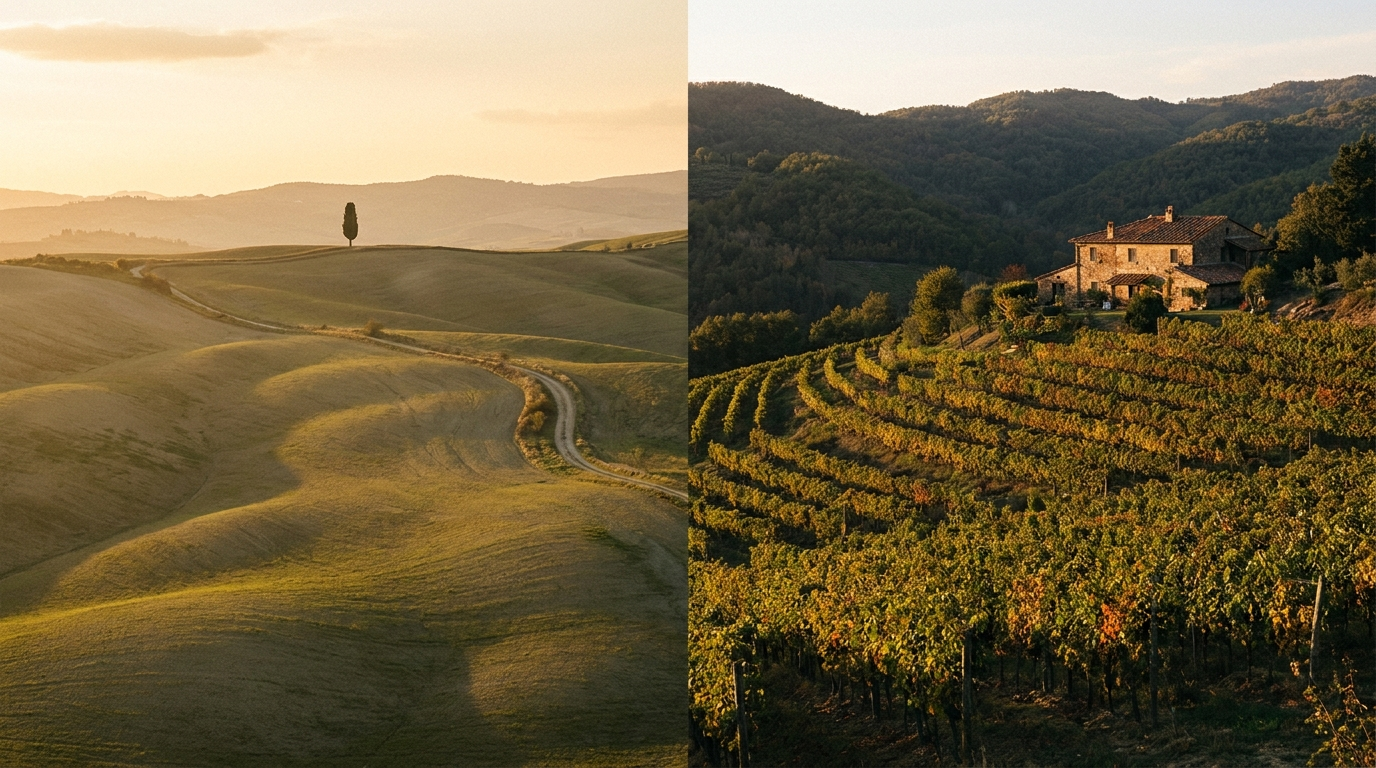
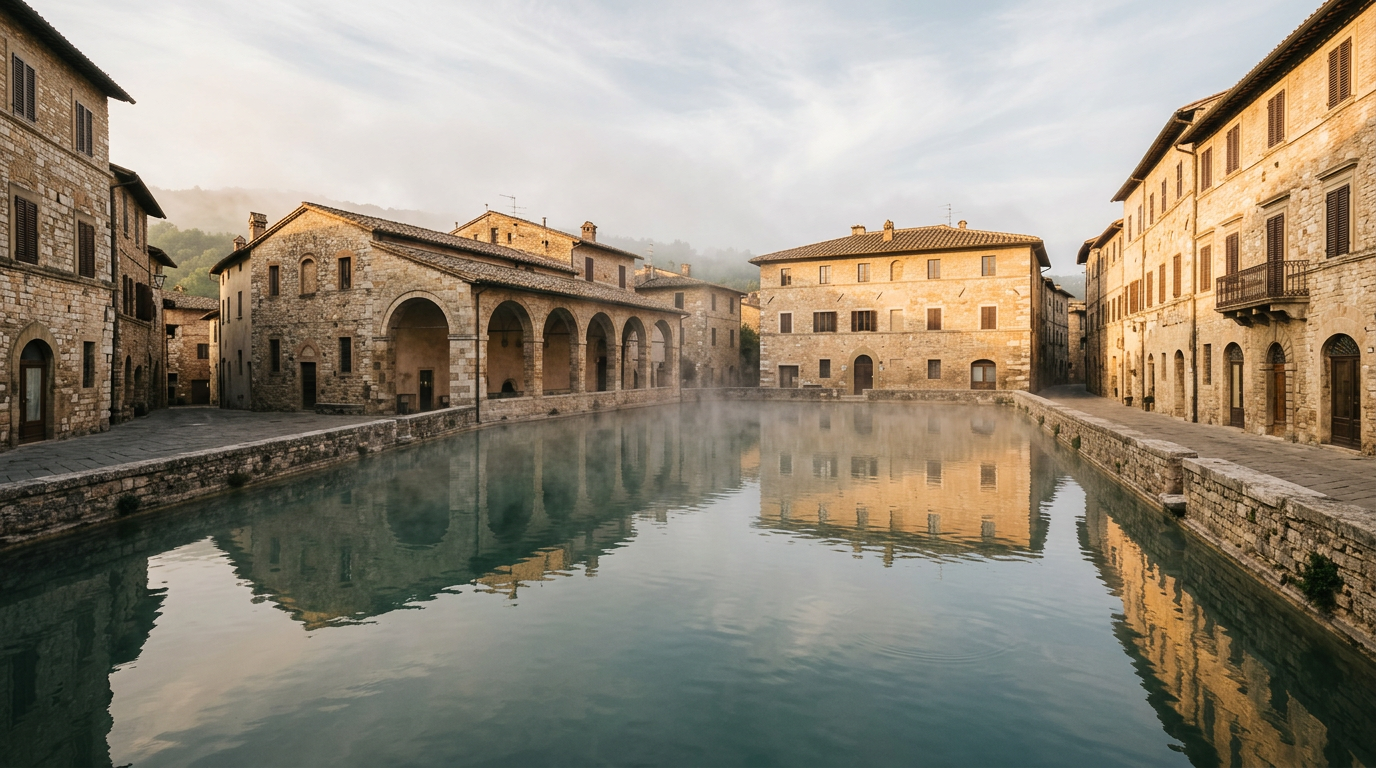
Monticchiello: The Quiet Hilltop Village Photographers Overlook
A photographer's guide to Monticchiello, the small walled hilltop village near Pienza that most Val d'Orcia itineraries skip, from the Porta Sant'Agata approach shot to the quiet terrace view toward Pienza.
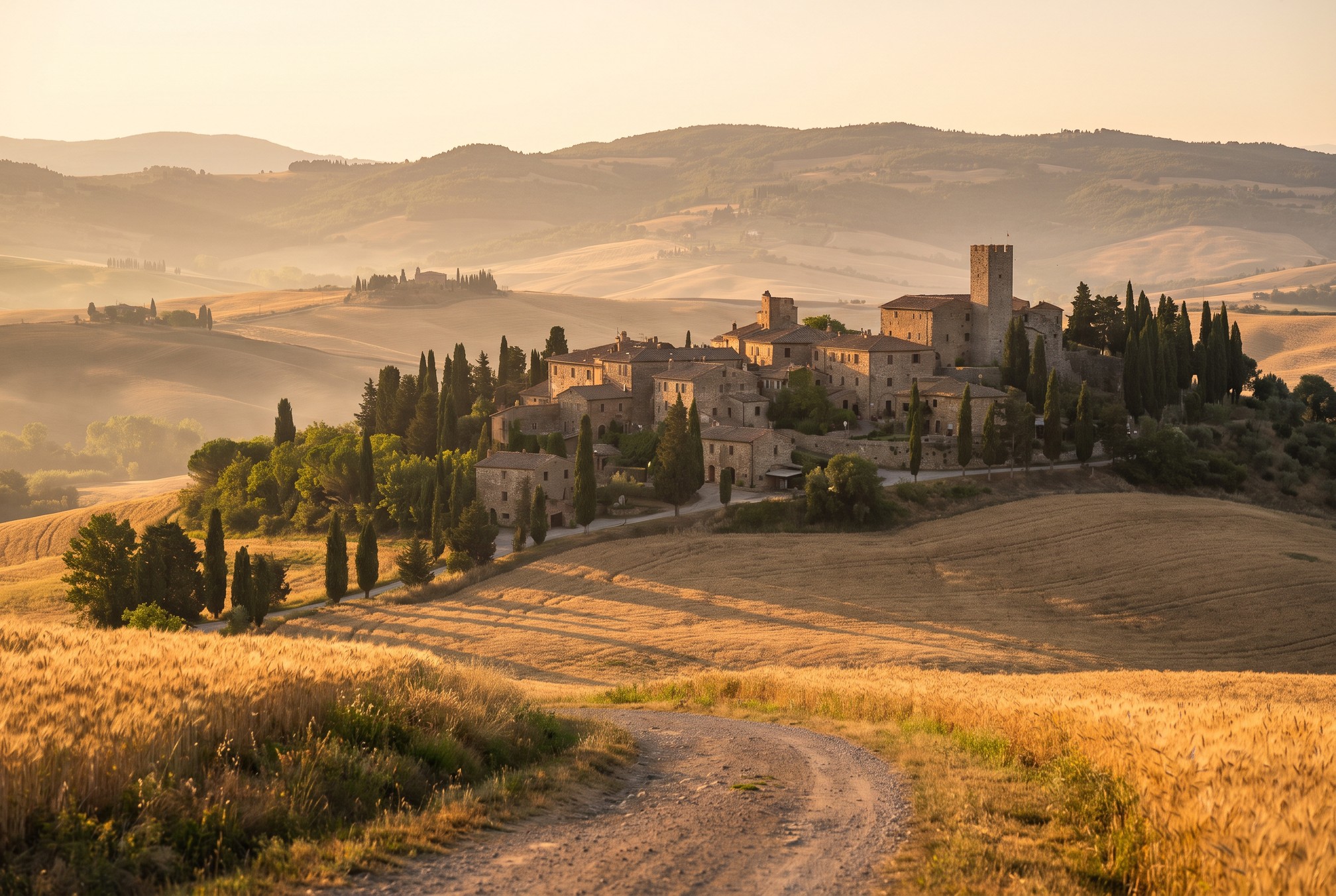
Monticchiello: The Quiet Hilltop Village Photographers Overlook
I have lost count of how many times I have stood in Piazza Pio II in Pienza at seven in the evening, trying to find an angle that does not include three other tripods and a tour group waiting for the same shot. Six kilometers down the road, on a hill that looks over that same stretch of Val d'Orcia, there is a village where I have shot an entire sunset without seeing another camera. That village is Monticchiello, and if you have already photographed Pienza, San Quirico, and the famous cypress roads, it might be the single best next place to point your lens.
Monticchiello does not show up on the shortlist most first time visitors build before their trip. It is smaller than Pienza, harder to find on a generic Tuscany itinerary, and it has no equivalent of the Horti Leonini gardens or a symmetrical Renaissance piazza to anchor a guidebook entry. What it has instead is a walled hilltop core that has barely changed shape in five hundred years, a working community that still performs its own history every summer, and a terrace view toward Pienza that, in my opinion, rivals anything else in the valley. This guide walks through exactly where to point your camera, when to go, and how to get the most out of a village that most photographers drive straight past.
Key Takeaways
Monticchiello rewards photographers who want Val d'Orcia's classic hilltop village look without the crowds that come with the more famous stops.
| Point | Details |
|---|---|
| Location | A frazione (hamlet) of Pienza, about 6 km southeast, roughly 13 km from Montepulciano |
| Best single shot | The panoramic terrace by the Rocca, looking northwest toward Pienza across the valley |
| Crowd level | Low nearly year round, with a brief spike in late July during the Teatro Povero festival |
| Best light | Late afternoon into sunset, when the low sun rakes across the valley below the terrace |
| Signature detail | Teatro Povero, a self written, self performed community theater tradition running since 1967 |
| Time needed | 90 minutes for the highlights, half a day if you want to shoot the approach at two different light conditions |
Table of Contents
- Where Monticchiello actually is
- Why photographers drive past it
- The approach shot from Porta Sant'Agata
- Walking the historic center
- The terrace: the best view in the village
- Teatro Povero: the village that performs itself
- Best time of day and season
- Camera settings and gear for a small hilltop village
- A realistic half day plan
- Frequently asked questions
- Sources
Where Monticchiello actually is
Monticchiello is technically a frazione, an administrative hamlet, of the comune of Pienza, sitting about six kilometers southeast of Pienza's center along a winding country road that climbs through olive groves and open farmland. If you are already staying anywhere near Pienza or San Quirico d'Orcia for a Val d'Orcia trip, it is a fifteen minute drive at most, and closer to ten if the road is empty, which it usually is. Coming from Montepulciano the drive takes about twenty minutes through some of the prettiest backroads in the region, past vineyards that catch beautiful side light in the late afternoon on the way in.
The village itself sits on a low hill with commanding views in two directions: back toward Pienza and the open Val d'Orcia to the northwest, and toward the Val di Chiana and Montepulciano to the southeast. That double orientation is part of what makes it so useful for a photographer, since depending on which side of the walls you are standing on, you get two completely different landscapes without moving the car at all.
Why photographers drive past it
Honestly, the main reason is that nobody tells them to stop. Every generic "best of Tuscany" list runs through Pienza, San Quirico, and maybe Montalcino, because those names show up in guidebooks that were written decades ago and have been recycled ever since. Monticchiello has no cathedral, no famous piazza with a name tourists recognize, and no gelato shop with a line out the door. It is a small, quiet, working village where about two hundred people actually live, and that is precisely the appeal if what you want is a version of Val d'Orcia that still feels lived in rather than staged for visitors.
I get why it happens. On a first trip you are working through a list, chasing the shots you have already seen on Instagram, and a village with no famous single image is easy to skip. But if you have already checked Pienza and San Quirico off your list, or you are planning a second Val d'Orcia trip and want somewhere with genuinely fewer photographers in your frame, Monticchiello is exactly the kind of stop that separates a standard Tuscany photo trip from one where you come home with images nobody else has.
Pro Tip: Ask a local, if you get the chance, how to pronounce it correctly (mon-tee-kee-EL-lo, not mon-tich-ee-ello). It is a small thing, but it tends to open doors, quite literally, in a village this size where most visitors never bother to try.
The approach shot from Porta Sant'Agata
The classic entry point into Monticchiello is Porta Sant'Agata, a stone gate that has survived largely intact since the medieval period, when the village functioned as a defensive outpost for Siena watching the border with Orvieto and the Val di Chiana. Park in the small lot just outside the walls and walk up, and you will find that the gate itself, framed by the surrounding stone walls and a scatter of cypress trees on the slope below, makes for a strong compositional anchor even before you have set foot inside.
I like to shoot this from two positions. First, from directly below on the access road, using a wide angle somewhere around 24mm to include the full sweep of the wall and gate against the sky, ideally with some cloud texture to keep the sky from going flat and empty. Second, from further back on the farm road that loops around the base of the hill, where a mid telephoto in the 70 to 100mm range compresses the walls, the gate, and a row of cypress trees into a single tight, layered frame. That second version is the one that tends to surprise people who have only ever seen the wide angle version of a hilltop village shot.
Walking the historic center
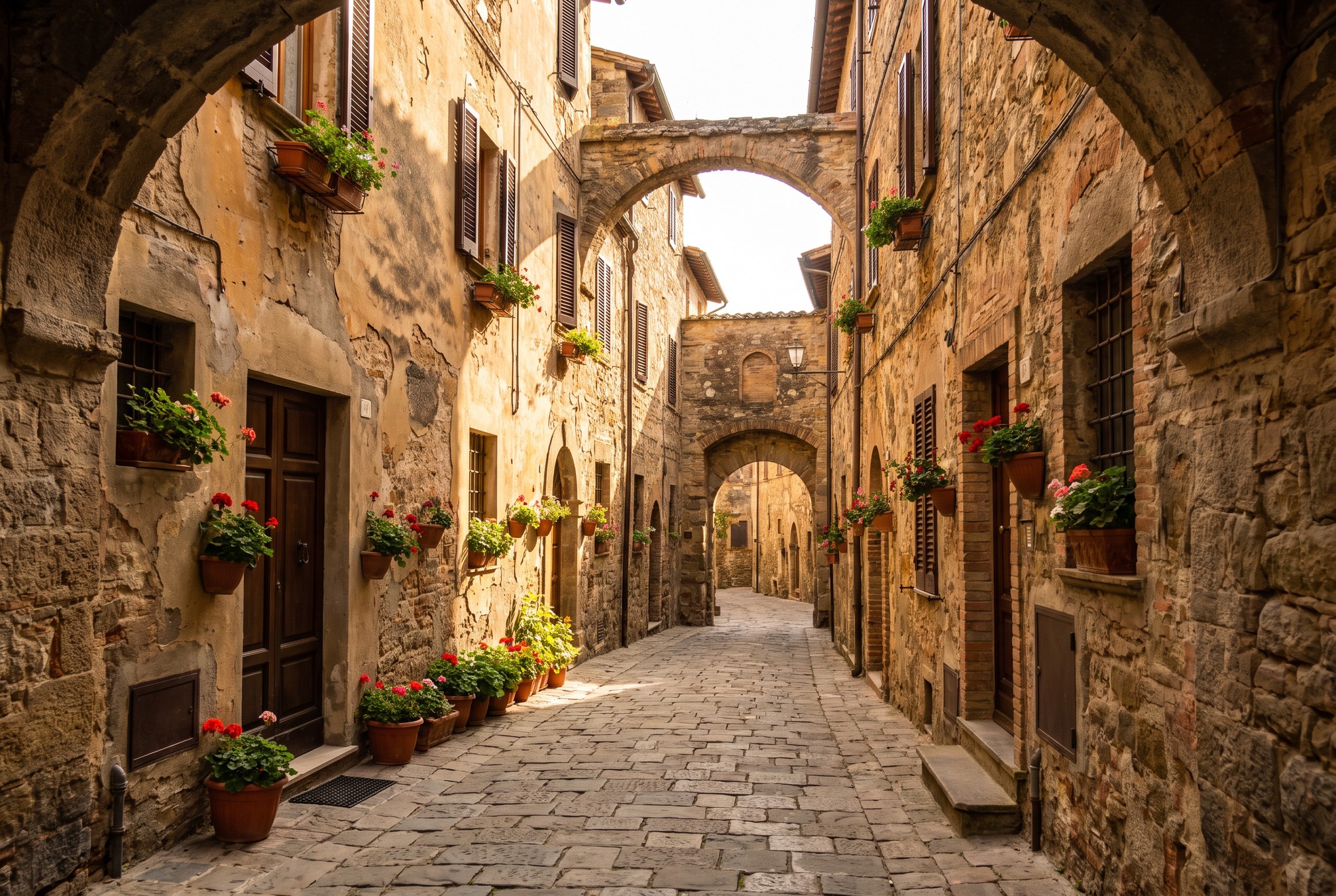
Once through the gate, the historic center of Monticchiello is small enough to fully explore on foot in under an hour, though you could easily spend three times that if you are shooting seriously. The streets are narrow, paved in worn stone, and lined with houses built directly into the medieval walls, many still showing the original stonework rather than the plastered facades you find in more restored towns. Wooden shutters in faded greens and blues, terracotta pots of geraniums on windowsills, and the occasional cat sunning itself on a doorstep give the whole place a lived in texture that is genuinely harder to find in villages that see heavier tourist traffic.
Follow the main street, Via Nuova, up toward the Chiesa dei Santi Leonardo e Cristoforo, the parish church at the heart of the village, which has a simple stone facade that photographs well in the flat, even light of an overcast morning if your trip does not line up with clear skies. From there, small side alleys branch off toward the walls on either side, and a few of them dead end at viewpoints looking straight out over the countryside, framed by the buildings on either side. These framed alley shots are some of my favorite images from Monticchiello precisely because almost nobody stops to look for them.
The terrace: the best view in the village
The single best viewpoint in Monticchiello, and the reason I keep coming back, is the small public terrace near the Rocca, the remains of the village's old fortress, on the northwest edge of the walls. From here the ground drops away sharply and you get an open, unobstructed view across a foreground of olive groves and cypress lined farm tracks toward Pienza, sitting on its own hill in the middle distance, with the wider Val d'Orcia stretching out behind it.
This is a composition that rewards patience more than gear. I usually set up with a standard zoom around 24 to 70mm, find a foreground element, a stone wall edge, an olive branch, a section of railing, to anchor the bottom of the frame, and then wait for the light to do the rest. In late afternoon, as the sun drops toward the horizon behind you, it rakes across the hills between Monticchiello and Pienza at a low angle, carving out every furrow and tree line in long shadow, which is exactly the kind of three dimensional depth that makes a rolling hills photograph work.
What surprises most first time visitors is how little competition there is for this spot. I have shown up on a clear September evening, the kind of light that would have twenty tripods lined up along the terrace in Pienza, and had the entire railing to myself. That means you can take the time to actually work a composition properly, trying a vertical frame for a tighter view of Pienza silhouetted on its hill, then switching to a wide horizontal to take in the full sweep of olive terraces and cypress rows in the foreground, without anyone waiting behind you for their turn.
If you want to go deeper on exactly how to make hills like these read as three dimensional rather than flat, our guide to photographing rolling hills covers foreground anchoring and lens choice in more detail, and everything in it applies directly to this terrace.
Teatro Povero: the village that performs itself
Here is the detail that makes Monticchiello genuinely different from every other hilltop village in Val d'Orcia, and the reason I think it deserves more attention from photographers than it gets. Since 1967, the residents of Monticchiello have written, produced, and performed their own outdoor theater every summer, called the Teatro Povero, or "poor theater." It is not a tourist reenactment staged for visitors. It began as a genuine act of community storytelling, with villagers writing plays about their own lives, their history through fascism and the war, and the challenges facing a small rural community, and performing those plays themselves in the village square using almost no professional set design or costume budget, hence "poor."
The festival runs for a few weeks in late July, and if your trip happens to overlap with it, the village comes alive in a way that is worth photographing on its own terms, full of warm evening light, a genuine local crowd rather than tourists, and a real sense of occasion. Outside of that window, which is most of the year, this history is still worth knowing because it explains why Monticchiello feels different from villages that exist primarily as backdrops. This is a place with an active, self documented cultural life, and that quietly comes through in how the village presents itself even on an ordinary Tuesday afternoon.
Pro Tip: If you do visit during the Teatro Povero weeks in late July, book accommodation well in advance and expect the small village to fill up in the evenings. Outside that window you can generally show up with no reservation and find the streets close to empty.
Best time of day and season
Monticchiello's low crowd levels mean the usual advice about racing the tour buses at dawn matters less here than it does in Pienza. That said, light still matters more than crowd avoidance, and the terrace view toward Pienza is unquestionably best in the last two hours before sunset, when the low sun is behind you and lighting the valley and the town of Pienza itself from the front. Sunrise works too, but you are shooting into the sun from the terrace at that hour, which flattens the scene unless you specifically want a silhouette or backlit composition.
Inside the village walls, the narrow streets create their own microclimate of light and shadow that shifts through the day. Late morning, once the sun clears the surrounding rooflines, gives you the most even light for the alley and doorway shots. Midday sun creates harsh contrast in the narrow streets, similar to any hill town, but because Monticchiello is so quiet you can usually just wait out the harsh hour with a coffee rather than fighting crowds for a shaded angle.
| Viewpoint | Best time | What you get |
|---|---|---|
| Porta Sant'Agata, from below | Golden hour, either end of the day | Full gate and wall silhouette against the sky |
| Farm road loop, telephoto | Late afternoon | Compressed layers of wall, gate, and cypress trees |
| Historic center alleys | Mid to late morning | Even light on stone textures and doorway detail |
| Terrace toward Pienza | Last two hours before sunset | Front lit valley view with Pienza in the middle distance |
| Village square | Late July, Teatro Povero | Warm evening light with a genuine local crowd |
Camera settings and gear for a small hilltop village
For the terrace and approach shots, I lean heavily on a standard zoom, 24 to 70mm on a full frame body, shooting somewhere around f/8 to f/11 to keep both a foreground anchor and the distant hills toward Pienza reasonably sharp. If I am specifically compressing the wall and cypress trees from the farm road below, I will switch to a 70 to 200mm and open up slightly, f/5.6 to f/8, since the subject is further away and depth of field is less of a concern than it is with a close foreground element.
Inside the narrow streets, a slightly wider lens, in the 24 to 35mm range, handles the tight alleys better, and I will often drop to f/5.6 or even f/4 if the light is fading, since there is rarely a strong foreground to background depth requirement in a straight alley shot the way there is on the open terrace. A polarizer earns its keep here too, cutting glare off the worn stone paving and slightly deepening the blue of the sky on a clear afternoon, though dial it back if you are shooting directly into a low sun, since a polarizer can create uneven darkening across a wide sky at that angle.
Tripod use is genuinely comfortable in Monticchiello in a way it often is not in busier villages, since you are unlikely to be blocking foot traffic on the terrace or in most of the alleys. I will usually bring one for the terrace shot specifically to bracket exposures across the sunset, holding detail in both the bright sky and the shaded foreground olive branches without needing an aggressive graduated filter.
Pro Tip: Bracket three exposures at the terrace during sunset, one metered for the sky, one for the midtones, and one for the shaded foreground, even if you plan to process a single raw file afterward. The dynamic range between a bright western sky and a shaded stone wall in the foreground regularly exceeds what a single frame will comfortably hold.
If quiet, uncrowded compositions like the ones Monticchiello offers are what you are after for your whole trip, not just one afternoon, it is worth thinking about how you structure the rest of your itinerary around it. Our private Tuscany photo tours are built specifically to prioritize these kinds of lesser known viewpoints over the standard, crowded stops, with timing planned around when the light actually works rather than when a tour bus schedule allows it.
A realistic half day plan
If you only have an afternoon, here is roughly how I would spend it. Arrive around four hours before sunset and shoot the approach and gate first, while the light is still relatively high but starting to warm up. Spend the next hour walking the historic center, working the alleys and the church facade in the softer, more even light that comes as the sun drops lower. With about ninety minutes left before sunset, head to the terrace and set up, giving yourself time to find a foreground composition you actually like rather than grabbing the first angle you see. Stay through sunset and into the first few minutes of blue hour, when the sky over Pienza often holds a deep, saturated color for ten or fifteen minutes after the sun itself has dropped.
If you have a full day, come back the next morning for the alley and doorway shots in fresh, even light before the shadows get harsh, then use the middle of the day to drive the loop toward San Quirico or back to Pienza, returning to Monticchiello only if a second sunset is worth the repeat visit, which in my experience it usually is.
Frequently asked questions
Is Monticchiello worth visiting if I only have one day in Val d'Orcia? If it is your very first day in the region and you have never seen Pienza or San Quirico, prioritize those first, since they cover more ground in terms of classic Val d'Orcia imagery. If you have two or more days, Monticchiello earns a dedicated afternoon.
Do I need to pay to enter Monticchiello? No, the village is a normal, lived in place with free public access to the streets, gate, church exterior, and terrace. There is no entrance fee or ticketed area for photographers.
Is there parking near the village? Yes, there is a small free parking area just outside Porta Sant'Agata, generally easy to find a spot in outside of the Teatro Povero festival weeks in late July.
How does Monticchiello compare to San Quirico d'Orcia for photography? San Quirico is larger, has more to see in terms of gardens and gates, and sees noticeably more visitor traffic. Monticchiello is smaller and quieter, with its single best asset being the terrace view toward Pienza rather than a wide variety of compositions within the walls.
Can I fly a drone over Monticchiello for a wider view of the terrace? Treat any drone flight here the same as you would anywhere else in an Italian historic center: assume restrictions apply near the walls and church, register in advance under EASA rules if you are visiting from the US, and always ask locally before taking off, since a small village like this has no dedicated tourist office to clear it for you on the spot.
Sources
- Comune di Pienza: official page on the frazione of Monticchiello
- Moments Log: The Ultimate Guide to Underrated Villages in Italy's Tuscany