Val d'Orcia vs Chianti: Which Tuscan Region Is Better for Photography
An honest side by side comparison of Val d'Orcia's open clay hills and Chianti's dense vineyard landscapes, covering crowds, driving distances, and which region actually suits your style of photography.
Val d'Orcia vs Chianti: Which Tuscan Region Is Better for Photography
Every first time visitor to Tuscany eventually runs into the same fork in the road, usually while staring at a map at two in the morning trying to plan a route. Do you base yourself in Val d'Orcia, with its bare clay hills and cypress lined farm roads, or in Chianti, with its dense vineyards and stone farmhouses tucked between Florence and Siena? Both regions show up constantly in Tuscany photography, and both have earned the attention. They are not, however, the same kind of place to photograph, and picking the wrong one for your particular interests can mean a week of chasing images that never quite match what you pictured before you left home.
This is not a "best of" ranking, because there isn't one. It is an honest comparison of what each region actually looks like through a lens, how crowded each one gets, and which kind of photographer tends to leave each place happier. By the end you should have a much clearer sense of where to point your car, or whether the right answer is simply both.
Key Takeaways
Val d'Orcia and Chianti reward different kinds of photography, and the right choice depends more on the images you want than on which region is objectively "better."
| Point | Details |
|---|---|
| Landscape style | Val d'Orcia offers open, bare clay hills with dramatic negative space; Chianti offers dense vineyard rows framed by forest and stone farmhouses |
| Crowd levels | Chianti sees heavier day-trip traffic from Florence and Siena; Val d'Orcia stays quieter except at its most famous single spots |
| Best for | Val d'Orcia suits wide open compositions and minimalism; Chianti suits layered, textured scenes and closer working distances |
| Driving distances | Chianti's villages sit closer together; Val d'Orcia requires longer drives between comparable viewpoints |
| Wine culture overlap | Both regions offer strong wine tourism, but Chianti's is more built out for casual drop-in visits |
| Realistic answer | A trip of eight days or longer can comfortably base in both, splitting roughly four and four |
Table of Contents
- The short answer
- What Val d'Orcia actually looks like
- What Chianti actually looks like
- Side by side comparison
- Crowds and timing
- Driving and logistics
- Which region suits which photographer
- Can you do both in one trip
- Frequently asked questions
The short answer
If you have to pick just one region and your priority is dramatic, minimal, wide open landscape photography with long sightlines and strong negative space, choose Val d'Orcia. If your priority is texture, layered depth, and the classic postcard image of vineyard rows curving between cypress trees and stone farmhouses, choose Chianti. Neither answer is wrong, and plenty of photographers who have shot both regions end up preferring Val d'Orcia for its solitude and Chianti for how easy it is to find a strong composition without much scouting.
Pro Tip: If you are only spending three or four days in Tuscany, resist the urge to split your time evenly between both regions. The driving alone will eat into your shooting windows. Pick one, get to know its light and its back roads, and save the other region for a return trip.
What Val d'Orcia actually looks like
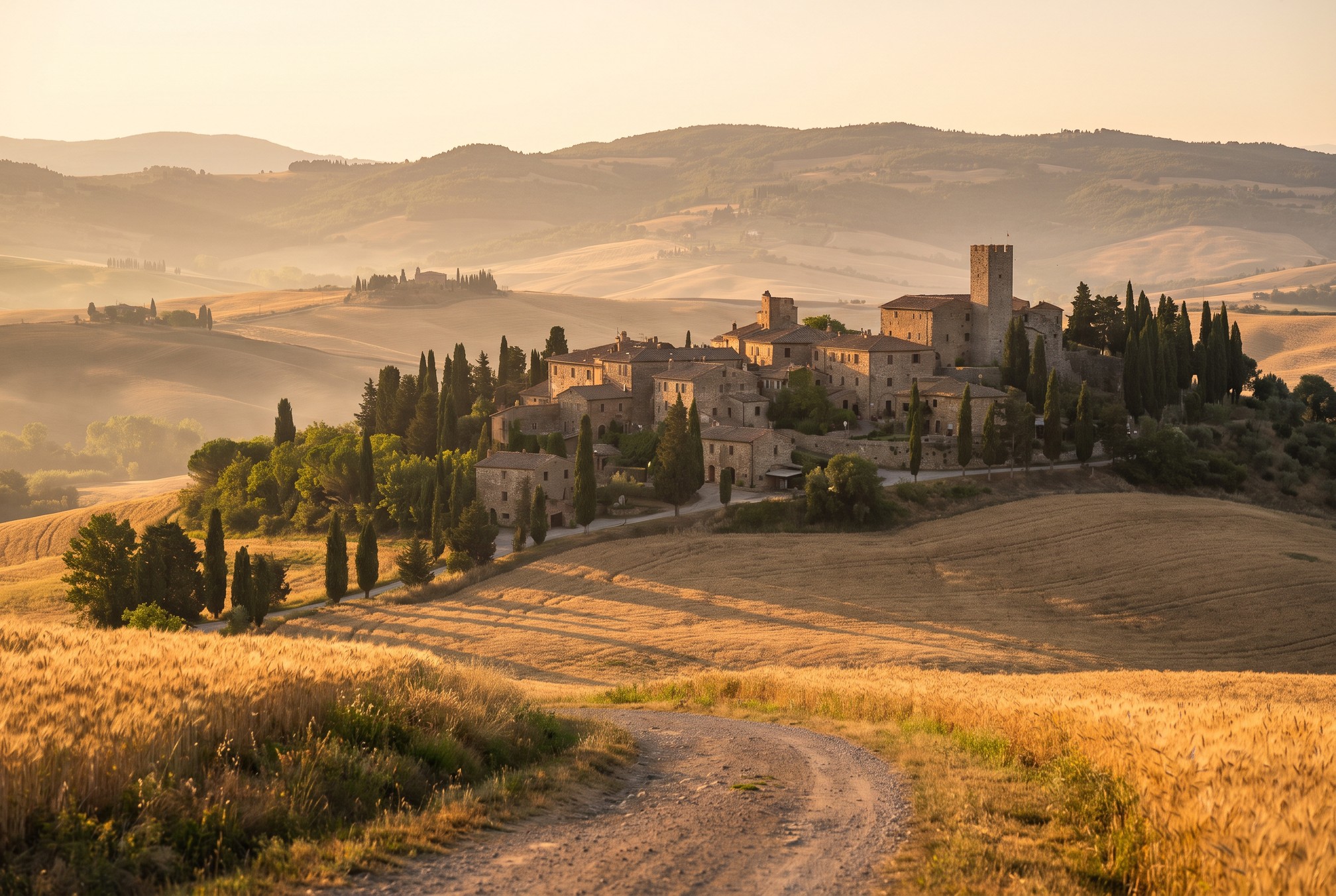
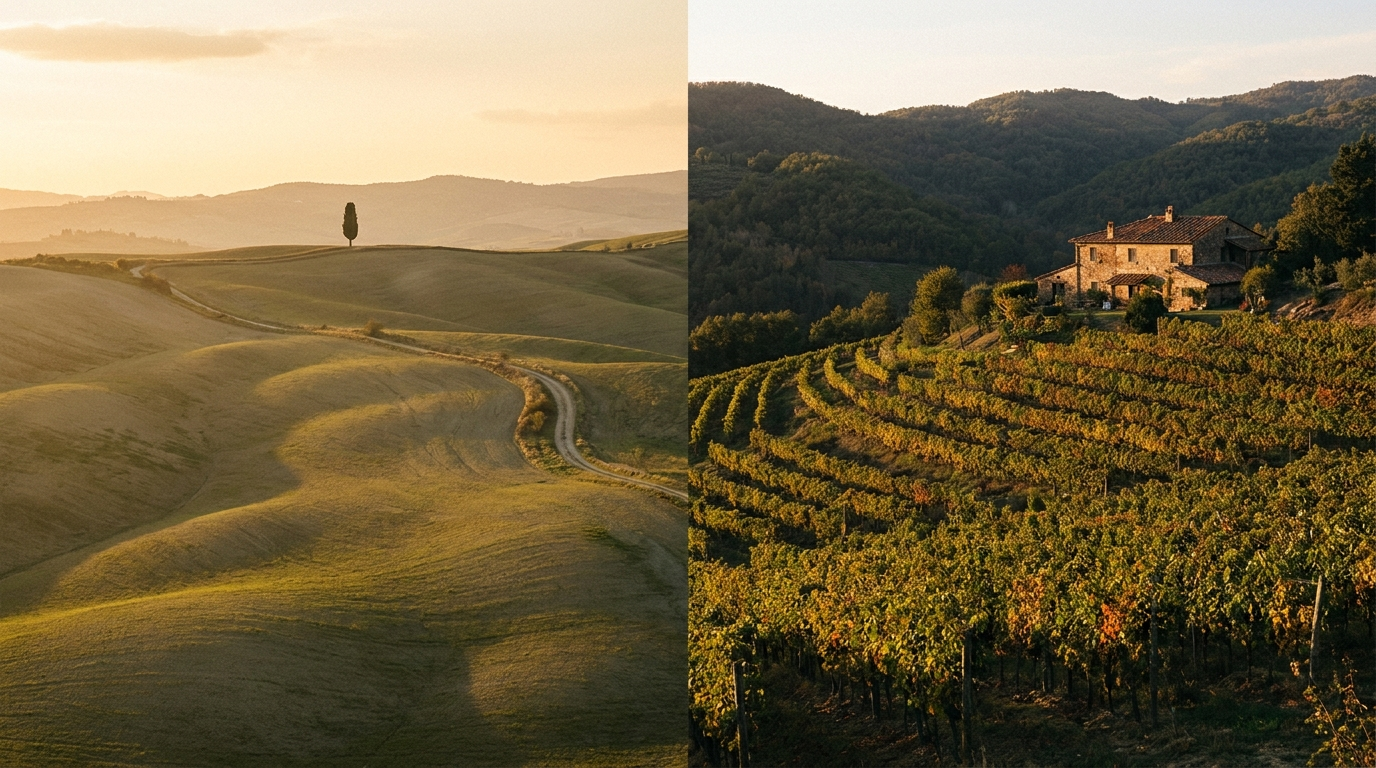
Val d'Orcia sits south of Siena, a UNESCO listed valley of bare clay hills, scattered farmhouses, and the occasional lone cypress standing on a ridge like a punctuation mark. The land here was historically too poor for dense vineyard planting across every slope, which is part of why the hills stayed open and grassy rather than being fully terraced with vines. That openness is exactly what makes the region so photogenic. A single tree, a single farmhouse, or a single winding road can carry an entire composition because there is so little visual clutter competing with it.
The color story shifts dramatically with the season, from saturated green in spring to a golden, almost Californian dry-grass tone by late summer. Villages like Pienza and San Quirico d'Orcia sit on hilltops with genuine terrace views over the valley, and the region's famous cypress lined roads near San Quirico and Monticchiello are some of the most photographed rural roads in the world. If you want to understand the region in more depth, our deep dive on Val d'Orcia covers the geography and history behind why it looks the way it does.
What Chianti actually looks like
Chianti sits between Florence and Siena, and unlike Val d'Orcia it is a working wine region through and through. The hills here are covered in dense, orderly rows of vines, broken up by patches of forest, stone farmhouses with terracotta roofs, and small hilltop villages like Greve, Radda, and Castellina that anchor each sub-zone. Where Val d'Orcia gives you open space, Chianti gives you layers. A typical Chianti composition might stack vineyard rows in the foreground, a stone farmhouse in the middle distance, and forested hills fading into haze behind it, all within a much tighter working distance than a comparable Val d'Orcia shot.
Chianti is also closer to two major tourist cities, which shapes both its infrastructure and its crowd levels. Wineries here are set up for casual tastings and drop-in visits in a way that Val d'Orcia's more scattered agriturismi generally are not. The trade-off is that popular viewpoints, particularly around Greve and the road between Panzano and Radda, see considerably more traffic during peak season than most of Val d'Orcia outside its single most famous spots.
Side by side comparison
| Category | Val d'Orcia | Chianti |
|---|---|---|
| Landscape character | Open, bare, minimal, long sightlines | Dense, layered, textured, shorter sightlines |
| Signature subject | Lone cypress trees, winding farm roads | Vineyard rows, stone farmhouses |
| Peak season crowds | Moderate, concentrated at a few famous spots | Heavier, spread across more villages |
| Distance between key villages | 15 to 25 minutes by car, more for outer points | 10 to 20 minutes by car in most sub-zones |
| Wine tourism access | Scattered, often needs advance booking | Dense, more casual drop-in options |
| Best light for beginners | Forgiving; open space works at most hours | More demanding; midday light flattens the layering |
Crowds and timing
Because Chianti sits directly between Florence and Siena, it absorbs a steady stream of day-trip traffic from both cities, especially from late morning through mid afternoon in high season. Tour buses and rental cars alike funnel through the same handful of postcard roads, and the most photographed single viewpoints can genuinely feel crowded by ten in the morning during June and July.
Val d'Orcia is not empty, and its handful of iconic spots, particularly the cypress roads near San Quirico, do draw a real crowd of their own. But the region as a whole is more spread out and less centrally located relative to the two big cities, which means the crowd thins out faster once you move even a short distance off the single most famous roads. Shooting at sunrise, in either region, remains the single most effective way to avoid other photographers regardless of which one you choose.
Shoulder season shifts the calculation in both regions, but not equally. Chianti's proximity to Florence means it never fully empties out, since city day-trippers keep showing up on weekends even in November. Val d'Orcia, by contrast, can feel almost deserted in the weeks right after the harvest crowds leave and before the winter holidays begin, which is one more reason photographers chasing solitude tend to gravitate south toward Pienza and San Quirico rather than staying in the more trafficked vineyard country.
Driving and logistics
Chianti's villages sit closer together, which makes it easier to string several locations into one shooting day without long transfers. You can realistically shoot a sunrise vineyard scene near Panzano, spend the midday hours in Greve, and be back out for golden hour at a different viewpoint entirely, all within a compact loop.
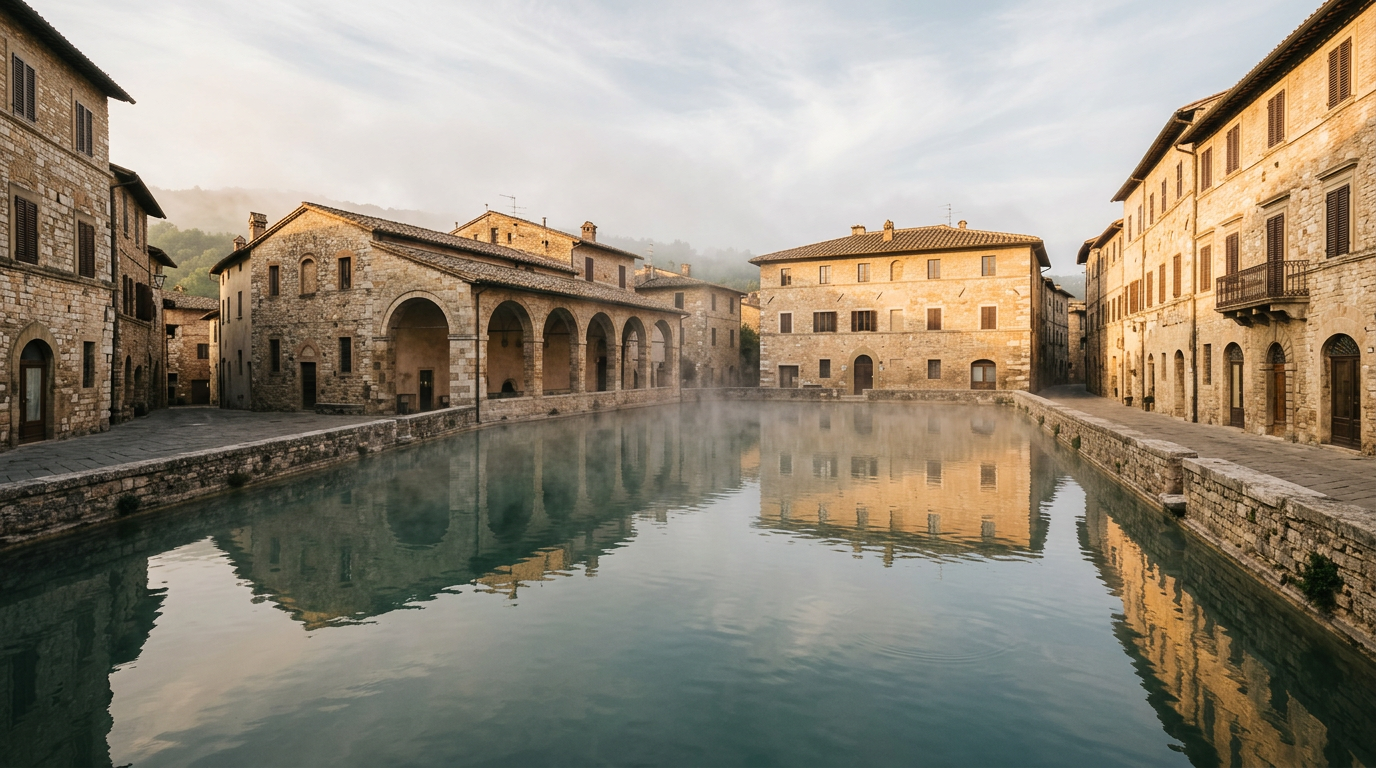
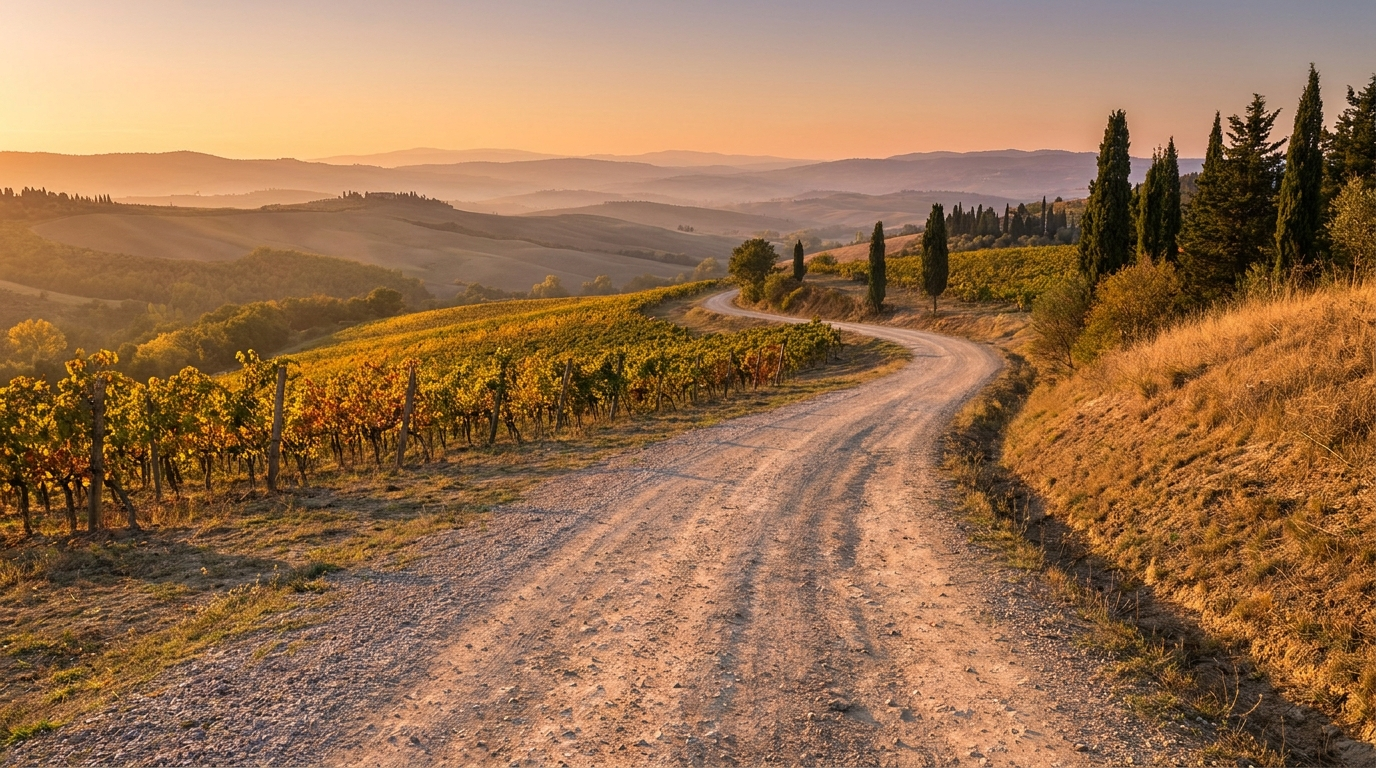
Val d'Orcia rewards patience more than density. The signature viewpoints, from Pienza's terrace to the cypress roads near San Quirico to the thermal square at Bagno Vignoni, are spread across a wider area, and some of the best compositions sit down unpaved farm roads that take longer to reach and require more careful driving. Plan for more time in the car per shot in Val d'Orcia, and budget accordingly if your schedule is tight.
Which region suits which photographer
Photographers who gravitate toward minimalism, negative space, and a single strong subject against an open sky tend to leave Val d'Orcia far happier than they expected. It is a region that punishes visual clutter and rewards patience with light, since the same bare hillside can look completely different under morning fog, harsh midday sun, or the long shadows of late afternoon.
Photographers who enjoy layering, texture, and finding order within a busier frame tend to prefer Chianti. The dense vineyard rows give you built-in leading lines almost everywhere you point a camera, and the forested hills provide a natural backdrop that does a lot of compositional work without much effort. If you shoot a lot of architecture or enjoy incorporating human elements like wineries and working farms into a landscape frame, Chianti's density plays to that strength more naturally than Val d'Orcia's open spaces do.
Lens choice tends to diverge between the two regions as well, even among photographers who own the exact same kit. In Val d'Orcia, a wide angle lens earns its keep constantly, since so many of the strongest compositions depend on foreground to background depth across a huge open scene. In Chianti, a standard zoom or a short telephoto often does more work, letting you isolate a single row of vines or compress a farmhouse against the hillside behind it without the wider distortion that can make a tightly packed vineyard scene look busier than it actually feels standing in front of it.
Can you do both in one trip
Yes, and for a trip of eight days or longer it is a genuinely good plan. The two regions are close enough together, roughly ninety minutes apart by car, that a single base near Siena can put both within reasonable striking distance, though most photographers get better results basing separately in each region for four or five days apiece rather than commuting long distances daily.
A common and effective structure is to start in Chianti, since its density means you can build confidence and come home with strong images even on a jet-lagged first few days, then move south into Val d'Orcia for the second half of the trip once you are more rested and ready to put in the extra driving time that its scattered viewpoints demand. For a full breakdown of everything worth pointing a camera at across the wider region, our Tuscany Photography Guide covers both areas and several more in detail.
Pro Tip: If you do split your trip, shoot Chianti first. Its tighter geography and forgiving midday options are a gentler introduction than Val d'Orcia's longer drives and more demanding light, which is a better fit once you have found your rhythm.
Frequently asked questions
Which region is better for a first time visitor to Tuscany? Chianti is generally easier for a first trip because of its density and proximity to Florence and Siena, both of which are worth visiting in their own right. Val d'Orcia rewards a second or third Tuscany trip once you know you want to slow down and dig into fewer, more specific locations.
Is Val d'Orcia part of Chianti? No. They are separate sub-regions of Tuscany with different soil, history, and land use. Chianti is a defined wine appellation; Val d'Orcia is a UNESCO listed valley named for the Orcia river, with its own separate wine appellations including Brunello di Montalcino and Vino Nobile di Montepulciano.
Which region has better light for photography? Neither is objectively better. Val d'Orcia's open terrain makes it more forgiving across a wider range of the day, while Chianti's layered scenes are more dependent on low angle golden hour light to avoid flattening out at midday.
Can I see the famous cypress trees in both regions? Individual cypress trees and short cypress-lined stretches exist in both, but the specific iconic cypress roads that show up constantly in Tuscany photography, near San Quirico d'Orcia and Monticchiello, are in Val d'Orcia, not Chianti.