Workshop vs Self Guided: How Should You Photograph Tuscany?
An honest comparison of guided photography workshops versus a self planned Val d'Orcia trip, covering real costs, access to private farm roads, and how much a local guide actually changes your odds of catching the light.
Workshop vs Self Guided: How Should You Photograph Tuscany?
Every few weeks someone asks me a version of the same question. They have seen the cypress roads, the fog over Val d'Orcia, the golden light on the hills near Pienza, and they want to know if they should book a guided photography workshop or just rent a car and figure it out themselves. It is a fair question, and it deserves a fair answer rather than the answer you would expect from a company that runs photography tours for a living.
So here is my honest attempt at one. I have led groups through Val d'Orcia for years, and I have also traveled plenty of places on my own with nothing but a camera bag and a rental car. Both approaches can get you home with genuinely strong images. They just get you there in very different ways, at very different costs, and with very different odds of catching the shot you actually came for.
Key Takeaways
There is no universally correct answer here, only the answer that fits your budget, your experience level, and how much of the trip you want to spend problem solving versus shooting.
| Point | Details |
|---|---|
| Typical cost gap | A week-long guided workshop usually runs $3,000 to $6,000 all in; a self-guided week with a rental car and mid-range agriturismo lodging often lands at $1,500 to $2,500 |
| Biggest access difference | Many of the most photographed cypress roads and farm driveways in Val d'Orcia sit on private land, and guides typically hold long standing permission that solo visitors do not |
| Biggest timing difference | A local guide already knows which hilltop catches fog first this week and which field was just plowed, information a weather app cannot give you |
| Best fit for a workshop | First time visitors, photographers who want feedback on their images each evening, and anyone who would rather shoot than scout |
| Best fit for self guided | Experienced landscape shooters who already know their gear, want full control of the schedule, and do not mind a slower first couple of days |
| Middle ground | A small private tour splits the difference, giving you local access and timing knowledge without a large group's fixed itinerary |
Table of Contents
- The quick verdict
- What a self guided trip actually costs
- What a workshop actually costs
- Access: the roads you cannot just walk onto
- Timing: why a local guide beats your weather app
- A day in the life: workshop vs self guided
- Gear and troubleshooting when something goes wrong
- Workshop vs self guided, at a glance
- Who should go self guided
- Who should join a workshop
- Frequently asked questions
- So which should you actually pick
The quick verdict
If you have never shot Val d'Orcia before, do not know the region, and want to come home with a strong, consistent set of images without burning your first three mornings figuring out where to stand, a guided workshop is the safer bet. If you already know your camera cold, enjoy the process of scouting a location yourself, and are working with a tighter budget, a self guided trip can absolutely deliver, it just asks more of you before the light shows up. Neither choice is wrong. What is wrong is assuming one is obviously better without actually running the numbers, which is what the rest of this guide is for.
Pro Tip: Whichever route you choose, build in one buffer day with no fixed plan. Val d'Orcia weather changes fast, and a spare morning to chase fog or wait out rain is worth more than an extra village on the itinerary.
What a self guided trip actually costs
A self guided week in Val d'Orcia is genuinely affordable if you are willing to do the planning yourself. A manual transmission rental car booked a few months ahead runs roughly $250 to $450 for a week depending on season, and fuel for the driving you will actually do, mostly short hops between San Quirico, Pienza, and Montepulciano, adds maybe $80 to $120. A mid-range agriturismo room with a kitchenette runs $100 to $180 a night in most seasons, more during the May and October photography rush. Add flights, and a realistic total for a solo or two person self guided week lands between $1,500 and $2,500 per person, sometimes less if you split a car and a room with a travel partner.
The real cost of a self guided trip is not money though, it is time and uncertainty. You will spend hours before the trip scouting locations on satellite maps and photography forums, and you will spend at least your first morning or two on the ground figuring out where the light actually falls versus where you assumed it would. Some photographers enjoy that process. Others find it eats into shooting time they would rather spend behind the camera.
What a workshop actually costs
A week-long guided photography workshop in Val d'Orcia typically runs $3,000 to $6,000 per person, and the range depends heavily on group size, accommodation level, and how much one-on-one guiding is included. That price usually bundles lodging, most meals, ground transport between locations, a guide who already knows the sunrise and sunset spots for the week's weather, and often nightly image review sessions where you get feedback on what you shot that day.
The number looks steep next to a self guided budget until you account for what it removes. You are not renting a car, you are not navigating unfamiliar farm roads in the dark before sunrise, and you are not burning a morning discovering that the field you scouted online was harvested last week and looks nothing like the photo that convinced you to go there. For a first Tuscany trip, that removed uncertainty is often worth more than the price difference suggests on paper.
Access: the roads you cannot just walk onto
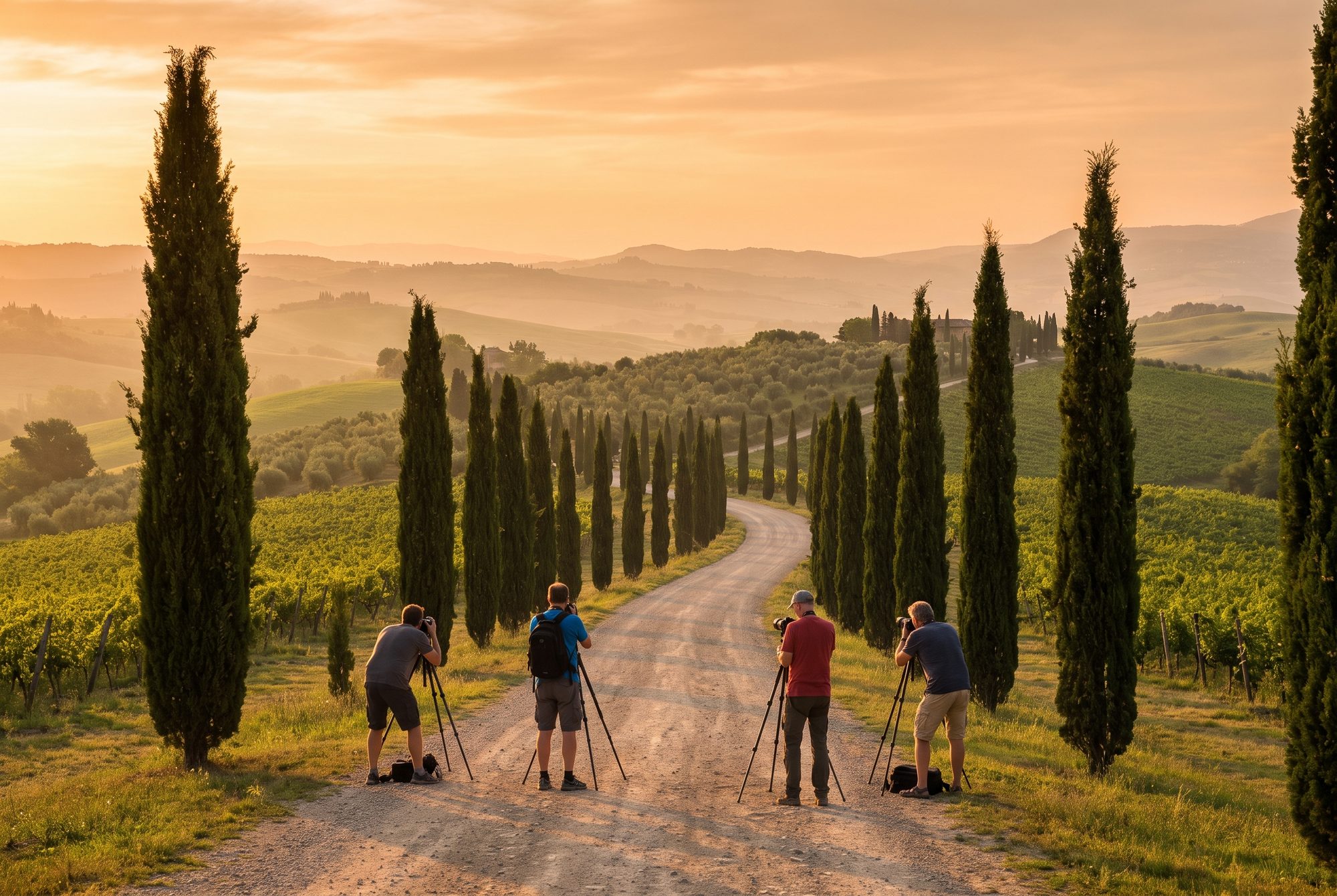
Here is the detail most photographers do not realize until they are standing at the edge of a field with a locked gate in front of them. A large share of the classic Val d'Orcia images, the winding cypress driveways, the isolated farmhouse on a hilltop, sit on active private farmland. The land is owned and worked by families who have, understandably, grown tired of tourists parking on their access roads or walking into their crops for a photo. We cover one of the most photographed examples of this in our guide to the cypress road near San Quirico, and the access rules there are typical of the region, not an exception.
Tour operators who have run trips in the area for years generally hold standing relationships with these landowners, sometimes going back a decade, built on always asking first, never blocking farm equipment, and occasionally paying a small access fee. A solo visitor can still get some of these shots from public roads with a longer lens, a 70-200mm f/2.8 compresses a distant cypress row nicely, but the tightest, most iconic compositions from just inside the property line, the kind shot at 24mm or 35mm with the road curving right up to your feet, are usually only available with permission a guide already has.
This is not a minor technicality either. A farmer who has waved the same guide's van through the gate every season for years is making a judgment call based on trust, not paperwork, and that trust does not automatically extend to a rental car pulling up at 5:30am with strangers behind the wheel. Showing up uninvited and shooting from just inside a fence line, even briefly, is the fastest way to get a Val d'Orcia access point closed to everyone, guided and independent visitors alike. If you go self guided, plan on shooting these iconic roads from public right of way with a longer lens, and treat any private frontage as off limits unless you have asked someone in person first.
If getting inside that access gap matters to you as much as saving money does, it is worth looking at what a guided Val d'Orcia photo tour actually includes before you write it off as an unnecessary expense. The value is not really the guiding, it is the decade of relationships that come with it.
Timing: why a local guide beats your weather app
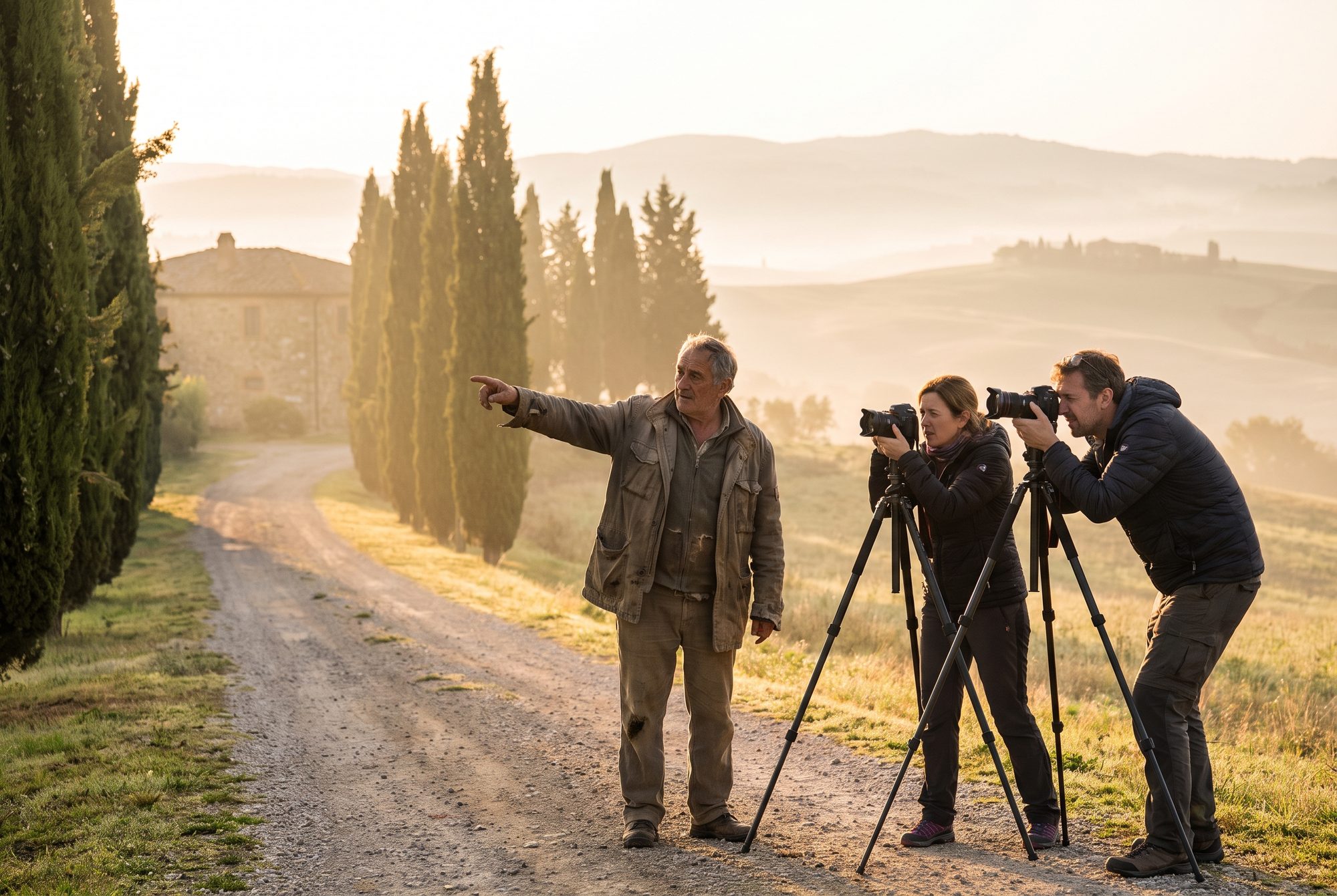
Fog is the single most requested shot on any Val d'Orcia trip, and it is also the hardest one to plan for from a distance. The general pattern is well known: a clear evening sky, calm wind, and a sharp overnight temperature drop create the conditions for fog to pool in the valleys by sunrise. What a weather app cannot tell you is which specific hilltop above San Quirico or Pienza catches that fog first this week, because the exact viewpoint shifts slightly depending on wind direction and which fields were irrigated the day before.
A guide who has been checking these conditions every morning for the entire season already knows the answer without needing to guess. They also know the backup plan for a morning when the fog does not show, which matters more than it sounds like it should. A self guided photographer who wakes up to a clear, fog-free sky after setting an alarm for 5am has to improvise on the spot. A guide has already improvised that exact scenario a dozen times before and has somewhere else worth driving to.
Pro Tip: If you are going self guided and chasing fog, check the forecast the night before, not days in advance. Look for a clear sky, wind under 5 miles per hour, and an overnight low at least fifteen degrees Fahrenheit below the daytime high. All three lining up is your green light.
A day in the life: workshop vs self guided
Numbers on a page do not tell you what the actual experience feels like at 4:45am, so here is roughly how each version of the trip plays out. On a workshop, the alarm goes off in the dark, there is coffee waiting downstairs, and a short drive with the group gets everyone to a pre-scouted viewpoint with time to spare before first light. The guide points out where to stand and why, you shoot until the light goes flat around 7:30, and you are back at the agriturismo for a proper breakfast before most tourists in the valley are even awake. Midday is usually free time or a planned cultural stop, a pecorino tasting near Pienza or a short wine visit outside Montalcino, before a second session in the late afternoon builds toward sunset. Evenings often include a group image review, where the guide looks at what everyone shot and explains, specifically, why one composition worked better than another.
A self guided day starts the same way, dark and early, but from there it diverges. You are checking the weather yourself, deciding between two or three locations you found on satellite maps, and driving to whichever one your gut says is right. Sometimes that gut call is correct and you get the shot. Sometimes you arrive to find the light hitting the hillside from the wrong angle, or a field you scouted online was harvested last week and no longer looks anything like the reference photo. That is not a failure, it is just the tuition you pay for full independence. By your third or fourth morning you will have a much better feel for the valley, but that learning curve costs you real shooting time on the front end that a guide would have skipped for you. Midday is entirely yours to plan, and evenings are spent editing alone or comparing notes with a travel partner if you have one, without the structured feedback a workshop builds in by default.
Gear and troubleshooting when something goes wrong
This is the part nobody budgets time for, but it comes up on nearly every trip. Someone's polarizer jams on the filter thread. Someone leaves their spare battery on the charger back at the hotel. Someone cannot figure out why their long exposure of a cypress road at blue hour keeps coming out soft, and the answer turns out to be a two second self timer they forgot to set, not a tripod problem at all.
On a workshop, a guide who has seen every version of this can usually solve it in under a minute, sometimes with a spare piece of gear from their own bag. Going self guided, you are your own technical support. That is entirely manageable if you already know your camera well: carry a rocket blower and a microfiber cloth for dust and haze, bring a spare battery and card for every day you shoot rather than every trip, and if you are running a 3 or 6 stop graduated ND for the harsh midday light discussed elsewhere on this site, test it at home before you are standing on a hillside at 5:45am trying to read the manual by phone light. For long exposures on the cypress roads, a sturdy tripod, a remote shutter release or a 2 second timer, and an aperture around f/8 to f/11 will get you sharp results without hunting for the sweet spot on the fly.
Workshop vs self guided, at a glance
| Factor | Guided workshop | Self guided |
|---|---|---|
| Typical cost per week | $3,000 to $6,000 | $1,500 to $2,500 |
| Access to private farm roads | Usually included via standing relationships | Limited to public roads and longer lenses |
| Timing and location knowledge | Handled by a guide who checks conditions daily | Self researched, more trial and error |
| Gear troubleshooting | Guide on hand, often with spare gear | You are your own technical support |
| Schedule flexibility | Fixed group itinerary, less personal freedom | Fully your own pace |
| Feedback on your images | Often included as nightly review sessions | None unless you arrange it yourself |
| Best for | First time visitors, those short on planning time | Experienced shooters, tighter budgets |
Who should go self guided
Self guided travel makes the most sense if you already know your camera without having to think about it, you have shot landscapes somewhere unfamiliar before and enjoyed the scouting process, and your budget is a real constraint rather than a preference. It also suits photographers who value total control of their schedule more than anything else. If a sudden change in the light means you want to scrap the day's plan and chase clouds for three hours, nobody in a self guided trip needs to agree with you first.
If this is you, our beginner's guide to photographing Tuscany is worth reading even if you are not a beginner, since it covers the camera settings and first shot list that will save you time on day one regardless of experience level.
Who should join a workshop
A workshop makes more sense if this is your first trip to Val d'Orcia, if you want to spend your time shooting rather than researching, or if getting inside the private cypress roads and farm driveways matters more to you than saving money. It also suits photographers who learn faster with feedback. Reviewing your own images at the end of a long shooting day is useful. Reviewing them with someone who can tell you exactly why your composition on the cypress road did not work, and what to change tomorrow morning, tends to accelerate that learning curve considerably.
If that sounds like where you are right now, take a look at our Val d'Orcia photography tours, which are built around exactly this kind of daily access and nightly feedback loop, or our private tours if you would rather have that same local access without joining a larger group.
Frequently asked questions
Is a photography workshop actually worth the extra cost? If this is your first Val d'Orcia trip and you value guaranteed access to private locations plus feedback on your images, yes, for most photographers the extra cost buys real value rather than just convenience. If you are an experienced shooter on a tight budget, the gap is harder to justify.
Can I photograph the famous cypress roads without a guide? You can shoot many of them from public roads with a longer lens, but the closest, most iconic compositions from just inside the property line usually require permission that solo visitors do not have.
How big is a typical Tuscany photography workshop group? Group sizes vary by operator, but small groups of 6 to 10 photographers are common, since larger groups make it harder to guarantee everyone a clean, uncrowded angle on a narrow farm road.
What if I only want a guide for part of my trip? Private, shorter guided days are a real option for travelers who want to combine a few days of local access with a few days of independent exploring, and many operators, including ours, offer exactly this kind of flexible arrangement.
Is self guided a good idea for a first time visitor? It can work if you are comfortable navigating rural roads and doing your own research, but expect your first day or two to involve more trial and error than a guided trip, particularly around finding the best light and the least crowded viewpoints.
So which should you actually pick
If you have to choose in the next five minutes, ask yourself one question: would you rather save money and accept some trial and error, or spend more and remove as much uncertainty as possible from a trip you may only take once. Neither answer is wrong, and plenty of photographers have come home from Val d'Orcia thrilled with either approach. The honest truth is that a workshop mostly buys you time and access, not talent, and a self guided trip mostly costs you time and access, not results. What you do with the light once you are standing in front of it is still entirely up to you.