Long Exposure Photography in Val d'Orcia: When It Works and When It Doesn't
A practical look at where long exposure genuinely improves a Val d'Orcia photograph, moving clouds over hills, water at Bagno Vignoni, and where it just works against the scene, with real ND filter strength recommendations.
Long Exposure Photography in Val d'Orcia: When It Works and When It Doesn't
I used to bring a full stack of ND filters on every single trip to Val d'Orcia and use maybe a third of them. Long exposure has this reputation as the technique that turns an ordinary landscape into something dramatic, and sometimes that is exactly true. A bank of clouds smearing across a ridge of hills at sixty seconds can look like something out of a movie. But I have also stood on a hillside near San Quirico, screwed on a ten stop filter out of habit, and produced a flat, lifeless frame that would have been a far better photograph at a fifth of a second with the tripod left in the car.
The difference between those two outcomes is not the gear. It is knowing which scenes in Val d'Orcia actually have something worth smoothing out, and which ones just have a static hillside that looks better sharp. This guide walks through both cases with real settings, not vague advice to "experiment," plus the specific filter strengths I actually carry when I lead a group through this part of Tuscany.
Key Takeaways
Long exposure earns its place in Val d'Orcia when there is genuine motion in the frame. Everywhere else, it just costs you contrast and sharpness for nothing.
| Point | Details |
|---|---|
| Where it works best | Moving cloud banks over the hills, and the thermal water at Bagno Vignoni |
| Where it usually fails | Static hillsides with no cloud movement, wildflower fields in any breeze, midday light with no real ND stop needed |
| Most useful filter | A 6 stop ND for cloud drag without losing too much shutter control |
| The trap to avoid | Reaching for a 10 stop filter out of habit rather than because the scene needs it |
| Non negotiable gear | A tripod rated for real wind, since Val d'Orcia's ridgelines are exposed |
| Best exposure length for cypress rows | Usually none. Cypress trees move in wind and long exposure blurs them in a way that reads as a mistake, not a style |
Table of Contents
- The short version
- When long exposure genuinely helps
- Moving clouds over the hills
- The water at Bagno Vignoni
- Where long exposure works against you
- The gear that actually matters
- Filter strength by scene
- How I actually meter a long exposure in the field
- A note on wind, because Val d'Orcia has a lot of it
- Frequently asked questions
- Quick checklist before you commit to a long exposure
The short version
If you only take one thing from this article, take this. Long exposure is a tool for recording motion that happens over time, not a filter you slap on to make a landscape look moodier. In Val d'Orcia, the two places that reliably have motion worth recording are a sky with real cloud movement, which happens on plenty of days here especially in shoulder season, and the water at Bagno Vignoni's thermal square. Almost everything else in this part of Tuscany, the rolling hills themselves, the gravel farm roads, the famous cypress avenues, is static. A long exposure of something static does not add drama. It just removes the fine detail and contrast that made the scene interesting in the first place.
When long exposure genuinely helps
There is a simple test I run before I ever attach a filter. I ask myself what is actually moving in this frame, and would recording that movement over several seconds or minutes make the photograph better or just different. A field of wildflowers swaying gently in a breeze is moving, technically, but blurring it usually just looks like a focus mistake. A bank of clouds sliding across the sky above a ridge of hills is moving in a way that reads as intentional and often genuinely improves the composition, because it adds a sense of scale and time that a frozen sky cannot.
The honest answer is that most of Val d'Orcia's most photographed scenes, the classic curved road lined with cypress trees near San Quirico, the rolling hills near Pienza, do not benefit from long exposure at all. They benefit from sharp, well composed frames shot at a normal shutter speed during good light. Save the ND filters for the two situations below, where they earn their place in your bag.
Moving clouds over the hills
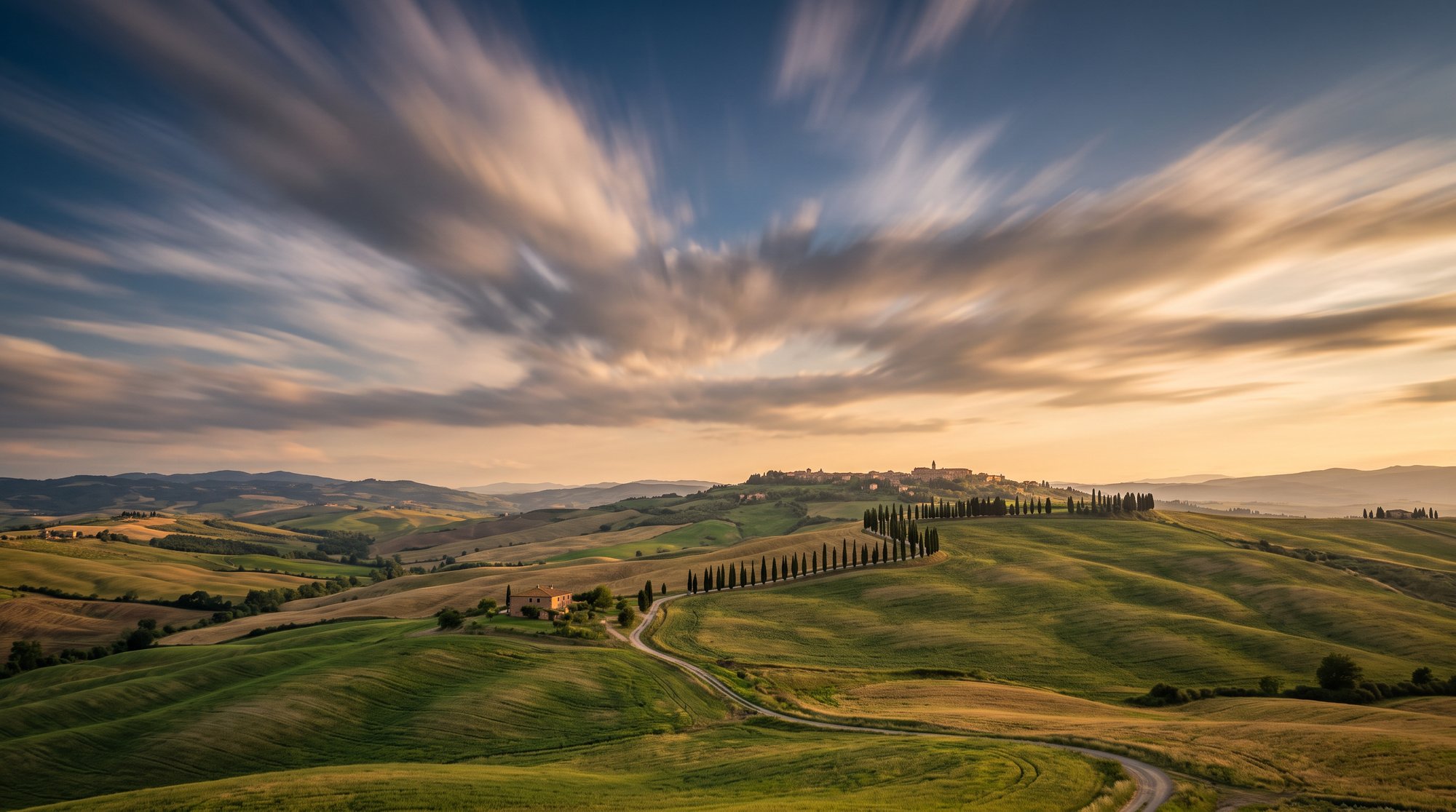
On a breezy day, especially in the shoulder seasons of spring and autumn when weather systems move through more actively, you can get real cloud drag over the ridgelines around Val d'Orcia. A six stop ND filter dropping your shutter speed to somewhere between two and eight seconds is usually enough to show clear directional movement in the clouds without turning the sky into a complete blur. I find this works especially well from elevated viewpoints looking across multiple ridges, like the classic view toward the Podere Belvedere cypress grove or the open farmland east of Pienza, where the layered hills give the moving sky something to contrast against.
Technique wise, this is a fairly standard long exposure setup. Mirror lockup or electronic first curtain shutter if your camera supports it, a solid tripod, and a remote release or a two second self timer so you are not introducing shake by pressing the shutter button with your finger. I shoot these at f/8 to f/11 for depth of field across the layered hills, ISO 100, and let the shutter speed fall wherever the six stop filter and available light put it. If the sky is moving fast and I want more obvious streaking, I will step up to a ten stop filter and push the exposure to fifteen or twenty seconds, but for most cloud conditions here, six stops is the more useful tool because it keeps enough shutter speed control that you are not waiting three minutes between test shots.
Pro Tip: Check the cloud movement with your naked eye for thirty seconds before you commit to a filter. If the clouds are barely drifting, a long exposure will not add the dynamic streaking you are picturing. It will just soften a sky that was already fairly static, which reads as a mistake rather than a style.
The water at Bagno Vignoni
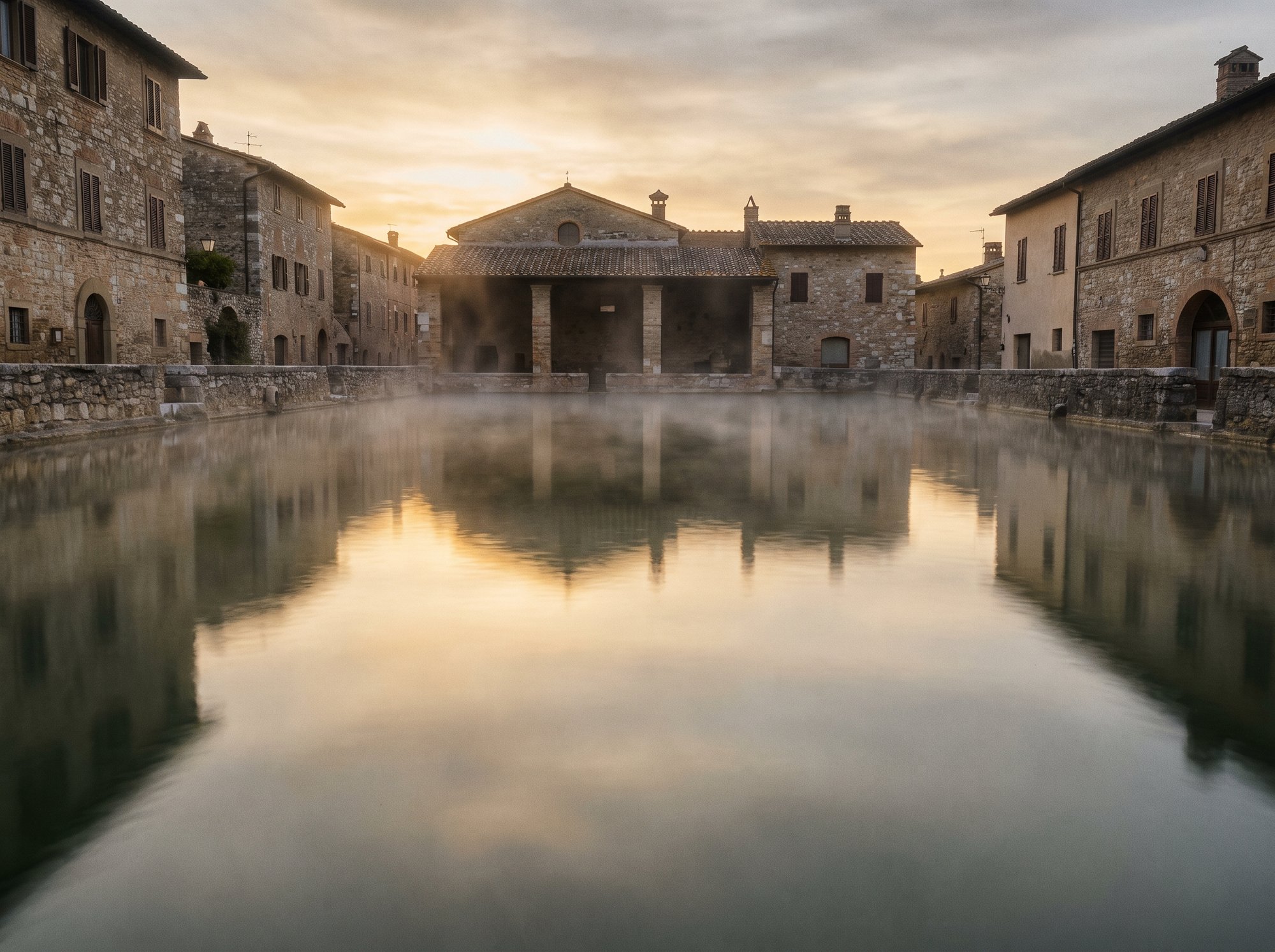
Bagno Vignoni is the other genuinely strong long exposure location in Val d'Orcia, and it works for a completely different reason. The town's historic square is filled with a thermal water pool instead of paving stones, and that water is almost always moving slightly, both from the natural thermal current and from steam rising off the surface in cooler months. A long exposure of two to six seconds smooths the surface into something closer to a mirror, which pulls in soft reflections of the surrounding stone buildings and makes the square feel even more unusual and dreamlike than it already is in person.
A three stop ND filter is usually plenty here, sometimes not even necessary at all if you are shooting at dawn or dusk when ambient light is already low. I like an aperture around f/11 for a clean, front to back sharp image of the surrounding architecture, and I meter for a shutter speed in the two to four second range as a starting point, checking the histogram and adjusting from there. If you visit on a cold morning between roughly October and March, steam rising off the warmer water against cooler air adds another moving element that a slightly longer exposure, six to ten seconds, can render as a soft atmospheric haze around the pool's edges rather than sharp, distracting wisps.
I go into more detail on the specific vantage points and steam timing for this square in my full guide to photographing Bagno Vignoni, which is worth reading before you visit since the best angles depend on which side of the pool has buildings behind it for reflections.
Where long exposure works against you
This is the section most gear guides skip, and it is the one that actually saves you time in the field. Three specific Val d'Orcia scenarios come up constantly where photographers reach for an ND filter and end up with a worse photograph than if they had just shot normally.
The first is wildflower and wheat fields in any wind at all, which is most days here. A long exposure of a field with even a light breeze produces a mushy, indistinct blur across the entire foreground that reads as camera shake or a focus error to anyone looking at the print, not as an intentional artistic choice. If you want motion in a field shot, a much shorter exposure, somewhere around a quarter to half a second, can suggest gentle movement in the grass while keeping enough structure that the eye can still resolve individual stems and flower heads. Anything longer just erases the texture that made the field worth photographing.
The second is the cypress avenues themselves, which are probably the single most photographed subject in this entire region. Cypress trees sway more than they look like they should in even a moderate wind, and a long exposure of the famous curved cypress road near San Quirico will blur the tree canopies into soft green smudges while the trunks and road stay sharp, an inconsistency that looks like an error rather than a style. I cover the specific light angles and timing that actually make this location work in my guide to photographing rolling hills with real depth, and none of the techniques there involve long exposure, because the composition depends on crisp layering, not motion blur.
The third is using a strong ND filter simply because the light is bright, without any moving element in the frame at all. A ten stop filter on a static hillside at midday does not create drama. It removes contrast, mutes color, and can introduce a color cast depending on the filter's glass, all for a shutter speed change that benefits nothing in the composition. If nothing in the frame is moving, the correct move is almost always a faster shutter speed and a polarizer for contrast, not an ND filter.
The gear that actually matters
You do not need six ND filters for a Val d'Orcia trip. I carry three, and honestly use two of them regularly. A three stop filter for the water at Bagno Vignoni and for holding back bright skies in a graduated version, a six stop for cloud movement over the hills, and a ten stop that stays in the bag more often than not, reserved for genuinely fast moving skies or if I want an unusually long exposure of several minutes for a specific creative effect. Beyond the filters themselves, a tripod that can handle real wind is not optional here. Val d'Orcia's ridgelines are exposed, and a lightweight travel tripod that is perfectly fine in a sheltered forest will transmit enough vibration in an open hilltop breeze to soften an otherwise sharp long exposure.
A remote shutter release or your camera's built in intervalometer removes one more source of shake, and a variable ND filter, while convenient for video work, is worth avoiding for serious stills here because of the uneven darkening and occasional color banding they can introduce at their extreme settings, particularly noticeable in the wide, even skies you get over Val d'Orcia's hills. Fixed strength filters from a reputable manufacturer, checked with a lens hood or a filter holder cap to block stray light leaking in around the edges during long exposures, give you more predictable, consistent results shot after shot.
Filter strength by scene
| Scene | Recommended ND strength | Typical shutter speed |
|---|---|---|
| Moving clouds over hills, moderate wind | 6 stops | 2 to 8 seconds |
| Moving clouds over hills, fast wind | 10 stops | 15 to 30 seconds |
| Bagno Vignoni water, daylight | 3 stops | 2 to 4 seconds |
| Bagno Vignoni steam, dawn or dusk | None to 3 stops | 6 to 10 seconds |
| Wildflower or wheat field in breeze | None | 1/4 to 1/2 second, no filter |
| Static hillside, no motion in frame | None | Normal handheld or tripod speed |
How I actually meter a long exposure in the field
The trick with a strong ND filter is that once it is on the lens, your camera's viewfinder or live view may go nearly black, which makes composing and focusing difficult after the fact. I always compose, focus, and take a quick test exposure without the filter first, checking the histogram to get a clean baseline shutter speed at my chosen aperture and ISO. From there, I calculate the new shutter speed by counting stops. A base exposure of 1/60th of a second with a six stop filter becomes roughly 1 second. The same base exposure with a ten stop filter lands around 15 to 20 seconds, accounting for a bit of reciprocity drift most sensors show at longer exposures. Most phones have a free ND calculator app, or you can simply double the shutter speed once for every stop, which is the same math with fewer steps to mess up in the field.
Once the filter is on and the shutter speed is set, I switch to manual focus and lock it, since autofocus often hunts and fails through a dark ND filter, and I use a two second timer or remote trigger every single time, including on a heavy tripod, because Val d'Orcia's open hillsides catch enough wind to matter even when it feels calm at ground level.
Pro Tip: Shoot a bracket of two or three exposures at slightly different shutter speeds around your calculated value, especially for cloud movement shots. Cloud speed varies enough moment to moment that the "correct" math answer is often not the most visually pleasing result, and having options to compare on a larger screen back at your accommodation is worth the extra thirty seconds in the field.
A note on wind, because Val d'Orcia has a lot of it
Val d'Orcia's open, rolling terrain means wind is a constant factor, more so than in a sheltered forest or urban setting where most long exposure tutorials are shot and written. Hanging a weight, even a camera bag, from your tripod's center column hook adds meaningful stability on an exposed hilltop, and shielding the tripod with your own body on the windward side during the actual exposure can make a visible difference in sharpness at shutter speeds beyond a few seconds. If gusts are strong enough that you can feel your tripod shift when you touch it, that is a sign to either find a more sheltered composition or accept a shorter maximum exposure time than you had planned, rather than fighting conditions that will show up as soft, doubled edges in the final file.
This is also exactly the kind of on the ground judgment call that is hard to get right on a first visit but becomes second nature after a few mornings in the field with someone who already knows which ridgelines catch the worst gusts and which are naturally sheltered. If you would rather spend your mornings actually shooting instead of troubleshooting tripod shake, that is a big part of what a guided Val d'Orcia photography tour is for. We already know which viewpoints hold still in a stiff breeze, which mornings are worth setting an alarm for cloud movement, and we carry the filter strengths that actually get used, so you can spend your time composing instead of guessing.
Frequently asked questions
Do I need a ten stop filter for Val d'Orcia? Not usually. A six stop filter covers most cloud movement scenarios and keeps your shutter speeds short enough to review results quickly in the field. Save the ten stop for genuinely fast moving skies or a deliberate, very long exposure effect.
Can I do long exposure photography of the cypress trees? Technically yes, but I would not recommend it. Cypress canopies move enough in typical Val d'Orcia wind that a long exposure blurs the foliage while leaving trunks and road surfaces sharp, which reads as a mistake rather than an intentional look.
What is the best time of day for long exposure at Bagno Vignoni? Early morning, particularly in the cooler months from October through March, when the temperature difference between the thermal water and the air produces visible steam alongside the water's natural movement.
Will a polarizer work instead of an ND filter? A polarizer cuts glare and boosts contrast but only costs you one to two stops of light, not nearly enough for the multi second exposures needed to smooth water or show cloud drag. The two filters solve different problems and I often stack a polarizer under an ND filter for the water shots at Bagno Vignoni.
Is a variable ND filter good enough for this kind of trip? It is convenient for one filter that covers a range of strengths, but the color banding and uneven darkening some variable NDs show at their strongest settings can be a real problem against Val d'Orcia's wide, even skies. Fixed strength filters give more consistent results if image quality matters more to you than pack space.
Quick checklist before you commit to a long exposure
| Check | Why it matters |
|---|---|
| Is something in the frame actually moving | No motion means no reason for a long exposure |
| Is the tripod on stable, wind sheltered ground | Val d'Orcia's ridgelines catch more wind than they look like they would |
| Have you focused and locked focus before adding the filter | Autofocus often fails through a dark ND filter |
| Are you using a remote release or timer | Removes shutter press shake on long shutter speeds |
| Have you checked the histogram, not just the screen preview | LCD previews can look brighter than the actual exposure in daylight |
Long exposure is one of the more satisfying techniques to pull off well precisely because it is so easy to use badly. Val d'Orcia rewards restraint here more than almost any other landscape technique I use in the region. Ask what is moving, match the filter strength to that motion, and leave the ND filters in the bag for the scenes that are better served by a normal, sharp exposure and good light.