What Makes a Photography Guide Actually Good (Not Just a Good Photographer)
Being a talented photographer and being a great tour guide are different skills. Here is what actually separates the two, and how to spot the difference before you book.
What Makes a Photography Guide Actually Good (Not Just a Good Photographer)
I have met a lot of extraordinary photographers over the years who would be terrible guides. Some of them shoot work that stops me scrolling, images with a kind of quiet technical mastery that takes a decade to build. And I would not want to spend a week traveling with half of them, let alone hand them a group of seven strangers at 5am and ask them to get everyone home happy, safe, and with a memory card full of keepers. Being good behind a camera and being good at running a photography tour are two different skill sets that happen to overlap, and the overlap is smaller than most people assume before they book their first guided trip.
This matters more than it sounds like it should, because most photography tour marketing leans hard on the first skill and says almost nothing about the second. You will see a guide's portfolio, their gear list, maybe a magazine credit or two. What you will not see, until you are standing in a wet field at dawn with fog rolling in and a decision to make, is whether that same person can actually run the day. I have watched both versions up close, guides who are brilliant with a camera and mediocre with a group, and guides who are strong photographers and genuinely excellent at the harder, less glamorous job of guiding. This is what actually separates them.
Key Takeaways
A strong photography portfolio is not the same qualification as running a good tour. Four things separate a real guide from a talented photographer with a microphone.
| Point | Details |
|---|---|
| The core distinction | Reading a portfolio tells you if someone can shoot. It tells you almost nothing about whether they can run a group, read weather, or teach |
| Reading conditions | A good guide reads light and weather in real time and reroutes a whole day's plan on short notice when it pays off |
| Teaching without condescension | The best guides adjust their language and pace to whoever is standing next to them, from a first time shooter to an advanced hobbyist |
| Managing the group, not just the shot | Energy, safety, and pacing across a full week matter as much as any single sunrise |
| Local knowledge as a decision tool | Knowing the land well enough to break the planned itinerary, not just describe it, is what actually earns the fee |
Table of Contents
- The real difference between a photographer and a guide
- Reading light and weather in real time
- Teaching without condescension
- Managing a group's energy and safety
- Knowing the land well enough to break the plan
- A real morning that went off script
- Photographer vs guide, at a glance
- How to actually evaluate a guide before you book
- Frequently asked questions about photography tour guides
- So what should you actually look for
The real difference between a photographer and a guide
A portfolio answers one question: can this person make a strong photograph. It does not answer whether they can make ten strangers who just met each other on a bus feel comfortable enough to ask a dumb question about aperture, whether they will notice that one guest has been quietly falling behind on the walk to a viewpoint for two mornings in a row, or whether they can look at a sky at 4:45am and decide, correctly, that the planned location is wrong for today and the group needs to be somewhere else in the next twenty minutes. None of that shows up in a gallery of landscape shots. It only shows up in the field, day after day, under real conditions.
I say this as someone who runs tours for a living, so take the framing for what it is. But the distinction is not a sales pitch, it is just an honest description of two different jobs that get bundled under one title. A photography instructor teaches technique. A tour operator handles logistics. A guide does both of those things while also reading the group, reading the land, and reading the weather, often simultaneously, often before coffee. On our own Val d'Orcia photography tour, we run every departure with two guides for a maximum of seven guests specifically because this job is genuinely hard to do well solo. One person cannot read the light, teach a beginner how to meter a scene, and keep an eye on the group's energy at the same time, not consistently, not for seven straight days.
Reading light and weather in real time
Anyone can check a weather app. A good guide is doing something closer to pattern recognition built from years of watching the same valley behave in slightly different ways under slightly different conditions. In Val d'Orcia specifically, that means knowing that a clear evening sky combined with a sharp overnight temperature drop and calm wind is the recipe for fog, and knowing which hilltop viewpoint near San Quirico or Pienza will actually clear before the fog burns off, versus which one will be socked in until well past the good light is gone. That is not something you learn from a forecast. It is something you learn from standing in that field forty or fifty times across different seasons and paying attention to what actually happened versus what the app predicted.
The technical side matters here too, and a real guide should be able to walk you through it on the spot, not just point at a pretty view. I want a guide who can look at a hazy midday sky and immediately suggest dropping a circular polarizer to cut the glare and pull contrast back into the hills, or who notices the wind picking up before a long exposure shot of cypress trees and tells you to bump your shutter speed up from six seconds to two before you waste ten minutes on a soft, useless frame. Small calls like that, made correctly and quickly, repeated across a week, are the difference between coming home with a folder of nearly-there images and a folder of images you are actually proud of.
Pro Tip: Ask a prospective guide one specific question before you book: "what's the tell that conditions are about to change for the better or worse at this particular location." A real guide answers immediately with something concrete. A guide who is mostly a photographer with a nice portfolio tends to give a vague, general answer about checking the weather.
Gear knowledge matters here too, but not in the way most people expect. It is less about owning the newest body and more about knowing which piece of glass actually solves the problem in front of you. A guide worth their fee should be able to explain, on the spot, why a three stop hard-edge graduated ND is the right filter for a flat horizon line above San Quirico but the wrong choice for a scene with an uneven hilltop skyline where a soft edge grad avoids a visible line cutting across a rooftop. That kind of specific, situational advice, not a generic gear list, is what actually improves your images over a week of shooting.
Teaching without condescension
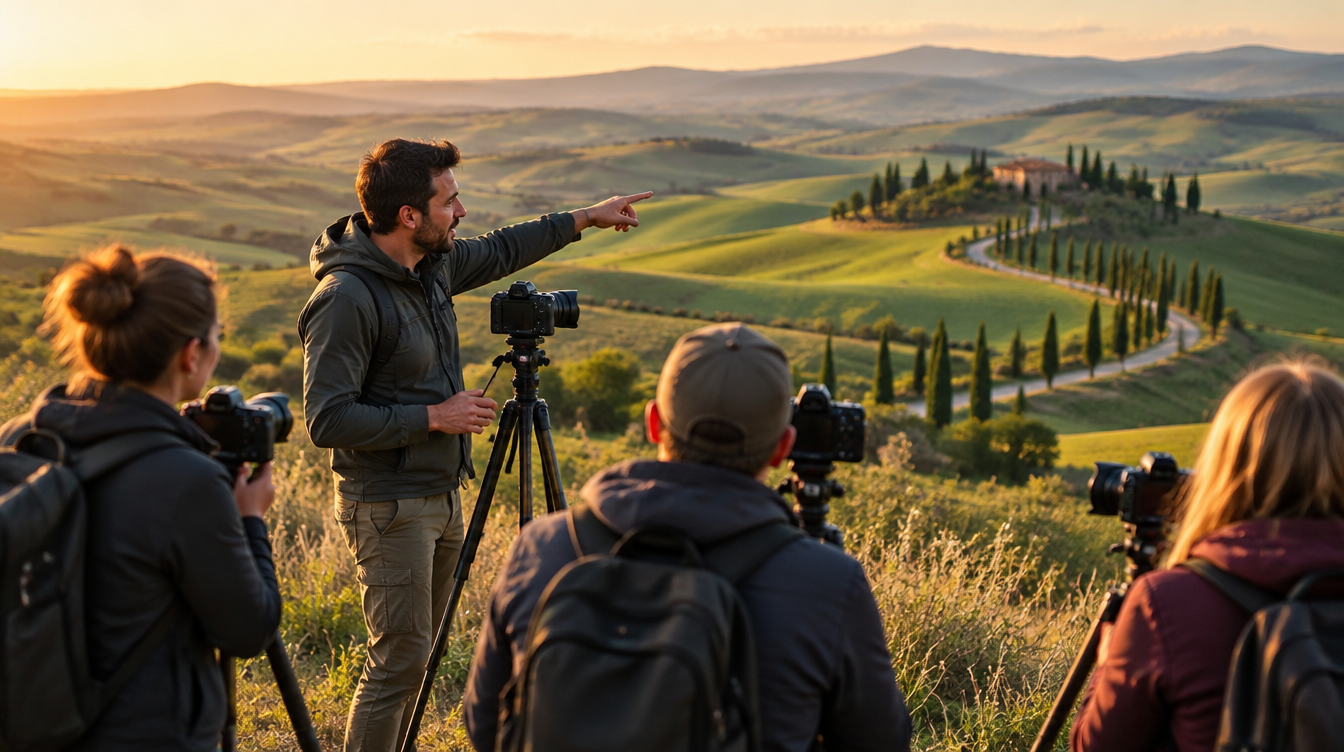
A group of seven photographers is never a group of seven people at the same skill level, and a good guide adjusts to each person rather than running one script for everyone. I have watched a guide spend fifteen minutes patiently walking a guest through the exposure triangle for the first time, using plain language and no jargon, then turn around ten minutes later and have a genuinely technical conversation about focus stacking with a guest who has been shooting for twenty years. Both guests need to leave that interaction feeling like their time was well spent, and that only happens if the guide actually reads where each person is starting from instead of defaulting to a canned lecture.
Condescension is the failure mode to watch for here, and it is more common than it should be in this industry. A guide who sighs at a basic question, or who takes over someone's camera and starts adjusting settings without explaining why, is teaching in a way that makes people feel small instead of capable. The better move, and the one our own guides Lorenzo Ranieri Tenti and Alessandro Cantarelli lean on constantly, is to ask a guest what they are trying to achieve with a shot first, then walk them toward the setting that gets them there, so the lesson sticks instead of just fixing one frame. That approach works whether someone showed up with a phone camera mentality still stuck in auto mode or a full manual shooter who just wants a second opinion on composition.
Managing a group's energy and safety
A single stunning sunrise is not the hard part of guiding. Keeping seven people rested, hydrated, safe on uneven farm tracks in the dark, and genuinely enjoying themselves across six straight days of early wake-ups is the actual job, and it is mostly invisible when it is done well. You notice it more by its absence. A guide who is only thinking about their own shot will push a group too hard on day three because the light was good and forget that half the group is exhausted. A guide who is actually managing the trip will notice that fatigue building and quietly adjust the next morning's call time, or build in an extra hour of sleep before a shorter afternoon session, without anyone having to ask.
Safety shows up in less dramatic ways than people expect. It is a guide who knows exactly which farm road gets genuinely slick after rain and reroutes the group rather than risking a fall in the dark with everyone carrying a tripod and two thousand dollars of camera gear. It is someone counting heads before the van pulls away from a viewpoint, every single time, without making a visible production of it. None of this appears in a portfolio, and none of it is optional if you are the person responsible for a group of strangers for a full week in an unfamiliar country.
Knowing the land well enough to break the plan
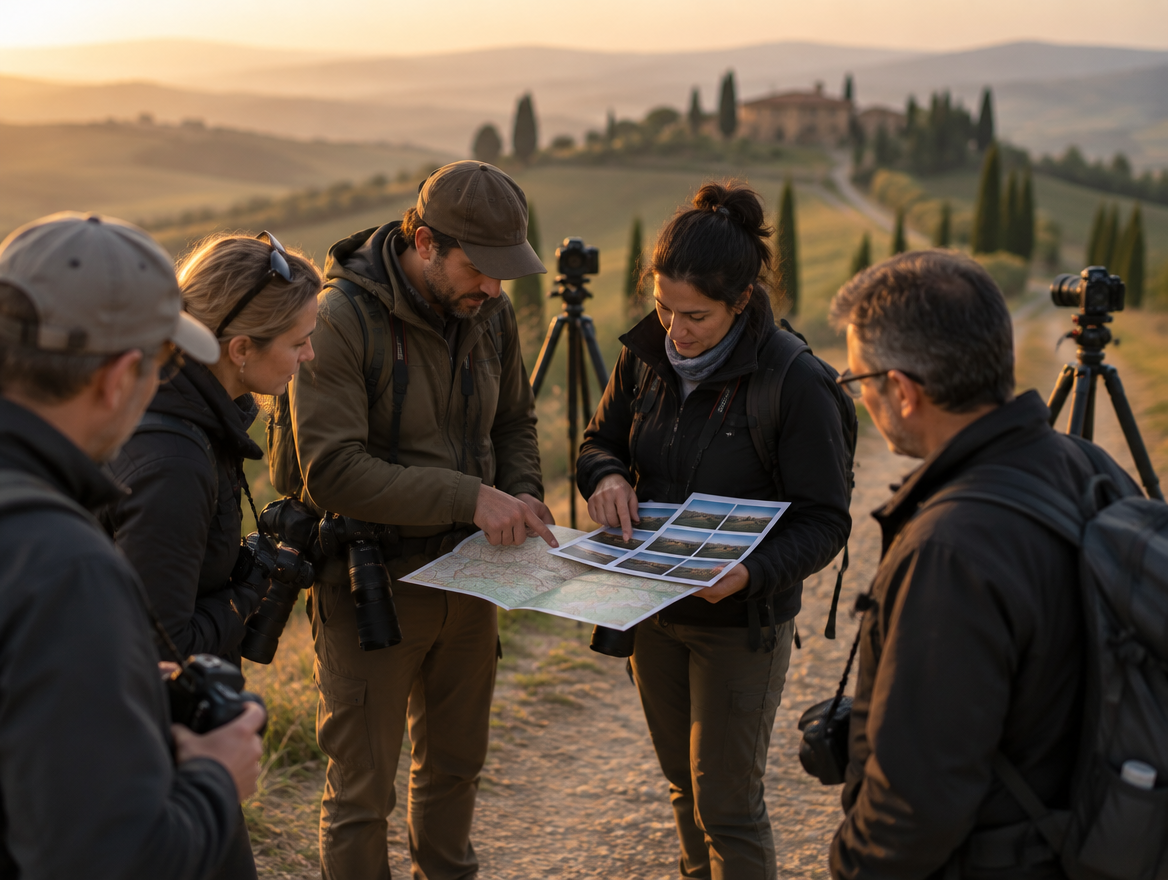
Every good tour has an itinerary. The best guides treat that itinerary as a plan, not a contract, and are willing to abandon it the moment conditions demand something different. That only works if the guide actually knows the region deeply enough to have a real alternative ready, not just a vague sense that things should probably change. Knowing that the fog is not going to clear at the usual Pienza viewpoint but almost certainly will thirty minutes away near Monticchiello, and having driven that route enough times to know exactly how long it takes at 5am with no traffic, is the kind of specific, hard-won local knowledge that turns a mediocre morning into a great one.
This is also where the difference between a tour built around a fixed bus schedule and a tour built around the light becomes obvious in practice, not just in the marketing copy. A rigid schedule cannot bend for a fog window that only lasts ninety minutes. A guide who genuinely knows the land, and has the authority within the tour to make that call without waiting on approval from someone back at head office, can. That flexibility is worth more than almost any single piece of gear you could pack.
A real morning that went off script
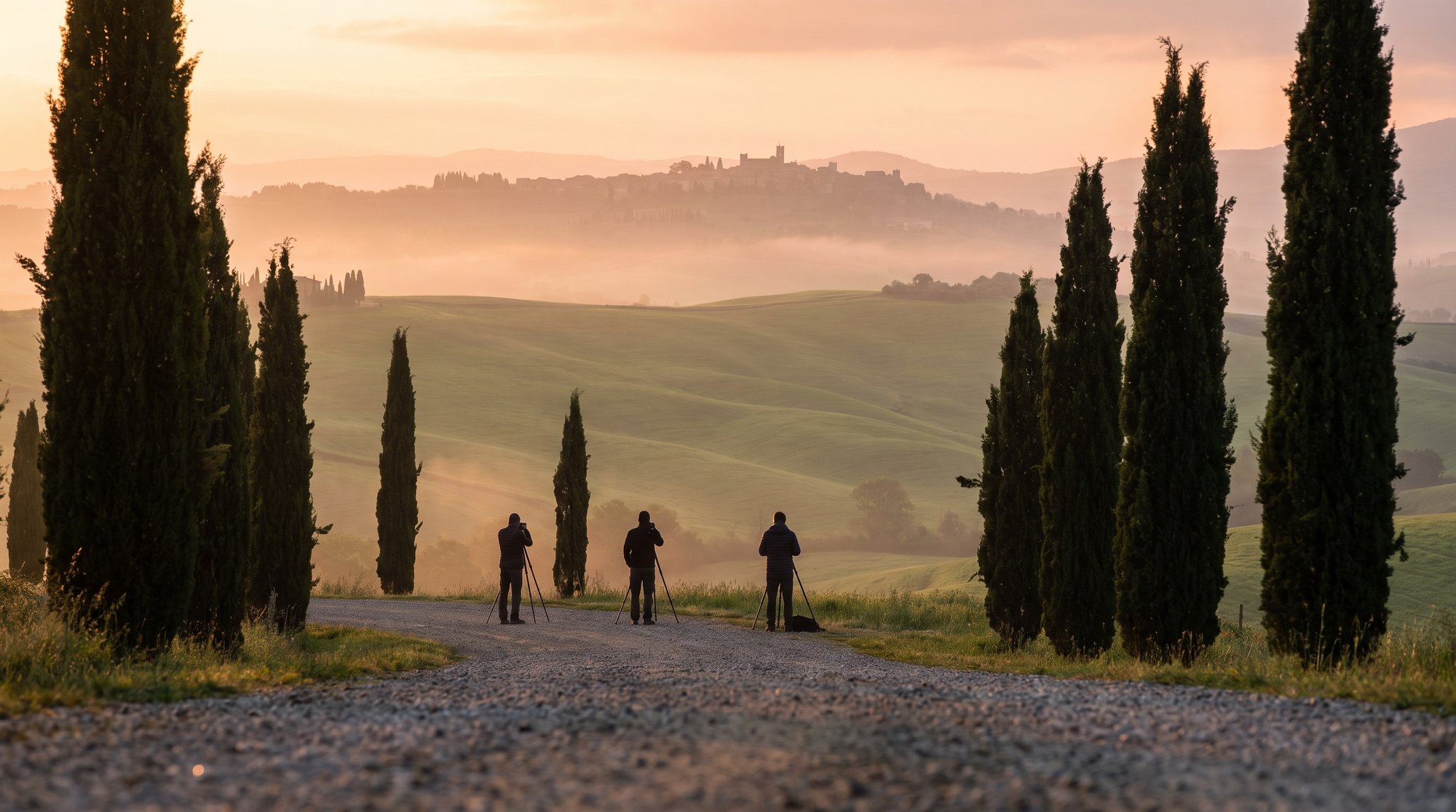
One October morning a few seasons back, the plan called for sunrise at a cypress grove near San Quirico, a dependable, classic shot that works most mornings. The overnight temperature drop had been sharper than usual and the wind was dead calm, both signs I have learned to take seriously. Instead of sticking to the plan, the group got a wake-up call twenty minutes earlier than scheduled and drove to a ridge above the valley instead. It paid off. Fog had pooled thick below the hilltop towns, and the group spent forty-five minutes photographing villages floating above a sea of white that most visitors to Tuscany never get to see, let alone photograph from the right angle with the right lens. Nobody in that group would have gotten that shot from a fixed itinerary followed by someone without the judgment, or the willingness, to change the plan on short notice.
That is the kind of decision a guide who is only thinking about their own photography rarely makes, because it involves risk. If the fog had not shown up, the group would have missed the reliable cypress grove shot for nothing. A guide who is genuinely responsible for the group's experience, not just their own portfolio, weighs that risk honestly and still makes the call when the signs line up, because the upside for the whole group is worth it. If you are weighing whether this kind of adaptive guiding matters enough to book a guided trip at all, our Val d'Orcia photography tour is built entirely around that idea, with a seven day itinerary flexible enough to chase a fog window or a break in the clouds instead of sticking rigidly to a plan drafted months earlier from another continent.
Photographer vs guide, at a glance
| A talented photographer | A genuinely good guide |
|---|---|
| Has a strong personal portfolio | Has a strong portfolio and a track record of groups coming home happy |
| Knows how to get their own best shot | Knows how to get everyone in the group their best shot |
| Reads light for their own composition | Reads light and weather to decide the whole day's plan |
| Can explain a technique if asked | Adjusts teaching style to each guest without being asked |
| Follows the printed itinerary | Knows the land well enough to safely deviate from it |
| Focused on the next frame | Focused on group energy, safety, and pacing across the whole week |
How to actually evaluate a guide before you book
Portfolios and gear lists are easy to find and easy to be swayed by, but they are the least useful signal for the questions that actually matter on a trip. A more useful approach is to look at how long a guide has been running trips in that exact region, not just shooting there personally, since repeated group logistics is a different skill from repeated personal visits. Read reviews for mentions of teaching, pacing, and how weather changes were handled, not just how pretty the final images turned out, since anyone can post pretty images from a beautiful region regardless of how the week actually went. And if you get the chance to ask a direct question before booking, ask about a time a guide changed the plan and why. A specific, confident answer tells you more than any credential on a website.
It is also worth asking how many guides are on a given departure relative to group size. A single guide running a group of fifteen is stretched thin no matter how talented they are, and something has to give, usually either the individual teaching time or the flexibility to adapt the plan on short notice. A lower guide-to-guest ratio is not just a comfort feature, it is a structural reason a tour can actually deliver on the things described above. We cover this specific dynamic in more depth in our piece on small group versus large group photo tours, which walks through exactly how group size changes the shooting experience.
Frequently asked questions about photography tour guides
Is a bigger name photographer always a better guide? Not necessarily. A well known name tells you the person can shoot at a high level, but it does not tell you whether they can teach, manage a group, or make good real-time calls about weather and location. Those are separate, learnable skills that some excellent photographers never develop.
How many guides should a small group tour have? For a group in the range of six to eight guests, two guides is a strong ratio that allows for individual attention without either guide being stretched too thin. Larger groups with only one guide tend to sacrifice either teaching time or itinerary flexibility.
Can a guide really change the itinerary on short notice? A good one can, and should be expected to, when weather or light conditions genuinely call for it. Ask directly during your research whether a tour's itinerary is treated as fixed or as a flexible plan built around conditions.
What should I look for in reviews about a guide? Look past the final images and read for specifics about teaching style, pacing, and how the guide handled anything that did not go according to plan. Those details tell you far more about the actual experience than a list of beautiful photographs anyone could have taken given enough time in a beautiful place.
Do the guides on a WeShoot tour also shoot personally during the trip? Yes, but guiding the group comes first. Our guides are working photographers, which is part of why they can teach with real technical depth, but their job on a departure is reading conditions, teaching, and managing the group, not chasing their own personal shot list at your expense.
Does group size actually change how much guiding attention I get? Yes, directly. On a departure capped at seven guests with two guides, you are getting something close to one guide for every three or four people, which is enough for real one-on-one feedback during a shoot rather than a shouted instruction from across a field. That ratio is the practical reason smaller, well guided groups tend to produce noticeably better keeper rates than larger ones, regardless of how talented any single guide is.
So what should you actually look for
A great photograph tells you someone can shoot. It does not tell you they can guide. Before you book any photography tour, anywhere, try to find evidence of the harder skills: real-time judgment about weather and light, patient teaching that adapts to different skill levels, attentiveness to group energy and safety across a full week, and enough local knowledge to genuinely deviate from a printed plan when conditions call for it. Those are the things that separate a trip where you came home with a handful of solid frames from one where you came home with images you are still proud of years later, and a guide's portfolio alone will never tell you which kind of trip you are signing up for.