A Day in the Life on a WeShoot Val d'Orcia Photography Tour
Curious what a day on a WeShoot Val d'Orcia photography tour actually looks like? Here is the real schedule, from the 4:30am alarm and a foggy cypress road sunrise to the midday break, golden hour, and the evening photo review over dinner.
A Day in the Life on a WeShoot Val d'Orcia Photography Tour
People ask us all the time what actually happens on a photography tour day in Val d'Orcia. Not the marketing version, the real one. Do you really get up before dawn? Is it a rigid schedule or is there room to just wander? How much of the day is shooting versus sitting in a van? I have run and joined enough of these days to walk you through one from start to finish, the good parts and the parts nobody puts in the brochure, like the ninety minutes in the middle of the day when everyone just wants a nap.
This is not a single specific date. It is a composite of a typical spring or autumn day on a WeShoot Val d'Orcia tour, built from the pattern that repeats trip after trip because it works. If you are trying to decide whether a guided trip fits your travel style, or you just want a concrete sense of what you are signing up for, this should answer most of your questions.
Key Takeaways
A single guided day in Val d'Orcia usually breaks into two shooting blocks separated by a long midday rest, with a group review at night.
| Point | Details |
|---|---|
| Wake up call | Usually 4:30 to 5:00am for a sunrise shoot, earlier in summer when the sun comes up before 6am |
| Two shooting blocks | Sunrise session and golden hour session, each two to three hours including travel and setup |
| Midday break | Three to four hours off for food, rest, and optional casual shooting in a town |
| Evening structure | Dinner followed by an informal group photo review, usually forty five minutes to an hour |
| Physical demand | Moderate. Mostly standing and short walks on gravel farm roads, not technical hiking |
| Daily gear | Tripod, two to three lenses, a polarizer and graduated ND, headlamp, and a light rain shell |
Table of Contents
- The alarm before dawn
- Driving to the cypress road in the dark
- Shooting sunrise in the fog
- Breakfast and the slow Tuscan late morning
- The midday break nobody tells you about
- An afternoon scout through a hilltop town
- Chasing golden hour at a second location
- Dinner and the evening photo review
- What a typical day actually looks like
- What to pack for a day like this
- Frequently asked questions about a guided shooting day
- Is a guided day worth it
The alarm before dawn
The alarm goes off at 4:30am and the villa is dead quiet except for the sound of espresso machines starting up one by one. Nobody talks much this early. You pull on whatever layers make sense for the season, in April that usually means a base layer, a fleece, and a shell you will peel off within the hour, and you do the same gear check you did the night before out of habit more than necessity. Battery in the camera, spare battery in a pocket, memory cards formatted, tripod plate seated properly on the camera base. It sounds obsessive until the one morning you forget and realize it thirty minutes from the villa with no way back in time.
Coffee happens fast, usually standing up, sometimes a piece of bread with jam if anyone has the appetite for it this early. Most people do not. Your body has not caught up with the idea that it is time to be awake, but your guide has already checked the overnight temperature drop and the forecast one more time, because that number is what decides where the group is driving in the next ten minutes.
Driving to the cypress road in the dark
The vans pull out while it is still properly dark, headlights catching nothing but empty farm roads and the occasional startled hare. This is where a guide who actually lives the terrain earns their keep. Knowing which gravel road turns to mud after a week of rain, which gate is unlocked at this hour and which is not, and which pull off spots have room for three vehicles without blocking a farmer's tractor route, none of that is obvious from a map, and getting it wrong costs you the light you woke up for.
Conversation in the van is minimal. Someone always asks whether there will be fog, and the honest answer is usually "we will know in twenty minutes." Fog in Val d'Orcia depends on a clear sky overnight and a sharp temperature drop, and even with a good forecast it is never a certainty until you are standing on the ridge and can see it, or cannot.
Shooting sunrise in the fog
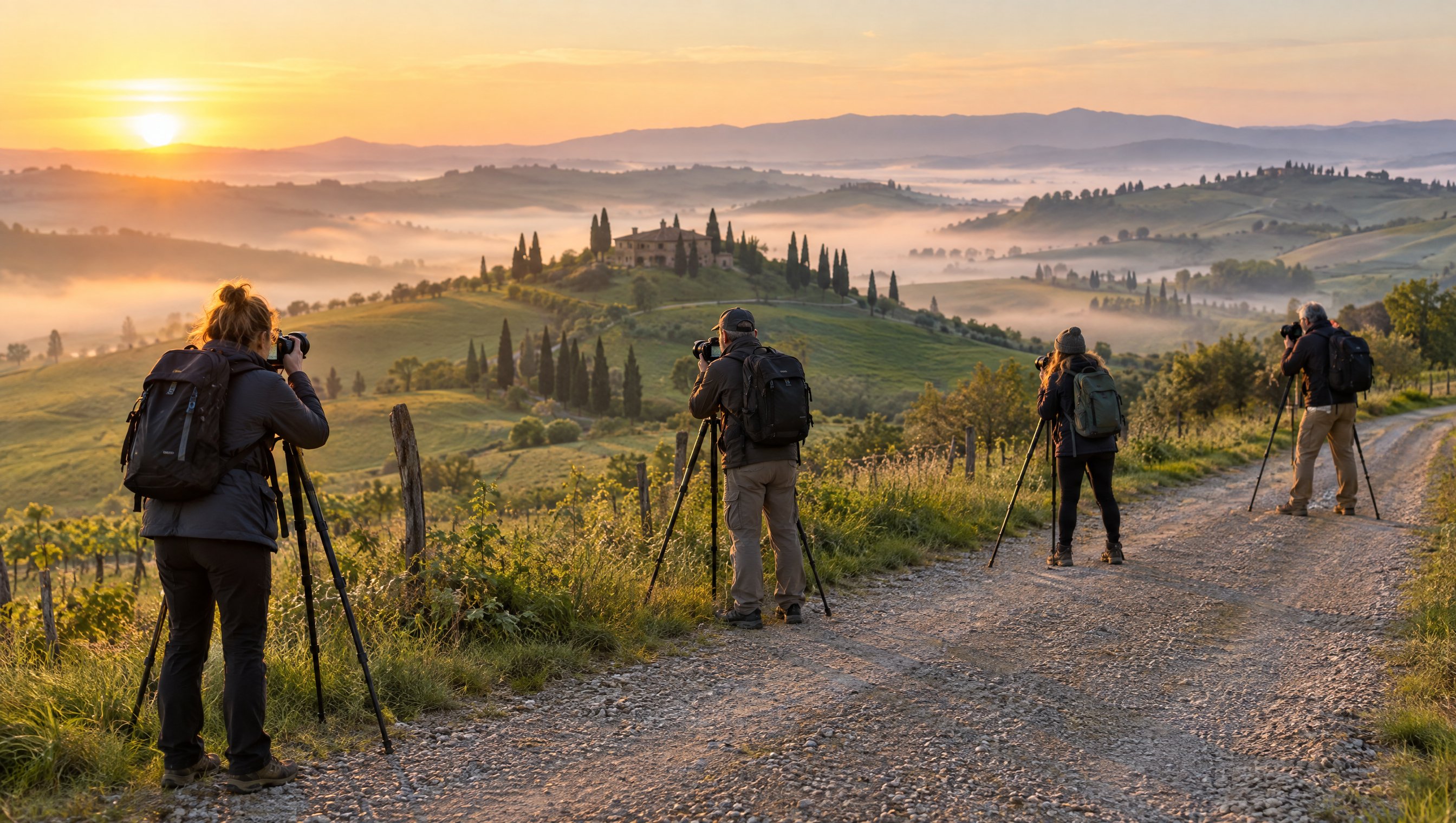
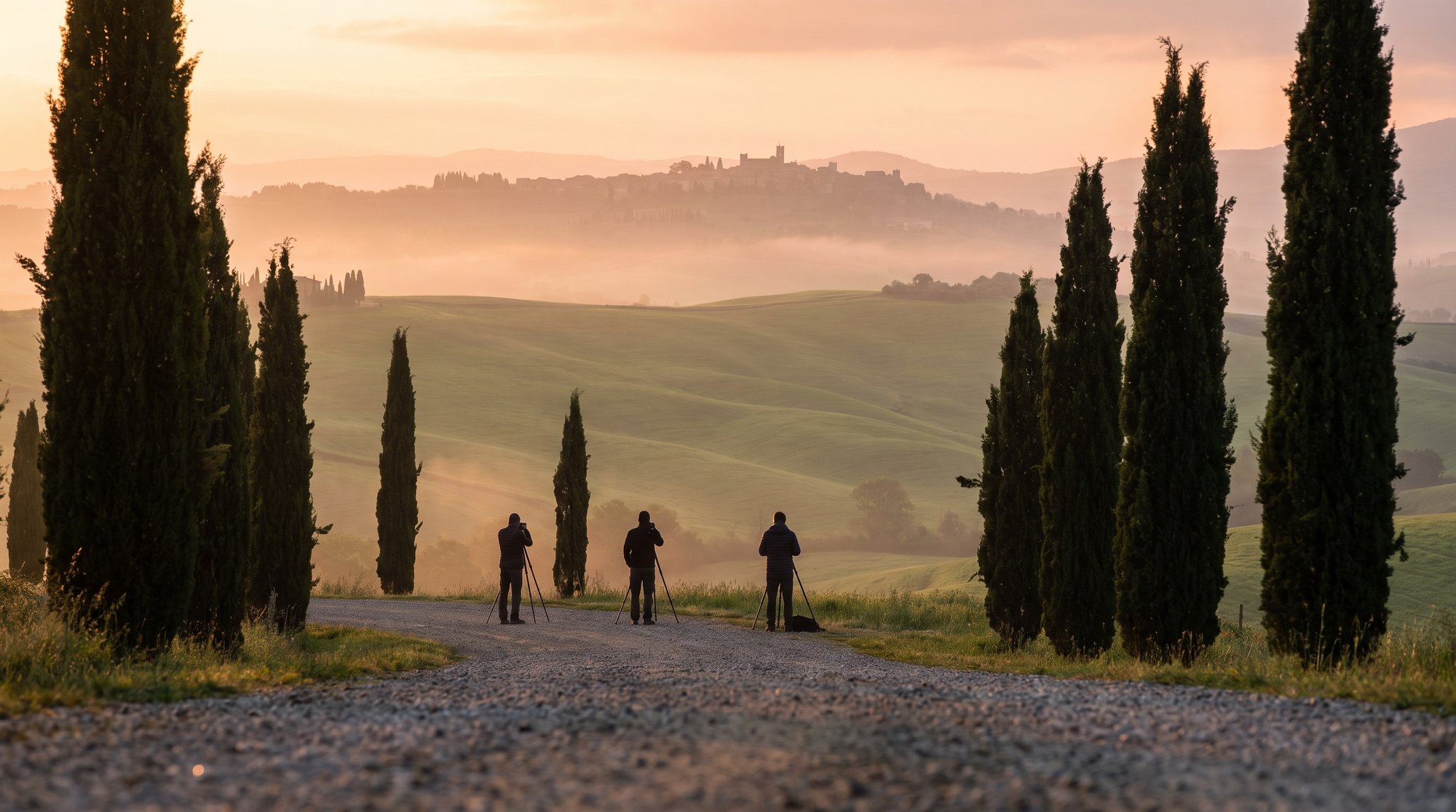
Arriving at the cypress road forty minutes before sunrise gives everyone time to find a composition without rushing. Tripods go down on the gravel shoulder, never on the crop rows, and the group spreads out along maybe a hundred meters of road so nobody is standing in anyone else's frame. If the fog is running, you can see it pooling in the low ground between the ridge lines, sitting below the hilltop towns like a second sky.
My settings for this kind of shot start around f/8 to f/11 for enough depth of field to keep the near cypress trees and the distant hills reasonably sharp, ISO 100 to keep noise out of the shadow detail, and shutter speed set by whatever the meter says once I have dialed in that aperture and ISO, usually somewhere between a quarter second and two seconds in the minutes before actual sunrise. A sturdy tripod is not optional here. I carry a 24 to 70mm for the wide establishing shot with a cypress or a stone wall as a foreground anchor, and a 70 to 200mm close by for compressing the layered ridgelines once the fog starts breaking apart into pockets, which is often the more interesting shot than the wide one.
Pro Tip: When you are shooting into fog with the sun about to break the horizon, meter for the brightest part of the sky and let the foreground go a stop or two darker than you think it should. Fog reflects a huge amount of light, and overexposing it turns a delicate scene into a flat white wash with no detail left to recover, even shooting RAW.
Once the sun actually clears the ridge, you have maybe ten to fifteen minutes of genuinely great light before it climbs high enough to lose that low, warm, directional quality. This is the point in the morning where you stop talking to anyone and just work, checking the histogram between shots rather than trusting the LCD preview in direct low sun, which will lie to you about exposure almost every time.
Breakfast and the slow Tuscan late morning
By 8am the good light is gone and everyone is suddenly starving. Breakfast back at the villa, or occasionally at a small bar in San Quirico d'Orcia if the morning location was closer to town, is the first real meal and the first real conversation of the day. This is when people start pulling out laptops or just their camera's rear screen to show each other what they got, and it is honestly one of the better parts of a guided trip. Shooting alone you never get that immediate "look what I found" moment with someone who was standing thirty feet away and caught something completely different.
The pace slows down deliberately here. Nobody is rushing anyone through breakfast, because the next few hours are built around the fact that midday light in Val d'Orcia is genuinely bad for landscape work, and there is no reason to fight it.
The midday break nobody tells you about
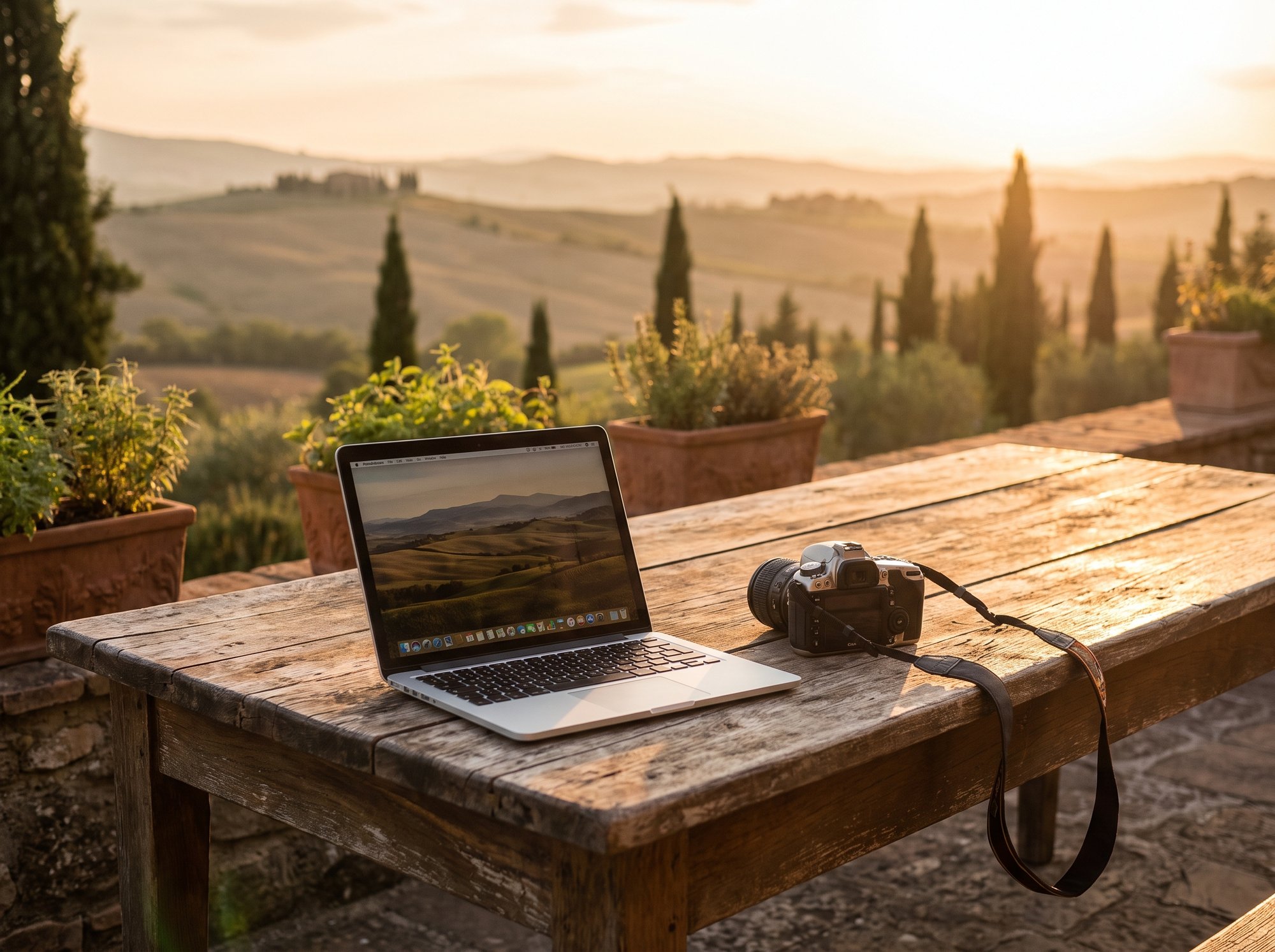
This is the part of the schedule that surprises first time guests the most. Roughly from 11am to 3 or 4pm, depending on the season, there is no organized shooting. The sun is high, the light is flat and harsh, and even the most dedicated landscape photographer struggles to make a compelling image of rolling hills under a straight-down midday sun. So the group scatters. Some people nap. Some sit by the pool. Some use the dead time to go through the morning's files and do a first editing pass, and this is often when a guide will sit down one on one with someone and walk through basic Lightroom adjustments on an actual image from that morning rather than a generic tutorial photo.
If this sounds like a lot of downtime, it is, and that is intentional. A trip that tries to shoot from dawn to dusk with no real break burns people out by day three, and burned out photographers make worse pictures, not better ones. The midday gap is also simply honest about the light. There is no secret midday shooting technique that beats waiting for better conditions.
An afternoon scout through a hilltop town
Around 3pm, once the harshest light has started to soften, the group often heads into one of the hilltop towns, Pienza or Monticchiello most commonly, for a slower, more casual session that is as much about scouting the evening's golden hour location as it is about shooting. This is street and architecture work rather than pure landscape, and it calls for a different lens entirely. I usually carry a fast 35mm prime here, something around f/1.4 or f/1.8, for doorways, alleys, and the kind of tight architectural detail that a zoom lens tends to flatten into something less interesting.
Part of the value of a guide in this window is timing. Knowing that the tour buses that fill Pienza's main terrace by 11am have usually cleared out by mid afternoon, or that a particular alley in Monticchiello gets a shaft of direct light through a gap in the buildings for about twenty minutes starting around 4:15pm in spring, is the kind of hyper local knowledge that takes years to accumulate on your own and that a good local guide hands you for free.
Chasing golden hour at a second location
The second and, for most people, favorite shooting block of the day starts about ninety minutes before sunset at a location deliberately different from the morning's cypress road. Variety matters here, both because repeating the same composition twice in one day gets stale fast and because different vantage points catch the evening light differently than the morning light hit them.
If we are on an open hillside looking west across the valley, this is where I lean on a graduated neutral density filter to hold detail in a sky that is often five or six stops brighter than the foreground hills by the time the sun gets low. Without it you are choosing between a blown out sky or a foreground so dark it needs aggressive shadow recovery in post, and neither looks as good as getting closer to a balanced exposure in camera. White balance I typically leave on daylight rather than auto for this kind of shot, since auto white balance tends to fight the warm tones that are the entire point of golden hour, cooling the image down exactly when you want it warm. I fine tune it properly in Lightroom afterward anyway, but starting from a consistent baseline across a whole sequence of shots saves real time later.
Pro Tip: Check your histogram for clipped highlights every few shots during golden hour, not just at the start. As the sun drops, the dynamic range between the sky and the shadowed side of a hill widens fast, and a shot that looked fine five minutes earlier can blow out the sky entirely by the time you take the next one.
If you have been considering a trip like this and want to see how a location like the cypress roads changes between the two shoots of a single day, our cypress road location guide goes deep on exactly that spot, and it is one of the two or three locations that shows up on nearly every WeShoot Val d'Orcia itinerary for good reason.
Dinner and the evening photo review
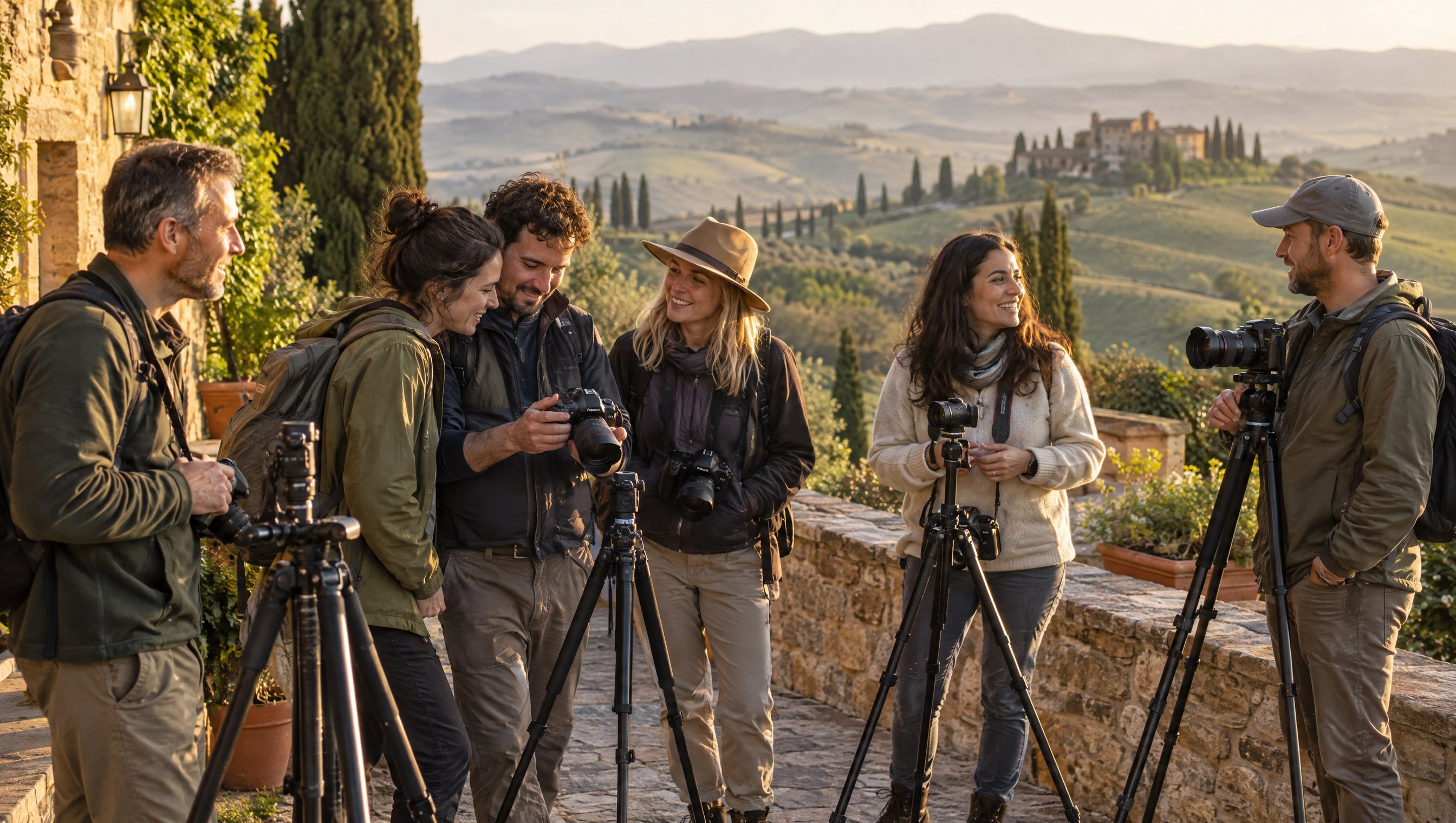
Dinner on a tour day is unhurried, usually at a family run trattoria the guide has been eating at for years, and it is where the day's shared experience really settles in. After plates are cleared, most groups do some version of an informal photo review, not a formal critique with a projector and a script, just people pulling up two or three favorite shots from the day on a laptop or tablet and talking through them together.
This is genuinely one of the most useful parts of the day for improving as a photographer, and it is the piece that is hardest to replicate traveling alone. A guide looking at your fog shot might point out that pulling the highlights down half a stop and warming the shadows slightly would separate the foreground cypress from the background haze more effectively, feedback that is specific to your actual photograph rather than a general editing tutorial. If a day built around this much hands on, in the field teaching sounds like what you are looking for rather than a purely self directed trip, that is precisely the structure of a WeShoot Val d'Orcia photo tour, and it is worth a look if today's walkthrough has you leaning toward booking a guided trip over planning one entirely on your own.
What a typical day actually looks like
| Time | Activity |
|---|---|
| 4:30am | Wake up, quick coffee, final gear check |
| 5:00am | Depart by van for the sunrise location |
| 5:40am to 7:30am | Sunrise shoot, fog and low light photography |
| 8:00am | Breakfast and informal image sharing |
| 11:00am to 3:00pm | Midday break, rest, optional editing session |
| 3:00pm to 5:30pm | Afternoon scout through a hilltop town |
| 6:00pm to 8:00pm | Golden hour shoot at a second location |
| 8:30pm | Dinner |
| 9:30pm | Informal group photo review |
Times shift with the season since sunrise and sunset move by hours across the year, but the shape of the day, two shooting blocks bracketing a long midday rest, holds steady across most of the calendar.
What to pack for a day like this
A daypack for this kind of schedule stays fairly lean, since you are not carrying it for hours of hiking, just short walks from a van to a shooting position and back. My own daily kit runs a tripod, a 24 to 70mm and a 70 to 200mm as the core two lenses with a fast 35mm added for the town session, a circular polarizer and one graduated ND filter, spare batteries since cold mornings drain them faster than you expect, a headlamp for the walk out in the dark, and a light rain shell that has saved more than one April morning from being cut short.
A dedicated camera bag insurance policy is also worth having before a trip like this, since gear does get bumped, dropped, or occasionally rained on standing outside on a farm road at 5am, and that is a separate topic worth reading up on before you travel with several thousand dollars of equipment in a van full of gravel roads.
A few smaller items earn their weight too. A microfiber cloth lives in every jacket pocket I own during a Tuscany trip, since morning dew settles on a front element within minutes of setting up near fog, and wiping it with a sleeve just smears the moisture around instead of clearing it. A small bean bag is worth throwing in alongside the tripod for shots taken resting the camera on a stone wall or a farm gate, which happens more often than you would expect once you start noticing how many good compositions sit at exactly that height. And a second, smaller memory card wallet kept separate from your main bag means a lost or dropped card during a gear swap in the dark does not cost you the whole trip's files, just one card's worth.
Frequently asked questions about a guided shooting day
Do I need to be an early riser to enjoy this? You need to be willing to get up early on shooting mornings, but the schedule is built around a long midday rest specifically so the early starts do not compound into exhaustion by day three.
Is the pace too demanding for a beginner? Physically, no. Most locations involve short walks on gravel roads, not technical hiking. The demanding part is mental, learning to work quickly in changing light, and that is exactly the kind of thing a guide helps with in real time.
Do you get any free time? Yes, the midday block is genuinely unstructured, and most itineraries also build in at least one slower half day over the course of a full trip.
How many images do you typically come home with? That varies enormously by shooting style, but two shooting blocks a day across a week long trip easily adds up to several thousand frames, most of which get culled hard during the evening reviews and the post trip edit.
What happens if the weather does not cooperate? Locations shift. A rainy morning might mean a covered market or an interior shoot instead of an open hillside, and a guide with local knowledge usually has a backup plan ready before the group even asks.
Can I skip a session if I am tired? Yes, nobody is forced onto the van at 4:30am. Guests skip a sunrise now and then, usually once, and almost always regret it slightly when the group comes back talking about the fog that morning, but the option is always there and nobody judges you for taking it.
Is a guided day worth it
A day like this only works because of decisions made well before sunrise, which gravel road is passable, which field has fog pooling in it tonight, which alley catches light at 4:15 and not 4:30. You can absolutely learn all of that yourself over multiple self planned trips to Val d'Orcia. A guided day simply compresses years of trial and error into a single well timed itinerary, and trades some spontaneity for a much higher hit rate on the light and locations that make the whole trip worthwhile. We wrote a longer, more balanced comparison of the two approaches in our workshop versus self guided piece if you want the fuller pros and cons list before deciding which style of trip suits you.
Whichever way you end up traveling, the underlying rhythm described here, work the light hard at the edges of the day and rest through the middle of it, is worth building into a self planned itinerary too. Our full Tuscany Photography Guide covers the locations and seasonal timing that make that rhythm work across the whole region, not just for one composite day.