Photographing Tuscany in Spring: Poppies, Green Hills, and Fresh Light
A practical guide to timing a spring trip around the poppy bloom in Val d'Orcia, with the best fields near Pienza and San Quirico, weather patterns, and how the low spring sun reshapes the hills.
Photographing Tuscany in Spring: Poppies, Green Hills, and Fresh Light
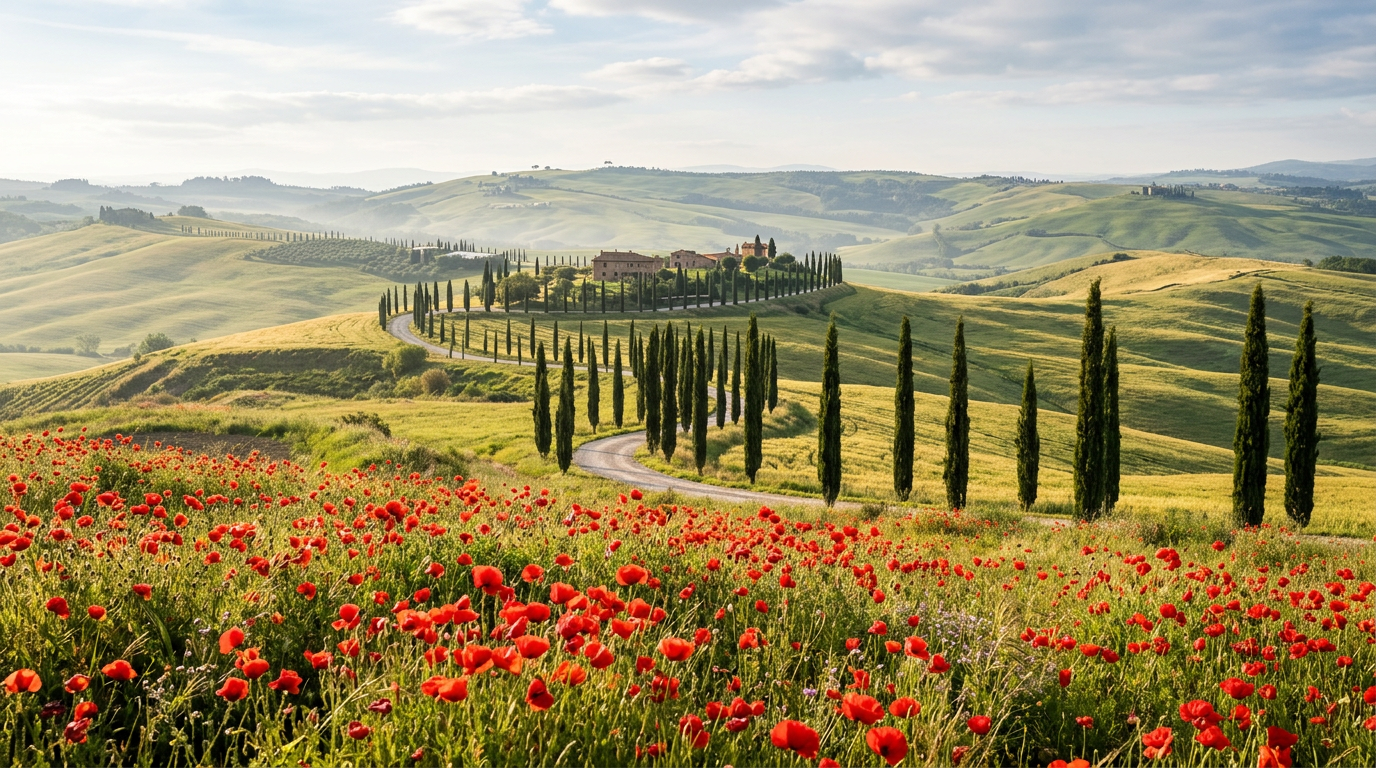
Spring is the season Val d'Orcia earns most of its postcard reputation. The hills turn a green so deep it looks almost artificial in photographs, wildflowers push up along every field margin, and somewhere between late April and the end of May, the poppies arrive. For a few weeks the countryside around Pienza and San Quirico d'Orcia fills with patches of red that photographers travel across the world to see, and then, almost as quickly as they appeared, the flowers are gone and the hills move on to summer gold.
None of this happens on a fixed calendar date, which is exactly why spring trips get planned wrong more often than any other season. Tourists arrive in early April expecting the postcard and find pale green hills with only scattered color. Others show up in mid June, a full month after the poppies have faded, wondering why the fields around Pienza look nothing like the photos they saved. This guide breaks down when the bloom actually happens, where to find it near Pienza and San Quirico, and how the low spring sun changes the character of the hills compared to the harsher, hazier light of summer.
Key Takeaways
Spring photography in Val d'Orcia is a timing game more than a location game, and the reward for getting the timing right is unmatched anywhere else in the year.
| Point | Details |
|---|---|
| Poppy bloom window | Scattered blooms from late April, fullest and most reliable through May, largely finished by mid June |
| Best base villages | Pienza and San Quirico d'Orcia, both within a short drive of the strongest fields |
| Light character | Lower sun angle than summer, longer golden hour, softer contrast, fewer harsh midday shadows |
| Weather risk | Rain and shifting clouds are common in April and early May, which usually improves the sky rather than ruining the shoot |
| Biggest mistake | Arriving too early in April expecting full poppy fields that have not yet opened |
Table of Contents
- Why spring looks different from every other season
- When the poppies actually bloom
- Where to find the best poppy fields
- How low spring light changes the hills
- Weather patterns to plan around
- A realistic spring shooting day
- Frequently asked questions about spring in Val d'Orcia
- A quick reference for planning your trip
Why spring looks different from every other season
Every season in Val d'Orcia has its own color story, but spring is the only one where the palette is actively changing week to week. The bare, muted hills of February give way to the first sharp green by mid March, and by late April that green has deepened into the saturated color most people picture when they imagine Tuscany. Wildflowers arrive in stages too, starting with small yellow and white blooms along field edges before the poppies take over as the dominant color in late April and May.
This matters for photographers because a spring trip is really several different trips depending on the exact week you land. Early spring gives you dramatic skies and fresh green with almost no crowds. Late spring gives you the poppies, warmer light, and noticeably more visitors on the roads around Pienza. Neither is wrong, but they produce very different photographs, so it helps to decide which version of spring you actually want before booking flights.
Pro Tip: If poppies are the priority, build in at least five to seven days of flexibility around your target dates. Bloom timing shifts from year to year based on winter rainfall, and a rigid two day window is the single biggest reason photographers miss the fields entirely.
When the poppies actually bloom
Poppies are wild and unmanaged in Val d'Orcia, which means nobody plants them on a schedule and nobody can guarantee an exact date. What is predictable is the general pattern. The first scattered poppies typically appear in sheltered, sunnier fields in the last week of April. By the first two weeks of May, blooms have usually spread across most of the fields that carry poppies at all, and this is the period that produces the dense, saturated red patches seen in classic Val d'Orcia photographs. The bloom generally holds through the third week of May before starting to thin, and by early June most fields have faded to green and gold as the flowers finish their short cycle.
Rainfall the previous winter and temperatures in early spring both shift this timeline by a week or two in either direction. A wet winter followed by a warm April tends to bring the bloom forward and makes it denser. A dry winter can delay and thin it out. Farmers in the area also rotate which fields are left fallow or planted with wheat each year, which changes exactly where the poppies show up even if the timing stays consistent, so the specific field that photographed well last May is not guaranteed to be the strongest field this year.
Where to find the best poppy fields
The single best strategy for finding poppies is to drive the minor roads around Pienza and San Quirico d'Orcia slowly, rather than chasing one specific field from a photo you saved online. Poppies grow in the gaps between cultivated crops, along wheat field margins, and in fallow patches, and their exact location shifts from year to year with crop rotation. That said, a few areas consistently produce strong results and are worth building an itinerary around.
| Area | What makes it work |
|---|---|
| Fields south of Pienza toward San Quirico | Rolling terrain with strong foreground to background layering, good for wide compositions with poppies leading into distant hills |
| The minor road network east of San Quirico | Quieter, less trafficked roads where fields are easier to photograph without other cars or visitors in frame |
| Slopes near the Pienza to Monticchiello road | Elevated views that let you shoot down onto poppy patches rather than only at eye level |
| Field margins along the SP146 | Easy roadside access, useful for a quick stop rather than a planned hike, though pull over safely and fully off the road |
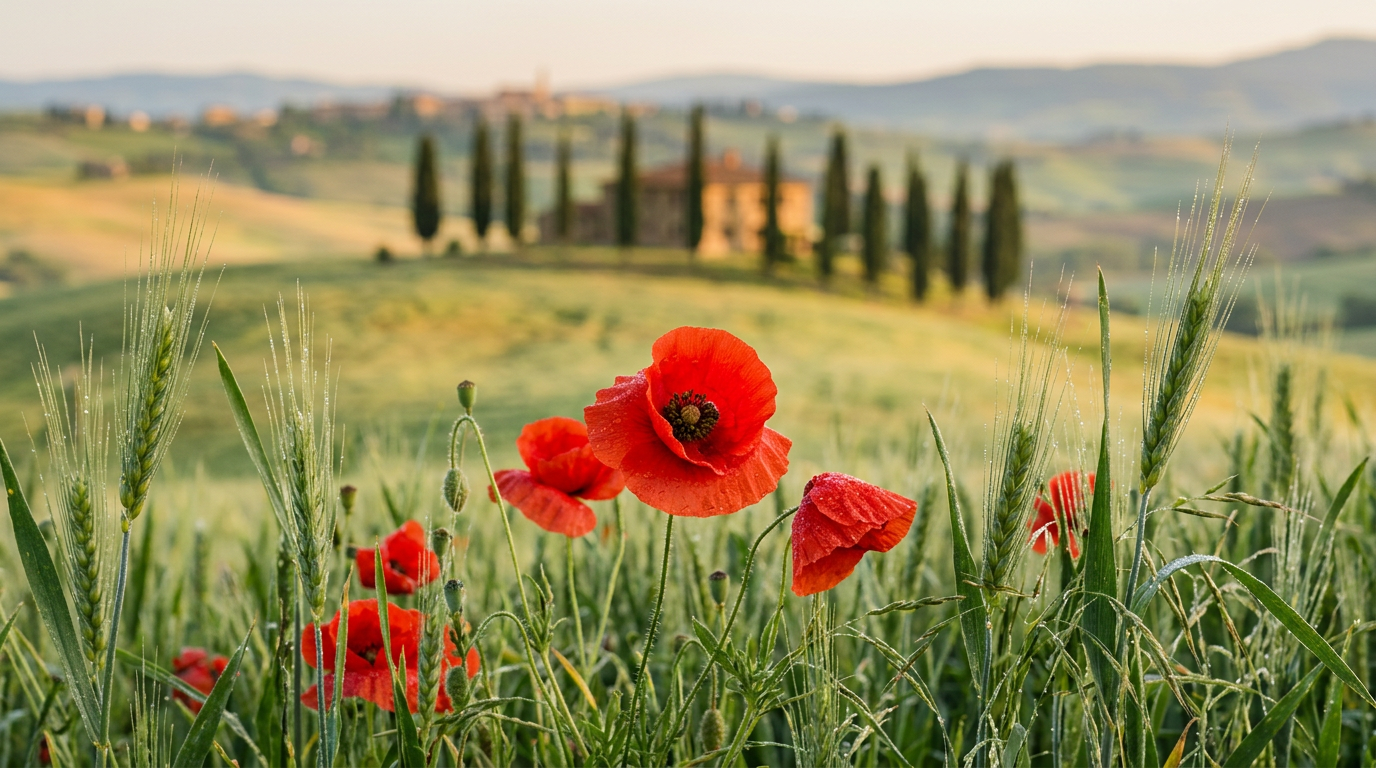
Pro Tip: Almost every poppy field you photograph in Val d'Orcia is on private farmland, even when there is no visible fence. Shoot from the road edge or established field margins, never walk into a planted field for a photograph, and treat every crop the same way you would treat someone's front lawn.
How low spring light changes the hills
Spring sits at a useful middle point in the year for sun angle. The sun climbs higher than it does in winter but stays noticeably lower than the punishing overhead light of July and August, which means the golden hour window at both ends of the day runs longer and the light stays workably soft for more of the morning and evening than it does in summer. This lower angle also rakes across the hills at more of a side angle, which is what creates the strong sense of depth and layering that makes Val d'Orcia's rolling terrain look genuinely three dimensional in a photograph rather than flat.
Spring air is also cleaner than summer air. The haze that builds up over July and August as the heat intensifies has not yet formed in April and May, so distant hills retain more contrast and color rather than fading into a pale, washed out blue the way they often do by midsummer. Combined with the greener hillsides, this is a large part of why spring images of Val d'Orcia tend to look more saturated and crisp than the same views photographed two months later.
The tradeoff is that spring days are shorter than summer ones, so you have less total daylight to work with, and the two golden hour windows are closer together than they will be by June. Plan a spring shooting day around two clearly separated blocks, an early one at sunrise and a later one before sunset, with a long rest in between rather than trying to shoot continuously through the middle of the day.
Weather patterns to plan around
April and the first half of May are the wettest stretch of the spring season in Val d'Orcia, and this is not something to plan around so much as plan for. Rain showers tend to move through quickly rather than settling in for a full day, and the hour after a shower clears is often when the best light of the entire trip shows up, with broken clouds, dramatic shafts of sun, and a freshly washed, saturated landscape. Photographers who treat rain as a reason to stay in and wait for a clear day miss some of the strongest images spring has to offer.
Temperature swings are also larger in spring than in summer. Mornings can start cool enough for a jacket even when the afternoon warms into the seventies Fahrenheit, so layering matters more than it does on a July trip where the temperature barely drops overnight. Wind is generally calmer in spring than in autumn, which is good news for anyone trying to photograph poppies close up, since even a light breeze is enough to blur delicate petals during anything but a fast shutter speed.
A realistic spring shooting day
A workable spring day in Val d'Orcia starts with a sunrise shoot at a hilltop viewpoint near San Quirico or Pienza, timed to catch the low light hitting the hills and any poppy fields nearby while the air is still cool and the light is still soft. After sunrise light hardens, usually by mid morning, that window closes and it makes sense to shift to walking the historic centers of Pienza or San Quirico, where the light is more forgiving under the shade of narrow medieval streets even as the sun climbs higher outside.
Midday is the natural point to rest, eat, and scout the next location rather than shoot, since the flat overhead light does the fewest favors for rolling hill compositions. As the afternoon light starts to lower again, usually from around two hours before sunset, head back out to the fields for a second poppy session with the sun now coming from the opposite direction, which often reveals a completely different field than the one that looked best at sunrise.
Frequently asked questions about spring in Val d'Orcia
What is the single best week to see the poppies? In a typical year, the first two to three weeks of May offer the most reliable combination of dense blooms and manageable crowds. Late April can work in a warm year, and the third week of May is often still strong, but plan for early to mid May as your primary target.
Do I need to book a guide to find the fields? No, but local knowledge helps, since the exact fields shift each year with crop rotation. Driving the minor roads slowly with a full tank of patience is often just as effective as any tip list, this one included.
Is spring more crowded than other seasons? Spring, particularly the poppy weeks in May, is busier than winter or early autumn, but nowhere near as crowded as the peak of summer. Weekday mornings are noticeably quieter than weekends.
What should I pack differently for spring versus summer? Bring layers for cooler mornings, a rain shell for sudden showers, and a fast shutter speed habit for windy poppy close ups. You will not need the heavy haze filtering that a summer trip often calls for.
Can I photograph poppies without a long lens? Yes. A standard zoom in the 24 to 70 millimeter range covers both wide field compositions and closer detail shots. A longer lens is useful for compressing a distant field against a hillside, but it is not required to get strong poppy images.
A quick reference for planning your trip
| Priority | Recommendation |
|---|---|
| Peak poppy density | First three weeks of May |
| Fewer crowds, still green | Mid to late April |
| Best base villages | Pienza and San Quirico d'Orcia |
| Shooting rhythm | Sunrise fields, midday rest, sunset fields from the opposite direction |
| Rain response | Wait it out, the clearing sky afterward is often the best light of the day |
Spring rewards photographers who stay flexible more than any other season in Val d'Orcia. The poppies will not wait for a fixed itinerary, and neither will the weather, so build slack into your schedule and treat a rainy morning as a reason to shoot the villages instead of a reason to lose the day. For a broader look at how spring compares to the rest of the year, see our month by month guide to photographing Tuscany, and for background on the region itself, our explainer on Val d'Orcia covers the geography and history behind why these particular hills look the way they do.
If you want a fuller picture of the villages and viewpoints worth building a spring itinerary around, our Tuscany Photography Guide covers the wider region beyond just the poppy fields, including the cypress roads and hilltop towns that photograph well in any season but especially well once the hills have turned green.
Sources
- Visit Tuscany: official regional tourism board, seasonal events and travel planning
- Outdoor Photographer: US landscape photography magazine, spring photography technique coverage