Shooting Through Summer Haze in Tuscany Without Losing Contrast
Practical techniques for photographing Val d'Orcia's summer haze, from polarizer use and sun angle to knowing when to stop fighting the haze and let it make the picture.
Shooting Through Summer Haze in Tuscany Without Losing Contrast
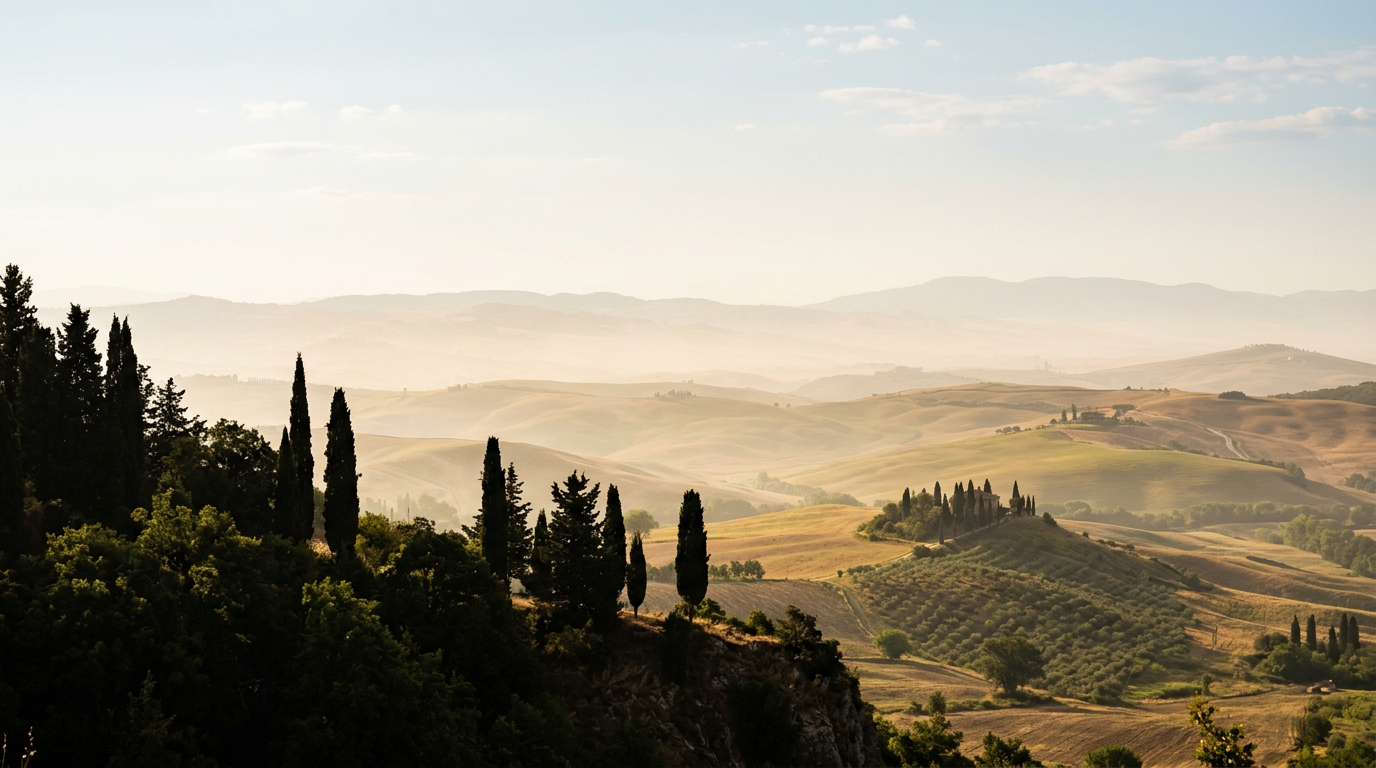
Land in Val d'Orcia in July or August and the first thing you notice, before you even find your hotel, is how different the light feels from the postcards. The hills that look razor sharp and saturated in every spring and autumn photograph you have seen suddenly look soft, pale, and almost washed out by mid morning. That is summer haze, and it is the single biggest reason serious landscape photographers avoid a July trip to Tuscany if they have any flexibility in their calendar.
Haze is not fog, and it will not clear by mid morning the way a valley fog does. It builds through the day as heat and humidity rise, and it can sit over Val d'Orcia for weeks at a time in the height of summer. If you are only able to travel in June, July, or August, though, you do not need to write off the trip. You need a different set of tools and a different way of thinking about what haze does to your images, because some of that softening can be worked around, and some of it can actually be used on purpose.
Key Takeaways
Summer haze in Tuscany reduces contrast and saturates distant hills with pale, milky light, but a handful of technique changes let you shoot through it or use it deliberately.
| Point | Details |
|---|---|
| What causes it | Rising heat and humidity scatter light through fine particles and moisture in the air, most severe from late morning through mid afternoon |
| Best shooting angle | Side lit or backlit subjects hold contrast better than shots taken straight into a hazy midday sun |
| Polarizer effect | A circular polarizer cuts scattered light and can meaningfully restore contrast, but only at roughly 90 degrees to the sun |
| Best time of day | The first two hours after sunrise, before haze has built up for the day |
| When to embrace it | Backlit scenes, layered hills, and cypress silhouettes often look more painterly with haze than without it |
Table of Contents
- Why Tuscan summers get so hazy
- Shoot early, before the haze builds
- Work the sun angle, not just the clock
- The polarizer question
- Camera settings that help in hazy light
- When to stop fighting the haze
- A quick comparison of approaches
- Frequently asked questions about shooting in haze
- The bottom line on summer haze
Why Tuscan summers get so hazy
Val d'Orcia sits in a shallow basin surrounded by higher ground, and in summer that geography works against photographers. Overnight humidity from the Mediterranean climate mixes with the dust kicked up by dry farmland and rises as the day heats up, scattering sunlight in every direction rather than letting it travel to your lens in a single clean line. The result is the classic hazy look: distant hills lose color and contrast, whites creep toward the horizon, and the crisp layering that makes Val d'Orcia so photogenic in spring and autumn flattens into a soft gradient of pale blue and cream.
This is a real optical effect, not just a subjective impression. Scattered light from haze adds a veil of low contrast, non directional brightness across your entire frame, which is why simply increasing contrast in camera rarely fixes it. You are not dealing with a flat exposure, you are dealing with light pollution from the atmosphere itself, and that requires a different kind of correction than a typical contrast slider.
Shoot early, before the haze builds
The single most effective haze strategy costs nothing and requires no gear at all: get up earlier. Haze in Val d'Orcia is at its thinnest in the first hour or two after sunrise, before the day's heat has had time to lift moisture and dust off the ground. A field that looks pale and lifeless at eleven in the morning can look genuinely crisp at six thirty, with real color in the hills and a sky that still holds some blue instead of fading to white near the horizon.
This is also true, to a lesser extent, in the final hour before sunset, though evening haze tends to be thicker than morning haze because the day's accumulated heat has not yet dissipated. If you can only shoot once a day in summer, choose sunrise over sunset. The difference in air clarity is often significant enough to change what is actually possible in a single frame.
Pro Tip: Check sunrise time before you book your accommodation. In peak Tuscan summer, sunrise can be before 5:45 AM, which means leaving your lodging by 5:00 AM to reach a hilltop viewpoint with time to set up. Choose a base close to your shooting locations rather than a scenic but distant agriturismo if haze control is a priority for your trip.
Work the sun angle, not just the clock
Time of day matters, but the angle between you, your subject, and the sun matters just as much, and it is the piece most visiting photographers overlook. Shooting toward a hazy sun, especially anywhere near midday, sends the maximum amount of scattered light directly into your lens and produces the washed out, low contrast look that ruins so many summer Tuscany photographs. Turning ninety degrees so the sun is off to one side, or shooting with the sun mostly behind you, cuts through a meaningful amount of that scatter and restores color and contrast you would otherwise lose.
Backlighting is the other option worth learning deliberately in hazy conditions. Instead of fighting the haze, point your camera roughly toward the sun and let a cypress row, a farmhouse, or a ridge line go into silhouette against the glowing atmosphere. Haze actually helps this kind of shot, because it softens the sun into a broad, diffused glow rather than a harsh point source, giving you a gentler, more even backlit exposure than you would get on a perfectly clear day.
The polarizer question
A circular polarizer is the closest thing to a dedicated haze tool in a photographer's bag, but it comes with a real limitation that catches a lot of visitors off guard: it only works well at roughly ninety degrees to the sun. Point your polarizer directly at or directly away from the sun and you will barely notice a difference no matter how much you rotate the ring. Turn to shoot a scene with the sun to your left or right instead, and the same filter can meaningfully deepen the sky, cut glare off foliage, and pull back some of the milky scatter sitting over distant hills.
Rotate the filter slowly while looking through the viewfinder or at your live view screen rather than guessing at a fixed setting, since the strength of the effect changes continuously as you turn it and the correct point is different for every composition. Be aware that a polarizer also costs you roughly one to two stops of light, which matters if you are already working in flat, hazy conditions with less contrast to spare in your histogram.
A polarizer will not turn a hazy August afternoon into a clear October morning. Treat it as a modest contrast recovery tool for side lit compositions, not a fix for every hazy scene you encounter, and you will get more consistent use out of it.
Camera settings that help in hazy light
Beyond timing and filters, a few in camera habits make a real difference when you are shooting through haze. Slightly underexposing your shot, by about a third to two thirds of a stop compared to what your meter suggests, keeps highlights in hazy skies from blowing out and preserves more information you can pull contrast back from later in editing. Shooting in raw rather than JPEG matters more than usual in hazy conditions, since raw files retain far more tonal data in that flat, compressed range where haze pushes most of your histogram.
A longer focal length can also help more than people expect. Telephoto compression exaggerates the layering between foreground, midground, and background hills, and that layering effect can partially compensate for the contrast that haze takes away, since your eye reads depth from overlapping shapes even when color and contrast are both reduced. A wide angle lens, by contrast, tends to make hazy scenes look flatter and emptier, because it spreads the same soft light across a much larger portion of the frame.
When to stop fighting the haze
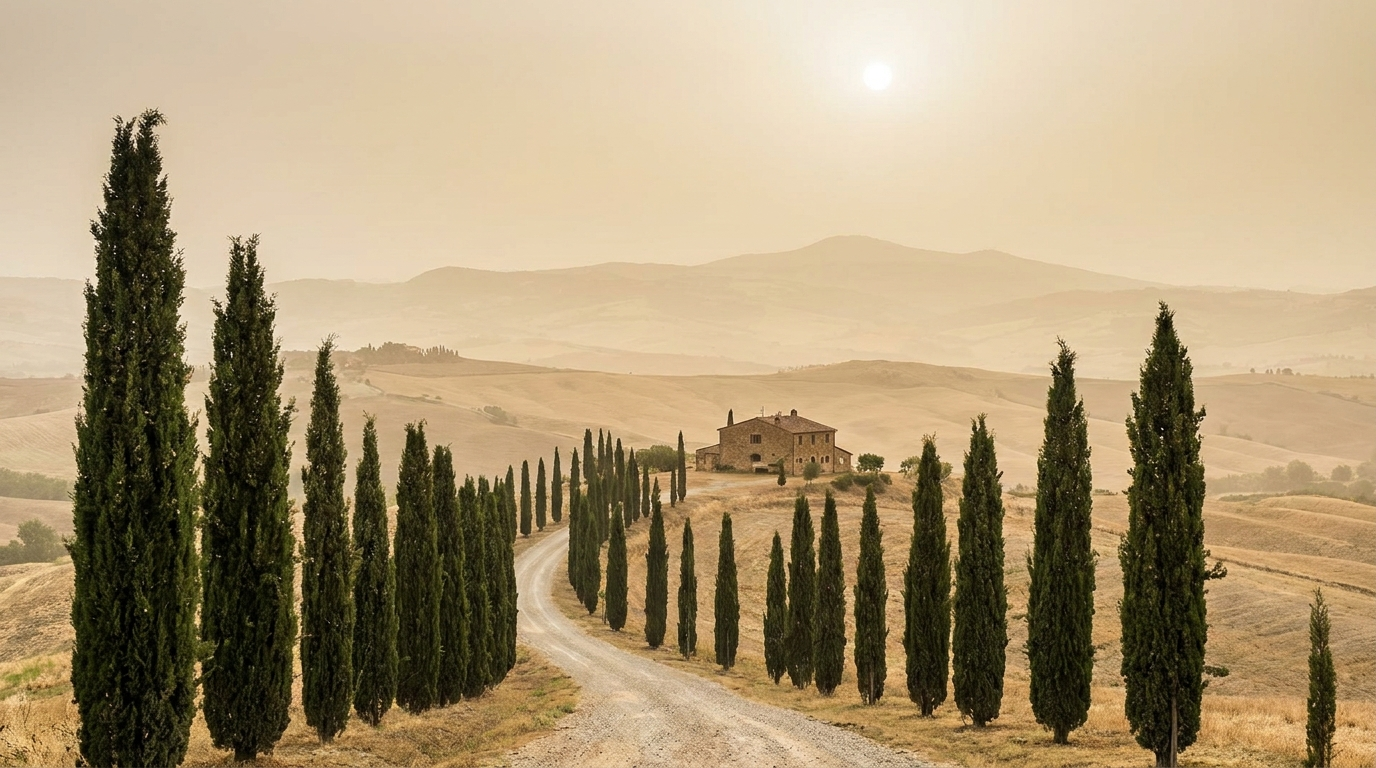
At some point on every summer trip, it is worth accepting that haze is not always a problem to solve. Some of the most striking Tuscany photographs made in July and August lean into the atmosphere rather than fighting it, using haze the way painters have used it for centuries to suggest distance, softness, and warmth. A row of cypress trees fading into pale gold layers toward the horizon, each ridge a slightly lighter shade than the one in front of it, is a genuinely different kind of image than the crisp, high contrast look most people associate with Val d'Orcia, and it is one that only exists because of the haze, not despite it.
This works best with strong, simple foreground shapes, a single cypress row, a lone farmhouse, a curved dirt road, set against layers of increasingly faint hills behind it. Complex, busy compositions tend to lose too much definition in haze to read clearly, but a simple silhouette against a soft, glowing background can look more intentional and more painterly than the same scene shot under a perfectly clear sky.
Pro Tip: If you are shooting for a painterly, hazy look on purpose, resist the urge to max out dehaze and contrast sliders in post processing. Pulling the haze back by 100 percent in editing usually looks unnatural and undoes the exact mood you drove out at 6 AM to capture. A partial edit almost always looks more convincing than a full correction.
A quick comparison of approaches
| Approach | When it works best | Main limitation |
|---|---|---|
| Shoot at sunrise | Any subject, any day | Requires an early alarm and travel time to your spot |
| Shoot side lit or backlit | Layered hills, cypress rows, silhouettes | Limits composition options compared to front lighting |
| Use a circular polarizer | Scenes with the sun roughly 90 degrees to your position | Little to no effect shooting toward or away from the sun, costs 1-2 stops of light |
| Underexpose slightly and shoot raw | Any hazy scene where you plan to edit afterward | Needs more work in post processing to recover the final look |
| Embrace the haze deliberately | Simple silhouettes and layered ridgelines at golden hour | Does not suit busy, detail heavy compositions |
Frequently asked questions about shooting in haze
Does haze ever fully clear in a Tuscan summer? Yes, but usually only after a strong weather system passes through and brings cooler, drier air behind it, which is uncommon in July and August. Clear post frontal days are worth reshuffling your itinerary for if the forecast shows one.
Is a graduated ND filter useful for haze? Not directly. A graduated ND balances exposure between a bright sky and a darker foreground, which is a different problem than haze's low contrast, non directional scatter. A circular polarizer is the more relevant filter for haze specifically.
Should I just avoid landscape photography in Tuscany during summer? Not necessarily. If summer is your only available travel window, plan around sunrise, favor side lit and backlit compositions, and consider building at least one deliberately hazy, painterly shot into your shot list rather than treating every image as a contrast problem to solve.
Does dehaze in Lightroom or similar software fully fix the problem? It helps, particularly on raw files with good tonal data, but pushed too far it introduces halos and unnatural darkening around distant hills. Moderate settings paired with good in camera technique produce a more convincing result than relying on dehaze alone.
The bottom line on summer haze
Haze is one of the clearest examples in Tuscany photography of a condition that rewards adapting rather than fighting. Shooting earlier, paying attention to sun angle, using a polarizer where the geometry actually supports it, and knowing when to lean into a soft, layered look instead of chasing maximum contrast will get you meaningfully stronger images than treating every hazy morning as a lost cause. If your travel dates are flexible at all, our month by month guide to timing a Tuscany trip lays out exactly when haze is worst and when it eases, so you can plan around it entirely if that matters more to you than working through it.
For a deeper look at how Val d'Orcia's rolling hills read as three dimensional shapes in a photograph, even in reduced contrast light, see our guide on composing depth into Tuscany's landscape, since the same layering principles that help on a clear day become even more important once haze starts working against you.