Photography Tour vs Photography Workshop vs Photography Retreat: What's the Difference
A clear breakdown of what a photography tour, workshop, and retreat actually mean in practice, where the terms overlap, and how to tell which one you're really booking.
Photography Tour vs Photography Workshop vs Photography Retreat: What's the Difference
I get some version of this question almost every week, usually by email, usually starting with "quick question." Someone has been searching for a way to improve their landscape photography and get to Tuscany at the same time, and along the way they have run into three different terms that all seem to describe the same basic idea. A photography tour. A photography workshop. A photography retreat. The websites selling each one use gorgeous photos and confident marketing copy, and none of them bother to explain how their format is actually different from the other two. So people end up comparing prices and photos without understanding what they are actually comparing.
I have run all three formats over the years in one shape or another, and I have also been a paying participant on other people's trips before I ever ran my own. So this is not a theoretical breakdown pulled from marketing pages. It is what actually happens on the ground under each label, where the lines genuinely blur, and how to figure out which one fits what you are actually trying to get out of a trip.
Key Takeaways
The three terms describe real differences in structure and focus, but the industry is not consistent about using them, so read the itinerary, not just the label.
| Point | Details |
|---|---|
| Photography tour | Built around locations and light, moving through a region on a schedule tied to sunrise and sunset, with guiding but lighter formal instruction |
| Photography workshop | Built around a skill or technique, often based in one place, with classroom time, assignments, and structured critique alongside shooting |
| Photography retreat | Built around pace and headspace as much as photography, with more unstructured time, fewer shoots per day, and an emphasis on creativity over checklist coverage |
| Where the terms overlap | Most well run trips borrow from all three, so the label on the sales page tells you less than reading the actual day by day itinerary |
| Where WeShoot sits | Structured as a tour, with real workshop elements folded in (masterclasses, one-on-one image reviews) most pure tours skip |
Table of Contents
- The quick answer
- What a photography tour actually is
- What a photography workshop actually is
- What a photography retreat actually is
- Where the three formats blur together
- Side by side comparison
- How to actually tell them apart from a sales page
- Which one should you actually book
- Where a Tuscany trip fits into all of this
- Frequently asked questions
- So what is the actual difference
The quick answer
A photography tour is organized around locations and the light at those locations, moving through a region on a schedule dictated by sunrise and sunset, with a guide handling logistics and giving in-field direction. A photography workshop is organized around a specific skill, technique, or body of knowledge, usually anchored in one base location, with classroom sessions, assignments, and structured critique built into the day alongside the shooting itself. A photography retreat is organized around pace and headspace as much as the photography, with a slower schedule, fewer shoots crammed into each day, and more room for reflection, journaling, or just sitting with a cup of coffee watching the light change instead of chasing the next composition. In practice almost no real trip is a pure example of just one of these, which is exactly why the terminology confuses people. Keep reading and I will walk through what actually happens under each label, and then how to read past the marketing to figure out what you are really booking.
Pro Tip: Ignore the word on the homepage and go straight to the day by day itinerary before you book anything. A trip calling itself a "workshop" with zero classroom time and a "retreat" with six shoots a day are both using the label loosely, and the itinerary is the only place that tells you the truth.
What a photography tour actually is
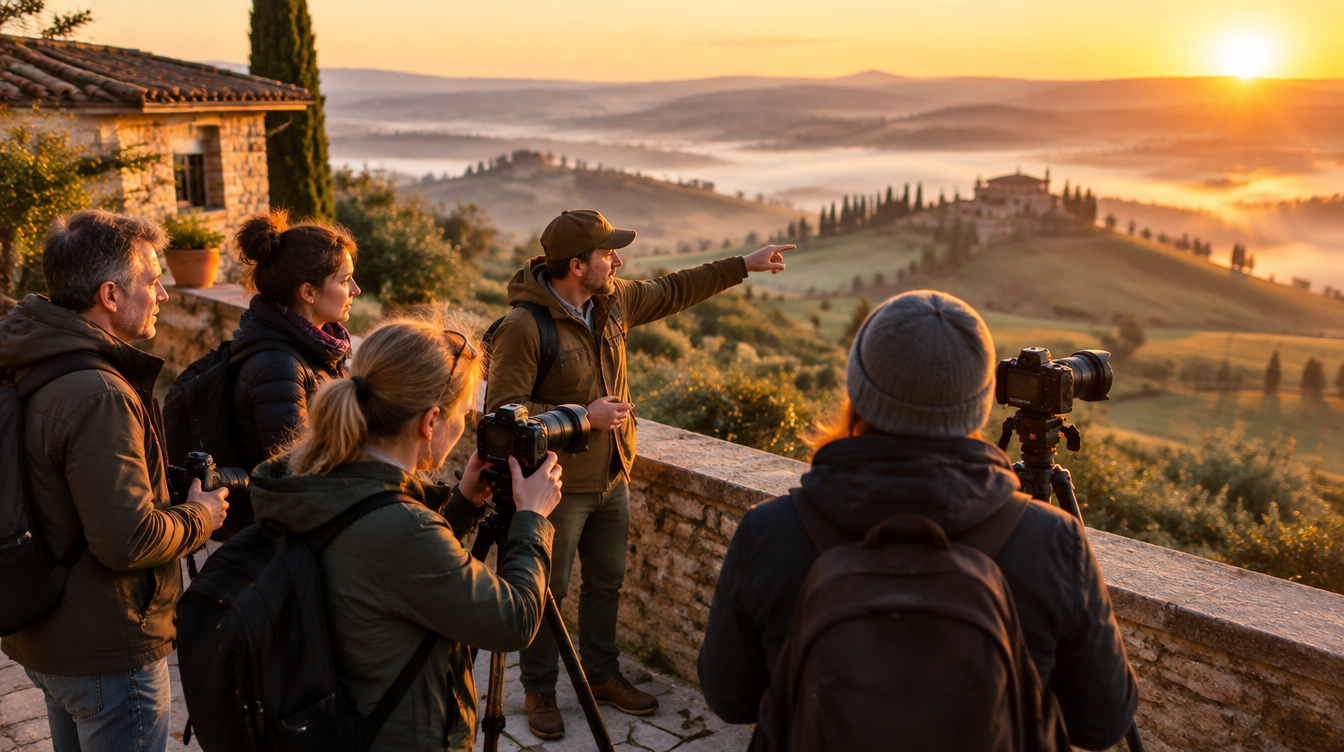
A photography tour is fundamentally a location-driven trip. The itinerary is built around a sequence of places that photograph well, timed to the light that makes them photograph well, with a guide who knows the region handling the logistics of getting your group to the right spot at the right moment. On a well run tour, most of your instruction happens in the field rather than in a classroom. A guide might crouch next to you at 6:15am and suggest dropping your aperture to f/11 for a two-second exposure on a slow moving stream, or point out that switching from a 70-200mm to a 24mm will change a shot of a cypress-lined road from "nice photo" to the kind of image that actually sells the scale of the landscape. That is real teaching, but it happens on the fly, tied directly to the scene in front of you rather than as a scheduled lesson.
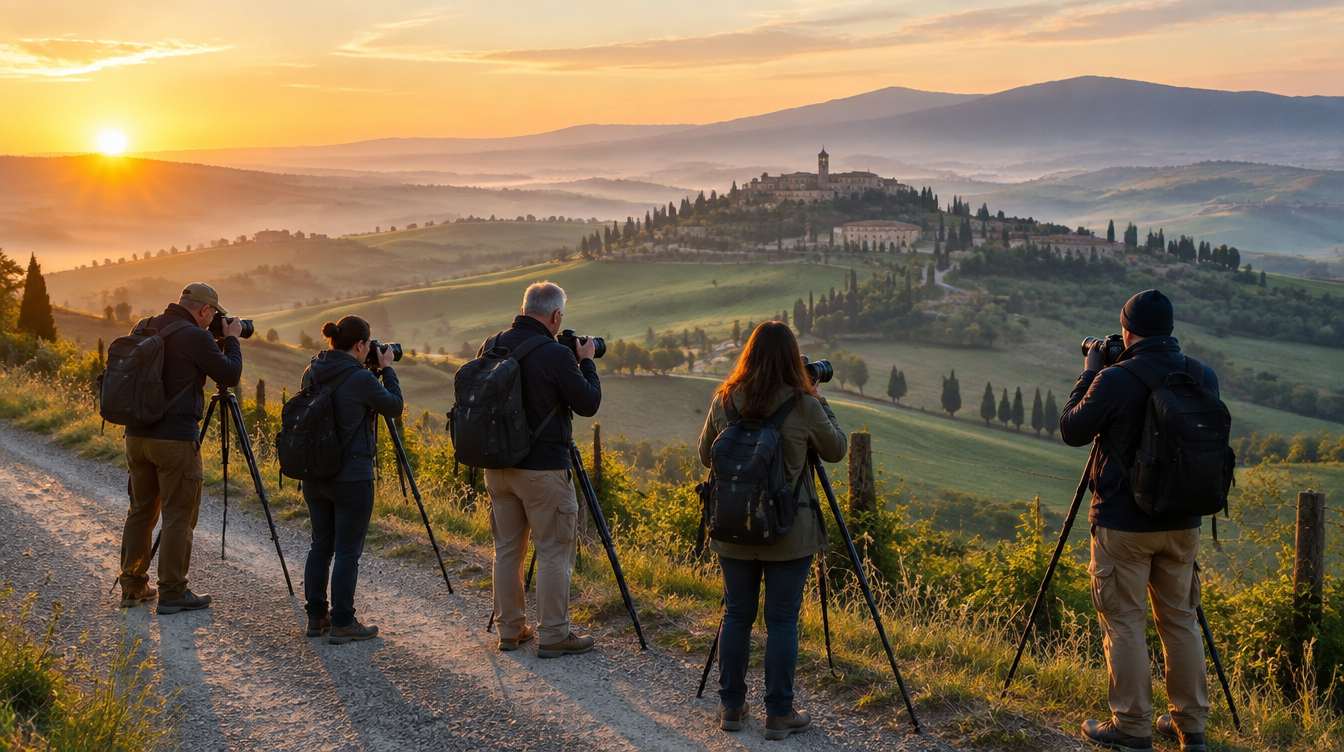
The trade-off is pace. A tour typically covers more ground and more distinct locations than a workshop or retreat, because location variety is the point. You are less likely to spend a full free afternoon exploring one single subject in depth, and more likely to move from a hilltop town at sunrise to a different valley by afternoon to a third spot for sunset. If you want to come home having seen and photographed a wide cross-section of a region, a tour format usually delivers that better than the other two, simply because covering ground is what it is built to do.
What a photography workshop actually is
A photography workshop is organized around a skill rather than a set of locations, even when it takes place somewhere beautiful. Classic examples are a long exposure workshop, a night photography and astrophotography workshop, or a post-processing workshop built around Lightroom and Photoshop. The itinerary usually includes dedicated classroom or lecture blocks, structured assignments you are expected to complete between shoots, and formal critique sessions where an instructor reviews your images with the group, not just a quick comment in the field. You might spend an entire morning learning exposure bracketing for HDR blending, then an afternoon reviewing your bracketed frames together before you ever pick up a camera again that day.
Because the skill is the anchor, a workshop often stays in one base location rather than moving through a region, which lets the group return to the same subject under different light or revisit a technique until it actually sticks. That repetition is genuinely valuable if you are trying to build a specific skill, focus stacking for macro work, manual mode confidence, histogram reading in tricky light, in a way that a single in-field correction on a moving tour usually cannot match. The trade-off is the same one in reverse: you will likely see fewer distinct locations than you would on a tour covering the same number of days.
What a photography retreat actually is
A photography retreat borrows the word from wellness travel for a reason. The schedule is deliberately lighter than either a tour or a workshop, with fewer shoots per day and more unscheduled time built in on purpose, not as a gap in planning. The stated goal is usually creative reconnection rather than technical improvement or location coverage: slowing down enough to actually see a scene instead of rushing to the next composition, journaling or discussing creative blocks as a group, and shooting with intention rather than volume. You might photograph a single olive grove for two unhurried hours instead of hitting four locations before lunch.
Retreats appeal most to photographers who already have solid technical fundamentals and are looking for inspiration or a creative reset rather than a lesson in aperture priority mode. If your goal is walking away with as many strong, varied images as physically possible in a week, a retreat's slower pace can feel frustrating. If your goal is remembering why you picked up a camera in the first place, it can be exactly the reset you need.
Where the three formats blur together
Here is the honest complication: almost no well designed trip is a pure example of just one format, and the industry has never agreed on strict definitions. A tour operator who wants to differentiate from cheaper bus tours will often fold in genuine workshop elements, structured post-processing sessions, one-on-one image reviews, a proper critique night, because pure location-hopping with no instruction is an easier product to commoditize and a harder one to charge a premium for. A workshop that stays in one location for a week will usually still move to two or three different shooting spots around that base, because staring at the exact same view for seven straight days would be a hard sell even to students focused purely on technique. And a retreat aimed at photographers will still include some structured shooting time, because a trip billed as photography focused that never actually goes anywhere to shoot would draw complaints fast.
This is also why the same company will sometimes use all three words on different pages of its own site, or even in the same sentence, without meaning anything precise by the distinction. It is marketing shorthand more than an industry standard, closer to how "boutique hotel" gets used for anything from a genuinely small independent property to a 200 room chain hotel with nice lobby furniture. The word is doing vibes work, not definitional work.
Side by side comparison
| Format | Primary focus | Typical pace | Instruction style | Best for |
|---|---|---|---|---|
| Photography tour | Locations and light | Fast, several locations per trip | In-field, tied to the scene in front of you | Seeing and photographing a wide slice of a region |
| Photography workshop | A specific skill or technique | Slower, often one base location | Classroom lessons, assignments, formal critique | Building a defined technical skill in depth |
| Photography retreat | Creativity and pace | Slowest, deliberately unhurried | Light, reflective, discussion-based | Photographers wanting a creative reset over new technique |
Pro Tip: If a sales page uses more than one of these words to describe the same trip, that is not necessarily a red flag. It usually just means the operator built a genuinely blended itinerary. Read the day by day schedule to see how much of each element actually shows up before you assume the label is accurate either way.
How to actually tell them apart from a sales page
Since the label alone will not tell you much, here is what I actually look for when I am evaluating someone else's trip, whether I am considering it as a participant or just sizing up how it compares to what we run. First, count the number of distinct shooting locations listed in the itinerary. A trip hitting six or seven named locations in a week is behaving like a tour regardless of what the homepage calls it. Second, look for the words "classroom," "lecture," "assignment," or "critique session" in the daily schedule. Their presence, and how often they show up, is the clearest workshop signal there is. Third, check how many shoots are scheduled per day. Two structured shoots a day, sunrise and sunset, with real free time in between, reads as a retreat pace no matter what the trip calls itself. None of these signals require insider knowledge. They are sitting right there in the itinerary on every legitimate operator's website, you just have to actually read past the hero image and the pricing table to find them.
It is also worth checking the guide to participant ratio, since it tells you how much individual attention you will realistically get under any label. A trip with two guides for seven participants can deliver real one on one feedback during a shoot in a way that one guide for twenty guests simply cannot, regardless of whether the company calls itself a tour, a workshop, or a retreat. Group size and guide ratio matter more to your actual experience than which of the three words appears in the trip's title.
A fourth thing worth checking, and one almost nobody asks about upfront, is what happens to the plan when the weather does not cooperate. A rigid, fully scripted itinerary that marches forward regardless of conditions is a warning sign under any of the three labels, because landscape photography lives and dies by light, and light is the one variable no operator controls. Ask directly whether the guides have the authority to scrap a planned stop and drive somewhere else if a fog bank rolls in overnight, or whether the group is locked into a printed schedule no matter what the sky is doing. The honest answer to that one question tells you more about the quality of a trip than the tour, workshop, or retreat label ever will.
Which one should you actually book
If you have never seen a region before and your main goal is coming home with a strong, varied portfolio from that place, lean toward a tour. The location coverage is the whole point, and most tours still include enough in-field guiding to improve your technique along the way even without formal classroom time. If you have a specific technical gap, you consistently underexpose skies, you have never tried focus stacking, your post-processing workflow is a mess, a workshop targeting that exact skill will move the needle faster than a tour ever will, because the entire structure is built around repetition and feedback on that one thing. If you are technically competent already but feel creatively stuck, uninspired by your own recent work, burned out on forcing yourself to shoot for likes rather than for yourself, a retreat's slower pace and reflective structure is worth more than another location checklist.
Most photographers considering a Tuscany trip land somewhere between the first two categories: they want to see a genuinely beautiful, varied region, and they also want real, structured improvement in their technique rather than just following a guide around with a camera. That combination is exactly why the trips we run are structured as tours with real workshop elements built in, rather than as a pure location tour or a pure classroom-based workshop.
Where a Tuscany trip fits into all of this
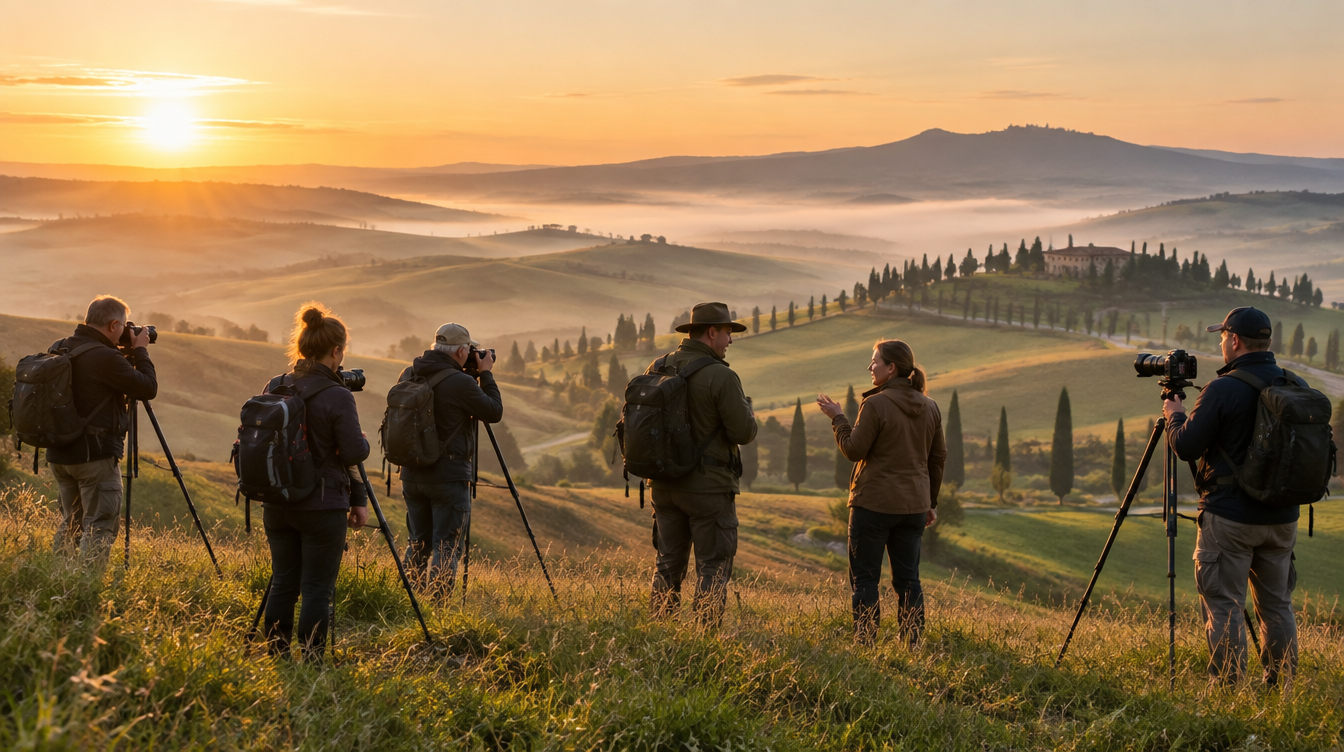
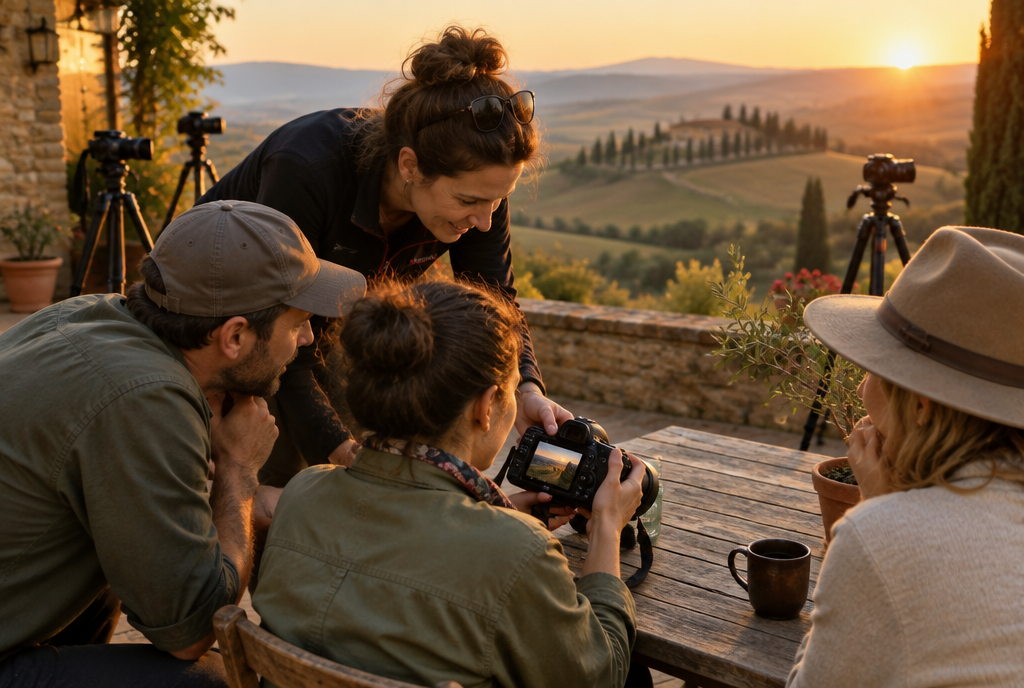
Our own Val d'Orcia photography tour is a good concrete example of how blended these formats get in practice. The bones of it are a tour: seven days moving through a sequence of specific villages, cypress-lined roads, and valley viewpoints, timed to sunrise and sunset light. But layered on top of that location structure are genuine workshop elements most pure tours skip entirely. Two professional photographer guides work with a maximum of seven participants, which is a tight enough ratio for real one-on-one feedback in the field. Built into the week are structured post-processing masterclasses and individual image reviews, the same kind of classroom-adjacent instruction you would expect from a dedicated editing workshop, not just a quick "nice shot" as you pack up your tripod. If what you actually want is Tuscany's locations and light plus genuine, structured improvement in your technique rather than a checklist tour or a slow, purely reflective week, that blend is worth a look, and it is the reason we do not describe the trip as purely one thing or the other.
Frequently asked questions
Is a photography tour more expensive than a workshop? Not inherently. Price depends far more on group size, guide ratio, and included accommodation than on which of the three labels the trip uses. A small group tour with two guides and villa lodging can easily cost more than a bare-bones workshop at a budget hotel.
Can a beginner join a photography workshop, or is it only for advanced shooters? Most workshops are built around a specific skill level, and reputable operators state this clearly on the trip page. A workshop focused on manual mode fundamentals is aimed squarely at beginners, while one focused on advanced focus stacking or astrophotography compositing assumes you already know your camera cold.
Do photography retreats include any actual instruction? Usually some, but it tends to be lighter and more discussion-based than a workshop's structured lessons. Do not book a retreat expecting a formal curriculum, and do not skip a retreat assuming there will be zero guidance either.
Which format is best for a solo traveler? All three work well for solo travelers, since group trips are specifically designed around people arriving without a built-in travel partner. A tour or workshop with a fixed, structured daily schedule tends to make solo logistics simplest, since you are never left wondering what the group is doing next.
Why do some companies use all three words interchangeably? Mostly because there is no enforced industry standard for the terms, and each word carries different marketing appeal. "Retreat" sounds restorative, "workshop" sounds rigorous, and "tour" sounds comprehensive, so some operators use whichever word tests best rather than the one that most precisely describes their itinerary.
What about words like "expedition" or "photo safari"? Same story, different vocabulary. "Expedition" tends to signal a more remote or physically demanding destination, and "safari" almost always refers to wildlife photography specifically, but neither term is regulated any more tightly than tour, workshop, or retreat. The same rule applies: read the itinerary, not the label, before you assume what kind of trip you are actually looking at.
Does a workshop always cost less than a tour since it covers fewer locations? Not necessarily. A workshop built around a narrow, specialized skill, night photography with expensive star tracker equipment provided, for example, can cost as much or more than a broader tour, because the price reflects the specialized instruction and gear rather than the number of locations on the itinerary.
So what is the actual difference
The honest answer is that the three words describe three different centers of gravity, locations for a tour, skill for a workshop, pace and headspace for a retreat, but almost every good trip borrows from all three to some degree. The label on the homepage is a rough signal at best. The day by day itinerary, the guide to participant ratio, and how the operator actually describes a typical day are what will tell you whether a trip matches what you are looking for. Read past the marketing word, and you will end up booking the right trip far more often than if you just went with whichever label sounded most appealing that week.