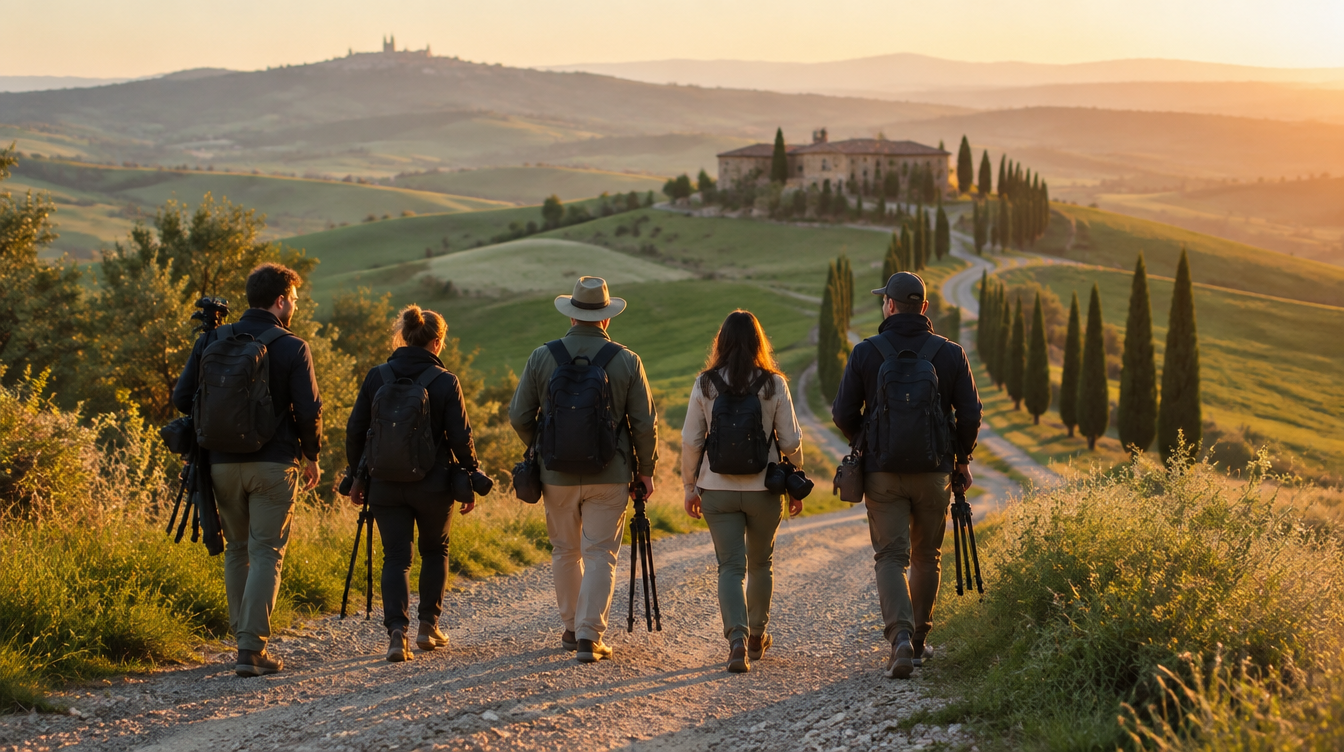
Is a Photography Tour a Good First Trip to Italy?
Why a small-group photography tour can be one of the easiest, most rewarding ways to experience Italy for the first time, and where a guided first trip still has real limits.
Is a Photography Tour a Good First Trip to Italy?
I get some version of this question almost every week: "I have never been to Italy, is it crazy to make my first trip a photography tour instead of just going on my own?" Usually it comes from someone who has watched a dozen YouTube videos about Tuscany, has a camera bag they are genuinely excited to use, and is also a little nervous about driving on unfamiliar roads, ordering in a language they do not speak, and figuring out which hill town is actually worth the detour and which one is a tour bus trap. That nervousness is completely reasonable, and it is exactly the gap a small group tour is built to close.
I am not going to pretend a guided trip is the only good way to see Italy for the first time. Plenty of people have had wonderful, chaotic, self-planned first trips to Italy and would not trade the wrong turns for anything. But if you are weighing a photography tour specifically as your first trip, rather than a "someday when I know the country better" trip, I think the case for going now is stronger than most people assume. Here is the honest version of why, along with where a guided first trip has real limits.
Key Takeaways
A guided small group photography tour removes the two hardest parts of a first Italy trip, logistics and not knowing where to go, while still getting you into real farmland and real conversations rather than a tour bus circuit.
| Point | Details |
|---|---|
| Biggest first-trip fear it solves | Not knowing where to go or when, so you spend the trip shooting instead of researching |
| Driving | Handled for you, no need to learn manual transmission or ZTL restricted zones on your first visit |
| Language | A non-issue day to day, since guides and local hosts bridge the gap at meals and shoots |
| Authenticity | Farmland access, small agriturismi, and local meals rather than a coach bus itinerary |
| What you still handle yourself | Flights, passport and entry requirements, travel insurance, and getting to the meeting point |
| Best for | First-timers who want to come home with real images, not just snapshots, without burning the trip on logistics |
Table of Contents
- The two things that wreck a first Italy trip
- Logistics: the part nobody enjoys figuring out alone
- Not knowing where to point your camera
- What your first morning actually looks like
- Does guided mean touristy?
- What a first-timer should still plan themselves
- Who a guided first trip is not right for
- Frequently asked questions
- The honest verdict
The two things that wreck a first Italy trip
After leading small group trips through Val d'Orcia for years now, I have watched a pattern repeat with almost every first-time visitor who tries to plan Italy solo. It is not the flights that trip people up, and it is rarely the food or the language in the way people expect. It is two specific things: logistics that eat far more time and stress than anticipated, and simply not knowing where the good light actually is on any given morning. Solve those two problems and a first Italy trip goes from stressful to genuinely relaxing. Fail to solve them and you end up with a week of half-decisions, missed golden hours, and a nagging feeling that you saw the postcard version of Tuscany instead of the real one.
Logistics: the part nobody enjoys figuring out alone
If you have never driven in Italy, the learning curve is steeper than it looks from home. Most rental cars are manual transmission, which catches out a lot of American drivers who have never had to shift on unfamiliar, narrow, and occasionally vertical Tuscan roads. Then there are ZTL restricted traffic zones in nearly every historic center, which can fine you automatically by camera if you drive into one without a permit, often without any obvious signage in English. None of this is unmanageable if you have done it before, or if you have weeks to research it. On a first trip, with jet lag and a full itinerary, it is one more thing competing for your attention when you would rather be composing a shot of a cypress lined road at sunrise.
On a guided tour, none of that is your problem. You get picked up, moved between locations in a comfortable van, and dropped at the next viewpoint with enough time before sunrise to set up calmly instead of sprinting from a parking spot with your tripod under one arm. I have watched more than one first-timer visibly relax on day two once they realized they were not going to have to navigate a rotary in Siena traffic before breakfast.
Pro Tip: If you do decide to self drive on a future trip, get your International Driving Permit sorted at home before you leave, not at the airport. It takes ten minutes at an AAA office in the US and saves you a genuinely stressful conversation with a rental car desk in Florence.
Beyond driving, there is a long tail of smaller logistics that quietly drain time and energy from a first solo trip: figuring out which restaurants take walk-ins versus which need a reservation two days out, working out cash versus card in smaller villages where a card reader is not always reliable, knowing when shops close for the afternoon riposo and plan a shoot around it instead of showing up to a locked door, and packing the right adapter for Italian outlets so your camera batteries are charged by the next morning. Individually these are minor. Stacked together across a week with no local guidance, they add up to a surprising amount of mental overhead that has nothing to do with photography and everything to do with just running a trip. A guided tour absorbs almost all of it, which frees up the attention you would rather spend on composition and light.
Not knowing where to point your camera
The second problem is quieter but costs you more images. Val d'Orcia looks deceptively simple in photographs, rolling green or gold hills, a lone cypress or two, a hilltop town catching the light. What those photographs do not show you is that the photographer was standing on a specific farm road, at a specific time, facing a specific direction, often after scouting the spot the evening before. A first-time visitor with no local knowledge will burn their first two or three mornings just figuring out where those roads are, and by the time they have it dialed in, the trip is often over.
A guide who has shot the same hills across dozens of departures already knows which farm road outside San Quirico catches first light best in October, which fields near Pienza still have a clean foreground without a fence line cutting through it, and which viewpoint is worth the extra ten minutes of driving when the forecast shows a clear night and a big temperature drop, the classic recipe for valley fog. You are not guessing. You are shooting from the first morning, with a wide aperture prime like a 35mm f/1.4 or a mid-range zoom in the 24-70mm range doing most of the work, and a graduated ND filter in your bag for the wide golden hour shots where the sky is several stops brighter than the hillside.
What your first morning actually looks like
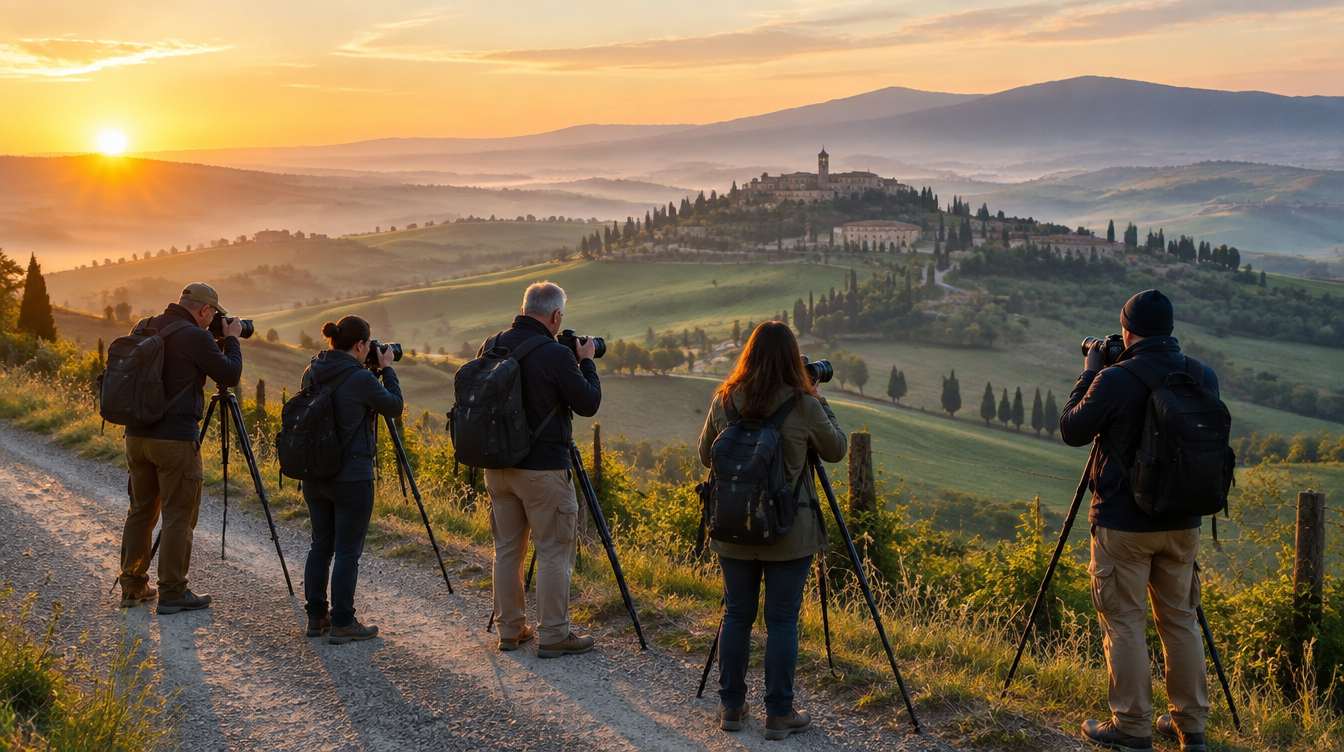
It helps to walk through an actual first morning rather than talk about the concept in the abstract, because this is usually the moment first-timers relax the most. The wake-up call is early, often 5:15 or 5:30 a.m., which sounds brutal until you are standing on a farm road outside San Quirico d'Orcia twenty minutes later, watching the sky go from black to deep blue with a guide quietly pointing out where the light is going to break first over the ridge. Nobody is rushing you. You already know where you are going, so instead of spending that time checking a map on your phone, you are checking your histogram and deciding between a vertical composition with a single cypress as an anchor or a wider shot layering three or four ridgelines back toward the horizon.
A guide will typically suggest a starting aperture, often somewhere around f/8 to f/11 for a deep landscape shot where you want the foreground grass and the distant hill town both reasonably sharp, and will help you check focus stacking is even necessary before you bother with it. If the light is soft and even, you might not need a graduated ND filter at all. If the sun breaks the ridge while you are shooting, that is when a two or three stop soft grad earns its place in your bag, holding back the sky while the foreground stays properly exposed. None of this is complicated once someone walks you through it once in the field, but it is exactly the kind of detail that takes a first-time visitor working alone several frustrating mornings to figure out through trial and error.
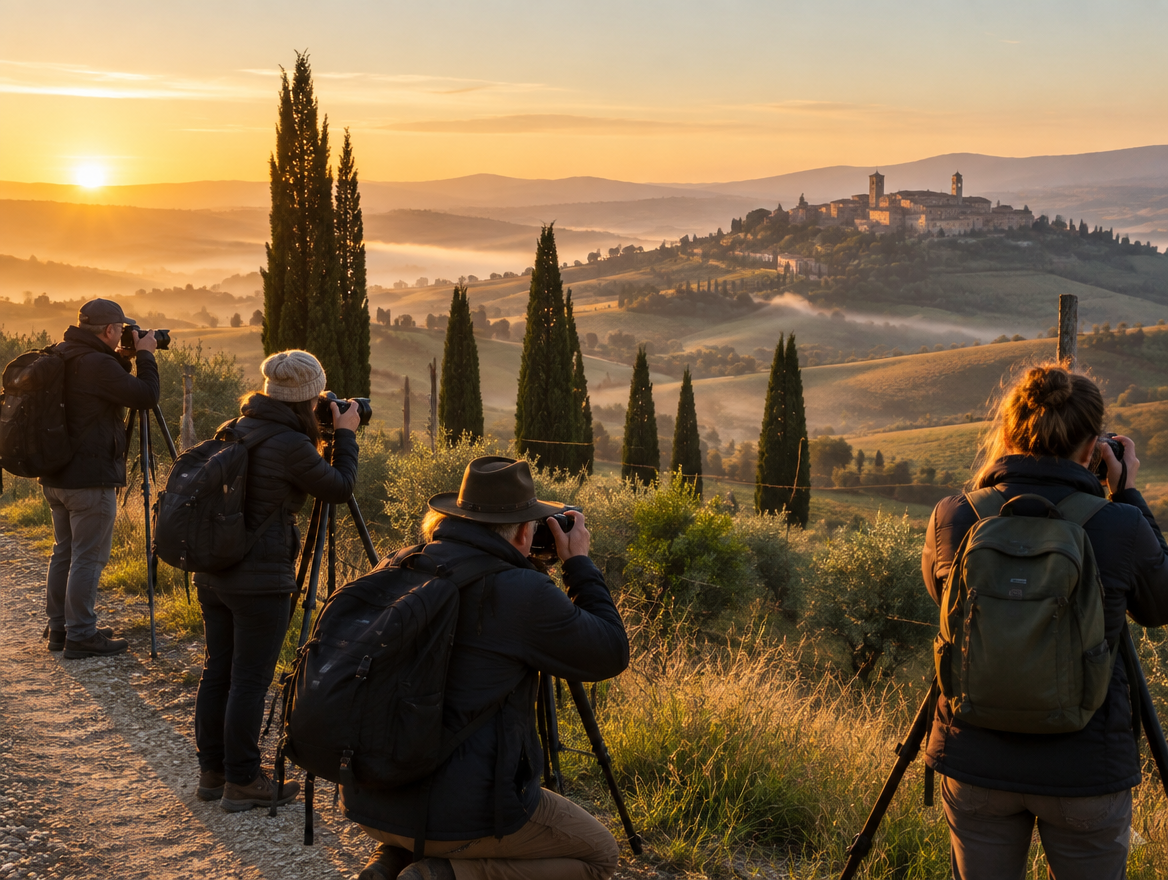
By the time the sun is fully up and the light turns harsh, the shoot wraps and the group heads back for a proper breakfast, not a granola bar eaten in a rental car. That rhythm, shoot, eat, rest through the harsh midday hours, shoot again at golden hour, repeats through the week, and it is a genuinely good rhythm for a first trip to Italy regardless of how experienced a photographer you are.
Does guided mean touristy?
This is the objection I hear most often, and it is a fair one. Plenty of "guided tours" really are coach buses that stop for twenty minutes at a scenic overlook alongside forty other buses doing the same thing. That is not what a small group photography tour looks like, and it is worth being specific about the difference. Our Val d'Orcia trip caps out at seven participants with two professional photographer guides, which means you are never standing in a crowd waiting for your turn at a viewpoint. You are walking onto working farmland well before sunrise, staying in a villa or agriturismo with a pool and spa rather than a chain hotel near a highway exit, and sitting down to meals of real regional cooking, not a buffet built for volume. A wine tasting at a working winery like Tassi is part of the itinerary, not an optional add-on tacked onto a shopping stop.
None of that is what people picture when they hear "tour." It is closer to traveling with a small group of friends who happen to know the region cold, and who also happen to be there to help you get a stronger shot when your composition needs a second pair of eyes. If the idea of a Tuscany trip appeals to you but the word "tour" makes you picture a flag-waving guide and a bus full of strangers, it is worth actually looking at what a small group photography departure includes before ruling it out. If that sounds like the kind of first trip you have in mind, our Val d'Orcia photography tour runs at exactly that scale, with departures scattered across spring, summer, and fall so you can match the trip to the season of Tuscany you actually want to photograph.
Pro Tip: Ask any operator directly how many participants and how many guides are on a typical departure before you book. A ratio of three or four guests per guide, or better, tells you a lot more about the real experience than the marketing photos do.
What a first-timer should still plan themselves
A guided tour removes plenty of friction, but it does not remove all of it, and it should not pretend to. You are still responsible for getting yourself to Italy and to the meeting point, which usually means booking your own flights into Florence, Pisa, or Rome and arriving with a day of buffer in case of delays. You need a valid passport with enough validity remaining, and it is worth checking the US Department of State's country information page for Italy before you go, since entry requirements can shift and that page stays current in a way a blog post cannot. Travel insurance, including coverage for your camera gear, is also on you, as is any time you want to spend before or after the tour exploring on your own.
| Task | Who handles it on a small group tour |
|---|---|
| Flights to Italy | You |
| Passport and entry requirements | You, using current official guidance |
| Travel and gear insurance | You |
| Ground transport during the tour | Handled by the tour |
| Route planning and location scouting | Handled by the tour |
| Lodging and most meals | Handled by the tour |
| Extra time before or after the tour | You, if you want it |
Who a guided first trip is not right for
I want to be straight about this rather than sell every reader on the same answer. If your idea of a first Italy trip is total improvisation, no fixed schedule, no pre-dawn wake-up calls, and the freedom to linger in a trattoria for three hours because you felt like it, a structured photography tour with an alarm set for 5:30 a.m. most mornings is going to feel restrictive rather than freeing. That style of trip is a completely valid way to see Italy, it is just a different trip than the one a photography-focused small group tour is built to deliver. A guided tour is the right first trip specifically for someone whose primary goal is coming home with strong images and a real understanding of the craft, not someone whose primary goal is unstructured wandering.
The same logic applies if photography is a casual interest rather than the main point of the trip for you. Someone who wants to take a few nice phone photos of a piazza and otherwise spend the week eating, relaxing by a pool, and wandering without an agenda will find the pace of a photography-focused itinerary too structured. That is a completely fine way to want to travel, it just means a general small group tour or an independent trip built around food and leisure is the better fit, and a photography tour would be solving a problem you do not actually have.
Frequently asked questions
Do I need to speak Italian? No. Guides handle the language day to day, and most people in the tourism industry in Tuscany speak workable English. Learning a handful of polite phrases goes a long way and is worth doing regardless of how you travel.
Is Italy safe for a first-time solo traveler joining a group tour? Yes, broadly. Tuscany in particular is low crime by international standards. The usual common sense travel precautions apply, and the U.S. Department of State's travel advisory page for Italy is the right place to check current guidance before you book.
Will I miss the "real" Italy by going on a tour? That depends entirely on the tour. A coach bus circuit through gift shops, yes. A small group trip staying in a family run agriturismo, eating meals cooked by local hosts, and walking onto farmland most visitors never see, no. Ask specifically what a day looks like before assuming either answer.
How much photography experience do I need before a first trip like this? None. A first trip is exactly when a guide is most useful, since you get real-time feedback on composition and settings instead of figuring it out by trial and error on your own.
Should I bring a translation app, or is that unnecessary? Bring one anyway. You will not need it for anything the tour handles, but it is genuinely useful for a quick menu question at a meal on a free evening or a conversation with a shopkeeper in a village square. Download the Italian language pack ahead of time so it works without a data connection.
Do I need a European SIM card or will my phone just work? Most US carriers now offer an international day pass or an eSIM add-on that works fine for maps and messaging. Check with your carrier before you leave rather than assuming, since roaming rates without a plan add up fast and you do not want to be troubleshooting a phone plan on your first morning in Tuscany.
The honest verdict
For most first-time visitors whose main goal is photography, I think a small group guided tour is one of the easier, lower-stress ways to experience Italy, not a compromise version of it. You skip the two things that genuinely wreck a lot of first trips, unfamiliar driving and not knowing where to go, and you still get the farmland, the local meals, and the unhurried mornings that make Tuscany feel like more than a postcard. You give up total spontaneity, and if that is the part of travel you value most, plan your own trip instead. But if you want to land in Italy for the first time and start making real images by day one rather than day four, a guided small group tour is built for exactly that.
If a first trip built around photography rather than sightseeing sounds like what you are after, our Val d'Orcia photography tour is deliberately structured for that: small groups, real farmland access, and two guides who have already solved the logistics problem so your first week in Italy goes straight into shooting instead of figuring out where to park.
Renting a car yourself is a completely valid choice for a later Italy trip once you know the roads and the ZTL rules, and it is worth reading through before you decide either way. Our deeper guide to renting a car in Tuscany for a photography trip covers exactly what a US driver needs to know, including the ZTL restrictions and manual transmission learning curve mentioned above, if you want the full picture before choosing between self-driving and a guided departure for your first visit.