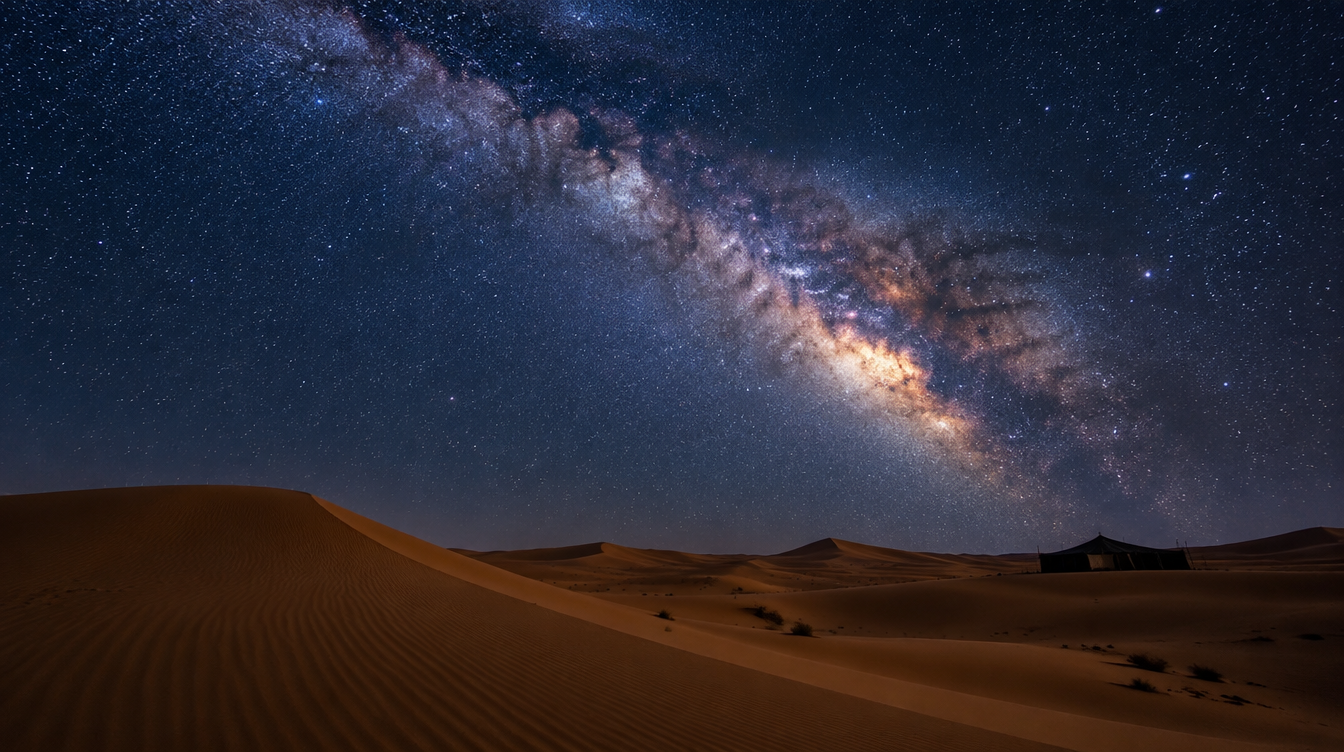
The 500 Rule vs the NPF Rule: How to Get Sharp Stars Every Time
Why the 500 rule leaves stars trailing on modern high resolution cameras, how the NPF rule fixes it with real camera examples, and a quick reference table for common setups.
The 500 Rule vs the NPF Rule: How to Get Sharp Stars Every Time
I still remember the first time a client on a night shoot zoomed into a frame on the back of her camera, certain she had nailed it, and found every star smeared into a tiny comma instead of a clean point of light. She had done everything the old advice told her to do. Divide 500 by her focal length, set the shutter to that number of seconds, done. The problem was her camera. It had more than twice the resolution of the camera that "rule" was built around decades ago, and at that resolution, the trailing was obvious the moment she pinched to zoom.
That moment is why this guide exists. The 500 rule is not wrong so much as it is outdated, built for a world of 12 and 16 megapixel sensors that stopped being the norm years ago. The NPF rule, which accounts for your camera's pixel size and your lens's aperture, gets you much closer to the truth. Below I will walk through why stars move at all, where the 500 rule falls apart, and how to run the NPF numbers yourself with real camera examples, so the next time you are under a genuinely dark sky, you come home with pinpoint stars instead of a lesson in sensor resolution.
Key Takeaways
The short version: the 500 rule was built for low-resolution sensors and routinely overestimates how long you can expose before stars trail on today's cameras, while the NPF rule factors in your actual pixel size and aperture for a far more reliable number.
| Point | Details |
|---|---|
| Why stars move at all | Earth rotates at a nominal 15.04 arcseconds per second, so any exposure longer than a few seconds records that motion as a streak rather than a point |
| The 500 rule | 500 divided by your full-frame-equivalent focal length gives a rough max exposure in seconds; it ignores your sensor's resolution entirely |
| Why it breaks down | On 40+ megapixel bodies, individual pixels are small enough that the same amount of star movement becomes visible well before the 500 rule's time limit |
| The NPF rule | A formula built from your aperture, pixel pitch, and focal length that generally lands at roughly half the exposure time the 500 rule suggests on a modern body |
| Fastest fix if you are unsure | Shoot shorter than either rule suggests, check focus and stars at 100% zoom on location, and adjust before you lose the shot |
| Where to practice this | Under genuinely dark skies, far from any city glow, where the difference between a sharp and a trailing star is actually visible |
Table of Contents
- Why stars move in your photos
- The 500 rule: what it is and why photographers still use it
- Why the 500 rule breaks down on modern high-resolution sensors
- The NPF rule: a more accurate formula for sharp stars
- NPF vs 500 rule: worked examples with real cameras
- Quick reference table
- Does the NPF rule work for crop sensor cameras
- Practical tips: ISO, aperture, and stacking
- Putting it into practice under real dark skies
- Frequently asked questions about sharp star photography
Why stars move in your photos
Before any formula matters, it helps to understand what you are actually fighting. Earth spins at a nominal angular velocity of about 7.29 × 10⁻⁵ radians per second, according to NASA's Goddard Space Flight Center, which works out to roughly 15.04 arcseconds of apparent sky movement every second. That number is tiny, but a sensor is unforgiving. Stretch a long enough exposure and that slow drift becomes a visible streak instead of a crisp dot, exactly what star trail photographs intentionally exploit.
This is also why a full rotation of the night sky does not take exactly 24 hours. A sidereal day, the time it takes Earth to complete one rotation relative to the distant stars rather than the sun, runs about 86,164 seconds, according to Wikipedia's entry on sidereal time, nearly four minutes shorter than the familiar 24 hour solar day. That gap is why stars shift position slightly earlier each night through the year. The practical takeaway is simpler: the sky never stops moving, and every star photo answers the same question, whether you planned it or not, of how much of that motion your sensor recorded.
The 500 rule: what it is and why photographers still use it
The 500 rule is about as simple as photography math gets. Take 500, divide it by your lens's focal length (adjusted for crop factor if you are not on a full-frame body), and the result is your maximum shutter speed in seconds before stars start to visibly trail. A 20mm lens on full frame gives you 25 seconds. A 14mm lens gives you roughly 36 seconds. It is the kind of rule you can do in your head standing in a dark field with cold fingers, which is exactly why it spread so widely and why so many beginner guides still teach it as gospel.
The rule survived for a reason. For years it was a genuinely useful approximation, and on lower resolution cameras it still works reasonably well today. The issue is not that the math is fake, it is that the rule was built around a certain pixel count, with no mechanism for adjusting once that assumption stops being true. A formula with no input for your actual sensor cannot account for your actual sensor, and that gap is exactly where modern cameras expose it.
Pro Tip: If you only remember one number tonight, remember this: treat the 500 rule's answer as your absolute ceiling, not your target. Shoot a test frame, zoom to 100% on the camera's rear screen, and look at a bright star near the edge of the frame rather than the center. Edge stars trail first and are the most honest warning you will get in the field.
Why the 500 rule breaks down on modern high-resolution sensors
Pixel pitch is the missing variable, and it is worth sitting with for a moment because it explains everything that follows. Pixel pitch, sometimes called pixel density, is simply how many pixels are packed into a given sensor area. As Wikipedia's entry on pixel density puts it, density is the pixel count divided by the sensor's area, and the comparison it gives is a useful gut check: a 20.1 megapixel APS-C sensor works out to about 6.2 megapixels per square centimeter, while a 20.4 megapixel compact sensor crams the same pixel count into a much smaller area, for roughly 70 megapixels per square centimeter. Smaller, denser pixels resolve finer detail, which is great for daytime landscapes and terrible for star trailing, because the same tiny amount of sky motion now covers more pixels than it would on a sensor with larger, more spread out photosites.
There is a second piece to this, which is how much blur the human eye actually tolerates before an image reads as "soft" rather than "sharp." Photographers call this the circle of confusion, defined by Wikipedia's entry on the circle of confusion as the blur spot created when light from a lens does not converge to a perfect point, with diffraction and lens imperfections setting the practical floor on how small that spot can get. The conventional threshold used for a final image is about 0.2mm at a normal 25cm viewing distance, which sounds generous until you remember that a 45 or 60 megapixel sensor is resolving detail far finer than that at the pixel level, long before the image is ever downsized for viewing.
Aperture plays a role too, which trips up readers who assume depth of field has nothing to do with star sharpness. Wikipedia's entry on diffraction-limited systems notes that at f/8, the diffraction spot size on a typical lens is around 9.76 micrometers for green light, already close to the pixel pitch of many full-frame cameras, meaning the system is jointly limited by diffraction and sensor resolution. Wide open at f/2.8 or f/1.8, that diffraction penalty shrinks, which is one reason the fastest aperture your lens offers is usually the right starting point for night photography.
Put those three things together and the 500 rule's blind spot becomes obvious. It was calibrated in an era of far larger pixels, and a modern high-resolution body simply resolves the same physical star movement at a scale the old rule never anticipated. The rule is not broken on every camera. It is broken specifically on the cameras most enthusiast and professional photographers are now shooting with.
The NPF rule: a more accurate formula for sharp stars
The NPF rule, widely credited in the astrophotography community to French astronomer Frédéric Michaud, fixes the 500 rule's biggest weakness by actually including your sensor's pixel pitch in the math, alongside your aperture and focal length. The formula, as it is commonly published across astrophotography references, is:
Maximum exposure time (seconds) = (35 × N + 30 × P) / F
where N is your aperture's f-number, P is your sensor's pixel pitch in micrometers, and F is your lens's focal length in millimeters. Three real, measurable inputs instead of one. Because P now accounts for how densely packed your sensor's pixels are, the formula naturally gives a shorter, more conservative answer on a high-resolution body and a more generous one on a lower-resolution body, which is exactly the behavior the 500 rule is missing. It is worth being upfront that the original publication behind this formula is not something I was able to independently verify this time around, so treat the attribution as the widely reported version rather than a primary citation, but the formula itself is consistent and reproducible across every serious astrophotography reference that documents it.
Pixel pitch itself is easy to work out for your own camera: divide your sensor's physical width in millimeters by its horizontal pixel count, then multiply by 1,000 for the answer in micrometers. You only need to do this once per camera body.
NPF vs 500 rule: worked examples with real cameras
Numbers make this concrete faster than any explanation, so here is the same comparison run across three current full-frame bodies with genuinely different pixel pitches, all at a common night-photography aperture of f/2.8.
The Canon EOS R5 has a 44.8 megapixel full-frame sensor measuring 36 by 24mm with a maximum output of 8,192 by 5,464 pixels, which works out to a pixel pitch of about 4.39 micrometers, the tightest of the three cameras here. The Sony a7 IV sits in the middle with a 33 megapixel sensor at 35.9 by 23.9mm and a maximum resolution of 7,008 by 4,672 pixels, for a pixel pitch close to 5.12 micrometers. The Nikon Z6 III has the most forgiving pixel pitch of the group at roughly 5.94 micrometers, thanks to its lower 24.5 megapixel count spread across a similarly sized 35.9 by 23.9mm sensor.
Run all three through the NPF formula at 20mm and f/2.8, and the Canon R5 tops out at roughly 11.5 seconds, the Sony a7 IV at roughly 12.6 seconds, and the Nikon Z6 III at roughly 13.8 seconds. The plain 500 rule, by contrast, gives every one of those cameras the same answer regardless of sensor: 25 seconds, more than double what NPF suggests for the Canon body. The 500 rule does not know or care which of these three cameras you are holding. NPF does, and on the highest resolution body in the group, that gap is the difference between a frame you can actually use and one that falls apart the moment you zoom in to check it.
Quick reference table
Here is the same comparison expanded across a few common wide-angle focal lengths used for night photography, all at f/2.8 full frame. Treat these as starting points for the field, not as guarantees, since seeing conditions, how closely you plan to crop, and how large you intend to print all shift the honest answer slightly.
| Focal length | 500 rule result | NPF (Canon R5, 4.39µm) | NPF (Sony a7 IV, 5.12µm) | NPF (Nikon Z6 III, 5.94µm) |
|---|---|---|---|---|
| 14mm | 35.7s | 16.4s | 18.0s | 19.7s |
| 20mm | 25.0s | 11.5s | 12.6s | 13.8s |
| 24mm | 20.8s | 9.6s | 10.5s | 11.5s |
| 35mm | 14.3s | 6.6s | 7.2s | 7.9s |
Notice how consistent the pattern is: NPF lands at roughly half of what the 500 rule promises across every focal length, and the gap barely moves as you widen out, because pixel pitch stays constant for a given camera regardless of which lens you mount. If you shoot one of these bodies regularly, write your own NPF numbers on a piece of tape on the back of the camera, since doing this math by headlamp at 2am in the desert is nobody's idea of fun.
Does the NPF rule work for crop sensor cameras
Yes, and this is one of the more common points of confusion I hear from photographers who shoot APS-C or Micro Four Thirds bodies. Because the NPF formula uses your sensor's actual pixel pitch rather than a full-frame-equivalent focal length, it already accounts for the crop in a more honest way than the 500 rule does. With the 500 rule, you have to remember to multiply your focal length by the crop factor before dividing, an extra step that is easy to forget in the field. With NPF, you plug in the real pixel pitch of your actual sensor and the real focal length printed on your lens, and the formula does the adjusting for you, because a smaller sensor packing a high pixel count naturally produces a smaller pixel pitch, which the formula already treats as more demanding.
In practice, this means crop-sensor shooters often see shorter maximum exposure times than full-frame shooters at the same focal length and aperture. If you shoot crop sensor and have only ever used the 500 rule, this is usually the reason your "by the book" star shots have looked softer than expected at full resolution.
Practical tips: ISO, aperture, and stacking
Once you have a realistic maximum shutter speed from the NPF formula, the rest of your exposure triangle has to do the remaining work of gathering enough light. Most night photographers land somewhere around ISO 3200 to 6400 for the Milky Way, adjusted based on how clean that specific camera's high ISO files look, paired with the widest aperture the lens offers, typically f/2.8 or faster on dedicated night lenses. Pushing ISO higher adds noise, but a shutter speed longer than your NPF number trades noise for trailing, and trailing is usually the less forgivable of the two, since noise can be reduced in editing and a trailed star generally cannot.
Pro Tip: If your NPF number feels too short to gather enough light at your current ISO ceiling, do not just ignore the math and expose longer. Instead, shoot several frames at the correct NPF shutter speed and stack them in post, or invest in a star tracker that physically counter-rotates with the sky, letting you expose for minutes instead of seconds without any trailing at all.
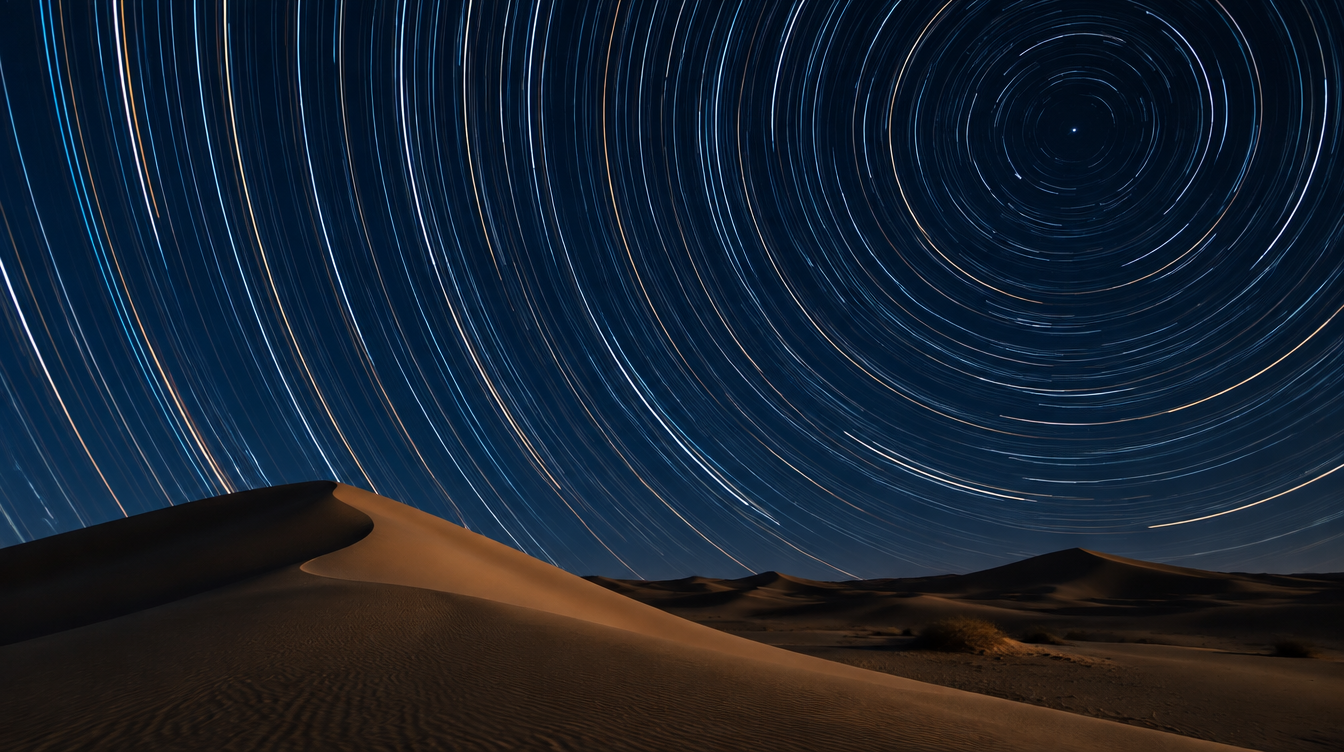
Stacking multiple short exposures is the technique most working night photographers lean on once they understand the NPF limits, because it sidesteps the trade-off entirely. Shoot ten or twenty frames at your correct NPF shutter speed, then combine them in software designed for exactly this, and you get the low noise of a long cumulative exposure with none of the trailing a single long exposure would introduce.
Putting it into practice under real dark skies
None of this math matters if you are shooting from a backyard under a glow of city light, because light pollution will wreck your contrast long before sensor resolution becomes your limiting factor. The places where getting your NPF number right actually shows up in the final image are places with genuinely dark skies, the kind where the Bortle scale, the standard reference astronomers use to rate sky darkness, describes its darkest Class 1 rating as skies dark enough that the Scorpius and Sagittarius regions of the Milky Way visibly cast shadows, a level of contrast most photographers never get to see with their own eyes, let alone photograph.
This is exactly the kind of sky our Tunisia Milky Way Phototour is built around. The trip crosses the Chott el Jerid salt flats at golden hour, winds through the dunes near the Star Wars film sets at Mos Espa, and pushes deep into the Sahara on an 80 kilometer 4x4 route to a remote Berber tent camp the group calls Camp Mars, where the night shoots happen with no camp lights nearby, just stars, silence, and your camera. Our guide, Lorenzo Ranieri Tenti, has twice been named Milky Way Photographer of the Year, and the itinerary keeps the group small, roughly ten to twelve photographers, under skies dark enough that every NPF calculation in this article actually matters. If you have been shooting under compromised suburban skies and wondering why your results never match the images that inspired you, a trip like this is the fastest way to find out how much of the gap was never about your gear at all.
Frequently asked questions about sharp star photography
What is the 500 rule in photography? It is a quick formula for estimating the longest shutter speed you can use before stars visibly trail: divide 500 by your full-frame-equivalent focal length to get a maximum exposure time in seconds. It is simple to calculate in the field but does not account for your sensor's resolution.
Why are my star photos blurry even when I followed the 500 rule? The most common cause is a high-resolution sensor. The 500 rule was built around lower pixel-count cameras, and on a modern 40 to 60 megapixel body, the same amount of real star movement covers more pixels and becomes visible well before the 500 rule's time limit is reached.
What is the NPF rule and how is it different from the 500 rule? The NPF rule is a formula that factors in your aperture, your sensor's pixel pitch, and your focal length, rather than focal length alone. It generally produces a shorter, more conservative maximum exposure time than the 500 rule, especially on high-resolution cameras.
What is pixel pitch and why does it matter for astrophotography? Pixel pitch describes how physically large or small each pixel on your sensor is, based on sensor size divided by resolution. Smaller pixels resolve finer detail, which also means they reveal star trailing sooner, since the same amount of sky motion covers proportionally more of a smaller pixel.
Does the NPF rule work for crop sensor cameras? Yes. Because the formula uses your sensor's actual pixel pitch and actual focal length rather than a full-frame-equivalent number, it naturally adjusts for crop sensors without any extra conversion step.
What ISO should I use for Milky Way photography? Most night photographers start around ISO 3200 to 6400, paired with the widest aperture the lens allows, typically f/2.8 or faster, then adjust based on how clean that specific camera's high ISO files look.
What is the difference between the NPF rule and the "Rule of 600"? They are not the same thing, despite sometimes being used interchangeably online. The Rule of 600 is simply a looser multiplier variant similar in spirit to the 500 rule, while the NPF rule is a distinct formula that explicitly incorporates pixel pitch and aperture rather than just a single multiplier divided by focal length.
Can I just use a star tracker instead of worrying about these rules? A star tracker physically counter-rotates your camera to match the sky's movement, letting you use exposures far longer than either rule would normally allow. It solves the trailing problem differently rather than making NPF irrelevant, and it is especially useful for deep sky or Milky Way detail shots.
What is the best aperture for sharp stars? Generally the widest aperture your lens offers without introducing too much coma or softness in the corners, often f/2.8 on dedicated night lenses. A wider aperture also slightly relaxes your NPF-calculated maximum exposure time compared to a smaller one.
Whichever formula you reach for, the underlying lesson is the same: a rule of thumb is a starting point, not a guarantee, and the only way to really know if your stars are sharp is to check them at full resolution while you are still standing under the sky that made them, not back home on a laptop screen after the trip is over.
Sources
- NASA Goddard Space Flight Center: Earth's nominal rotation rate
- Wikipedia: Sidereal time
- Wikipedia: Pixel density
- Wikipedia: Circle of confusion
- Wikipedia: Diffraction-limited system
- Wikipedia: Canon EOS R5 specifications
- Wikipedia: Nikon Z6 III specifications
- Wikipedia: Sony a7 IV (ILCE-7M4) specifications
- Wikipedia: Bortle scale